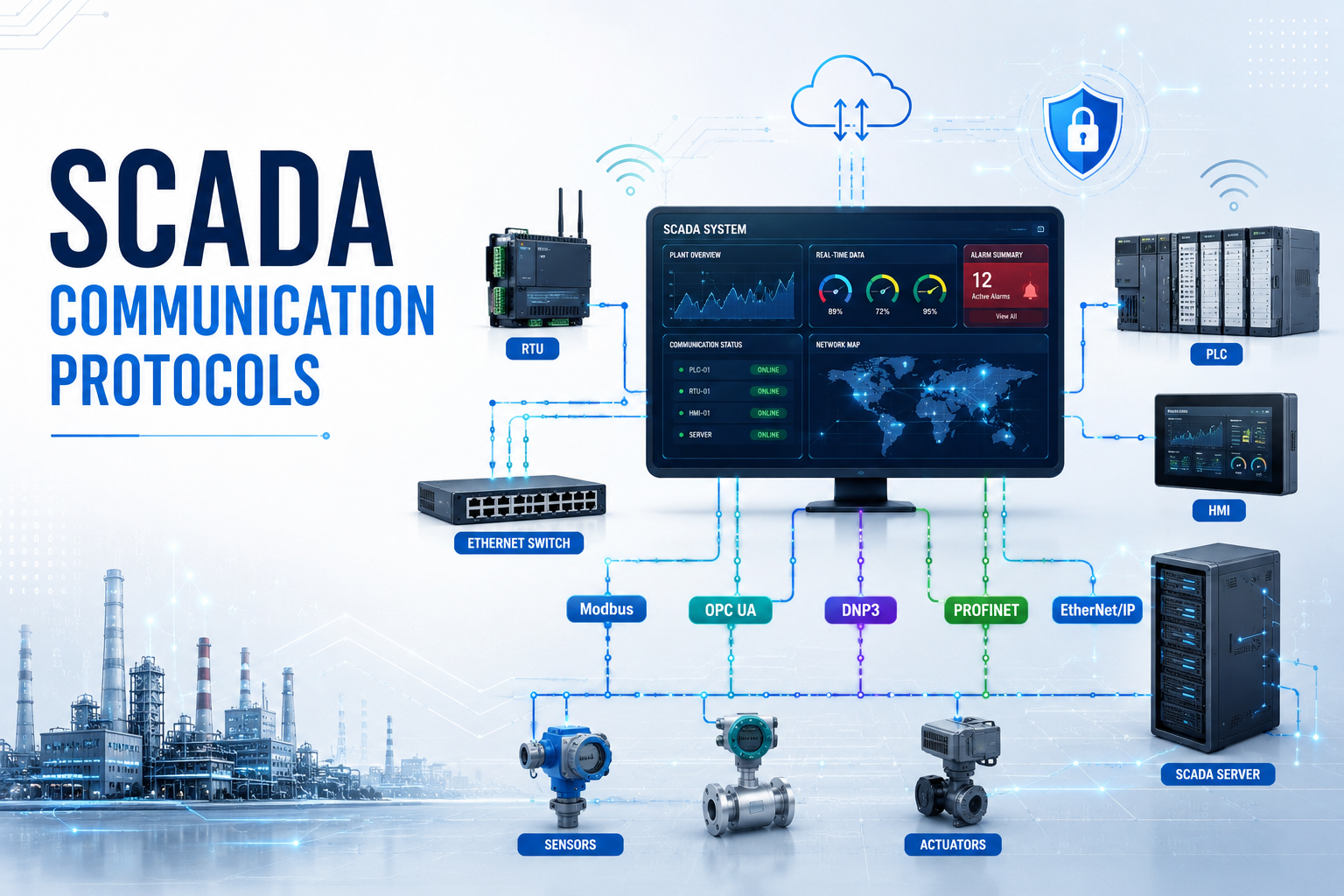
Modern industrial automation systems depend heavily on fast, reliable, and secure communication between machines, controllers, sensors, and monitoring platforms. This is where SCADA communication protocols become important.
SCADA communication protocols are industrial communication standards that allow devices like PLCs, RTUs, sensors, HMIs, and SCADA servers to exchange real-time operational data across factory networks. These protocols act as the communication language of industrial automation systems.
In modern smart factories, thousands of industrial devices continuously share production data, machine status, alarms, temperature values, pressure readings, motor conditions, and operational commands. Without communication protocols, industrial equipment from different manufacturers would not be able to communicate properly.
SCADA communication protocols are critical because they directly affect industrial system performance, reliability, scalability, cybersecurity, and real-time monitoring capabilities. Whether it is a manufacturing plant, power station, water treatment facility, oil refinery, or smart building, communication protocols form the backbone of industrial automation infrastructure.
Today’s Industry 4.0 environments rely heavily on advanced industrial communication technologies such as Modbus TCP/IP, OPC UA, Profinet, EtherNet/IP, and DNP3 to support connected factories, Industrial IoT (IIoT), predictive maintenance, cloud analytics, and remote monitoring systems.
From PLC-to-SCADA connectivity to enterprise-level MES and cloud integration, industrial communication protocols make modern digital manufacturing possible.
What Are SCADA Communication Protocols?
SCADA communication protocols are industrial communication standards that allow PLCs, RTUs, sensors, HMIs, and SCADA servers to exchange real-time industrial data reliably.
Simple Definition
A SCADA communication protocol defines the rules, structure, timing, and method used for industrial devices to communicate with each other inside an automation system.
These protocols determine:
- How industrial data is transmitted
- How devices identify each other
- How commands are sent
- How alarms and feedback are handled
- How communication errors are detected
In simple words, protocols act like a common industrial language between automation devices.
Why SCADA Communication Protocols Exist
Industrial environments contain equipment from multiple vendors and technologies. A factory may use:
- Siemens PLCs
- Allen-Bradley HMIs
- Schneider Electric drives
- ABB sensors
- Third-party SCADA software
Without standardized communication protocols, these systems would not be able to exchange data reliably.
Protocols solve this interoperability problem by creating standardized communication methods for industrial automation systems.
Difference Between SCADA Protocols and Normal IT Networking
Normal IT networks mainly focus on:
- File transfers
- Emails
- Internet browsing
- Office communication
Industrial SCADA communication networks focus on:
- Real-time response
- Deterministic communication
- High reliability
- Continuous operation
- Industrial safety
- Low latency control
Unlike office networks, industrial communication systems must work continuously in harsh environments with minimal downtime.
For example, even a few milliseconds of delay in a factory automation line can impact production quality or machine synchronization.
Real Factory Example
Consider a bottling plant automation system.
Industrial sensors detect bottle position and conveyor speed. The PLC processes this data and sends machine status information through protocols like Modbus TCP or Profinet to the SCADA server.
The SCADA system then displays:
- Production counts
- Conveyor speed
- Machine alarms
- Motor conditions
- Downtime alerts
Operators monitor this information on HMI screens and can remotely control equipment when needed.
Without industrial communication protocols, this real-time coordination between field devices and SCADA systems would not be possible.
Why SCADA Communication Protocols Matter in Industrial Automation
SCADA communication protocols determine how fast, reliable, secure, and scalable industrial communication becomes inside a plant.
Real-Time Monitoring
SCADA protocols allow continuous real-time monitoring of industrial operations.
Factories can instantly monitor:
- Temperature
- Pressure
- Motor status
- Tank levels
- Production speed
- Energy consumption
This helps operators react quickly to abnormal conditions before failures occur.
Data Acquisition
One of the main functions of SCADA systems is collecting industrial data from field devices.
Communication protocols enable SCADA servers to gather operational data from:
- PLCs
- RTUs
- Sensors
- Smart instruments
- Industrial drives
This data becomes useful for analytics, reporting, optimization, and predictive maintenance.
Remote Control
SCADA communication protocols support remote industrial control operations.
Operators can:
- Start motors
- Stop conveyors
- Open valves
- Reset alarms
- Change process parameters
All commands are transmitted securely through industrial communication protocols.
Alarm Handling
Industrial systems use communication protocols for real-time alarm notifications.
If:
- Pressure exceeds limits
- Motors overheat
- Equipment fails
- Network faults occur
The SCADA system instantly receives alarm data and alerts operators.
This improves industrial safety and reduces downtime.
Historical Data Logging
Protocols continuously transfer operational data to SCADA historians and databases.
This historical data helps industries analyze:
- Production efficiency
- Downtime trends
- Energy usage
- Equipment performance
- Maintenance requirements
Multi-Vendor Integration
Modern factories rarely use equipment from a single manufacturer.
SCADA protocols allow seamless integration between devices from:
- Siemens
- Rockwell Automation
- Schneider Electric
- ABB
- Mitsubishi
- Omron
Protocols like OPC UA are especially important for multi-vendor interoperability.
Industrial Cybersecurity Implications
Industrial communication protocols also influence cybersecurity.
Older protocols often lack:
- Encryption
- Authentication
- Secure communication layers
Modern protocols like OPC UA include:
- Encryption
- User authentication
- Certificate-based security
As factories become more connected through IIoT and cloud systems, secure communication protocols become essential for protecting industrial infrastructure.
How SCADA Communication Works
Industrial SCADA communication follows a structured workflow where data continuously moves between field devices, controllers, servers, and operator stations.
Step 1: Sensors Collect Field Data
Industrial sensors measure process values such as:
- Temperature
- Pressure
- Flow rate
- Vibration
- Level
- Speed
These sensors generate electrical or digital signals from real-world industrial processes.
Step 2: PLC or RTU Processes the Signals
The PLC or RTU receives sensor inputs and performs control logic operations.
Examples include:
- Starting motors
- Activating alarms
- Opening valves
- Controlling conveyor systems
The controller becomes the decision-making unit of the automation system.
Step 3: Communication Protocol Transfers Data
Industrial communication protocols transmit operational data between devices.
Protocols such as:
- Modbus TCP
- OPC UA
- DNP3
- Profinet
- EtherNet/IP
allow industrial controllers to exchange information with SCADA servers over industrial networks.
Step 4: SCADA Server Receives Data
The SCADA server collects all field data from industrial controllers.
It processes:
- Machine status
- Process variables
- Alarm conditions
- Historical trends
- Equipment diagnostics
The server acts as the central monitoring system.
Step 5: HMI Displays Information
Operators interact with industrial systems using HMI screens.
The HMI displays:
- Live process values
- Alarm notifications
- Production dashboards
- Equipment health status
- Industrial trends and analytics
This provides complete operational visibility.
Step 6: Operators Send Control Commands Back
Operators can remotely control industrial equipment through the HMI interface.
Commands are sent back through SCADA communication protocols to the PLC or RTU, which then controls field devices accordingly.
This creates a complete two-way industrial communication loop.
Types of SCADA Communication Protocols
SCADA communication protocols can be divided into multiple categories based on communication technology, transmission medium, speed, and industrial application requirements.
Modern industrial automation environments use a combination of serial, Ethernet-based, and wireless communication protocols depending on factory infrastructure, scalability needs, and operational requirements.
Serial Communication Protocols
Serial communication protocols are among the oldest and most widely used industrial communication methods in SCADA systems. These protocols transmit data one bit at a time over communication lines.
Even today, many industries still use serial communication because of its simplicity, reliability, and compatibility with legacy industrial equipment.
RS-232
RS-232 is one of the earliest industrial serial communication standards used in SCADA and PLC communication systems.
It supports point-to-point communication between two devices and is commonly used for:
- PLC programming
- HMI communication
- Industrial device configuration
- Legacy SCADA connectivity
Key Characteristics of RS-232
- Short communication distance
- Lower noise immunity
- Simple implementation
- Limited communication speed
- Supports only one-to-one device connection
RS-232 is mostly found in older industrial automation systems and laboratory equipment.
RS-485
RS-485 is a more advanced serial communication standard widely used in industrial automation networks.
Unlike RS-232, RS-485 supports multi-device communication over longer distances and performs better in electrically noisy industrial environments.
It is commonly used in:
- Modbus RTU networks
- SCADA field communication
- Industrial sensors
- RTUs
- Energy meters
- Building automation systems
Key Characteristics of RS-485
- Long-distance communication support
- Multi-drop device connectivity
- Better industrial noise resistance
- Lower installation cost
- Reliable field-level communication
RS-485 remains highly popular in factories because of its stability and low infrastructure requirements.
Limitations of Serial Communication Protocols
Although serial communication protocols are still widely used, they have several limitations in modern industrial automation environments.
Common Limitations
- Lower communication speed
- Limited scalability
- Difficult network expansion
- Restricted bandwidth
- Reduced real-time performance
- Limited remote accessibility
- Complex troubleshooting in large networks
As factories move toward smart manufacturing and Industry 4.0, many industries are gradually replacing serial systems with Ethernet-based industrial communication networks.
Legacy Industrial Systems
Many older factories still operate using serial communication infrastructure because replacing industrial communication systems can be expensive and operationally risky.
Legacy systems commonly include:
- Old PLCs
- RTUs
- SCADA systems
- Industrial drives
- Power monitoring equipment
Protocols such as Modbus RTU and serial DNP3 are still actively used in:
- Water treatment plants
- Power utilities
- Oil & gas facilities
- Manufacturing plants
For this reason, serial communication protocols continue to remain relevant in industrial automation.
Ethernet-Based Protocols
Ethernet-based industrial communication protocols are now the foundation of modern SCADA systems and smart factory infrastructure.
These protocols use industrial Ethernet networks to provide faster, scalable, and more reliable industrial communication.
Industrial Ethernet
Industrial Ethernet is an advanced version of traditional Ethernet designed specifically for industrial automation environments.
It supports:
- Real-time communication
- High-speed data transfer
- Large-scale industrial networking
- Multi-device integration
- Remote monitoring systems
Modern industrial protocols built on Ethernet include:
- Profinet
- EtherNet/IP
- Modbus TCP/IP
- EtherCAT
- OPC UA over Ethernet
Industrial Ethernet networks connect:
- PLCs
- SCADA servers
- HMIs
- Industrial PCs
- IIoT devices
- Smart sensors
Faster Communication
One of the biggest advantages of Ethernet-based SCADA protocols is high-speed communication.
Compared to traditional serial communication, Ethernet networks provide:
- Faster response times
- Higher bandwidth
- Reduced latency
- Better real-time monitoring
- Large-scale data transmission
This becomes critical in:
- High-speed manufacturing
- Robotics
- Packaging lines
- Motion control systems
- Predictive maintenance applications
Modern factories generate massive amounts of industrial data that require fast communication infrastructure.
Modern Factory Networks
Industry 4.0 environments rely heavily on Ethernet-based communication architecture.
Modern smart factory networks support:
- Cloud SCADA
- Industrial IoT
- Edge computing
- AI-based analytics
- Digital twins
- MES integration
- Remote industrial monitoring
Ethernet-based industrial communication also simplifies:
- Network expansion
- Device integration
- Centralized monitoring
- Industrial cybersecurity implementation
Today, Ethernet communication has become the standard architecture for advanced industrial automation systems.
Wireless Industrial Protocols
Wireless industrial communication protocols are becoming increasingly important in modern industrial automation environments.
These technologies enable flexible communication without requiring extensive physical cabling infrastructure.
Wireless SCADA communication is commonly used in:
- Remote industrial sites
- Smart factories
- Oil & gas pipelines
- Water distribution systems
- Renewable energy plants
- Mobile industrial equipment
Wi-Fi
Industrial Wi-Fi enables wireless communication between SCADA systems, HMIs, PLCs, and industrial devices inside factories.
Industrial Wi-Fi networks support:
- Mobile HMI access
- Wireless monitoring
- Remote diagnostics
- Factory-wide communication
Advantages include:
- Easy deployment
- Reduced wiring costs
- Flexible device connectivity
- Faster system expansion
However, industrial Wi-Fi must be properly secured to prevent cybersecurity risks.
LoRaWAN
LoRaWAN is a long-range, low-power wireless communication technology widely used in Industrial IoT applications.
It is ideal for:
- Remote monitoring
- Utility infrastructure
- Smart agriculture
- Environmental monitoring
- Tank level monitoring
Advantages of LoRaWAN
- Very long communication range
- Low power consumption
- Suitable for remote assets
- Low infrastructure cost
LoRaWAN is becoming increasingly popular in large-scale IIoT deployments.
Zigbee
Zigbee is a low-power wireless mesh networking protocol used for short-range industrial communication.
It is commonly used in:
- Building automation
- Smart lighting
- Sensor networks
- HVAC systems
- Wireless monitoring systems
Zigbee networks support multiple connected devices with relatively low energy consumption.
Cellular SCADA
Cellular SCADA systems use mobile communication networks such as:
- 4G LTE
- 5G
- NB-IoT
to connect remote industrial assets with centralized SCADA systems.
Cellular communication is highly useful in geographically distributed industries such as:
- Oil & gas pipelines
- Solar power plants
- Wind farms
- Water distribution networks
- Mining operations
Benefits of Cellular SCADA
- Wide geographic coverage
- Remote accessibility
- Reduced infrastructure dependency
- Faster deployment in remote areas
With the growth of industrial 5G networks, cellular SCADA communication is expected to become even more important in future smart factories and Industry 4.0 ecosystems.
Most Common SCADA Communication Protocols Explained
Industrial automation runs on communication. Every PLC reading, every sensor value, every operator command depends on a protocol doing its job correctly. This section breaks down the eight most widely used SCADA communication protocols, what each one does, where it excels, and where it falls short.
Modbus Protocol
Modbus is the most widely used industrial communication protocol for connecting PLCs, SCADA systems, sensors, and industrial devices.
Developed by Modicon in 1979, Modbus became the de facto standard for industrial device communication because it was open, simple, and free to implement. Decades later, it still runs inside factories, water plants, oil fields, and energy infrastructure worldwide.
Modbus RTU
Modbus RTU (Remote Terminal Unit) is the serial implementation of the protocol. It transmits data in compact binary format over RS-232 or RS-485 wiring.
Communication follows a strict master-slave model. One master device, typically a PLC or SCADA server, sends a request. One slave device, a sensor, drive, or meter, responds. No device speaks unless spoken to.
Key characteristics of Modbus RTU:
- Maximum cable distance of approximately 4,000 feet on RS-485
- Supports up to 247 slave devices on a single RS-485 bus
- Data rates from 1,200 bps up to 115,200 bps
- Uses CRC (Cyclic Redundancy Check) for error detection
- Four data types: coils, discrete inputs, holding registers, input registers
Modbus RTU remains the communication backbone of millions of legacy field devices that are too costly or too risky to replace.
Modbus TCP/IP
Modbus TCP/IP wraps the same Modbus register model inside standard TCP/IP packets and transmits over Ethernet. The function codes and data structure remain identical to RTU. Only the physical layer and transport change.
This transition removed the biggest limitation of RTU, which was distance and device count. Over Ethernet, Modbus TCP/IP supports multiple masters, longer distances, and significantly faster poll rates.
Key characteristics of Modbus TCP/IP:
- Operates at 100 Mbps to 1 Gbps on standard Ethernet infrastructure
- No device count limitation imposed by the protocol itself
- Allows simultaneous connections from multiple SCADA clients
- Port 502 is the registered TCP port for Modbus communication
- No native encryption or authentication in the base standard
Most modern PLCs, variable frequency drives, power meters, and flow transmitters support Modbus TCP/IP alongside their native protocols.
Advantages of Modbus
- Completely open standard with no licensing fees
- Supported natively by virtually every industrial device manufacturer
- Extremely lightweight processing overhead
- Simple register-based addressing is easy to configure and troubleshoot
- Large pool of engineers and technicians with hands-on experience
- Extensive documentation and community support
Limitations of Modbus
- Zero native security in the base specification, no authentication, no encryption
- Limited data types compared to modern protocols
- No built-in event reporting or change-of-value notification
- Master-slave polling does not scale efficiently to hundreds of devices
- No native support for metadata, units, or data context
- Register mapping varies by manufacturer, requiring manual documentation
Best Use Cases
Modbus fits best in these scenarios:
- Connecting field sensors and actuators to PLCs in localized control panels
- Brownfield sites where replacing existing Modbus devices is cost-prohibitive
- Simple data acquisition applications without security requirements
- Energy metering and power quality monitoring at device level
- Budget-constrained automation projects with straightforward communication needs
Industries That Rely on Modbus
Oil and Gas: Tank level monitoring, pump control, wellhead instrumentation, pipeline pressure measurement.
Water and Wastewater: Pump station control, chemical dosing systems, flow measurement, level sensors.
Energy and Power: Revenue-grade energy meters, transformer monitoring, generator control panels.
Manufacturing: CNC machine interfaces, conveyor drives, temperature controllers, press monitoring systems.
Building Systems: Legacy HVAC controllers, chillers, boilers, and electrical panels in older commercial buildings.
OPC UA Protocol
OPC UA is a secure, platform-independent industrial communication standard widely used in Industry 4.0 systems.
OPC UA (Open Platform Communications Unified Architecture) is not simply a successor to older OPC standards. It is a complete re-architecture of industrial data communication that addresses the security, scalability, and interoperability demands of connected manufacturing.
Released in 2008 by the OPC Foundation, OPC UA has become the primary protocol recommendation in virtually every Industry 4.0 reference architecture, including the Industrial Internet of Things Consortium (IIC) frameworks and the German Plattform Industrie 4.0 initiative.
Platform Independence
Earlier OPC standards were Windows-only, built on Microsoft’s DCOM technology. OPC UA runs on any operating system and any hardware platform.
OPC UA clients and servers operate natively on:
- Windows and Linux servers running SCADA software
- Embedded Linux on industrial gateways and edge devices
- Real-time operating systems on PLCs and DCS controllers
- Cloud platforms including AWS, Azure, and Google Cloud
- Mobile and web applications through REST and WebSocket adapters
This platform neutrality eliminates the integration barriers that blocked cross-vendor connectivity for decades. A Siemens PLC, a Rockwell controller, a Beckhoff motion system, and a Mitsubishi robot can all expose OPC UA servers simultaneously, and one SCADA client can connect to all of them using identical methods.
Data Modeling
This is where OPC UA separates itself from every legacy protocol. Modbus sends raw register values. OPC UA sends structured information.
An OPC UA server exposes data as an address space containing nodes. Each node has a type, attributes, references to related nodes, and optional metadata. A temperature sensor does not just return the number 85. It returns an object with properties including the value, engineering unit (Celsius or Fahrenheit), timestamp, data quality flag, high alarm limit, and low alarm limit.
OPC UA companion specifications extend this modeling capability for specific industries:
- OPC UA for Machinery standardizes how manufacturing equipment exposes its operational data
- OPC UA for Robotics defines robot state, axes, and program information
- OPC UA for Pharma covers batch processing and recipe management
- OPC UA for Energy addresses power generation and grid equipment
These companion specs allow SCADA systems to consume device data without custom engineering for each device model.
Security Features
OPC UA was designed with security as a core requirement, not an add-on. The protocol includes a complete security stack at the application layer.
Security mechanisms built into OPC UA:
- Transport Layer Security (TLS): All communication can be encrypted using industry-standard TLS 1.2 or 1.3
- X.509 Certificate Authentication: Clients and servers authenticate using digital certificates before exchanging data
- Role-Based Access Control: Each user or application receives permissions scoped to specific nodes and operations
- Message signing: Messages can be signed to verify integrity even when encryption is not required
- Audit logging: All access events, configuration changes, and command executions are logged with timestamps and user identity
This security architecture makes OPC UA the only major industrial protocol considered suitable for direct connectivity across IT/OT network boundaries without additional tunneling or wrapping.
Cloud Integration
OPC UA’s publish-subscribe extension (OPC UA PubSub) adds a lightweight, event-driven communication model on top of the core client-server architecture. When combined with MQTT as the transport, OPC UA PubSub becomes the reference architecture for connecting plant floor data to cloud platforms.
The data flow looks like this: Field devices publish tag values to an OPC UA PubSub broker. Cloud subscribers, whether Azure IoT Hub, AWS IoT Core, or a custom application, receive those values in real time without polling. The entire pipeline carries the OPC UA information model, so data arrives in cloud systems with full context intact.
IIoT Compatibility
OPC UA functions simultaneously as a field-level device protocol, a plant-level SCADA protocol, and an enterprise integration protocol. This unified stack eliminates the need for separate protocols at each automation hierarchy level.
Modern IIoT deployments use OPC UA to implement the Unified Namespace (UNS) architecture, where all plant data is published to a central MQTT broker using a standardized topic structure. Any system in the enterprise, from SCADA to MES to cloud analytics, subscribes to the data it needs. No point-to-point integrations. No data silos.
DNP3 Protocol
DNP3 (Distributed Network Protocol 3) was engineered specifically for the communication challenges of utility infrastructure. Where Modbus assumes reliable, short-distance connections, DNP3 assumes unreliable long-distance links and designs around that reality.
Power Industry Applications
DNP3 became the standard protocol for electric power SCADA systems in North America. It governs communication between utility control centers and remote substation equipment including circuit breakers, reclosers, capacitor banks, and protective relays.
The protocol handles the operational requirements of power grid management:
- Supervisory control of switching equipment and generation assets
- Status monitoring of transmission and distribution infrastructure
- Automatic fault location and isolation sequences
- Load management and demand response coordination
Large investor-owned utilities, rural electric cooperatives, and independent system operators all operate DNP3 networks spanning thousands of endpoints across regional grids.
Remote Telemetry
DNP3 was designed for applications where communication links are slow, unreliable, and expensive. Earlier utility SCADA systems communicated over leased telephone lines, microwave radio, and power line carrier at data rates measured in hundreds of bits per second.
DNP3 adapts to these constraints through:
- Data link layer error detection with automatic retransmission on unreliable media
- Application layer fragmentation that splits large messages across multiple link-layer frames
- Unsolicited reporting where remote units report changes without waiting to be polled, dramatically reducing required bandwidth
- Time-tagged events that timestamp data at the source so late-arriving messages remain useful
- Data integrity levels that classify measurements by how recently they were confirmed
This combination makes DNP3 suitable for cellular, satellite, and radio communication where packets arrive late or out of order.
SCADA in Utilities
DNP3 extends beyond electric power into water distribution systems, wastewater treatment, natural gas pipeline monitoring, and oil transmission networks. Any utility infrastructure that requires centralized supervisory control over geographically dispersed remote sites is a candidate for DNP3.
Water utilities use DNP3 to monitor reservoir levels, pump station status, pressure zones, and chlorine dosing systems across municipal distribution networks from a single SCADA operations center.
Secure Authentication
The base DNP3 specification transmitted commands and data without authentication, making it vulnerable to replay attacks and unauthorized command injection on accessible network segments.
DNP3 Secure Authentication Version 5 (SAv5) addressed this with a challenge-response mechanism. Before executing any control operation, the receiving device challenges the initiating system to prove its identity using a pre-shared key. This prevents unauthorized parties from injecting malicious control commands even if they have network access.
SAv5 compliance is now required in many utility cybersecurity frameworks including standards aligned with NERC CIP requirements for bulk electric system protection.
Profibus Protocol
Profibus (Process Field Bus) is the serial fieldbus standard developed by Siemens and a consortium of German automation companies in the late 1980s. It became the dominant field-level communication standard in European industrial automation and remains deeply embedded in existing factory infrastructure.
Siemens Ecosystem
Profibus integration is native to the Siemens SIMATIC automation platform. S7-300 and S7-400 PLCs communicate with distributed I/O, drives, and instrumentation over Profibus DP without gateway hardware. The TIA Portal engineering environment provides complete Profibus network configuration, diagnostics, and device management.
Beyond Siemens, Profibus gained broad vendor adoption. Over 3,000 device types from hundreds of manufacturers carry Profibus certification, including Endress+Hauser instruments, Siemens and ABB drives, and Phoenix Contact I/O modules.
Factory Automation
Profibus DP (Decentralized Periphery) is the primary variant for factory automation. It connects the PLC master to distributed peripheral devices including remote I/O stations, servo drives, encoders, and valve terminals.
Profibus DP operates in a mono-master or multi-master configuration. In mono-master mode, one PLC controls all slave devices with cycle times as low as 1 millisecond for small networks. This deterministic cyclic communication suits closed-loop control applications where consistent update rates matter.
Profibus PA (Process Automation) is the process industry variant. It uses the same protocol but runs on MBP (Manchester Bus Powered) physical layer, allowing the fieldbus cable to carry both data and power to intrinsically safe field instruments in hazardous areas.
High-Speed Device Communication
Profibus DP supports data rates from 9.6 kbps up to 12 Mbps depending on cable length. At 12 Mbps, the maximum segment length is 100 meters. Longer runs require repeaters or a reduction in data rate.
The protocol uses a token-passing scheme among masters and polling for slave devices. This deterministic bus access method guarantees maximum cycle times, which is critical for coordinated motion and synchronized multi-axis applications in manufacturing.
Profinet Protocol
Profinet is Siemens’ Ethernet-based industrial communication protocol and the designated successor to Profibus in new automation installations. It delivers real-time performance and IIoT connectivity on standard Ethernet hardware.
Ethernet-Based Industrial Communication
Profinet uses standard 100 Mbps or 1 Gbps Ethernet as its physical layer. Standard Cat5e or Cat6 cabling, industrial managed switches, and fiber optic connections all work within a Profinet network. This eliminates the specialized Profibus cabling and connectors required in older installations.
Profinet defines three communication classes:
- NRT (Non-Real-Time): Standard TCP/IP communication for parameterization, diagnostics, and configuration. Used for non-time-critical data exchange.
- RT (Real-Time): Cyclic I/O data exchange bypassing the TCP/IP stack for reduced latency. Typical cycle times of 1 to 10 milliseconds.
- IRT (Isochronous Real-Time): Hardware-scheduled communication with cycle times below 1 millisecond and jitter under 1 microsecond. Required for high-performance motion control and synchronized axes.
Real-Time Industrial Networking
Profinet IRT achieves its deterministic performance through hardware-level scheduling in ASIC-based switches. Time slots for IRT communication are reserved in each network cycle, guaranteeing that time-critical data reaches its destination before the deadline regardless of other network traffic.
This makes Profinet IRT suitable for applications that previously required dedicated motion control buses including robotics, CNC machining centers, printing machinery, and packaging lines where multiple axes must coordinate within microseconds.
Industrial IoT Compatibility
Profinet networks integrate with the IIoT layer through OPC UA. SIMATIC PLCs running Profinet I/O expose OPC UA servers that publish process data to SCADA systems, MES platforms, and cloud analytics tools. The TIA Portal configures both the Profinet I/O network and the OPC UA data model from a single engineering environment.
Siemens Industrial Edge devices sit at the Profinet network boundary, running containerized analytics applications that process data locally before forwarding summarized results to cloud platforms.
EtherNet/IP Protocol
EtherNet/IP (Ethernet Industrial Protocol) is the Ethernet-based protocol standard developed by Rockwell Automation and managed by ODVA (Open DeviceNet Vendors Association). It is the communication standard for Allen-Bradley PLCs and the broader Logix automation platform.
Allen-Bradley Ecosystem
EtherNet/IP is native to every current Rockwell Automation controller including the CompactLogix, ControlLogix, and GuardLogix product lines. It carries I/O data, controller-to-controller messaging, HMI communication, drive configuration, and SCADA connectivity over the same network simultaneously.
The Rockwell ecosystem integration is comprehensive. Studio 5000 Logix Designer configures EtherNet/IP I/O modules directly. FactoryTalk View SE SCADA software uses EtherNet/IP to pull tag data from controllers without an intermediate OPC server. PowerFlex drives, POINT I/O modules, and Kinetix servo drives all communicate natively over EtherNet/IP.
CIP Protocol
CIP (Common Industrial Protocol) is the application layer that EtherNet/IP implements. CIP is also shared by DeviceNet and ControlNet, giving the Rockwell ecosystem a consistent object model across different physical layers.
CIP defines a device as a collection of objects. Each object has attributes (data values) and services (operations that can be performed on them). This object model handles both:
- Implicit messaging (I/O data): Time-critical cyclic exchange of process data with defined connection parameters and packet intervals
- Explicit messaging (connected/unconnected): On-demand data requests for configuration, diagnostics, and non-time-critical information
CIP Safety extends the same architecture to functional safety applications, supporting SIL 2 and SIL 3 safety functions over the same EtherNet/IP network without dedicated safety buses.
Industrial Ethernet Advantages
EtherNet/IP inherits all the infrastructure advantages of standard Ethernet while adding industrial-grade features:
- Standard cabling, switches, and fiber optic infrastructure reduce material and installation costs
- Device Level Ring (DLR) topology provides fault recovery in under 3 milliseconds when a cable break or switch failure occurs
- Linear and star topologies supported with managed industrial switch infrastructure
- Bandwidth available for I/O, configuration, diagnostics, and SCADA data simultaneously
- Scales from small machine-level networks to plant-wide architectures without protocol changes
BACnet Protocol
BACnet (Building Automation and Control Networks) is the ASHRAE and ISO standard protocol for building automation systems. It was designed specifically for the communication requirements of commercial building infrastructure including HVAC, lighting, fire detection, and access control.
Building Automation Systems
BACnet defines a comprehensive set of standardized data objects for building systems. Rather than raw register values, BACnet devices expose named objects with properties that map directly to building automation concepts:
- Analog Input/Output objects for sensor readings and control signals
- Binary Input/Output objects for on/off status and commands
- Schedule objects for time-based control sequences
- Trend Log objects for historical data storage within the device
- Notification Class objects for alarm routing and escalation
This standardized object model means a BACnet SCADA client can read a chiller’s supply air temperature, check its operating schedule, and retrieve its alarm history using the same protocol and the same data model regardless of which manufacturer built the chiller.
HVAC Monitoring
BACnet handles the full spectrum of HVAC monitoring and control:
- Air handling unit control including supply fan, return fan, economizer, heating and cooling coils
- Variable air volume (VAV) box temperature and airflow control at zone level
- Chilled water plant optimization including chiller sequencing and cooling tower control
- Boiler plant monitoring including combustion efficiency and hot water distribution
- Building pressure management and outdoor air control for ventilation compliance
Large commercial buildings may have thousands of BACnet devices across multiple controllers, all managed through a centralized BACnet SCADA or building management system (BMS) platform.
Smart Building SCADA
Modern smart building platforms extend BACnet connectivity to enterprise energy management, sustainability reporting, and predictive maintenance applications. BACnet/IP runs over standard building Ethernet infrastructure, which simplifies integration with IT systems.
OPC UA connectors bridge BACnet building data to enterprise analytics platforms. A facility manager can view energy consumption alongside occupancy data, weather forecasts, and utility rate schedules in a unified dashboard that pulls from BACnet, IT systems, and external data sources simultaneously.
Smart building SCADA platforms from vendors including Siemens Desigo CC, Johnson Controls Metasys, and Honeywell EBI all use BACnet as their primary field protocol while exposing OPC UA or REST APIs for enterprise integration.
IEC 60870-5-104 Protocol
IEC 60870-5-104 is the TCP/IP network adaptation of the IEC 60870-5-101 standard for power system telecontrol. It governs communication between utility control centers and remote terminal units (RTUs) at substations, generation facilities, and grid switching points.
Utility and Power Grid Communication
IEC 60870-5-104 is the standard protocol for power grid SCADA in Europe, Asia, the Middle East, and Latin America. It defines the complete communication framework for supervisory control of electrical infrastructure:
- Monitoring functions: Reading analog measurements including voltage, current, active power, reactive power, and frequency from remote sites
- Control functions: Issuing switching commands to circuit breakers, disconnectors, and tap changers with confirmation and feedback
- Protection functions: Receiving protection relay operation events with time tags
- Parameter functions: Reading and writing setpoints and protection relay parameters remotely
The protocol uses a balanced or unbalanced transmission mode. In balanced mode, both the control center and RTU can initiate transmission spontaneously. In unbalanced mode, the control center polls the RTU.
Remote SCADA Monitoring
IEC 60870-5-104 was designed to operate over any TCP/IP network including dedicated WAN links, fiber optic rings, and encrypted VPN tunnels. Port 2404 is the standard TCP port for IEC 60870-5-104 connections.
The protocol handles the realities of wide-area utility networks:
- Spontaneous data transmission: RTUs report measured values and events to the control center without waiting to be polled, enabling near-real-time visibility across large networks
- Time synchronization: The control center sends time synchronization commands to RTUs to align event timestamps across the network
- Redundant connections: The protocol supports primary and standby connections to control centers, with automatic switchover on communication failure
- Data integrity: Sequence numbers and acknowledgment mechanisms ensure command delivery and prevent duplicate execution
IEC 60870-5-104 interoperability is tested and certified through international conformance testing programs, ensuring that RTUs from different manufacturers communicate reliably with control center SCADA systems from different vendors, which is critical in utility environments where multi-vendor interoperability is a procurement requirement.
SCADA Protocol Comparison Table
| Protocol | Speed | Medium | Best For | Native Security | Primary Industry |
|---|---|---|---|---|---|
| Modbus RTU | Up to 115 kbps | Serial (RS-485) | Legacy devices, simple sensor connections | None | Manufacturing, Oil & Gas |
| Modbus TCP/IP | 100 Mbps+ | Ethernet | Ethernet-based legacy migration | None | Water, Energy, General |
| OPC UA | 100 Mbps+ | Ethernet / Wireless | Industry 4.0, IT/OT integration, IIoT | Yes (TLS, certificates) | All industries |
| DNP3 | Variable | Serial / Ethernet | Utility SCADA, remote telemetry | SAv5 Authentication | Power, Water Utilities |
| Profibus DP | Up to 12 Mbps | Serial fieldbus | Siemens PLC field device networks | Limited | Automotive, Pharma |
| Profinet | Up to 1 Gbps | Ethernet | Siemens real-time control and SCADA | Moderate | Discrete Manufacturing |
| EtherNet/IP | Up to 1 Gbps | Ethernet | Rockwell/Allen-Bradley ecosystems | Moderate | Automotive, Food & Bev |
| BACnet/IP | 100 Mbps+ | Ethernet | Building automation, HVAC | Moderate | Commercial Buildings |
| IEC 60870-5-104 | Variable | Ethernet/TCP | Power grid telecontrol | Limited | Power Utilities |
SCADA Communication Architecture
Field Level
Physical sensors and actuators generate the raw signals. Transmitters convert analog measurements into digital values. Smart field devices may communicate directly via HART, IO-Link, or wireless protocols.
Control Level
PLCs and RTUs execute control logic and serve as protocol endpoints. They store process data in structured memory, respond to polling requests, or push event data to higher-level systems.
Supervisory Level
SCADA servers aggregate data from multiple controllers. Historians log timestamped process values. HMI stations render live operational views and accept operator input.
Enterprise Level
MES and ERP systems consume aggregated process data for production scheduling, quality tracking, and business analytics. Cloud analytics platforms access this data via OPC UA, MQTT, or REST APIs.
How to Choose the Right SCADA Protocol
The best protocol depends on your specific system constraints and objectives. Work through these decision factors:
Distance: Serial protocols like RS-485 cap out around 4,000 feet. Long-range remote sites need cellular, LoRaWAN, or DNP3 over leased lines.
Data speed: Motion control and synchronized I/O require sub-millisecond cycle times, which means Profinet IRT or EtherNet/IP with DLR. Slow sensor polling works fine with Modbus TCP/IP.
Vendor ecosystem: Siemens-dominant plants standardize on Profinet. Rockwell-dominant plants use EtherNet/IP. Mixed environments benefit from OPC UA as a protocol aggregation layer.
Cybersecurity requirements: Any internet-connected or IT-integrated SCADA system needs a protocol with native encryption and authentication. OPC UA is the clear answer here.
Legacy system support: Brownfield sites with existing Modbus or Profibus infrastructure should plan for protocol conversion gateways rather than full device replacement.
Real-time requirements: Supervisory data collection tolerates latency. Closed-loop control does not. Separate these data paths if needed.
Cloud connectivity: OPC UA PubSub with MQTT transport is the prevailing architecture for cloud-connected SCADA.
Cost: Modbus devices are inexpensive and widely available. OPC UA-capable hardware carries a premium. Factor total cost of ownership, not just device cost.
SCADA Communication Security Challenges
Industrial protocol security has historically been an afterthought. Many legacy protocols were designed for isolated networks, not internet-connected environments.
Core vulnerabilities:
- Modbus and DNP3 (without SAv5) transmit data in plaintext with no authentication
- Legacy devices cannot be patched or updated
- Remote access through VPNs creates new attack surfaces if misconfigured
- Flat OT networks allow lateral movement after initial compromise
- Protocol converters and gateways introduce additional attack vectors
Security architecture for SCADA networks:
- Network segmentation: Use industrial DMZs to separate OT and IT zones. No direct connectivity between plant floor devices and corporate networks.
- Encrypted protocols: Migrate to OPC UA or use TLS tunneling for legacy protocol traffic
- VPN for remote access: Enforce multi-factor authentication and least-privilege access policies
- Firewalls with deep packet inspection: Industrial-aware firewalls that understand protocol semantics, not just port numbers
- Zero trust architecture: Verify every device and user, assume no implicit trust based on network location
- IEC 62443 compliance: The international standard for industrial cybersecurity provides a structured framework for OT network defense
SCADA Protocols in Industry 4.0
Industry 4.0 demands that operational data flow seamlessly from field devices to cloud analytics platforms without data silos or manual extraction.
IIoT integration: OPC UA PubSub over MQTT allows SCADA data to flow directly to cloud platforms including AWS IoT, Microsoft Azure IoT Hub, and Google Cloud IoT without custom middleware.
Edge computing: Edge nodes sitting between PLCs and cloud systems run protocol translation, local analytics, and data filtering. They reduce cloud bandwidth costs and enable offline operation.
Unified Namespace (UNS): A modern architecture pattern where all plant data is published to a central MQTT broker using a standardized topic hierarchy. Any system, from SCADA to ERP, subscribes to relevant topics without point-to-point integration.
Predictive maintenance: High-frequency vibration, temperature, and current data from field devices feeds machine learning models. This requires protocols capable of streaming time-series data with consistent timestamps.
AI-driven analytics: Plant optimization algorithms need clean, contextualized data. OPC UA’s information modeling provides the semantic context that raw Modbus registers cannot.
Real Industrial Use Cases
Manufacturing Plants
Automotive assembly lines use EtherNet/IP for PLC-to-SCADA communication with cycle times under 10 milliseconds. OPC UA serves as the data bridge to MES systems tracking production counts and quality metrics.
Water Treatment Plants
Municipal water systems use Modbus RTU for legacy pump and valve controllers alongside DNP3 for remote lift stations. SCADA servers poll hundreds of remote nodes across city infrastructure.
Oil and Gas Industry
Pipeline SCADA networks span hundreds of miles. RTUs at compressor stations and valve sites communicate via cellular or satellite using DNP3 or Modbus over SCADA radios. OPC UA gateways consolidate data for cloud historian platforms.
Power Plants and Substations
IEC 60870-5-104 connects substation RTUs to utility control centers. DNP3 handles inter-substation automation. Cybersecurity frameworks aligned with NERC CIP standards govern access controls.
Smart Buildings
Building management systems use BACnet/IP for HVAC, lighting, and access control. OPC UA connectors bridge building data to enterprise energy management and sustainability reporting platforms.
Common SCADA Communication Problems and Fixes
Data loss on serial networks Cause: Cable impedance mismatches, missing termination resistors, or address conflicts. Fix: Verify 120-ohm termination at both ends of RS-485 bus, audit device addresses for duplicates.
High latency in Modbus polling Cause: Too many devices on a single master with sequential polling. Fix: Optimize poll rates by priority, separate high-frequency devices onto dedicated masters.
Network congestion on industrial Ethernet Cause: Mixing SCADA traffic with office IT traffic on shared switches. Fix: Implement VLANs, use managed industrial switches with Quality of Service (QoS) configuration.
Protocol conversion failures Cause: Gateway configuration errors between Modbus devices and OPC UA servers. Fix: Validate register mapping tables, confirm data type alignment, test with protocol analyzers.
Device mismatch after firmware update Cause: Updated devices changing default register layouts or baud rate settings. Fix: Maintain device configuration baselines, test updates in staging before production rollout.
The Future of SCADA Communication Protocols
OPC UA over TSN (Time-Sensitive Networking): TSN adds deterministic scheduling to standard Ethernet, enabling OPC UA to handle motion control-level real-time requirements. This collapses the distinction between field-level and supervisory protocols onto a single network.
5G industrial communication: Private 5G networks bring sub-millisecond latency and high bandwidth to mobile assets, AGVs, and remote monitoring in environments where cabling is impractical.
MQTT as industrial transport: MQTT’s lightweight publish-subscribe model, originally built for IoT, has been adopted as the preferred transport for OPC UA PubSub in cloud-connected architectures.
AI-native SCADA: Analytics embedded directly in edge controllers and SCADA servers eliminate the data pipeline to cloud for routine optimization decisions.
Edge-native SCADA: Distributed SCADA architectures running containerized applications on edge hardware reduce central server dependency and improve resilience.
Best Practices for SCADA Communication Networks
- Use industrial-grade managed switches with VLAN support and port security, not consumer networking hardware
- Physically and logically segment OT networks from IT networks using industrial DMZ architecture
- Standardize on OPC UA for any new integration between SCADA and business systems
- Build in redundancy at every layer including redundant network paths, redundant PLCs, and redundant SCADA servers
- Deploy continuous network monitoring tools that understand industrial protocols and can detect anomalous polling patterns
- Apply firmware and software updates on a scheduled basis with a tested rollback plan
- Document your communication architecture including all device addresses, protocol configurations, and network topology
- Conduct annual security assessments aligned with IEC 62443 requirements
Conclusion
SCADA communication protocols have evolved from simple serial polling systems to secure, high-speed, cloud-connected networks that power smart manufacturing. The transition from RS-485 and Modbus RTU to OPC UA over industrial Ethernet is not just a technology upgrade. It is a fundamental shift in how operational data is modeled, secured, and consumed.
Legacy protocols will remain in use for decades due to the sheer volume of installed devices. The practical path forward is layered integration: preserve functional legacy infrastructure, add protocol translation gateways, and build new systems on open, secure, scalable standards.
As Industry 4.0 accelerates and OT networks become increasingly connected to IT systems and cloud platforms, protocol selection becomes a strategic decision. The right communication architecture directly affects plant uptime, data quality, cybersecurity posture, and the ability to deploy advanced analytics.
Industrial operators who standardize on modern protocols and implement proper network security today will have a significant operational advantage as automation becomes denser and more interconnected.
Need SCADA Communication Integration for Your Factory?
AutomatexLab specializes in industrial communication architecture for manufacturing, utilities, and process industries.
Services include:
- PLC-to-SCADA integration and commissioning
- OPC UA server configuration and data modeling
- Industrial network design and segmentation
- Protocol conversion gateway deployment
- SCADA troubleshooting and performance optimization
- IIoT connectivity and cloud SCADA integration
- Factory automation consultation for greenfield and brownfield sites
FAQs
Modbus is still the most widely deployed protocol globally due to its presence in legacy infrastructure. OPC UA is the most adopted protocol in new deployments.
Modbus transfers raw register values with no context, security, or data modeling. OPC UA transfers structured data objects with metadata, security, and semantic meaning. Modbus is simple and ubiquitous. OPC UA is powerful and future-proof.
OPC UA with MQTT transport is the reference architecture for Industry 4.0 connectivity. It handles both field-level device communication and enterprise cloud integration.
Yes. Hundreds of millions of Modbus-capable devices are installed worldwide. Modern factories typically use Modbus for legacy device connectivity while standardizing new installations on Ethernet-based protocols.
OPC UA is the only major industrial protocol that combines platform independence, robust security, hierarchical data modeling, and cloud compatibility in a single standard. It is the connective tissue of smart manufacturing.
OPC UA has the most comprehensive built-in security stack including TLS encryption, certificate-based authentication, and role-based authorization. DNP3 with SAv5 is the most secure option in utility applications.
Siemens systems primarily use Profibus for legacy field devices and Profinet for current Ethernet-based installations. OPC UA is used for integration with WinCC and higher-level systems.
Profibus runs over serial fieldbus wiring at up to 12 Mbps. Profinet runs over industrial Ethernet at up to 1 Gbps with real-time scheduling. Profinet supports modern network topologies and IIoT connectivity that Profibus cannot.