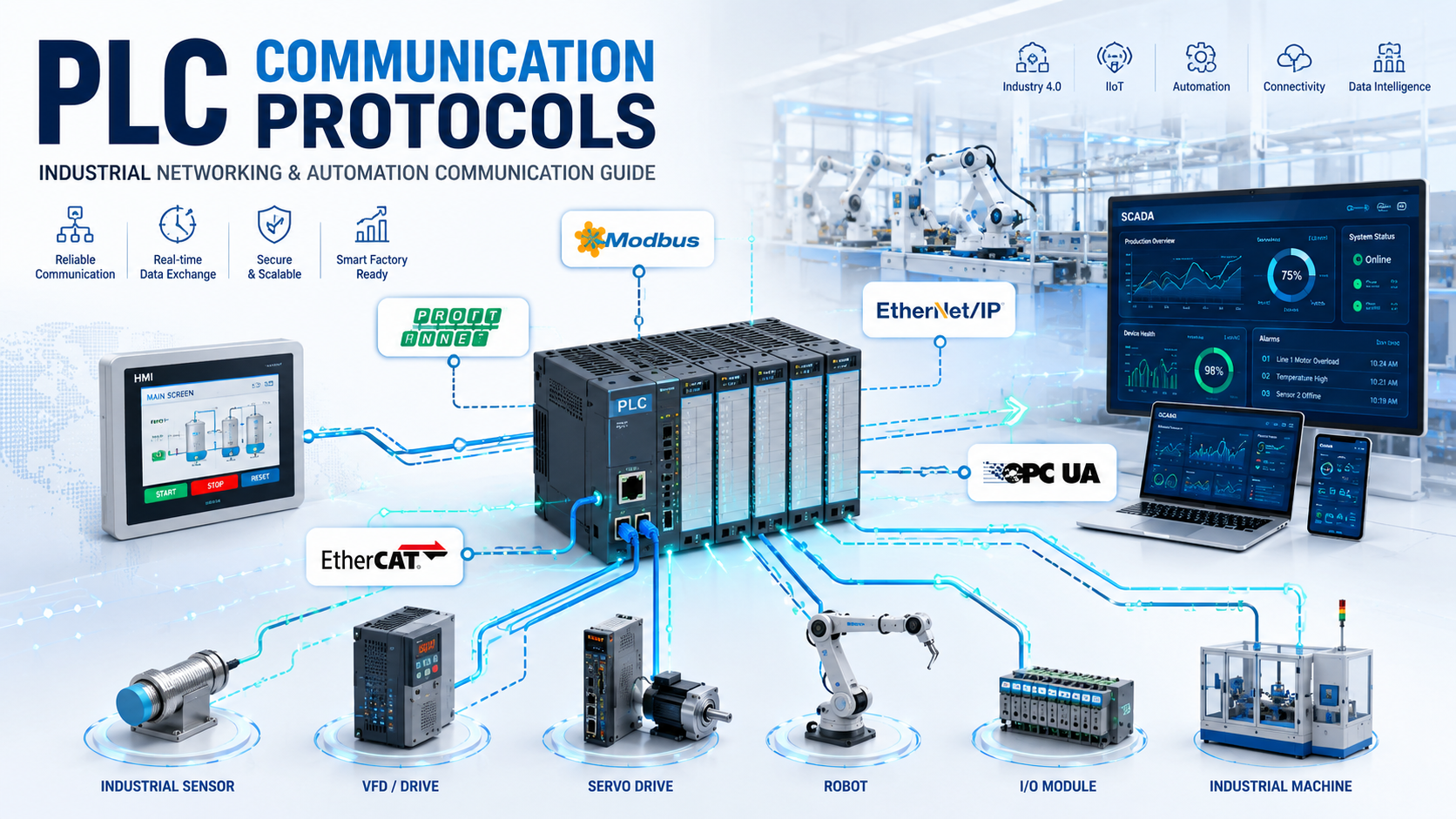
Industrial automation runs on communication. Without proper protocols, your PLCs, SCADA systems, HMIs, and sensors would be isolated islands of data with no way to talk to each other. PLC communication protocols are the universal languages that make modern factories, oil rigs, water treatment plants, and manufacturing lines work together seamlessly.
This guide breaks down everything you need to know about PLC communication protocols, from basic serial connections to advanced Industrial IoT integration.
What Are PLC Communication Protocols?
Quick Answer: PLC communication protocols are standardized rules that allow industrial devices like PLCs, HMIs, sensors, VFDs, and SCADA systems to exchange data reliably.
Think of protocols as the grammar and vocabulary that machines use to communicate. Just like humans need a common language to understand each other, industrial devices need agreed-upon rules for sending and receiving data.
How Protocols Work in Automation
A protocol defines several critical elements:
- Data format and structure
- Message timing and sequencing
- Error detection and correction
- Device addressing schemes
- Transmission speed and methods
When a PLC needs to read a temperature sensor, the protocol dictates exactly how that request gets formatted, transmitted, received, acknowledged, and returned with the actual temperature value.
Real-World Communication Example
Picture a bottling plant. The PLC controlling the filling station needs to communicate with multiple devices simultaneously:
- HMI displays showing production rates
- VFDs controlling conveyor speeds
- Pressure sensors monitoring fill levels
- SCADA system logging production data
- Quality control cameras
- Cloud platforms for analytics
Each connection uses a specific protocol to ensure reliable data exchange. Without standardized protocols, you would need custom integration for every single device combination.
Role in Industry 4.0 and Smart Factories
Modern industrial automation depends on interoperability. Your Allen-Bradley PLC needs to talk to a Siemens drive. Your Modicon controller must interface with third-party sensors. Your entire factory floor has to send data to cloud analytics platforms.
Protocols make this possible. They allow devices from different manufacturers to work together, enable remote monitoring, support predictive maintenance, and create the connected infrastructure that defines Industry 4.0.
Why PLC Communication Protocols Matter in Industrial Automation
Quick Answer: Protocols ensure reliable, fast, and structured communication between industrial devices for real-time control and monitoring.
Real-Time Monitoring and Control
Industrial processes happen fast. A packaging line might fill hundreds of bottles per minute. A motor drive needs position updates every few milliseconds. Protocols ensure data arrives when needed with minimal delay.
Real-time protocols like PROFINET and EtherCAT provide deterministic communication, meaning data transmission times are predictable and guaranteed.
Centralized Control and Visibility
Protocols enable centralized control rooms where operators monitor entire facilities from single locations. SCADA systems gather data from hundreds of PLCs across a plant using standardized protocols like Modbus TCP or OPC UA.
This centralization reduces staffing costs, improves response times, and provides comprehensive visibility into operations.
Remote Diagnostics and Troubleshooting
When a machine goes down at 2 AM, technicians can diagnose problems remotely using protocol-based communication. They can:
- Read PLC fault codes
- Monitor sensor values
- Adjust parameters
- Download program changes
- Reset equipment
This capability saves hours of travel time and reduces downtime costs significantly.
Reduced Wiring Complexity
Serial protocols and industrial Ethernet dramatically reduce wiring compared to hardwired I/O. Instead of running individual wires for each sensor and actuator, you run a single network cable connecting dozens or hundreds of devices.
This simplification lowers installation costs, reduces troubleshooting time, and makes system modifications easier.
Data Logging and Analytics
Protocols enable continuous data collection for quality control, compliance reporting, and process optimization. Modern protocols like OPC UA seamlessly connect factory floor devices to databases, historians, and analytics platforms.
Manufacturing companies use this data to identify bottlenecks, optimize energy usage, predict maintenance needs, and improve product quality.
Predictive Maintenance
Communication protocols feed machine learning algorithms with real-time equipment data. Vibration sensors, temperature monitors, and current draw measurements flow continuously to analytics systems that predict failures before they happen.
This predictive capability transforms maintenance from reactive to proactive, reducing unplanned downtime by up to 50 percent in many facilities.
How PLC Communication Works
Understanding communication architectures helps you design better automation systems.
Master-Slave Communication
In master-slave architectures, one device controls all communication. The master (usually a PLC or SCADA system) polls slave devices (sensors, drives, remote I/O) on a schedule.
Slaves only respond when asked. They never initiate communication.
Advantages:
- Simple and predictable
- Easy to troubleshoot
- Deterministic timing
Disadvantages:
- Master is a single point of failure
- Slaves cannot report urgent events immediately
- Polling creates network traffic even when no data changes
Modbus RTU and PROFIBUS DP commonly use master-slave architecture.
Client-Server Architecture
Client-server models allow any device to request data from any other device. A PLC might act as both client and server, requesting data from sensors while serving data to an HMI.
This architecture provides more flexibility than master-slave but requires more sophisticated network management.
Ethernet/IP and Modbus TCP typically use client-server models.
Producer-Consumer Model
In producer-consumer architectures, devices broadcast data to the network. Any device interested in that data (a consumer) can listen and use it.
Multiple consumers can use the same data without additional network traffic. If three PLCs all need the same temperature reading, the sensor broadcasts it once and all three receive it simultaneously.
EtherCAT and POWERLINK use producer-consumer models for efficient, real-time communication.
Polling vs Event-Driven Communication
Polling: The controller regularly asks devices for data, whether anything changed or not. Simple but creates consistent network traffic.
Event-driven: Devices report data only when something changes or when triggered by specific conditions. More efficient but requires more sophisticated programming.
Modern protocols often combine both approaches, using polling for critical data and event-driven communication for less time-sensitive information.
Data Types in PLC Communication
Protocols handle different types of industrial data:
Coils: Single-bit digital values representing on/off states like limit switches, start buttons, or alarm conditions.
Registers: Multi-bit values storing numbers like temperature readings, speed setpoints, or counter values.
Analog Signals: Continuous values representing physical measurements, typically transmitted as 4-20mA current loops or 0-10V voltage signals.
Digital Signals: Discrete on/off signals for switches, relay contacts, and binary sensors.
Tags and Variables: Named data elements that can represent any data type, used in modern protocols like Ethernet/IP and OPC UA.
Types of PLC Communication Protocols
Serial Communication Protocols
Quick Answer: Serial protocols transmit data one bit at a time and remain common in legacy automation systems and cost-sensitive applications.
RS232
RS232 was the original standard for serial communication in industrial automation.
Features:
- Point-to-point communication only
- Maximum distance of about 50 feet
- Simple 3-wire connection
- Speeds up to 115,200 baud
Advantages:
- Extremely simple to implement
- Low cost
- Widely supported
- Good for short-distance device communication
Limitations:
- Only connects two devices
- Short distance
- Susceptible to electrical noise
- Limited speed
Use Cases:
- Programming cables for PLCs
- Local HMI connections
- Barcode scanner interfaces
- Older instrumentation
RS485
RS485 improved on RS232 by supporting multiple devices and longer distances.
Features:
- Supports up to 32 devices on one network (more with repeaters)
- Distances up to 4,000 feet
- Differential signaling for noise immunity
- Speeds up to 10 Mbps over short distances
- Two-wire or four-wire configurations
Advantages:
- Multi-drop capability
- Excellent noise resistance
- Long-distance communication
- Reliable in harsh industrial environments
- Lower cost than Ethernet
Industrial Applications:
- Modbus RTU networks
- Building automation systems
- Remote sensor networks
- Industrial weighing systems
- Motor drive communications
Serial Protocol Comparison
| Protocol | Max Distance | Max Speed | Devices Supported | Noise Resistance |
|---|---|---|---|---|
| RS232 | 50 feet | 115 kbps | 2 | Poor |
| RS485 | 4,000 feet | 10 Mbps | 32+ | Excellent |
| RS422 | 4,000 feet | 10 Mbps | 10 | Excellent |
Ethernet-Based PLC Communication Protocols
Quick Answer: Ethernet protocols provide high-speed industrial communication for modern automation systems with bandwidth for video, data logging, and cloud connectivity.
Ethernet/IP
Ethernet/IP (Industrial Protocol) is the dominant protocol in North American manufacturing, particularly in facilities using Rockwell Automation equipment.
How It Works:
Ethernet/IP uses the Common Industrial Protocol (CIP) over standard Ethernet networks. It supports both real-time I/O messaging and standard TCP/IP communication for configuration and monitoring.
Industrial Applications:
- Assembly line automation
- Packaging machinery
- Material handling systems
- Robotic work cells
- Plant-wide SCADA systems
Advantages:
- Uses standard Ethernet infrastructure
- Excellent Allen-Bradley integration
- Supports large networks with thousands of devices
- Handles both I/O and information messaging
- Strong vendor support and training
PROFINET
PROFINET is Siemens’ industrial Ethernet protocol, dominant in European and global automation markets.
Siemens Ecosystem:
PROFINET provides seamless integration across Siemens automation products including S7-1200, S7-1500, and TIA Portal programming software.
Real-Time Communication:
PROFINET offers three communication classes:
- Standard communication for configuration and diagnostics
- Real-time communication for cyclic I/O data
- Isochronous real-time for motion control with sub-millisecond precision
Manufacturing Use Cases:
- Automotive assembly
- High-speed packaging
- Synchronized motion control
- Process automation
- Food and beverage production
EtherCAT
EtherCAT (Ethernet for Control Automation Technology) provides extremely fast, deterministic communication for demanding motion control applications.
High-Speed Motion Control:
EtherCAT processes data on-the-fly as frames pass through each device. This topology enables update rates under 100 microseconds with thousands of I/O points.
Robotics Applications:
- Multi-axis robotic arms
- CNC machine tools
- Semiconductor manufacturing equipment
- Printing presses
- Electronic assembly machines
EtherCAT’s speed and precision make it ideal for applications requiring tight coordination between multiple servo drives and I/O modules.
Modbus TCP/IP
Modbus TCP/IP brings the simplicity of Modbus RTU to Ethernet networks.
Ethernet Version of Modbus:
Modbus TCP encapsulates standard Modbus messages in TCP/IP packets. This allows existing Modbus devices to communicate over Ethernet with minimal protocol changes.
Easy Integration:
Almost every PLC, HMI, and SCADA system supports Modbus TCP. This universal compatibility makes it the go-to choice for integrating devices from different manufacturers.
Common Applications:
- Energy monitoring systems
- Building HVAC controls
- Water treatment facilities
- Simple machine automation
- Data acquisition systems
POWERLINK
POWERLINK is an open-source industrial Ethernet protocol offering real-time performance without proprietary licensing fees.
Features:
- Deterministic communication with cycle times under 200 microseconds
- Standard Ethernet hardware compatibility
- Open specification with no license costs
- Growing adoption in packaging and robotics
Best For:
- Cost-sensitive automation projects
- Applications requiring vendor-neutral standards
- Real-time motion control on a budget
Fieldbus Communication Protocols
Quick Answer: Fieldbus protocols are designed for industrial device-level communication, connecting sensors, actuators, and drives directly to control systems.
PROFIBUS
PROFIBUS (Process Field Bus) remains widely installed in process automation and factory automation worldwide.
PROFIBUS DP vs PA:
PROFIBUS DP (Decentralized Peripherals):
- Fast communication for factory automation
- Connects drives, I/O modules, and valves
- Speeds up to 12 Mbps
- RS485 physical layer
PROFIBUS PA (Process Automation):
- Intrinsically safe for hazardous areas
- Powers devices over the same cable
- Slower speeds for process instruments
- MBP-IS physical layer
Industrial Adoption:
PROFIBUS networks number in the millions worldwide, particularly in:
- Chemical processing plants
- Oil refineries
- Pharmaceutical manufacturing
- Automotive factories
- Power generation facilities
DeviceNet
DeviceNet is Rockwell Automation’s device-level network, common in North American manufacturing.
Rockwell Ecosystem:
DeviceNet integrates seamlessly with Allen-Bradley PLCs, providing simple connectivity for sensors, pushbuttons, drives, and other low-level devices.
Device-Level Communication:
DeviceNet uses the CAN (Controller Area Network) physical layer, originally developed for automotive applications. This provides excellent noise immunity and reliability.
Typical Applications:
- Machine safety systems
- Conveyor controls
- Assembly station I/O
- Sensor networks
- Drive coordination
CANopen
CANopen, also based on CAN technology, specializes in motion control and mobile machinery.
Motion Control Applications:
- Servo drive networks
- Multi-axis positioning systems
- Automated guided vehicles (AGVs)
- Construction equipment
- Medical devices
CANopen’s deterministic communication and built-in device profiles make it ideal for coordinated motion across multiple drives.
FOUNDATION Fieldbus
FOUNDATION Fieldbus dominates process automation in oil, gas, and chemical industries.
Process Automation Industries:
FOUNDATION Fieldbus supports advanced process control features like:
- Distributed control across field devices
- Function blocks running in instruments
- Redundant communication paths
- Intrinsically safe installations
- Device diagnostics and asset management
Where It’s Used:
- Offshore oil platforms
- Refinery process units
- Chemical batch plants
- Pharmaceutical cleanrooms
- Pipeline monitoring
Wireless PLC Communication Protocols
Industrial wireless technologies are growing rapidly as costs decrease and reliability improves.
Wi-Fi in Industrial Automation
Industrial Wi-Fi extends beyond commercial standards to support:
- Deterministic communication for control applications
- Redundant access points for reliability
- Interference management in noisy environments
- Security features for industrial networks
Applications:
- Mobile equipment monitoring
- Temporary installations
- Retrofitting existing facilities
- Warehouse automation
- Crane and hoist controls
Bluetooth Industrial Usage
Bluetooth Low Energy (BLE) enables short-range wireless communication for:
- Wireless sensors and transmitters
- Handheld programming terminals
- Predictive maintenance sensors
- Asset tracking tags
- Commissioning tools
LoRaWAN for Industrial IoT
LoRaWAN provides long-range, low-power communication for distributed sensors:
- Tank level monitoring across sites
- Remote pump station control
- Agricultural automation
- Environmental monitoring
- Parking lot sensors
Range extends several miles with minimal power consumption.
Zigbee Networks
Zigbee creates mesh networks of battery-powered sensors:
- Building automation systems
- Process monitoring
- Energy management
- Safety sensor networks
5G Industrial Automation
5G private networks are beginning to support:
- Ultra-reliable low-latency control
- Mobile robotics
- Augmented reality maintenance
- High-bandwidth video analytics
- Edge computing applications
Wireless Considerations
Benefits:
- Reduced installation costs
- Flexibility for mobile equipment
- Easy expansion and reconfiguration
- Access to difficult locations
Security Concerns:
- Encryption requirements
- Network segmentation
- Authentication protocols
- Regular security updates
Best Practices:
- Use industrial-grade equipment
- Implement redundant paths
- Monitor signal strength
- Regular security audits
Most Popular PLC Protocols Explained in Detail
Modbus Protocol
Quick Answer: Modbus is one of the most widely used industrial communication protocols because of its simplicity, open specification, and universal device support.
Understanding Modbus Variants
Modbus RTU:
Modbus RTU (Remote Terminal Unit) transmits binary data over serial connections. It’s the most common Modbus variant in industrial automation.
- Uses RS485 or RS232 physical layers
- Binary data format for efficiency
- CRC error checking
- Master-slave architecture
- Up to 247 devices per network
Modbus ASCII:
Modbus ASCII transmits readable ASCII characters instead of binary data. It’s easier to debug but less efficient.
- Human-readable messages
- LRC error checking
- Slower than RTU
- Rarely used in modern systems
Modbus TCP:
Modbus TCP runs over Ethernet networks using standard TCP/IP.
- No device limit (IP-based)
- Uses port 502
- Standard Ethernet infrastructure
- Easy integration with IT systems
Modbus Addressing Structure
Modbus organizes data into four address spaces:
| Address Type | Data Type | Access | Common Use |
|---|---|---|---|
| Coils (0x) | Single bit | Read/Write | Digital outputs |
| Discrete Inputs (1x) | Single bit | Read only | Digital inputs |
| Input Registers (3x) | 16-bit word | Read only | Analog inputs |
| Holding Registers (4x) | 16-bit word | Read/Write | Setpoints, parameters |
Registers and Coils Explained
Coils represent discrete outputs like:
- Motor start/stop commands
- Valve open/close states
- Alarm acknowledgments
Discrete Inputs represent digital sensor states:
- Limit switch positions
- Emergency stop status
- Level switch states
Input Registers hold analog measurements:
- Temperature readings
- Pressure values
- Flow rates
Holding Registers store configuration and setpoints:
- PID tuning parameters
- Speed references
- Timer presets
Modbus Advantages
- Universally supported across manufacturers
- Open protocol with no licensing fees
- Simple to implement and troubleshoot
- Extensive device availability
- Well-documented with abundant resources
Modbus Disadvantages
- No built-in security
- Limited data types
- Master-slave architecture creates bottlenecks
- No timestamp or quality indicators
- Relatively slow compared to modern protocols
Industrial Example: Energy Monitoring
A PLC monitors power consumption across a factory using Modbus RTU to communicate with energy meters:
- PLC sends Modbus request to Meter 1 at address 1
- Meter 1 responds with current, voltage, and power readings in registers
- PLC repeats for Meters 2-20
- PLC calculates total facility consumption
- Data logs to SCADA via Modbus TCP
- Operators view real-time energy usage on HMI
This simple architecture monitors complex electrical systems reliably and cost-effectively.
Ethernet/IP Protocol Deep Dive
Common Industrial Protocol (CIP):
Ethernet/IP implements CIP, the same application layer used by DeviceNet and ControlNet. This provides consistent data structures and device profiles across different networks.
Real-Time Communication:
Ethernet/IP supports both:
- Implicit messaging for time-critical I/O data
- Explicit messaging for configuration, diagnostics, and file transfers
Allen-Bradley Integration:
Rockwell Automation’s Logix platform (ControlLogix, CompactLogix) uses Ethernet/IP natively. Programming, I/O, HMI, drives, and safety systems all communicate seamlessly.
Factory Networking:
Large Ethernet/IP networks segment into:
- Control network for real-time I/O
- Device network for drives and smart devices
- Information network for SCADA and MES systems
This segmentation maintains performance while providing comprehensive connectivity.
PROFINET Protocol Deep Dive
Siemens PLC Communication:
PROFINET is the standard network for all modern Siemens controllers. TIA Portal provides integrated configuration and diagnostics.
Deterministic Communication:
PROFINET IRT (Isochronous Real-Time) achieves update times under 1 millisecond with jitter below 1 microsecond. This precision enables:
- Synchronized servo drives
- High-speed printing registration
- Coordinated robotic motion
- Precision assembly operations
PROFINET IO:
PROFINET IO replaces physical I/O cards with distributed I/O modules connected via Ethernet. This simplifies wiring and enables flexible machine layouts.
Device Classes:
- IO-Devices: Field devices like remote I/O, drives, sensors
- IO-Controllers: PLCs and control systems
- IO-Supervisors: Programming stations, HMIs, SCADA systems
OPC UA Protocol
Quick Answer: OPC UA enables secure and standardized industrial data exchange between machines, software platforms, and cloud systems regardless of manufacturer.
Platform-Independent Communication
OPC UA runs on any operating system and hardware platform. Windows, Linux, embedded controllers, and cloud servers all speak the same OPC UA language.
This independence eliminates the vendor lock-in common with proprietary protocols.
Industrial IoT Integration
OPC UA bridges the gap between traditional automation and modern IT systems:
- Structured data modeling with complex types
- Built-in information models for standardized data
- Service-oriented architecture
- Publish-subscribe for efficient data distribution
Cloud Connectivity
OPC UA securely transmits factory data to cloud analytics platforms:
- Azure IoT integration
- AWS industrial services
- Edge computing gateways
- Hybrid cloud architectures
Security Features
OPC UA includes enterprise-grade security:
- X.509 certificate authentication
- Encrypted communication
- User authentication and authorization
- Audit trails
- Secure key management
No other industrial protocol provides this level of built-in security.
Industry 4.0 Enabler
OPC UA is the foundation protocol for Industry 4.0 because it:
- Connects legacy systems to modern platforms
- Supports semantic data models
- Enables machine learning integration
- Provides vendor-neutral interoperability
PLC Communication Protocol Comparison
| Protocol | Max Speed | Relative Cost | Complexity | Best For |
|---|---|---|---|---|
| Modbus RTU | 115 kbps | Very Low | Simple | Basic monitoring, legacy systems |
| Modbus TCP | 100 Mbps | Low | Simple | Multi-vendor integration |
| Ethernet/IP | 1 Gbps | Medium | Moderate | Rockwell ecosystems, North American plants |
| PROFINET | 1 Gbps | Medium | Moderate | Siemens ecosystems, European plants |
| EtherCAT | 100 Mbps | Medium | High | High-speed motion control |
| OPC UA | 1 Gbps | Medium | High | IIoT, cloud integration, Industry 4.0 |
| PROFIBUS | 12 Mbps | Medium | Moderate | Process automation, legacy systems |
| DeviceNet | 500 kbps | Low | Low | Device-level I/O, Rockwell systems |
Detailed Protocol Comparison
Modbus:
- Simplest implementation
- Lowest cost
- Slowest speed
- No built-in diagnostics
- Minimal security
- Perfect for simple applications
PROFINET:
- High performance
- Excellent diagnostics
- Strong Siemens integration
- Higher initial cost
- More complex configuration
- Best for demanding manufacturing
Ethernet/IP:
- Strong North American presence
- Excellent Rockwell integration
- Good performance
- Moderate complexity
- Growing global adoption
EtherCAT:
- Fastest deterministic performance
- Complex topology requirements
- Excellent for robotics
- Growing vendor support
- Open specification
OPC UA:
- Future-proof architecture
- Best security
- Most complex
- Highest flexibility
- Essential for IIoT
PROFIBUS:
- Mature and stable
- Extensive installed base
- Being replaced by PROFINET
- Still common in process industries
Choosing the Right PLC Communication Protocol
Quick Answer: The best PLC protocol depends on speed requirements, existing infrastructure, device compatibility, budget constraints, and application-specific needs.
Factors to Consider
Existing Infrastructure
If you already have significant investment in one automation platform, stick with its native protocol:
- Rockwell systems: Ethernet/IP and DeviceNet
- Siemens systems: PROFINET and PROFIBUS
- Modicon systems: Modbus TCP
- Beckhoff systems: EtherCAT
Mixing protocols increases complexity, training requirements, and troubleshooting difficulty.
Device Compatibility
Choose protocols with broad device support in your industry:
- Energy management: Modbus
- Process automation: PROFIBUS or FOUNDATION Fieldbus
- Discrete manufacturing: Ethernet/IP or PROFINET
- Motion control: EtherCAT or PROFINET IRT
Speed Requirements
Match protocol speed to application needs:
Slow processes (seconds to minutes):
- Water treatment
- HVAC systems
- Tank farm monitoring
- Building automation
Use Modbus RTU or Modbus TCP.
Medium-speed processes (100ms to 1 second):
- Packaging lines
- Assembly machines
- Material handling
- Batch processing
Use Ethernet/IP or PROFINET.
High-speed processes (under 10ms):
- Robotics
- Servo motion
- Printing presses
- Electronic assembly
Use EtherCAT or PROFINET IRT.
Budget Constraints
Protocol costs include:
- Hardware (controllers, switches, cables)
- Software licenses
- Training
- Integration engineering
- Ongoing support
Modbus offers the lowest entry cost. Industrial Ethernet protocols require more investment but provide better long-term value through improved performance and diagnostics.
Real-Time Requirements
Deterministic communication matters when timing is critical:
- Synchronized motion control
- Safety systems
- High-speed counting
- Position registration
Choose protocols with guaranteed scan times like PROFINET IRT or EtherCAT.
Cybersecurity Needs
If your system connects to enterprise networks or the internet:
- Implement OPC UA for secure data exchange
- Use VPNs for remote access
- Segment networks with industrial firewalls
- Choose protocols with authentication support
Scalability Planning
Consider future expansion:
- Small systems (under 50 I/O points): Modbus RTU
- Medium systems (50-500 I/O points): Ethernet/IP or PROFINET
- Large systems (over 500 I/O points): Industrial Ethernet with managed switches
- Multi-site systems: OPC UA over VPN
Real-World Example: Protocol Selection
Automotive Assembly Plant:
Requirements:
- 200+ robots
- Synchronized motion control
- Vision inspection systems
- Extensive I/O
- MES integration
- Predictive maintenance
Protocol Choice: PROFINET
Reasoning: High-speed deterministic communication handles robot coordination. PROFINET IO simplifies extensive I/O. OPC UA gateway provides MES connectivity. Siemens ecosystem offers integrated safety and drive solutions.
Water Treatment Facility:
Requirements:
- Distributed pump stations
- Remote monitoring
- Slow process speeds
- Multi-vendor devices
- Budget constraints
- Simple troubleshooting
Protocol Choice: Modbus TCP
Reasoning: Adequate speed for slow processes. Universal device support. Low cost. Simple for maintenance staff. Existing Ethernet infrastructure. Easy SCADA integration.
Common PLC Communication Problems
Frequent Issues
Address Conflicts:
Multiple devices assigned the same Modbus address or IP address cause communication failures. Symptoms include intermittent communication, unexpected device responses, or complete communication loss.
Solution: Maintain detailed address documentation. Use DHCP carefully in industrial networks. Scan networks regularly to detect conflicts.
Baud Rate Mismatch:
Serial devices must match baud rate, parity, and stop bits exactly. A PLC set to 9600 baud cannot communicate with a device expecting 19200 baud.
Solution: Document all serial communication settings. Use configuration software to verify device settings. Test with known-good devices first.
Packet Loss:
Network congestion, faulty switches, or electromagnetic interference cause dropped packets. Critical data doesn’t reach its destination, creating erratic system behavior.
Solution: Monitor network utilization. Upgrade switches if necessary. Use managed switches with QoS. Implement redundant communication paths.
Electrical Noise:
Motor drives, welders, and high-voltage equipment induce noise on communication cables. Serial networks are particularly susceptible.
Solution: Use shielded cables with proper grounding. Separate communication cables from power cables. Install surge protection. Use fiber optic cables in severe environments.
Cable Failures:
Physical damage, connector corrosion, and manufacturing defects cause intermittent or complete communication failure.
Solution: Use industrial-grade cables rated for the environment. Protect cables in conduit or cable trays. Test cables during installation. Keep spare cables on hand.
IP Conflicts:
Two devices on the same Ethernet network with identical IP addresses cannot communicate reliably.
Solution: Use static IP addresses for all industrial devices. Maintain IP address spreadsheets. Implement IP address management tools. Avoid DHCP in control networks.
Configuration Errors:
Incorrect PLC programming, wrong device parameters, or mismatched protocol settings prevent communication.
Solution: Validate configurations before deployment. Save working configurations as backups. Use configuration management software. Document all settings.
Troubleshooting Checklist
Step 1: Verify Physical Layer
- Check cable connections
- Test cable continuity
- Verify proper termination
- Inspect connector condition
- Measure signal voltages
Step 2: Confirm Configuration
- Verify IP addresses or device addresses
- Check baud rate, parity, stop bits
- Confirm protocol selection
- Review timeout settings
- Validate device IDs
Step 3: Monitor Communication
- Use protocol analyzers to capture traffic
- Check for error packets
- Monitor response times
- Verify data content
- Look for retransmissions
Step 4: Isolate the Problem
- Disconnect devices one at a time
- Test with known-good devices
- Swap cables
- Check network switches
- Replace suspected components
Step 5: Check Environmental Factors
- Measure electrical noise levels
- Verify grounding
- Check for interference sources
- Monitor temperature extremes
- Assess moisture exposure
PLC Communication in Industry 4.0
Modern manufacturing demands seamless data flow from sensors to cloud platforms.
Smart Factories
Industry 4.0 smart factories use protocol integration to create:
Vertical Integration:
- Sensors feed PLCs
- PLCs connect to SCADA
- SCADA links to MES
- MES interfaces with ERP
- ERP connects to cloud analytics
Horizontal Integration:
- Machine-to-machine communication
- Coordinated production lines
- Automated material handling
- Quality data sharing
- Energy management coordination
Edge Computing
Edge gateways process data locally before sending to the cloud:
- Real-time analytics at the factory floor
- Reduced cloud bandwidth requirements
- Faster response to process changes
- Local data storage during network outages
- Protocol translation between legacy and modern systems
IIoT Integration
Industrial IoT platforms aggregate data from thousands of sensors and devices:
- Predictive maintenance algorithms
- Overall equipment effectiveness (OEE) tracking
- Supply chain optimization
- Remote monitoring across facilities
- Digital twin creation
OPC UA serves as the primary protocol connecting traditional automation to IIoT platforms.
Cloud SCADA
Cloud-based SCADA systems replace on-premise servers:
- Accessible from anywhere
- Automatic software updates
- Scalable infrastructure
- Reduced IT maintenance
- Geographic redundancy
Secure protocols like OPC UA over VPN enable safe cloud connectivity.
AI-Based Analytics
Machine learning algorithms process industrial data to:
- Predict equipment failures
- Optimize process parameters
- Detect quality defects
- Reduce energy consumption
- Improve production scheduling
Protocol standardization provides the clean, consistent data these algorithms require.
Predictive Maintenance
Communication protocols enable continuous condition monitoring:
- Vibration analysis from accelerometers
- Thermal imaging from infrared sensors
- Oil analysis from inline sensors
- Motor current signature analysis
- Acoustic monitoring
Data flows through protocols to maintenance management systems that schedule interventions before failures occur.
Future Trends
Time-Sensitive Networking (TSN):
TSN brings deterministic communication to standard Ethernet, allowing real-time control and IT data on the same network infrastructure.
AI-Driven Communication Optimization:
Machine learning will automatically tune network parameters, predict communication failures, and optimize bandwidth allocation.
Industrial Cybersecurity:
Enhanced security features will become standard in all protocols, addressing the growing threat landscape in connected factories.
Best Practices for PLC Communication Networks
Proper Cable Shielding and Grounding
Industrial environments generate significant electrical noise. Proper shielding protects communication integrity:
- Use shielded twisted-pair cables for all serial networks
- Ground shields at one end only to prevent ground loops
- Keep communication cables separate from power cables
- Use industrial-grade connectors with metal shells
- Install surge protection on outdoor cables
Network Segmentation
Divide industrial networks into logical segments:
Control Network:
- Real-time I/O communication
- Safety systems
- Motion control
- No internet connectivity
Device Network:
- Smart sensors and actuators
- Drives and field devices
- Moderate performance requirements
Information Network:
- SCADA and HMI systems
- Historians and databases
- MES integration
- Controlled internet access
Segmentation improves performance, simplifies troubleshooting, and enhances security.
Redundancy Design
Critical systems require redundant communication:
- Dual network paths
- Redundant switches
- Backup PLCs
- Failover protocols
- Continuous health monitoring
Secure Industrial Ethernet
Protect networks from cyber threats:
- Use industrial firewalls between network segments
- Implement VLANs for traffic isolation
- Enable port security on managed switches
- Disable unused switch ports
- Change default passwords
- Update firmware regularly
Protocol Documentation
Maintain comprehensive documentation:
- Network topology diagrams
- Device address lists
- Cable schedules
- Configuration files
- IP address spreadsheets
- Troubleshooting procedures
Good documentation reduces downtime and training time significantly.
Backup Configuration Management
Regular configuration backups prevent data loss:
- Back up PLC programs weekly
- Save switch configurations
- Document parameter changes
- Store backups off-site
- Test restore procedures
- Version control for programs
Real Industrial Applications of PLC Communication Protocols
Manufacturing Industry
Assembly Lines:
Automotive assembly lines use PROFINET or Ethernet/IP to coordinate:
- Robot welding stations
- Part feeders
- Conveyors
- Quality inspection
- Tool changers
- Safety systems
Deterministic communication ensures synchronized operation across dozens of stations.
Robotic Work Cells:
EtherCAT connects multiple servo drives for:
- Pick and place operations
- Material handling
- Machine tending
- Packaging
- Palletizing
Sub-millisecond update rates enable smooth, coordinated motion.
Oil and Gas
Remote Monitoring:
Offshore platforms use Modbus TCP over fiber optic links to monitor:
- Well pressure and flow
- Separator levels
- Pump performance
- Gas detection systems
- Environmental conditions
Data transmits to onshore control centers for continuous monitoring.
Pipeline SCADA:
Thousands of miles of pipelines use RTUs with:
- Modbus for local device communication
- Satellite communications for remote locations
- SCADA systems for central monitoring
- Leak detection algorithms
- Flow optimization
Water Treatment
Municipal Water Systems:
Water treatment facilities use PROFIBUS or Modbus to control:
- Chemical dosing pumps
- Filter backwash sequences
- Storage tank levels
- Distribution pressure
- Quality monitoring
SCADA Integration:
Central SCADA systems monitor multiple treatment plants:
- Real-time flow rates
- Water quality parameters
- Equipment status
- Alarm management
- Historical trending
Modbus TCP provides simple, reliable connectivity.
Food and Beverage
Batch Automation:
Recipe-based production uses industrial Ethernet for:
- Ingredient dosing
- Temperature control
- Mixing sequences
- CIP (clean-in-place) systems
- Quality tracking
Packaging Lines:
High-speed packaging machines use:
- Ethernet/IP for line coordination
- DeviceNet for device-level I/O
- Safety protocols for machine guarding
- Vision systems for quality
- Serialization for traceability
Power Plants
Distributed Control Systems:
Power generation facilities use multiple protocols:
- FOUNDATION Fieldbus for process instruments
- Modbus for power monitoring
- OPC UA for plant-wide data integration
- DNP3 for utility grid communication
Critical Infrastructure Protection:
Redundant communication paths and enhanced security protect against:
- Network failures
- Cyber attacks
- Equipment malfunctions
- Natural disasters
Conclusion
PLC communication protocols form the foundation of modern industrial automation. Your protocol choices directly impact system performance, reliability, scalability, and integration capabilities.
Modbus delivers simplicity and universal compatibility for basic applications. Industrial Ethernet protocols like Ethernet/IP and PROFINET provide the speed and determinism manufacturing demands. EtherCAT pushes boundaries in motion control. OPC UA bridges automation and IT for Industry 4.0 readiness.
Success requires matching protocols to applications, designing robust network architectures, implementing proper cybersecurity, and maintaining comprehensive documentation.
As factories become smarter and more connected, protocol selection becomes increasingly critical. The right communication infrastructure positions your facility for growth, enables predictive maintenance, supports data-driven decisions, and creates the agility modern manufacturing requires.
Invest time in proper protocol selection and network design. The decisions you make today will impact operations for years to come.
Build Reliable PLC Communication Systems With AutomatexLab
Whether you need PLC integration, SCADA networking, industrial protocol troubleshooting, or complete factory automation architecture, AutomatexLab helps businesses create scalable and future-ready industrial automation systems.
Our comprehensive automation services include:
PLC Programming: Custom control logic for all major platforms including Allen-Bradley, Siemens, Modicon, and Mitsubishi
SCADA and HMI Development: Intuitive operator interfaces with real-time monitoring and control
OPC UA Integration: Secure connectivity between factory floor devices and enterprise systems
Modbus and PROFINET Setup: Expert network design and commissioning for reliable industrial communication
Industrial IoT Solutions: Edge computing, cloud connectivity, and advanced analytics integration
Automation System Troubleshooting: Rapid diagnosis and resolution of communication issues, reducing costly downtime
Our experienced engineers understand the unique challenges of industrial environments. We design communication networks that work reliably in harsh conditions, integrate seamlessly with existing systems, and scale as your operation grows.
From single-machine retrofits to plant-wide automation projects, we deliver solutions that improve efficiency, reduce costs, and position your facility for the future.
Contact AutomatexLab today to discuss your industrial automation needs and discover how proper protocol selection and network design can transform your operations.
FAQs
No single protocol is best for all applications. Modbus works great for simple monitoring. Ethernet/IP excels in Rockwell environments. PROFINET dominates Siemens installations. EtherCAT leads in high-speed motion control. Choose based on your specific requirements, existing infrastructure, and application demands.
Modbus is a simple, slow protocol best for basic monitoring and control. PROFINET is a high-speed industrial Ethernet protocol with deterministic real-time communication, extensive diagnostics, and advanced features for demanding manufacturing applications. PROFINET costs more but delivers significantly better performance.
OPC UA complements rather than replaces Modbus. OPC UA excels at connecting automation systems to enterprise IT and cloud platforms. Modbus remains the practical choice for simple device communication. Many systems use both: Modbus for field devices and OPC UA for data integration.
EtherCAT provides the fastest deterministic communication with update rates under 100 microseconds. PROFINET IRT offers comparable performance. For non-deterministic throughput, standard Industrial Ethernet protocols running on Gigabit networks provide excellent speed.
Modern Siemens PLCs use PROFINET as their primary network. Older systems use PROFIBUS. Siemens controllers also support Modbus TCP, Ethernet/IP (via gateways), and OPC UA for system integration.
Allen-Bradley (Rockwell Automation) PLCs use Ethernet/IP as their primary protocol. DeviceNet handles device-level communication. Older systems use ControlNet or DH+. Rockwell PLCs also support Modbus for third-party device integration.
Yes, through protocol gateways and converters. A gateway can translate between Modbus and Ethernet/IP, allowing devices from different ecosystems to communicate. OPC UA also serves as a universal translator between protocols. However, mixing protocols adds complexity and potential points of failure.
Ethernet offers higher speeds, longer distances, more devices per network, built-in diagnostics, standard IT infrastructure compatibility, and lower long-term costs. While serial communication remains useful for simple applications, Ethernet provides the bandwidth and connectivity modern automation demands.