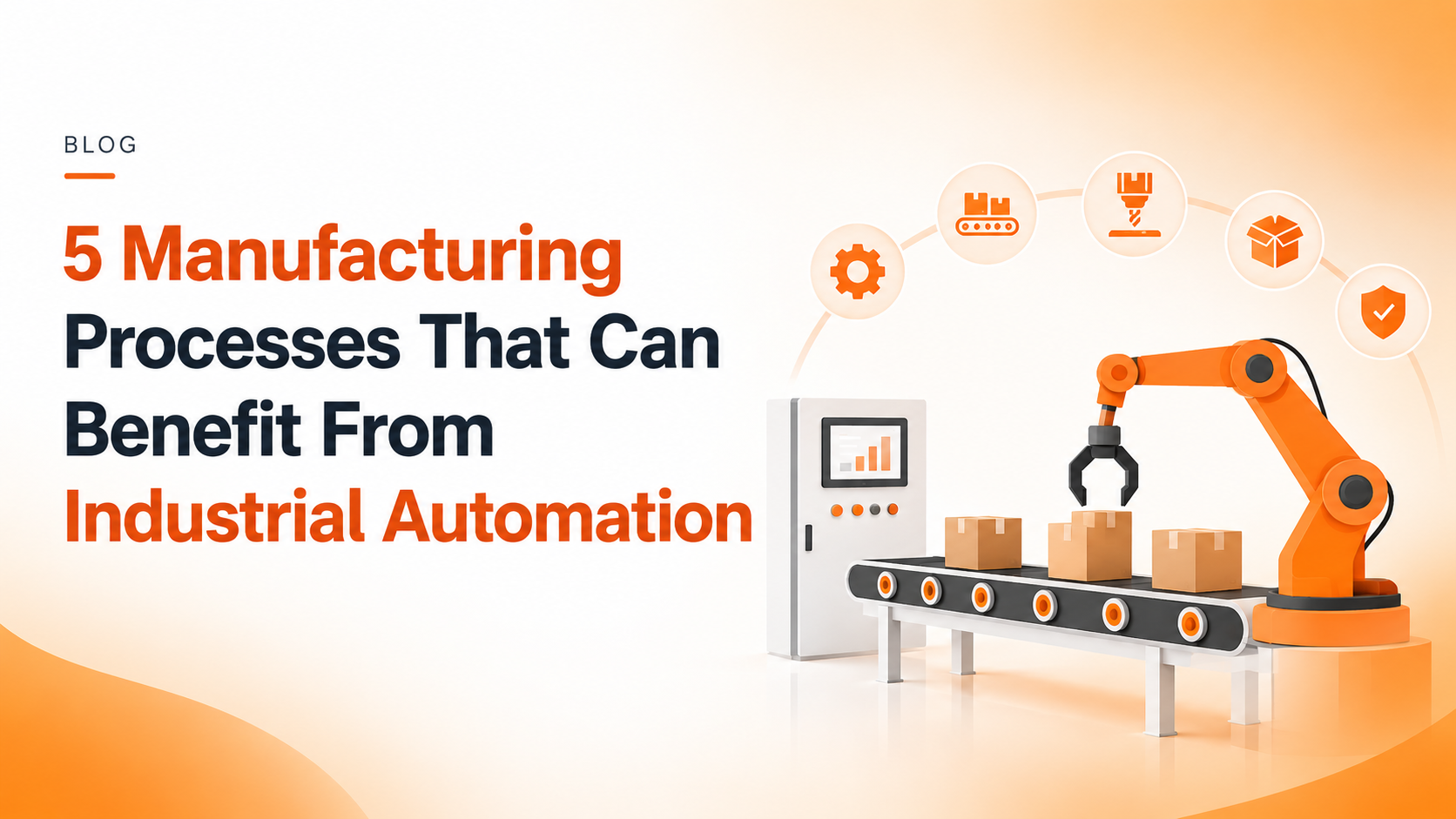
Industrial automation can improve manufacturing processes that involve repetitive work, strict process parameters, high production volumes, quality inspection, or continuous machine operation. Five processes that commonly benefit are assembly, material handling, machining, packaging, and quality inspection.
Automation in manufacturing can involve a wide range of technologies. These include programmable logic controllers (PLCs), human machine interfaces (HMIs), supervisory control and data acquisition (SCADA) systems, industrial robots, sensors, machine vision, variable frequency drives (VFDs), industrial IoT (IIoT) systems, and automated control systems. Each of these plays a specific role in making production faster, more consistent, and easier to monitor.
This article explains what can be automated in each of the five processes, how automation works, the benefits it provides, realistic examples, and when it makes financial sense to invest.
What Manufacturing Processes Can Be Automated?
Manufacturing automation involves using control systems, machines, software, and sensors to perform or monitor production tasks with reduced manual intervention. Almost any process that is repetitive, predictable, or hazardous can be automated to some degree.
The key is to identify tasks where human effort adds less value than a machine can provide in terms of speed, consistency, or safety. Once identified, these tasks can be integrated into a control system that manages the workflow automatically.
Common Technologies Used in Manufacturing Automation
- PLCs – Industrial computers that control machinery and processes based on input signals and programmed logic.
- SCADA systems – Software platforms that monitor and control large-scale industrial processes, often across multiple sites.
- HMI systems – Touchscreen or panel interfaces that let operators interact with machines and view real-time data.
- Industrial robots – Programmable machines that perform tasks like welding, picking, placing, and assembling.
- Sensors and actuators – Devices that detect physical changes and trigger mechanical actions.
- VFDs and motor control – Equipment that adjusts motor speed and torque to match production needs.
- Machine vision – Camera-based systems that inspect products for defects, dimensions, or presence.
- Industrial IoT – Connected devices that collect and share data for monitoring and analysis.
- MES and production monitoring software – Systems that track work orders, machine status, and quality data in real time.
These technologies work together to create a cohesive automation system. A PLC might receive a signal from a sensor, process it, and then send a command to a robot or conveyor. An HMI displays the status to an operator, while SCADA logs the data for later analysis.
Assembly and Production Line Operations
Assembly is one of the strongest candidates for automation because it often involves repetitive, standardized movements. When a product is assembled the same way thousands of times, a machine can do it faster and with fewer errors than a human.
What Can Be Automated?
- Component assembly
- Screwdriving
- Welding
- Pick-and-place operations
- Part positioning
- Material feeding
- Product sorting
These tasks are typically high-volume and low-variation. They require precision and consistency, which are strengths of automated systems.
How Automation Improves Assembly
Automation improves assembly in several ways:
- Faster cycle times – Machines do not tire or slow down.
- Consistent production – Every part is assembled the same way.
- Reduced repetitive manual work – Workers avoid strain and boredom.
- Better process control – Parameters like torque and speed are tightly regulated.
- Improved production tracking – Data is captured automatically for each unit.
These improvements lead to higher throughput and fewer defects. They also free up human workers to focus on tasks that require judgment, problem-solving, or creativity.
Example of Automated Assembly
Consider an automotive component line. A sensor detects a part on a conveyor. The signal goes to a PLC, which triggers a robot to pick up the part and place it into a fixture. The robot performs a screwdriving operation. A vision system checks that the screws are present and tight. The conveyor moves the finished assembly to the next stage. If a defect is found, the part is diverted automatically. The entire sequence runs without manual intervention, and the operator monitors the line through an HMI.
Material Handling and Conveyor Systems
Material handling automation reduces manual movement of components, raw materials, work-in-progress products, and finished goods. It is often the first step in automating a factory because it connects different processes and reduces the need for forklifts and manual carts.
What Can Be Automated?
- Conveyor systems
- Pallet movement
- Part sorting
- Loading and unloading
- Robotic pick-and-place
- Warehouse-to-production movement
These tasks are repetitive and can be dangerous when done manually. Automating them improves safety and efficiency.
Technologies Used
- PLCs – Control the speed and direction of conveyors.
- Sensors – Detect the presence, position, and size of items.
- VFDs – Adjust conveyor motor speed to match production flow.
- Servo motors – Provide precise positioning for robotic arms.
- Industrial robots – Handle picking, placing, and palletizing.
- Barcode/RFID systems – Track items as they move.
- HMI controls – Allow operators to monitor and adjust the system.
Example: Automated Conveyor System
A PLC-controlled conveyor system might work like this: A sensor detects a box at the infeed. The PLC starts the conveyor motor via a VFD. The box moves to a diverting station where a photoeye identifies its destination. The PLC activates a pneumatic diverter to push the box onto the correct lane. At the end of the line, a robot palletizes the boxes onto a pallet. The entire system is monitored through an HMI, and production data is sent to a central SCADA system.
Machining and Machine Tool Operations
CNC machining and other machine-tool operations can benefit from automation when production involves repeatable parts and predictable workflows. Automation reduces idle time and ensures that machines run at optimal conditions.
What Can Be Automated?
- CNC loading and unloading
- Tool handling
- Part positioning
- Machine sequencing
- Coolant monitoring
- Tool-condition monitoring
- Production data collection
These tasks are often manual and time-consuming. Automating them allows machines to run longer with less operator intervention.
Benefits of Automated Machining
- Consistent production – Parts are machined to the same specifications every time.
- Reduced machine idle time – Loading and unloading happen quickly.
- Improved machine utilization – Machines run more hours per day.
- Fewer manual handling steps – Less risk of injury and damage.
- Better production monitoring – Data is collected automatically for analysis.
Example: CNC Automation Workflow
A robotic arm loads a raw part into a CNC machine. The machine door closes, and the CNC program runs. Sensors monitor spindle load, coolant flow, and tool wear. After machining, the door opens, and the robot unloads the finished part. The part is placed on a conveyor for inspection. The next raw part is loaded, and the cycle repeats. The entire process is controlled by a PLC and monitored through an HMI.
Packaging and Palletizing
Packaging is highly suitable for automation because many packaging tasks are repetitive and follow predictable sequences. Automation ensures that products are packaged consistently and at high speed.
What Can Be Automated?
- Filling
- Capping
- Labeling
- Sealing
- Counting
- Weighing
- Carton forming
- Case packing
- Palletizing
These tasks are often the bottleneck in production lines. Automating them increases throughput and reduces labor costs.
How PLCs Control Packaging Lines
A PLC can coordinate the entire packaging line. For example: A sensor detects a bottle at the filling station. The PLC signals the filler to dispense a precise amount of product. The bottle moves to the capping station, where a servo motor tightens the cap to a set torque. A labeling machine applies a label, and a vision system verifies its position. The bottle is then packed into a carton, and the carton is sealed and palletized. Any error triggers an alarm on the HMI and stops the line.
Industries That Use Packaging Automation
- Food and beverage
- Pharmaceuticals
- Chemicals
- Consumer goods
- Automotive components
These industries require high volumes and consistent quality, making automation a natural fit.
Quality Inspection and Defect Detection
Automated inspection helps manufacturers detect defects consistently and identify quality problems earlier in the production process. It removes the variability of human inspection and provides data for continuous improvement.
What Can Be Automated?
- Dimension checking
- Surface inspection
- Product presence detection
- Label verification
- Color inspection
- Weight checking
- Defect detection
These tasks require precision and repeatability, which are strengths of automated systems.
Machine Vision in Quality Control
Machine vision systems use cameras, lighting, and image-processing software to inspect products. The software analyzes images for defects, dimensions, or presence. A PLC receives the results and decides whether to pass or reject the part. If a defect is found, a reject mechanism removes the part from the line. The data is logged for traceability.
Example of Automated Inspection
A camera captures an image of a part as it moves on a conveyor. The image-processing software compares the image to a reference. If the part is within tolerance, the PLC signals the conveyor to continue. If a defect is detected, the PLC activates a solenoid that pushes the part into a reject bin. The operator is alerted via the HMI, and the data is recorded in the SCADA system.
How Industrial Automation Improves Manufacturing
The benefits of automation apply across all five processes. They include higher efficiency, consistent quality, fewer errors, better monitoring, improved safety, and lower long-term operating costs.
Higher Production Efficiency
Automated systems run at consistent speeds and do not take breaks. They can operate continuously with minimal downtime, increasing overall throughput.
Consistent Product Quality
Machines perform tasks the same way every time. This reduces variation and ensures that products meet specifications.
Reduced Production Errors
Automation eliminates many human errors, such as incorrect assembly or missed steps. Sensors and vision systems catch defects early.
Better Machine Monitoring
PLCs and SCADA systems collect data on machine performance. This data helps identify bottlenecks, predict maintenance needs, and optimize processes.
Improved Worker Safety
Automation takes over dangerous tasks, such as welding, heavy lifting, and working in hazardous environments. Workers can monitor and maintain systems from a safe distance.
Lower Long-Term Operating Costs
While automation requires an upfront investment, it often reduces long-term costs through lower scrap rates, less downtime, and more efficient use of materials and energy. It is important to note that automation does not always reduce labor costs. It often shifts workers toward supervision, maintenance, programming, quality, and higher-value activities.
Which Manufacturing Processes Should You Automate First?
This is an important commercial-intent question. The answer depends on the specific situation. The following table provides a simple decision framework.
| Manufacturing Situation | Automation Potential |
|---|---|
| Highly repetitive task | High |
| High-volume production | High |
| Dangerous operation | High |
| Strict quality requirements | High |
| Frequent product changes | Medium |
| Low-volume customized production | Medium/Low |
| Highly unpredictable manual work | Lower |
Manufacturers should evaluate cycle time, production volume, labor requirements, defect rates, downtime, safety risks, and expected ROI before automating. The best candidates are processes that are repetitive, high-volume, dangerous, or quality-critical. Processes with frequent changes or low volume may be better left manual or partially automated.
What Does an Industrial Automation System Include?
An industrial automation system typically includes several key components. These work together to control, monitor, and optimize production.
PLC Control
The PLC is the brain of the system. It reads inputs from sensors, executes logic, and controls outputs to machines and actuators.
HMI Operator Interface
The HMI provides a graphical interface for operators to monitor the process, view alarms, and make adjustments.
SCADA Monitoring
SCADA systems collect data from PLCs and HMIs across the plant. They provide real-time monitoring, historical trends, and reporting.
Sensors and Actuators
Sensors detect physical conditions like position, temperature, pressure, and presence. Actuators convert control signals into physical actions, such as moving a cylinder or turning a motor.
VFD and Motor Control
VFDs control the speed and torque of AC motors. They are used in conveyors, pumps, fans, and other equipment to save energy and improve control.
Industrial Communication
Industrial communication protocols allow devices to exchange data. Common protocols include Modbus TCP/RTU, PROFINET, EtherNet/IP, PROFIBUS, and CAN. These protocols ensure that PLCs, HMIs, SCADA systems, and other devices can work together seamlessly.
Industrial Automation Example: From Manual Process to Automated Production
To understand the impact of automation, consider a hypothetical manufacturing process.
Before Automation
An operator manually loads a component into a machine. The operator starts the machine and waits for the cycle to finish. Then the operator checks the process, removes the component, inspects the product, and records production data. This process is slow, prone to errors, and depends on operator skill.
After Automation
An automated system detects the part, triggers a PLC sequence, and starts the machine. Sensors provide feedback on the process. After machining, a vision system inspects the product. If it passes, it moves to the next stage. If it fails, it is automatically rejected. Production data is recorded automatically.
What the Operator Does
The operator monitors the system through an HMI or SCADA interface. They can intervene if an alarm occurs, perform maintenance, or adjust parameters. The operator’s role shifts from manual labor to supervision and troubleshooting.
This example shows how automation can improve consistency, speed, and data collection. It also shows that automation does not eliminate the need for human workers. It changes their responsibilities.
When Is Industrial Automation Worth the Investment?
Automation is generally easier to justify when a process has high production volume, repetitive work, frequent quality problems, safety risks, significant downtime, or measurable manual handling costs.
Questions to Ask Before Automating
- How many units are produced per day?
- How long does each manual cycle take?
- What is the current defect rate?
- How much downtime occurs?
- How many operators are required?
- Is the process hazardous?
- Can the process be standardized?
- What data needs to be monitored?
- What is the expected payback period?
Answering these questions helps determine whether automation will provide a positive return on investment. In many cases, automating one bottleneck or repetitive process is a better starting point than automating an entire factory at once.
Conclusion
The five manufacturing processes that can benefit most from industrial automation are assembly and production lines, material handling, machining, packaging and palletizing, and quality inspection. Each of these processes involves repetitive tasks, strict quality requirements, or hazardous conditions that automation can improve.
Automation can involve PLCs, HMIs, SCADA systems, robots, sensors, machine vision, VFDs, IIoT, and MES software. These technologies work together to create systems that are faster, more consistent, and easier to monitor.
Manufacturers do not need to automate an entire factory at once. Automating one bottleneck or repetitive process can be a better starting point, especially when the improvement can be measured through cycle time, downtime, quality, throughput, or labor utilization. By starting small and scaling up, manufacturers can achieve significant gains without overwhelming their resources.