Modern factories face mounting pressure to deliver faster production, maintain consistent quality, and reduce operational costs. Manual operations struggle to keep pace with these demands.
Rising labor costs, unexpected machine downtime, production inefficiencies, manual errors, and inconsistent product quality create serious challenges for industrial facilities. These problems directly impact profitability and competitive positioning.
Industrial automation services solve these critical operational issues. Automation improves production speed, operational visibility, machine reliability, and process consistency across manufacturing environments.
AutomatexLab provides professional industrial automation services designed for factory owners, production managers, and industrial decision-makers seeking measurable improvements in operational control and productivity.
What Is Industrial Automation Service?
Definition of Industrial Automation Services
Industrial automation services encompass the design, implementation, and maintenance of automated control systems that manage manufacturing processes without continuous human intervention.
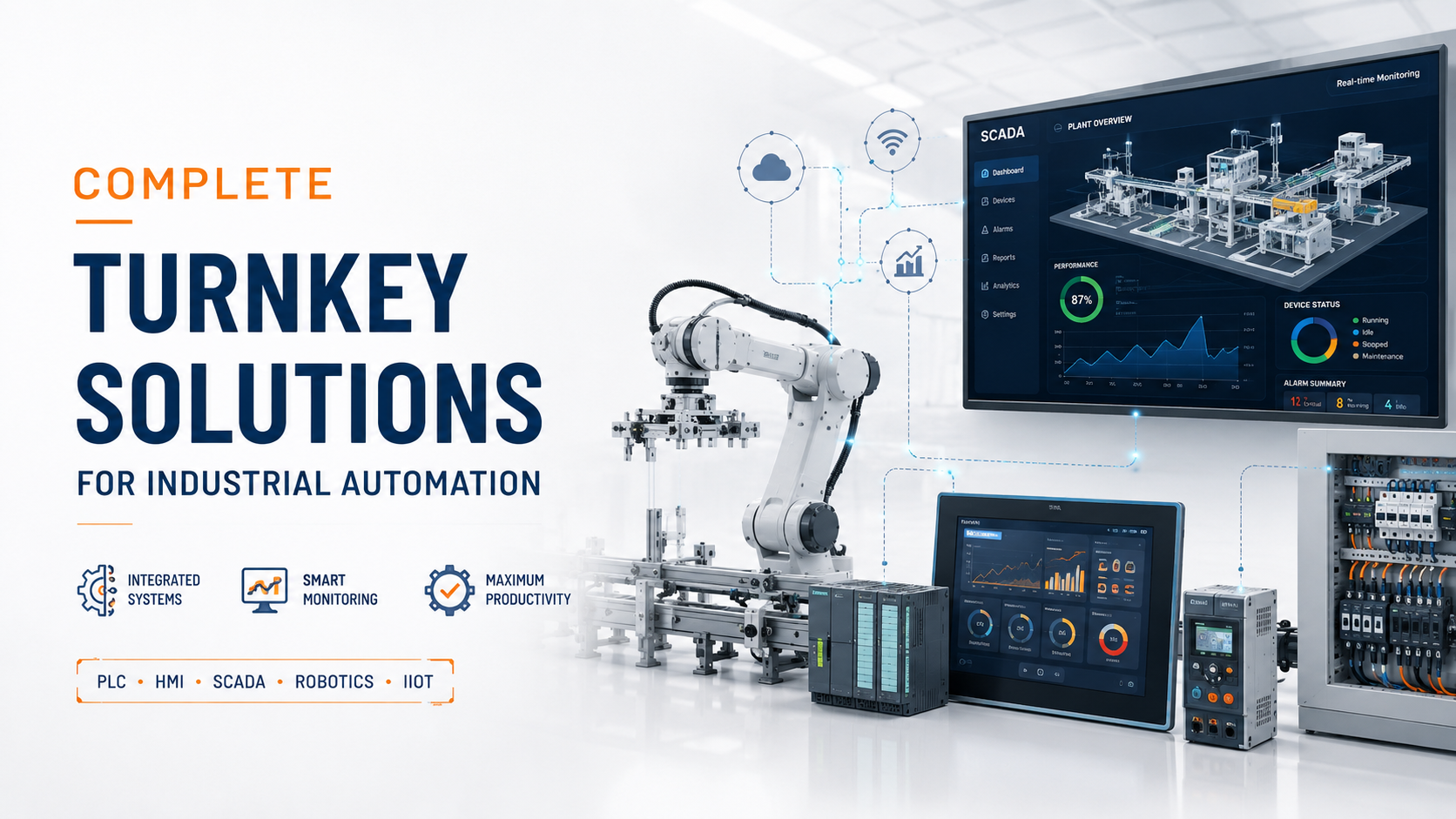
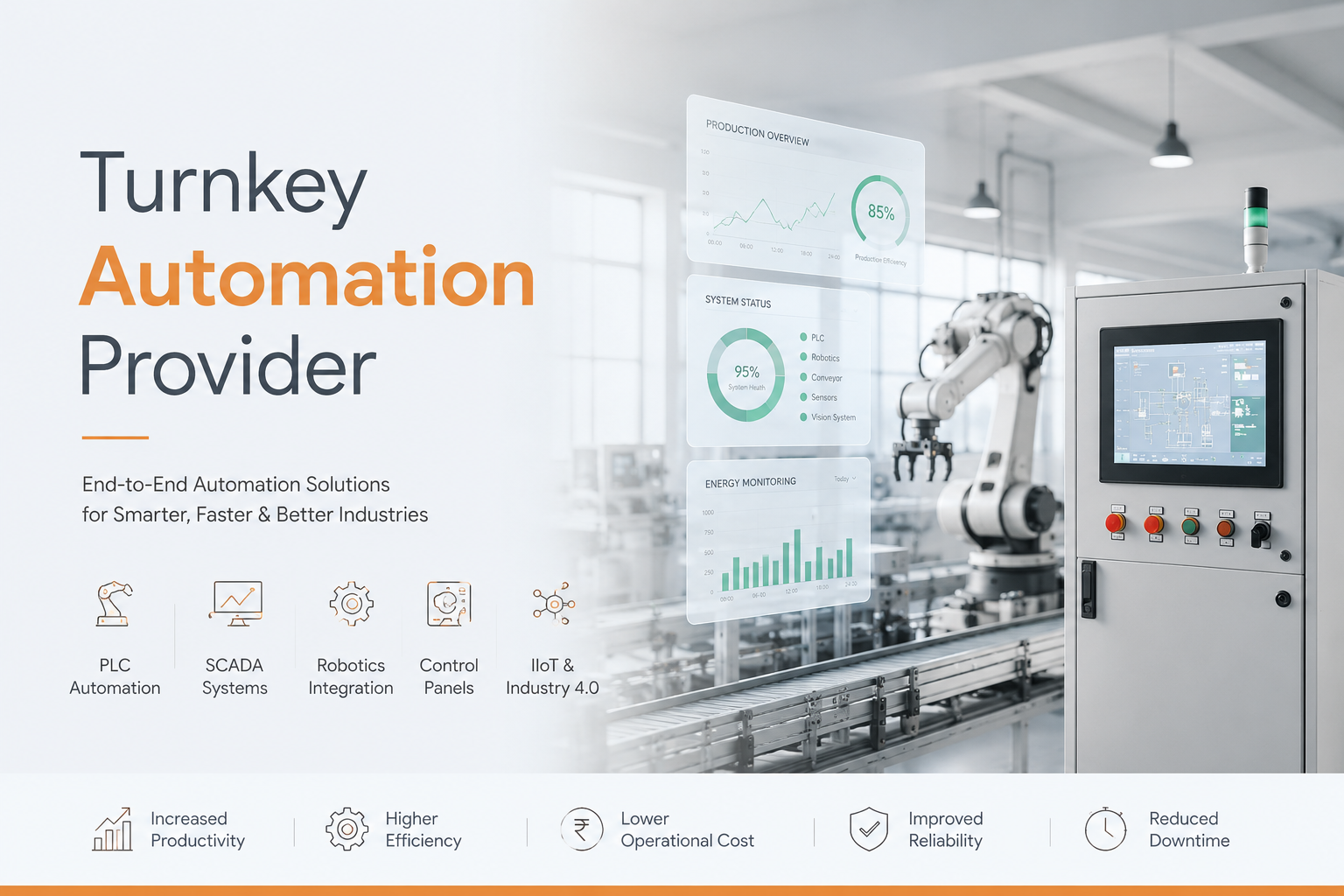
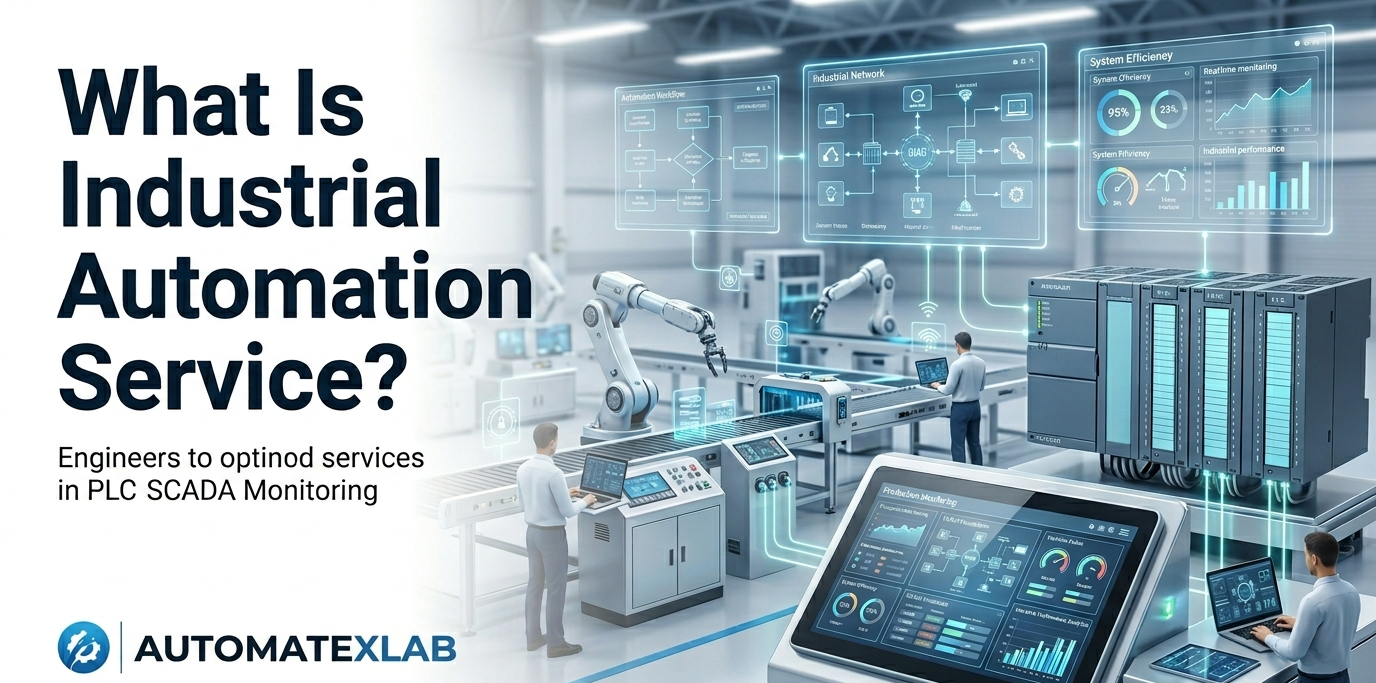
These services integrate multiple technologies to create intelligent production environments. PLC systems execute control logic, SCADA platforms monitor entire operations, HMI interfaces provide operator visibility, industrial sensors collect process data, control panels house electrical components, robotics handle physical tasks, and industrial communication networks connect all equipment.
How Industrial Automation Works
Sensors Collect Industrial Data
Industrial sensors measure temperature, pressure, flow, level, position, and other critical parameters. These devices continuously monitor equipment and process conditions.
PLC Systems Process Logic
Programmable Logic Controllers receive sensor inputs and execute programmed logic to make real-time control decisions. PLCs operate machinery based on predefined conditions and sequences.
HMIs Display Operational Information
Human Machine Interfaces present process data, equipment status, and alarm conditions to operators through graphical screens. HMIs enable human oversight and manual intervention when needed.
SCADA Systems Monitor Entire Processes
Supervisory Control and Data Acquisition platforms collect data from multiple PLCs and devices across entire facilities. SCADA systems provide centralized monitoring, historical data logging, and remote control capabilities.
Output Devices Perform Automated Actions
Based on PLC commands, output devices such as motors, valves, pumps, conveyors, and actuators perform physical actions that control production processes.
Why Industrial Automation Services Are Important
Reduce Human Dependency
Automation minimizes reliance on manual operations, reducing labor requirements for repetitive tasks and enabling staff redeployment to higher-value activities.
Improve Production Speed
Automated systems operate continuously at optimal speeds without fatigue, significantly increasing throughput compared to manual processes.
Increase Product Quality
Precise automated control maintains consistent process parameters, reducing variations that cause quality defects in manufactured products.
Reduce Industrial Downtime
Real-time monitoring and predictive maintenance capabilities identify potential failures before breakdowns occur, minimizing unplanned production stoppages.
Improve Workplace Safety
Automation removes workers from hazardous environments and dangerous tasks, reducing workplace accidents and injury risks.
Lower Operational Costs
Despite initial investment requirements, automation reduces long-term costs through improved efficiency, reduced waste, lower labor expenses, and decreased downtime.
Enable Real-Time Monitoring
Automated systems provide instant visibility into production status, equipment performance, and process conditions, enabling faster response to issues.
Improve Energy Efficiency
Optimized automated control reduces unnecessary equipment operation, minimizes waste, and lowers energy consumption across industrial facilities.
Industrial Automation vs Manual Operations
Difference Between Automated and Manual Production
Manual Systems Depend on Human Operations
Traditional manual operations require continuous human presence to monitor equipment, make control adjustments, and respond to process changes. This dependency creates inherent limitations in speed, consistency, and scalability.
Automation Systems Operate With Real-Time Logic Control
Automated systems execute control logic instantaneously based on sensor feedback, making thousands of decisions per second that would be impossible for human operators.
Automated Factories Reduce Human Error
Manual operations are susceptible to operator mistakes, inconsistent execution, and fatigue-related errors. Automation eliminates these human factors from routine control tasks.
Industrial Automation Improves Production Stability
Automated processes maintain stable operating conditions regardless of shift changes, operator experience levels, or external factors affecting human performance.
Why Modern Industries Prefer Automation
Faster Production Cycles
Automation enables higher production speeds and shorter cycle times, allowing manufacturers to meet increased demand without proportional increases in resources.
Better Operational Visibility
Automated systems generate comprehensive data about production processes, equipment performance, and quality metrics that manual operations cannot easily capture.
Lower Downtime Risk
Predictive maintenance capabilities and early fault detection reduce unexpected equipment failures that cause costly production interruptions.
Improved Process Accuracy
Precise automated control maintains tight tolerances and consistent process conditions that manual operations struggle to achieve.
Main Types of Industrial Automation Services
PLC Programming Services
PLC Logic Development
Custom control logic development creates the intelligence behind automated systems. Engineers program PLCs to execute specific sequences, safety interlocks, and process control algorithms tailored to unique production requirements.
Machine Automation Programming
Individual machine control programs coordinate motors, sensors, actuators, and other components to automate specific equipment functions and operations.
Process Control Programming
Complex process control applications manage continuous operations like temperature control, flow regulation, and batch processing across multiple interconnected systems.
PLC Troubleshooting and Optimization
Diagnostic services identify and resolve PLC program errors, optimize control logic for better performance, and update existing programs to improve functionality.
SCADA Development Services
Real-Time Process Monitoring
SCADA platforms display live production data, equipment status, and process conditions across entire facilities from centralized control rooms.
Alarm Management Systems
Intelligent alarm systems notify operators of abnormal conditions, equipment faults, and process deviations requiring attention or intervention.
Industrial Data Visualization
Graphical representations of process data, trends, and performance metrics help operators and managers understand complex production dynamics.
Remote Monitoring Solutions
Web-based and mobile SCADA access enables production oversight and control from remote locations, supporting distributed operations and off-site management.
HMI Development Services
Operator Interface Design
Custom HMI screens provide intuitive interfaces for equipment operation, displaying relevant information and controls operators need for effective process management.
Machine Visualization Screens
Animated graphics represent equipment status, material flow, and operational states, helping operators quickly understand machine conditions.
Touchscreen Industrial Controls
Modern touchscreen HMIs replace traditional button panels, offering flexible, user-friendly interfaces that simplify operator training and improve usability.
Production Monitoring Dashboards
Comprehensive dashboards consolidate key performance indicators, production counts, efficiency metrics, and quality data for operational oversight.
Industrial Control Panel Services
PLC Control Panel Design
Custom control panel layouts organize PLCs, power supplies, relays, terminals, and other components for optimal functionality and maintainability.
Electrical Panel Wiring
Professional wiring services ensure proper connections, appropriate wire sizing, clear labeling, and compliance with electrical codes and safety standards.
MCC Panel Integration
Motor Control Center integration coordinates multiple motor starters, VFDs, and protection devices for centralized motor management.
VFD Panel Installation
Variable Frequency Drive panels provide precise motor speed control, reducing energy consumption and enabling soft starting capabilities.
Industrial Networking Services
Ethernet/IP Configuration
Industrial Ethernet protocols enable high-speed communication between PLCs, HMIs, drives, and other devices using standard networking infrastructure.
Modbus Communication Setup
Modbus protocol configuration connects devices from different manufacturers, creating integrated systems from diverse equipment.
Profinet Integration
Profinet industrial networking provides real-time communication for demanding automation applications requiring fast, deterministic data exchange.
Remote Industrial Connectivity
VPN and secure remote access solutions enable off-site monitoring, troubleshooting, and control of industrial automation systems.
Industrial Automation Maintenance Services
Preventive Maintenance
Scheduled maintenance activities including PLC battery replacement, backup verification, sensor calibration, and system health checks prevent unexpected failures.
Emergency Breakdown Support
Rapid response services address critical equipment failures and production stoppages, minimizing downtime through expert troubleshooting and repair.
PLC Diagnostics
Systematic diagnostic procedures identify hardware failures, communication issues, program errors, and performance problems in PLC systems.
Automation System Health Checks
Comprehensive evaluations assess overall system condition, identify potential problems, and recommend improvements to maintain reliable operation.
Common Industrial Problems Solved by Automation Services
Frequent Machine Downtime
Automation services implement predictive maintenance monitoring, real-time fault detection, and automated diagnostics that identify problems before complete failures occur.
Production Bottlenecks
Process optimization through automated control eliminates inefficiencies, balances production rates across equipment, and maximizes throughput.
Manual Process Errors
Automated control removes human error from routine operations, ensuring consistent execution of process sequences and control actions.
Communication Failures
Industrial networking solutions create robust communication infrastructure that maintains reliable data exchange between automation components.
Inconsistent Product Quality
Precise automated control maintains stable process conditions that produce uniform product quality batch after batch.
High Operational Costs
Automation reduces labor requirements, minimizes waste, optimizes energy usage, and prevents costly production losses from quality defects and downtime.
Slow Production Cycles
Automated systems operate at optimal speeds continuously, dramatically reducing cycle times compared to manual processes.
Lack of Real-Time Monitoring
SCADA and HMI systems provide instant visibility into production status, enabling proactive management rather than reactive problem-solving.
Real Industrial Automation Use Cases
Packaging Plant Automation
Conveyor Synchronization
Multiple conveyors operate in perfect coordination, maintaining consistent product spacing and transfer speeds throughout packaging lines.
Production Line Speed Optimization
Automated control adjusts line speeds based on product type, downstream equipment capacity, and quality requirements.
Automated Fault Detection
Sensor systems detect missing products, jams, misaligned packages, and equipment malfunctions, automatically stopping lines to prevent damage.
Food Processing Automation
Batch Process Control
Automated recipe management controls ingredient additions, mixing times, temperatures, and process sequences for consistent batch quality.
Temperature Monitoring Systems
Critical temperature control during cooking, pasteurization, and cooling processes ensures food safety and regulatory compliance.
Automated Production Tracking
Real-time tracking systems monitor batch numbers, production quantities, and process parameters for complete traceability.
Water Treatment Automation
Pump Automation Systems
Automated pump control maintains optimal water levels, pressures, and flow rates while minimizing energy consumption.
SCADA-Based Monitoring
Centralized SCADA platforms monitor water quality parameters, treatment process performance, and equipment status across distributed facilities.
Remote Fault Diagnostics
Remote monitoring capabilities enable quick identification and resolution of equipment problems without requiring on-site visits.
Manufacturing Plant Automation
Robotic Process Coordination
PLCs coordinate industrial robots with conveyors, fixtures, and other equipment for seamless automated production workflows.
PLC-Controlled Production Lines
Integrated PLC control manages entire production lines, coordinating dozens of machines and hundreds of inputs and outputs.
Industrial Safety Integration
Automated safety systems monitor light curtains, emergency stops, and safety interlocks to protect workers while maintaining productivity.
Industries That Use Industrial Automation Services
Manufacturing Industries
General manufacturing facilities use automation for assembly, material handling, machining, welding, painting, and quality inspection operations.
Food Processing Plants
Food manufacturers implement automation for mixing, cooking, packaging, labeling, and sanitation processes while maintaining strict hygiene standards.
Pharmaceutical Industries
Pharmaceutical production requires precise automated control for batch processing, clean room operations, packaging, and regulatory compliance documentation.
Packaging Industries
Packaging operations rely heavily on automation for product feeding, filling, sealing, labeling, case packing, and palletizing.
Textile Industries
Textile manufacturing uses automation for spinning, weaving, dyeing, printing, and finishing processes requiring precise control.
Water Treatment Plants
Municipal and industrial water treatment facilities automate pumping, chemical dosing, filtration, and monitoring operations.
Automotive Manufacturing
Automotive plants employ extensive automation for welding, painting, assembly, material handling, and quality testing.
Chemical Industries
Chemical processing requires automation for precise mixing, reaction control, distillation, and hazardous material handling.
Signs Your Factory Needs Industrial Automation Services
Increasing Production Delays
Frequent delays meeting production schedules indicate inefficiencies that automation can eliminate through optimized control and faster cycle times.
Frequent Operator Errors
Repeated mistakes in manual operations signal the need for automated control that executes processes consistently without human error.
High Maintenance Costs
Excessive maintenance expenses often result from poor equipment monitoring and reactive maintenance approaches that automation can improve.
Repeated Machine Breakdowns
Chronic equipment failures suggest inadequate monitoring and maintenance that predictive automation systems can address.
Poor Production Visibility
Lack of real-time data about production status, equipment performance, and quality metrics indicates need for SCADA and HMI systems.
Manual Reporting Problems
Time-consuming manual data collection and reporting processes waste resources that automated data logging can eliminate.
Difficulty Scaling Production
Inability to increase production without proportional increases in labor and resources shows automation is needed for scalable growth.
How Industrial Automation Reduces Downtime
Real-Time Fault Monitoring
Continuous monitoring of equipment status, process parameters, and system health enables immediate detection of developing problems.
Predictive Maintenance Systems
Automated analysis of equipment vibration, temperature, operating hours, and performance trends predicts failures before they occur.
Faster Fault Diagnosis
Detailed alarm information, historical data, and automated diagnostics help maintenance teams quickly identify root causes of problems.
Automated Alarm Systems
Intelligent alarms notify appropriate personnel immediately when issues arise, reducing response time to critical situations.
Industrial Communication Monitoring
Network monitoring tools detect communication failures, slow response times, and connectivity issues affecting system performance.
Remote Troubleshooting Capabilities
Remote access enables expert technicians to diagnose and often resolve problems without travel time delays.
Industrial Automation Technologies Used in Modern Factories
PLC Systems
Programmable Logic Controllers from manufacturers like Allen-Bradley, Siemens, Mitsubishi, and Schneider Electric form the foundation of industrial control systems.
SCADA Platforms
Software platforms including Wonderware, Ignition, WinCC, and FactoryTalk provide supervisory control and data acquisition capabilities.
HMI Interfaces
Human Machine Interfaces from Rockwell, Siemens, Pro-face, and other manufacturers offer operator interaction with automated systems.
Industrial IoT Devices
Internet of Things sensors and edge computing devices extend automation capabilities with advanced connectivity and data analytics.
VFD Systems
Variable Frequency Drives control motor speeds precisely, reducing energy consumption and enabling soft starting of heavy loads.
Industrial Robotics
Robotic systems handle repetitive tasks, heavy lifting, precision assembly, welding, painting, and material handling operations.
AI-Based Predictive Maintenance
Artificial intelligence algorithms analyze equipment data to predict failures and optimize maintenance scheduling.
Benefits of Hiring Professional Industrial Automation Companies
Faster Production Optimization
Experienced automation engineers quickly identify improvement opportunities and implement solutions that maximize production efficiency.
Reduced Downtime Losses
Professional troubleshooting expertise minimizes recovery time when problems occur, reducing costly production interruptions.
Better Machine Reliability
Proper system design, quality components, and expert programming create automation systems that operate reliably for years.
Improved Safety Standards
Professional automation companies ensure compliance with safety standards and implement proper safety system integration.
Professional Troubleshooting Support
Access to experienced technicians who can diagnose complex problems saves time and prevents prolonged production losses.
Long-Term Cost Savings
Well-designed automation systems reduce ongoing maintenance costs, energy consumption, and operational expenses.
Scalable Automation Solutions
Professional designs accommodate future expansion, additional equipment integration, and evolving production requirements.
How AutomatexLab Provides Industrial Automation Services
PLC Automation Solutions
PLC Programming
Custom control logic development for new installations and existing equipment upgrades across all major PLC brands and platforms.
PLC Troubleshooting
Expert diagnosis and resolution of PLC hardware failures, program errors, communication issues, and performance problems.
PLC Upgrades
Migration from obsolete PLC systems to modern platforms while preserving production capability and minimizing downtime.
PLC System Optimization
Performance improvements through program optimization, network upgrades, and control strategy enhancements.
SCADA and HMI Services
SCADA Development
Custom SCADA application development providing real-time monitoring, historical data logging, reporting, and remote access capabilities.
HMI Design
Intuitive operator interface design that presents information clearly and enables efficient equipment operation.
Alarm System Integration
Intelligent alarm management systems that prioritize critical conditions and reduce operator alarm fatigue.
Real-Time Monitoring Solutions
Web-based and mobile monitoring solutions enabling production oversight from anywhere.
Industrial Control Panel Services
PLC Panel Manufacturing
Custom control panel fabrication including layout design, component selection, wiring, testing, and documentation.
Electrical Control Systems
Complete electrical system design and installation for automated equipment and production lines.
Custom Automation Panels
Specialized panels for unique applications including environmental controls, test equipment, and process skids.
Industrial Wiring Solutions
Professional wiring services ensuring code compliance, proper labeling, and maintainability.
Industrial Troubleshooting Services
Automation Fault Diagnosis
Systematic troubleshooting procedures quickly identifying root causes of automation system problems.
Communication Troubleshooting
Network diagnostics resolving connectivity issues between PLCs, HMIs, drives, and other networked devices.
Emergency Breakdown Support
Rapid response services minimizing production losses from critical equipment failures.
Preventive Maintenance Solutions
Scheduled maintenance programs preventing unexpected failures through systematic inspection and testing.
Industrial Network Integration
Ethernet/IP Setup
Industrial Ethernet network configuration enabling high-speed communication between automation components.
Modbus Integration
Modbus RTU and TCP protocol implementation connecting diverse equipment into integrated systems.
Profinet Configuration
Profinet network setup for demanding real-time control applications.
Remote Access Systems
Secure VPN and remote access configuration enabling off-site monitoring and support.
Why Industries Choose AutomatexLab
Experienced Automation Engineers
Our team brings decades of combined experience across diverse industrial applications and automation technologies.
Multi-Industry Automation Expertise
We have successfully implemented automation solutions in manufacturing, food processing, water treatment, packaging, and other industries.
Fast Technical Support
Rapid response to technical issues minimizes downtime and keeps production running smoothly.
Customized Automation Solutions
Every solution is tailored to specific operational requirements rather than forcing generic approaches.
PLC, SCADA, and HMI Expertise
Deep technical knowledge across all major automation platforms and technologies.
Downtime Reduction Focus
Our solutions prioritize reliability and maintainability to minimize production interruptions.
Reliable Industrial Support
Long-term relationships built on consistent delivery of quality solutions and responsive service.
How to Choose the Right Industrial Automation Service Provider
Experience With Industrial Projects
Look for providers with proven track records in your industry and application type.
Multi-Brand PLC Knowledge
Choose companies proficient with multiple PLC brands rather than single-platform specialists.
SCADA and Networking Expertise
Verify capabilities beyond basic PLC programming to include supervisory systems and industrial networking.
Troubleshooting Capabilities
Ensure the provider offers expert troubleshooting support for existing systems, not just new installations.
Remote Support Availability
Confirm availability of remote assistance to minimize response times during critical situations.
Preventive Maintenance Services
Select providers offering ongoing maintenance programs rather than only project-based services.
Fast Response Time
Evaluate responsiveness during initial contact as an indicator of future service quality.
Industrial Automation Statistics and Industry Trends
Rising Demand for Smart Factories
Global investment in smart manufacturing technologies continues accelerating as industries recognize competitive advantages of digital transformation.
Growth of Industrial IoT Adoption
More factories are implementing IoT sensors and edge computing devices to capture detailed operational data for analysis and optimization.
Increasing Investment in Predictive Maintenance
Companies are shifting from reactive and preventive maintenance to predictive approaches that reduce costs and improve equipment reliability.
Expansion of AI-Based Automation
Artificial intelligence is being integrated into automation systems for quality inspection, process optimization, and anomaly detection.
Growing Need for Remote Monitoring Systems
Distributed operations and skilled labor shortages are driving demand for remote monitoring and control capabilities.
Future of Industrial Automation Services
Smart Factories
Fully integrated digital factories will combine automation, IoT, AI, and data analytics for autonomous optimization and decision-making.
Cloud-Based SCADA Systems
Cloud platforms will replace traditional on-premises SCADA servers, offering scalability, accessibility, and reduced infrastructure costs.
AI-Based Machine Diagnostics
Machine learning algorithms will analyze equipment data to predict failures with increasing accuracy and recommend optimal maintenance actions.
Remote Industrial Monitoring
Advanced remote monitoring will enable centralized oversight of distributed facilities with minimal on-site staffing.
Data-Driven Manufacturing
Manufacturing decisions will increasingly rely on real-time data analysis rather than experience-based judgment.
Energy-Efficient Automation
Automation systems will incorporate sophisticated energy management capabilities to minimize consumption and environmental impact.
Autonomous Industrial Systems
Self-optimizing systems will automatically adjust parameters to maintain optimal performance as conditions change.
Conclusion
Industrial automation services transform production operations by eliminating manual control limitations and creating intelligent, self-regulating manufacturing environments.
PLC systems execute precise control logic. SCADA platforms provide comprehensive monitoring. HMI interfaces enable operator oversight. Industrial networking connects all components into integrated systems.
These technologies work together to improve production efficiency, reduce downtime, enhance product quality, lower operational costs, and increase workplace safety.
Professional automation support helps industries implement reliable solutions, troubleshoot problems quickly, and optimize systems for maximum performance.
Smart automation investments deliver measurable improvements in productivity, quality, and profitability while positioning companies for future growth.
Factories still depending on unstable manual operations often face hidden production losses, operational delays, and rising maintenance pressure.
AutomatexLab helps industries modernize automation environments through PLC programming, SCADA development, HMI solutions, industrial troubleshooting, control panel services, preventive maintenance, and industrial network integration.
Don’t wait for repeated machine failures and production losses to slow down your operations. Build a smarter, faster, and more reliable industrial automation environment with AutomatexLab designed for long-term industrial growth and operational stability.
FAQs
Industrial automation services include design, programming, installation, and maintenance of automated control systems using PLCs, SCADA, HMIs, and industrial networks to improve manufacturing efficiency and reliability.
Manufacturing, food processing, pharmaceuticals, packaging, textiles, water treatment, automotive, and chemical industries all rely heavily on industrial automation.
PLCs execute control logic that automates equipment operation based on sensor inputs, eliminating need for manual control and enabling precise, consistent process execution.
SCADA systems provide centralized monitoring of entire facilities, historical data logging, alarm management, and remote control capabilities that improve operational oversight.
Yes, automation reduces downtime through real-time monitoring, predictive maintenance, faster fault diagnosis, and automated alarm systems that identify problems before failures occur.
Costs vary widely based on project scope, from several thousand dollars for simple machine automation to hundreds of thousands for complete facility automation systems.
Professional automation engineers deliver faster implementation, better reliability, proper safety integration, ongoing support, and optimized solutions that maximize return on investment.
AutomatexLab offers PLC programming, SCADA development, HMI design, control panel fabrication, troubleshooting, preventive maintenance, and industrial networking services.