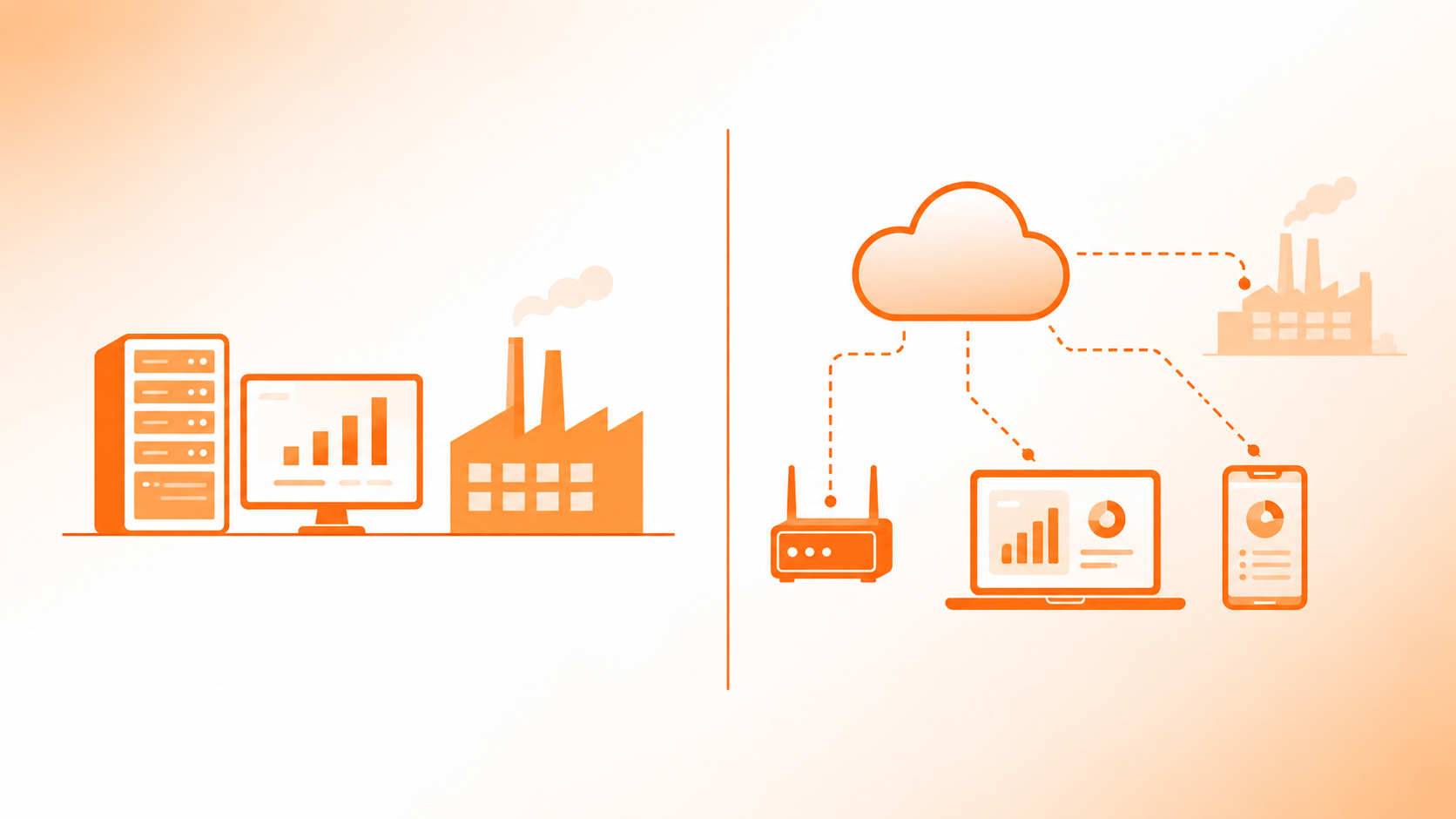
Cloud SCADA uses cloud infrastructure for data storage, visualization, and analytics while keeping critical control logic at the plant. Traditional SCADA runs entirely on local servers and workstations within the facility. The right choice depends on your operational priorities: traditional SCADA offers proven reliability and millisecond control response, while cloud SCADA provides remote visibility, easier scaling across multiple sites, and reduced on-site IT maintenance.
This comparison examines how both architectures work, where each performs well, what risks to consider, and how to decide which approach fits your operations.
What Is Traditional SCADA?
Traditional SCADA is a locally deployed system where all core functions run on servers and workstations inside the facility. The architecture typically includes a communication server that talks to PLCs and RTUs, a historian for data storage, an application server for logic and calculations, and HMI workstations for operators.
These systems connect to field devices through local networks or dedicated communication links. Because everything runs on-site, traditional SCADA provides deterministic response times and continues operating during internet outages. The trade-off is that every site needs its own hardware, software licenses, and IT support.
Traditional SCADA has been the standard for decades in industries like power generation, oil and gas, water treatment, and manufacturing. Its reliability comes from physical control over the entire stack and the ability to isolate systems from external networks.
What Is Cloud SCADA?
Cloud SCADA is a SCADA architecture that uses cloud infrastructure for functions such as data storage, remote monitoring, visualization, or analytics. The cloud platform handles historical data, dashboards, alarm notifications, and reporting, while PLCs and local controllers continue executing real-time control logic.
There are two main deployment patterns. In a hybrid architecture, data collection and control logic stay on local SCADA servers, and the cloud handles storage, analytics, visualization, and remote access. The local system and cloud platform exchange data through protocols like OPC UA or MQTT. This approach preserves local control reliability while adding cloud flexibility.
In a pure cloud architecture, data flows directly from PLCs or RTUs through edge gateways to cloud-hosted SCADA services. This model suits distributed assets with less demanding real-time requirements, such as solar farms, water distribution networks, or building management systems .
The key distinction from traditional SCADA is not where control happens but where data lives and how users access it.
Cloud SCADA vs Traditional SCADA: Core Differences at a Glance
| Factor | Traditional SCADA | Cloud SCADA |
|---|---|---|
| Deployment location | On-premises servers and workstations | Cloud infrastructure (with edge gateways) |
| Control logic | Local, deterministic | Local PLCs; cloud for monitoring and analytics |
| Remote access | Requires VPN or remote desktop setup | Web browser from any authorized device |
| Scalability | Hardware-bound; upgrades require capital investment | Elastic; add sites or tags through subscription |
| Upfront cost | High capital expenditure for servers, licenses, infrastructure | Lower entry cost; operational expenditure model |
| Maintenance | On-site IT manages patches, backups, hardware refreshes | Provider handles platform updates and security patches |
| Latency | Milliseconds; direct network connection | Depends on network; not for closed-loop control |
| Reliability during network outage | Continues operating independently | Local control continues; cloud visibility may pause |
| Security model | Air-gapped or segmented local network | Encrypted internet connectivity with defense-in-depth |
How Cloud SCADA Architecture Works
Understanding the data path helps clarify what cloud SCADA can and cannot do safely.
Edge Layer
Edge gateways or industrial routers sit at the plant and connect to PLCs, RTUs, and sensors. They collect data, perform protocol conversion, and buffer readings during network interruptions. Modern edge devices can run local logic for interlocks and safety functions, ensuring critical operations continue if cloud connectivity drops .
Connectivity Layer
Data travels from edge devices to the cloud through encrypted channels. Common protocols include MQTT with TLS, OPC UA, or HTTPS. These protocols support authentication and encryption, addressing the security concerns that come with internet-connected industrial systems .
Cloud Platform Layer
The cloud platform hosts the SCADA application services: historical database, alarm engine, trend analysis, dashboards, and reporting. Users access these through web browsers or mobile apps. Role-based access control limits what each user can see and do .
Local Control Layer
This is where cloud SCADA differs fundamentally from a fully remote control system. PLCs and local controllers continue executing real-time logic. Cloud SCADA monitors, analyzes, and suggests, but closed-loop control remains local. This design principle, sometimes summarized as monitor and advise, never directly control from the cloud, reflects the latency and reliability realities of industrial processes .
Key Benefits of Cloud SCADA
Remote Visibility Across Sites
Cloud SCADA lets authorized users view production data from any location through web-based dashboards. For organizations with multiple plants, pump stations, or remote assets, this eliminates the need to travel to each site for basic monitoring. Engineers can troubleshoot from home, headquarters, or another facility .
Reduced On-Site IT Burden
Traditional SCADA requires maintaining Windows servers, applying security patches, managing backups, and planning hardware refreshes. Cloud SCADA shifts these responsibilities to the service provider. Operations teams focus on production rather than server maintenance .
Elastic Scalability
Adding a new site to a traditional SCADA system often means procuring servers, installing software, and configuring network infrastructure. With cloud SCADA, the new site needs an edge gateway and a cloud subscription. Capacity adjusts without hardware changes .
Data Aggregation for Analytics
When data from multiple sites resides in one cloud platform, cross-site comparisons, benchmarking, and predictive maintenance models become practical. A traditional SCADA system at each site creates data silos that make enterprise-level analysis difficult .
Predictable Operating Costs
Cloud SCADA typically uses subscription pricing rather than large capital purchases. This shifts spending from capital expenditure to operational expenditure, which can simplify budgeting and reduce the upfront cost of new deployments .
Limitations and Risks of Cloud SCADA
Network Dependency
Cloud SCADA requires reliable internet connectivity. If the connection fails, remote visibility stops. Local control continues if PLCs and edge devices are properly configured, but operators lose the cloud dashboard until connectivity returns .
Security Surface Expansion
Connecting operational technology to the internet increases the attack surface. Edge gateways, communication links, and cloud platforms all become potential targets. Mitigations include encrypted protocols, certificate-based authentication, network segmentation, and continuous monitoring, but no internet-connected system is completely risk-free .
Latency for Time-Critical Functions
Cloud round-trip times typically range from tens to hundreds of milliseconds. Industrial control loops that require responses in 30 to 500 milliseconds cannot safely depend on cloud connectivity. This is why cloud SCADA is used for monitoring and analytics, not for safety interlocks or high-speed control .
Regulatory and Data Residency Considerations
Some industries and jurisdictions restrict where operational data can be stored or transmitted. Cloud deployments must account for data sovereignty requirements, which may limit provider options or require specific cloud regions .
Change Management Challenges
Moving to cloud SCADA changes workflows, roles, and responsibilities. Plant operators may need to coordinate with cloud architects. Access control and authentication procedures must evolve. Organizations that treat cloud migration as purely a technology project often underestimate these human factors .
Traditional SCADA: Where It Still Makes Sense
Traditional SCADA remains the appropriate choice in several scenarios.
High-speed control requirements. Processes that depend on sub-100-millisecond control loops, such as turbine control or certain chemical reactions, need local deterministic execution.
Limited or unreliable connectivity. Remote sites with satellite-only or intermittent network access cannot depend on cloud services for operational visibility.
Strict air-gap requirements. Some defense, nuclear, or critical infrastructure environments mandate physical isolation from external networks. While air gaps are not absolute security guarantees, regulatory frameworks may still require them .
Existing investments and expertise. Facilities with functioning traditional SCADA and trained staff may find migration costs outweigh benefits, especially if current systems meet operational needs.
Small single-site operations. A single plant with local operators and no remote monitoring needs may not justify cloud infrastructure complexity.
Cloud SCADA: Where It Delivers the Most Value
Multi-site and distributed assets. Water utilities with dozens of pump stations, solar farms with hundreds of inverters, or manufacturers with multiple plants benefit from centralized visibility.
Remote or unmanned sites. Sites that are expensive or impractical to staff can be monitored from a central operations center through cloud dashboards.
Rapid deployment needs. Cloud SCADA can be operational in hours rather than the days or weeks required to procure and configure on-premises servers .
Small to mid-sized operations. Organizations that cannot justify dedicated IT staff for SCADA maintenance can use cloud services to access enterprise-grade monitoring without the overhead .
Analytics and reporting requirements. When regulatory reporting, energy management, or predictive maintenance depends on aggregated data, cloud platforms provide the necessary infrastructure .
Security Considerations for Cloud SCADA
Security is the most common concern when organizations consider cloud SCADA. The question is not whether cloud is inherently less secure than on-premises, but whether the specific architecture and controls match the risk profile.
Defense in Depth
Effective cloud SCADA security uses multiple layers: encrypted communication (TLS 1.3), certificate-based device authentication, role-based access control, multi-factor authentication for administrative users, and continuous monitoring for anomalous behavior .
Data Flow Direction
Some implementations enforce outbound-only data flow from the plant to the cloud. This prevents external systems from initiating connections into the operational network, reducing the risk of unauthorized access .
Shared Responsibility
Cloud providers secure the infrastructure, but customers remain responsible for their data, access configurations, and application-level security. Understanding this division of responsibility is essential before migration .
Legacy Protocol Challenges
Older industrial protocols often lack native encryption or authentication. Edge gateways can encapsulate legacy traffic in secure tunnels, but organizations should assess whether legacy devices introduce unacceptable risk .
Cost Comparison: What to Expect
Cost structures differ significantly between the two approaches.
Traditional SCADA involves significant capital expenditure: servers, workstations, software licenses, network infrastructure, and installation. Ongoing costs include hardware maintenance, software support contracts, IT labor, and periodic refresh cycles. A seven-year total cost of ownership can exceed three times the initial investment when maintenance and upgrades are included .
Cloud SCADA typically shifts to operational expenditure: subscription fees based on tag count, data volume, or user count. There is little to no upfront hardware cost for the cloud platform itself. Edge gateways and network connectivity are still required. Over time, subscription costs accumulate, so organizations should model total cost over a five- to seven-year horizon .
The financial advantage of cloud SCADA is strongest when it avoids the need for dedicated IT staff, when scaling would otherwise require major hardware investment, or when the organization values predictable monthly costs over capital cycles.
Implementation Considerations
Assess Your SCADA Software’s Cloud Readiness
Not all SCADA software supports cloud deployment. Some vendors offer cloud-native or SaaS versions; others require infrastructure-as-a-service hosting, which is essentially moving servers to the cloud without gaining cloud benefits. Consult your vendor about supported deployment models .
Choose the Right Architecture
Hybrid architectures often provide the best balance for process industries: local control stays local, and cloud handles data aggregation and remote access. Pure cloud architectures suit distributed assets with tolerant latency requirements.
Plan for Connectivity Failure
Edge devices should buffer data during network outages and forward it when connectivity resumes. Local HMIs should continue functioning independently. Operators need clear procedures for what to do when cloud dashboards are unavailable .
Address Change Management Early
Identify which roles change, what new skills are needed, and how workflows will adapt. The technical migration is often easier than the organizational transition .
Engage OT and IT Together
Cloud SCADA sits at the intersection of operational technology and information technology. Both perspectives are needed: OT understands process requirements and safety constraints; IT understands cloud architecture, networking, and security frameworks.
How to Decide: A Practical Framework
Ask these questions to guide the decision:
What are your latency requirements? If control loops require sub-100-millisecond response, local control is mandatory. Cloud SCADA can still provide monitoring and analytics alongside local control.
How many sites do you need to monitor? Multiple sites or distributed assets favor cloud architectures for centralized visibility.
What is your connectivity reliability? Sites with stable, high-bandwidth connections can support cloud SCADA. Remote or intermittent connections may require a local-first approach.
What IT resources are available? If you lack dedicated staff for server maintenance, patching, and backups, cloud SCADA reduces this burden.
What are your security and compliance requirements? Understand your regulatory obligations. Cloud providers offer compliance certifications, but you remain responsible for configuration and access control.
What is your growth trajectory? If you expect to add sites, tags, or users, cloud scalability may be more cost-effective than repeated hardware investments.
Making the Transition
If you determine that cloud SCADA fits your needs, a phased approach reduces risk:
- Start with monitoring only. Connect a subset of data to the cloud for visibility and analytics without changing control architecture.
- Validate connectivity and security. Test edge gateways, encryption, authentication, and failover behavior in a controlled environment.
- Expand gradually. Add more sites or data points as confidence grows.
- Keep local control independent. Ensure PLCs and local HMIs continue functioning regardless of cloud availability.
- Document and train. Update procedures, train operators and engineers, and establish clear escalation paths for cloud-related issues.
Conclusion
Cloud SCADA and traditional SCADA serve different purposes within industrial operations. Traditional SCADA provides proven local control with deterministic timing and independence from external networks. Cloud SCADA adds remote visibility, cross-site data aggregation, reduced on-site maintenance, and elastic scalability.
The most practical path for most organizations is not choosing one over the other but understanding which functions belong where. Keep real-time control local. Move monitoring, analytics, and reporting to the cloud where they can be accessed from anywhere and scaled without hardware constraints.
The decision depends on your specific requirements: latency needs, site distribution, connectivity reliability, IT resources, security posture, and growth plans. A thorough assessment of these factors, ideally with input from both OT and IT teams, will clarify which architecture, or which combination, fits your operations.
Frequently Asked Questions
Can cloud SCADA replace traditional SCADA entirely?
For most industrial operations, no. Cloud SCADA handles monitoring, analytics, and remote access, but real-time control logic requires local execution for reliability and latency reasons. Hybrid architectures that combine local control with cloud visibility are the most common approach .
Is cloud SCADA secure enough for critical infrastructure?
Cloud SCADA can meet critical infrastructure security requirements when properly designed with encryption, authentication, network segmentation, and continuous monitoring. The security question is not cloud versus on-premises but whether the specific architecture and controls address your risk profile .
What happens to my SCADA system if the internet goes down?
Local PLCs and HMIs continue operating. Edge gateways buffer data for later upload. Remote users lose cloud dashboard access until connectivity returns. This is why local control must remain independent of cloud connectivity .
Does cloud SCADA work with existing PLCs and RTUs?
In most cases, yes. Edge gateways support common industrial protocols like Modbus, OPC UA, and EtherNet/IP. Legacy devices may require protocol conversion or additional hardware. Compatibility depends on the specific gateway and devices .
How does cloud SCADA handle data ownership?
Data ownership terms vary by provider. Most cloud SCADA subscriptions allow customers to export their data. Review contracts carefully for data portability, retention, and deletion policies.
What bandwidth does cloud SCADA require?
Bandwidth depends on tag count, update frequency, and whether you use report-by-exception. Modern protocols like MQTT with Sparkplug B optimize bandwidth by sending only changes. A typical site may require a few megabits per second or less .
Can I migrate gradually from traditional to cloud SCADA?
Yes. Many organizations start with cloud-based monitoring while keeping existing SCADA for control. Over time, they may expand cloud functionality or replace aging local infrastructure. A phased approach reduces risk and allows time for training .
What are the ongoing costs of cloud SCADA?
Expect subscription fees based on tags, data volume, or users. Additional costs include edge hardware, network connectivity, and any integration or customization services. Cloud eliminates server hardware refreshes and reduces IT labor for platform maintenance .
How does cloud SCADA support regulatory compliance?
Cloud providers offer compliance certifications for their infrastructure. You remain responsible for configuring access controls, audit logging, and data handling to meet industry-specific regulations. Data residency options may be available depending on the cloud region .
What skills does my team need for cloud SCADA?
Operators need training on web-based dashboards and remote access procedures. Engineers need familiarity with edge gateways, cloud protocols like MQTT, and security configurations. IT and OT collaboration becomes more important than in traditional deployments .