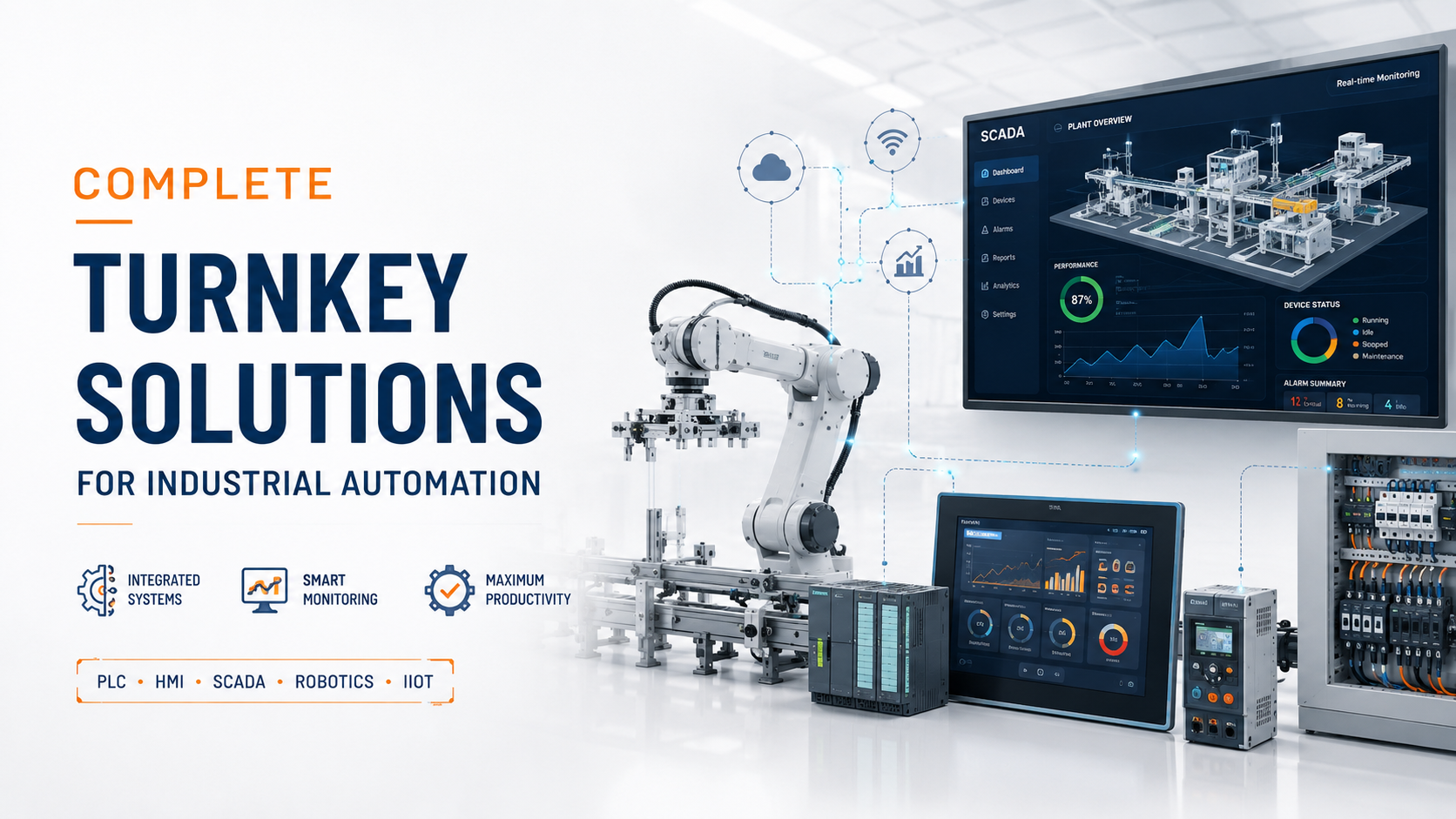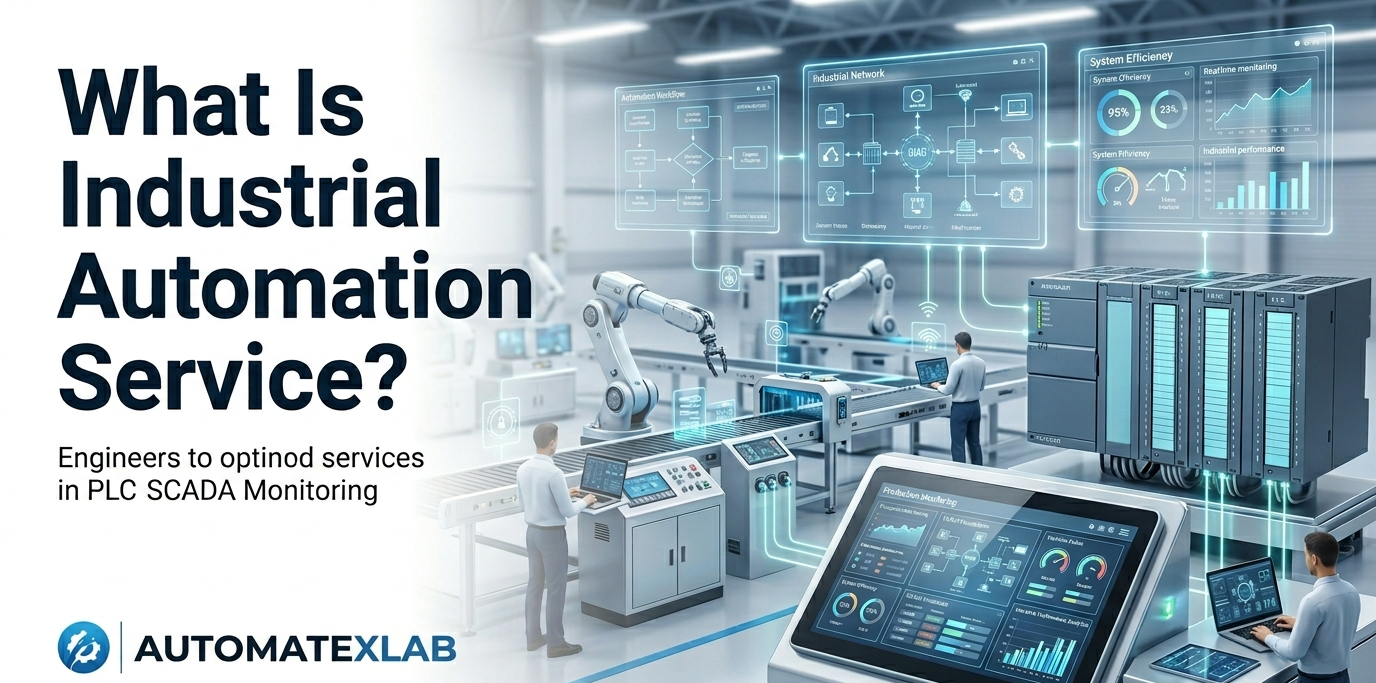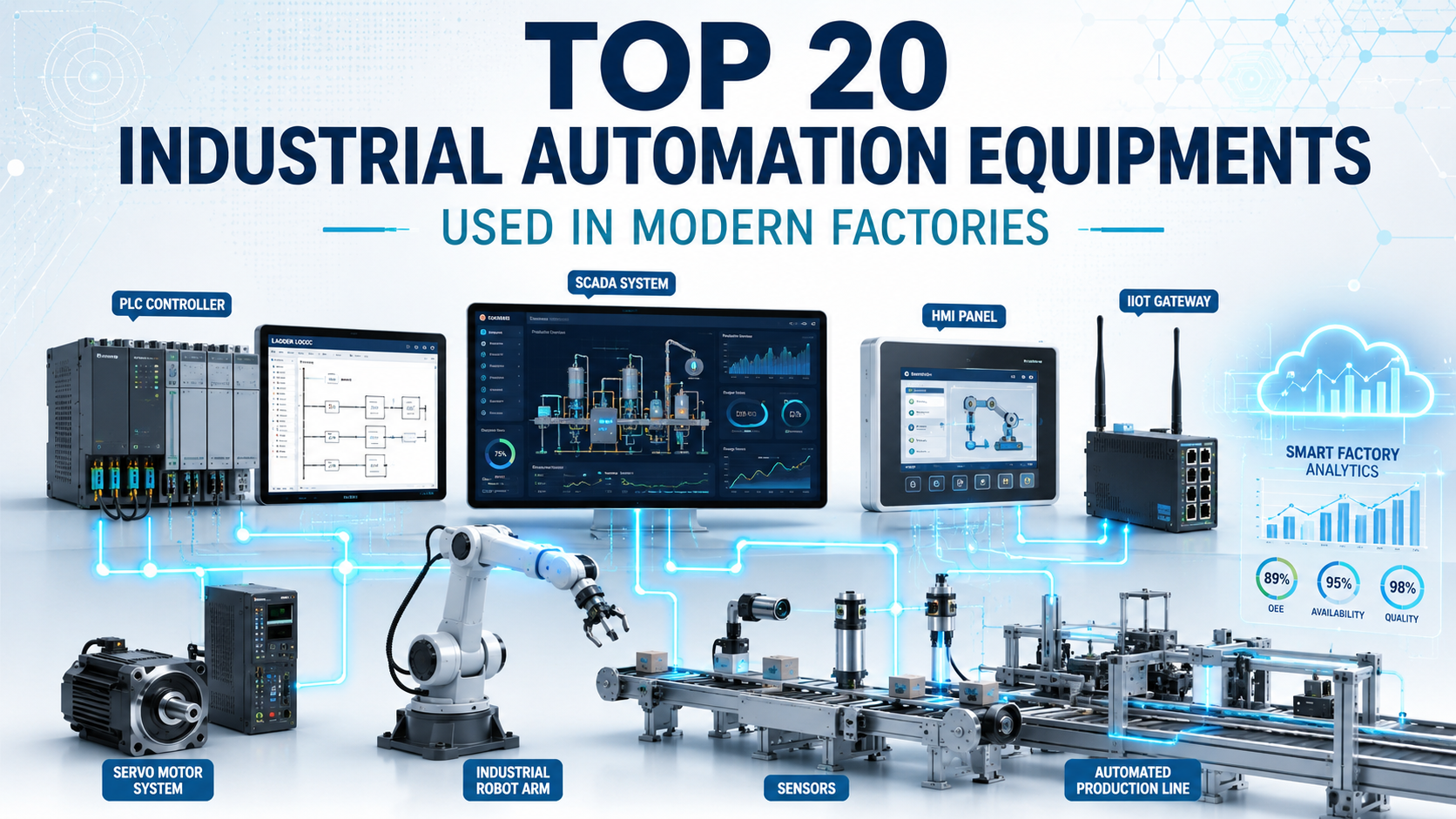
Industrial automation equipment includes machines, control systems, sensors, software platforms, and smart devices used to automate manufacturing processes, reduce downtime, and improve production output.
Modern factories rely on PLCs, SCADA systems, HMIs, industrial robots, sensors, VFDs, servo drives, and IIoT gateways to build efficient, data-driven production environments that run with minimal human intervention.
What Is Industrial Automation Equipment?
Industrial automation equipment is any hardware or software system that controls, monitors, or executes manufacturing tasks without constant human input. These systems replace or assist manual labor with programmable machines, sensors, and control logic.
In a manual factory, workers operate each machine individually. In an automated factory, machines communicate with each other through control networks, execute pre-programmed logic, and report data in real time.
Simple example: In a packaging plant, sensors detect incoming bottles, a PLC counts them, a servo motor positions the conveyor, and a SCADA system logs the data all without a single manual step.
Why Do Modern Factories Depend on Automation Equipment?
Factories adopt automation systems to solve real operational problems — not just to modernize. Here are the core reasons:
- Reduced downtime — Sensors and predictive systems catch faults before machines fail
- Faster production — Automated lines run 24/7 at consistent speeds
- Better quality — Machine precision eliminates variation caused by human error
- Energy savings — VFDs and smart motor controls reduce power consumption
- Real-time visibility — SCADA dashboards show live production data across the entire facility
- Worker safety — Automated systems handle hazardous or repetitive tasks
How Industrial Automation Systems Work Together
Before breaking down individual equipment, it helps to understand how these systems connect inside a real factory.
Typical automation workflow:
| Step | Equipment | Action |
|---|---|---|
| 1 | Sensor | Detects object on line |
| 2 | PLC | Processes control logic |
| 3 | Servo motor | Moves conveyor to position |
| 4 | HMI | Displays machine status |
| 5 | SCADA | Logs production data |
| 6 | IIoT Gateway | Sends data to cloud analytics |
Each layer of equipment serves a specific role. PLCs handle local logic. SCADA handles supervision. IIoT handles connectivity. They work as a system, not as isolated machines.
Top Industrial Automation Equipment Used in Modern Factories
Programmable Logic Controllers (PLCs)
A PLC is a rugged industrial computer that controls machines and processes based on programmed logic. It reads inputs from sensors, executes instructions, and sends output signals to actuators, motors, and other devices.
What PLCs control in factories:
- Conveyor belts and sorting systems
- Motor sequencing and startup
- Safety interlocks and shutdowns
- Packaging and filling lines
Real example: On a bottling line, a PLC counts bottles passing through a sensor, controls the fill valve timing, and triggers the capping machine — all in milliseconds.
Popular PLC brands:
| Brand | Common Use |
|---|---|
| Siemens | Automotive, process industries |
| Allen-Bradley (Rockwell) | Food, packaging, discrete manufacturing |
| Mitsubishi | Electronics, light manufacturing |
| Omron | Pharmaceutical, assembly lines |
PLCs are the backbone of factory floor automation. They are reliable, fast, and designed to operate in harsh industrial environments.
SCADA Systems
SCADA (Supervisory Control and Data Acquisition) is a software system that monitors and controls industrial processes across an entire facility or multiple sites.
Core SCADA functions:
- Real-time process monitoring
- Alarm detection and management
- Historical data logging
- Production reporting and analytics
SCADA does not directly control machines at the field level. Instead, it communicates with PLCs and RTUs to collect data and allow operators to supervise production from a central station.
SCADA architecture overview:
Field Devices → PLCs/RTUs → Communication Network → SCADA Server → Operator WorkstationIndustries like water treatment, oil and gas, and power generation rely heavily on SCADA for plant-wide supervision.
Human Machine Interfaces (HMIs)
An HMI is a touchscreen panel or display that allows operators to interact with machines and control systems directly on the factory floor.
What operators do with HMIs:
- Start and stop machines
- View live alarms and fault codes
- Monitor temperatures, pressures, and speeds
- Adjust setpoints and production parameters
- Track production counts per shift
Modern HMIs go beyond local panels. Web-based and cloud-connected HMIs allow remote monitoring from tablets, phones, and laptops.
HMI types comparison:
| Type | Use Case |
|---|---|
| Panel-mounted HMI | Machine-level control |
| PC-based HMI | Supervisory station |
| Web HMI | Remote access monitoring |
| Mobile HMI | Field technician use |
Industrial Sensors
Industrial sensors detect physical conditions like position, temperature, pressure, and proximity, then send that data to PLCs or control systems for processing.
Common sensor types in factories:
- Proximity sensors — Detect metal objects without contact; used for position detection on conveyors
- Photoelectric sensors — Use light beams to detect objects; common in packaging and sorting
- Pressure sensors — Monitor hydraulic and pneumatic system pressures
- Temperature sensors — Track heat levels in ovens, motors, and processes
- Ultrasonic sensors — Measure distance and level in tanks or bins
Sensors are the eyes and ears of any automation system. Without accurate sensor data, PLCs cannot make correct control decisions.
Variable Frequency Drives (VFDs)
A VFD controls the speed and torque of an AC motor by varying the frequency and voltage of the electrical supply. Instead of running motors at full speed constantly, VFDs adjust speed based on actual demand.
Benefits of using VFDs:
- Up to 50% energy savings on pump and fan applications
- Smooth motor startup reduces mechanical wear
- Precise speed control improves process consistency
- Built-in diagnostics and fault monitoring
Common VFD applications:
| Application | Why VFDs Help |
|---|---|
| Pumps | Match flow to demand instead of throttling |
| Fans and blowers | Reduce speed at partial load |
| Conveyors | Smooth start and variable speed control |
| Compressors | Energy-efficient pressure control |
Servo Motors and Servo Drives
Servo systems consist of a servo motor paired with a servo drive (amplifier) and a feedback device like an encoder. Together, they provide precise control over position, speed, and torque.
Where servo systems are used:
- CNC machining centers
- Robotic arms and end-of-arm tooling
- Pick-and-place machines
- Printing and label application systems
- Packaging and filling equipment
Servo vs. standard induction motor:
| Feature | Servo Motor | Standard Motor |
|---|---|---|
| Position control | Yes | No |
| Precision | Very high | Low |
| Speed range | Wide | Limited |
| Cost | Higher | Lower |
| Best use | Motion control | Fixed-speed loads |
Industrial Robots
Industrial robots are programmable mechanical arms or systems that perform physical tasks in manufacturing environments. They replace or assist humans in repetitive, hazardous, or precision-demanding tasks.
Robot types used in factories:
- Articulated robots — 6-axis arms used for welding, painting, and assembly
- SCARA robots — Fast, horizontal movement; ideal for assembly and pick-and-place
- Delta robots — High-speed parallel robots used in food and pharma picking
- Collaborative robots (Cobots) — Work alongside humans safely without full guarding
Factory applications:
| Task | Robot Type |
|---|---|
| Welding | Articulated |
| Palletizing | Articulated |
| Assembly | SCARA or Cobot |
| Packaging | Delta or SCARA |
| Machine tending | Articulated or Cobot |
Robot adoption is accelerating across small and mid-size manufacturers, not just large automotive plants.
Industrial IoT (IIoT) Gateways
An IIoT gateway is a hardware device that collects data from factory machines and equipment, then transmits it to cloud platforms or on-premise servers for analysis.
What IIoT gateways do:
- Bridge the gap between OT (operational technology) and IT systems
- Perform edge computing to process data locally before sending to cloud
- Enable remote monitoring of machine health and performance
- Support predictive maintenance programs
Smart factory use cases:
- Monitor motor vibration and temperature in real time
- Track OEE (Overall Equipment Effectiveness) automatically
- Send alerts when machines deviate from normal operating ranges
- Feed data into AI analytics platforms for pattern recognition
Distributed Control Systems (DCS)
A DCS is a process control system where control functions are distributed across multiple controllers located throughout a plant, rather than centralized in one PLC or computer.
Industries that use DCS:
- Oil and gas refineries
- Chemical and petrochemical plants
- Power generation facilities
- Pharmaceutical batch processing
PLC vs. DCS comparison:
| Factor | PLC | DCS |
|---|---|---|
| Best for | Discrete manufacturing | Continuous process control |
| Scalability | Moderate | High |
| Redundancy | Optional | Built-in |
| Integration | Machine-level | Plant-wide |
| Cost | Lower | Higher |
Industrial Control Panels
An industrial control panel is a pre-engineered enclosure that houses the electrical and automation components needed to control machines and systems.
Components typically inside a control panel:
- PLCs and I/O modules
- Circuit breakers and fuses
- Contactors and relays
- VFDs and soft starters
- Power supplies and transformers
- Terminal blocks and wiring
A well-designed control panel improves safety, simplifies maintenance, and makes troubleshooting faster. Panel layout directly affects machine uptime and technician response time.
Machine Vision Systems
Machine vision uses cameras, lighting, and software to inspect products, read codes, and verify quality at machine speed.
Factory applications:
- Surface defect detection on manufactured parts
- Barcode and QR code reading for traceability
- Dimensional measurement and tolerance checking
- Label verification on packaging lines
- Presence and absence inspection
Modern machine vision systems incorporate AI and deep learning to handle complex inspections that traditional rule-based systems cannot manage reliably.
Pneumatic Automation Systems
Pneumatic systems use compressed air to generate linear or rotary motion in industrial machinery.
Core components:
- Air compressors and dryers
- Solenoid valves (controlled by PLCs)
- Pneumatic cylinders and actuators
- Pressure regulators and filters
Common applications:
- Pick-and-place mechanisms in assembly
- Clamping and gripping in machining
- Packaging machine actuation
- Valve control in process piping
Pneumatics are fast, cost-effective, and easy to maintain, making them a staple in light-to-medium automation applications.
Hydraulic Automation Systems
Hydraulic systems use pressurized fluid to generate high-force motion. They are used where pneumatics cannot provide enough force.
Heavy industrial applications:
- Metal stamping and press machines
- Injection molding equipment
- Heavy-duty lifting and positioning systems
- Construction and mining equipment
Hydraulics deliver significantly more force per unit size compared to pneumatic or electric systems, which is why they remain the standard in high-tonnage manufacturing processes.
Industrial Relays and Contactors
Relays and contactors are electromechanical switching devices that control electrical circuits in industrial panels and machines.
How they work:
- A relay uses a low-power signal to switch a higher-power circuit
- A contactor is a heavy-duty relay designed for motor control applications
Industrial applications:
- Motor starting and stopping circuits
- Safety shutdown circuits
- Lighting and heating control
- Control panel signal routing
Despite advances in solid-state technology, electromechanical relays remain widely used because of their simplicity, reliability, and low cost.
Safety PLCs and Industrial Safety Systems
Safety systems are dedicated automation components designed to bring machines to a safe state when hazardous conditions are detected.
Key safety equipment:
- Emergency stop (E-stop) buttons and circuits
- Safety light curtains and laser scanners
- Safety relays and safety PLCs
- Two-hand control devices
- Safety mats and pressure-sensitive floors
Safety standards factories follow:
- SIL (Safety Integrity Level) — IEC 62061
- Performance Level (PL) — ISO 13849
- Machine Safety — OSHA and ANSI standards
Proper safety system design is not optional. It protects workers, prevents liability, and is required for regulatory compliance in most manufacturing sectors.
Manufacturing Execution Systems (MES)
MES is a software platform that connects and monitors everything on the factory floor in real time — from raw material input to finished product output.
Core MES functions:
- Production order tracking and scheduling
- Quality management and inspection records
- OEE calculation and downtime tracking
- Genealogy and traceability reporting
- Labor and material tracking
MES vs. ERP comparison:
| System | Focus | Data Level |
|---|---|---|
| MES | Factory floor operations | Real-time production |
| ERP | Business and financial operations | Planning and reporting |
MES bridges the gap between shop floor control systems (PLCs, SCADA) and enterprise business systems (ERP).
Industrial Communication Networks and Protocols
Factory machines and systems must communicate reliably to function as an integrated automation system.
Common industrial communication protocols:
| Protocol | Use Case |
|---|---|
| Modbus RTU/TCP | Legacy PLCs, simple devices |
| Profinet | Siemens-based automation networks |
| EtherNet/IP | Rockwell and industrial Ethernet |
| OPC UA | Platform-independent data exchange |
| MQTT | IIoT and cloud connectivity |
OPC UA is becoming the dominant standard for Industry 4.0 connectivity because it supports secure, platform-independent data exchange between PLCs, SCADA, MES, and cloud systems.
Edge Computing Devices
Industrial edge computing devices process data locally at the machine or production line level instead of sending all data to a central cloud server.
Why factories use edge computing:
- Millisecond response times for time-critical control decisions
- Reduced bandwidth and cloud storage costs
- Local AI inference for quality inspection and anomaly detection
- Operation continuity even when internet connectivity is lost
Edge devices sit between field equipment and cloud platforms, handling real-time analytics while forwarding summarized data upstream.
Automated Conveyor Systems
Automated conveyor systems transport materials, parts, and products through a factory using motor-driven belts, rollers, chains, or overhead carriers.
Key conveyor automation components:
- AC motors or servo drives for movement
- Proximity and photoelectric sensors for detection
- PLCs for control logic and sequencing
- VFDs for speed control and energy efficiency
- Barcode scanners for product routing
Smart conveyor systems use sensor data and PLC logic to dynamically route products, accumulate items, and synchronize with upstream and downstream machines automatically.
Predictive Maintenance Systems
Predictive maintenance uses sensor data, machine learning, and analytics to predict equipment failures before they happen, allowing planned maintenance instead of emergency repairs.
Technologies used:
- Vibration sensors on rotating equipment
- Thermal cameras for electrical and mechanical heat detection
- Current monitoring on motors
- Oil analysis sensors on hydraulic and lubrication systems
- AI platforms that analyze patterns and issue alerts
Predictive vs. reactive maintenance comparison:
| Approach | Downtime | Cost | Planning |
|---|---|---|---|
| Reactive | High | High | None |
| Preventive | Moderate | Moderate | Scheduled |
| Predictive | Low | Low | Data-driven |
Predictive maintenance programs typically reduce unplanned downtime by 30–50% and extend equipment life significantly.
How All Industrial Automation Equipment Works Together
Here is a step-by-step example of a fully automated production line integrating all major equipment types:
- Sensor detects a product entering the line and sends a signal to the PLC
- PLC executes control logic and activates the conveyor and positioning system
- Servo motor positions the product precisely under the assembly station
- Industrial robot performs the assembly or welding operation
- Machine vision system inspects the finished part for defects
- HMI displays real-time status for the line operator
- SCADA logs production counts, cycle times, and alarms
- MES updates the production order and quality records
- IIoT gateway sends machine health data to the cloud analytics platform
- Predictive maintenance system monitors vibration and temperature trends
This is the foundation of an Industry 4.0 smart factory — every system connected, every process visible, every decision data-driven.
Benefits of Industrial Automation Equipment
| Benefit | Result |
|---|---|
| Higher production efficiency | More output per shift with fewer resources |
| Lower operational costs | Reduced labor, scrap, and energy costs |
| Better product quality | Consistent precision across every cycle |
| Faster manufacturing | Automated lines run at optimized speeds continuously |
| Reduced downtime | Predictive monitoring catches faults early |
| Real-time visibility | SCADA and MES provide live factory dashboards |
| Improved worker safety | Automation handles hazardous and repetitive tasks |
Challenges of Industrial Automation
Automation delivers major advantages, but factories face real challenges during adoption:
- High upfront investment — Robots, PLCs, and SCADA systems require significant capital
- Skilled workforce gap — Technicians need training in PLC programming, networking, and robotics
- Integration complexity — Connecting legacy machines to modern systems is technically demanding
- Cybersecurity risks — Connected factory systems create new attack surfaces
- Legacy machine compatibility — Older equipment may not support modern communication protocols
These challenges are manageable with proper planning, phased implementation, and vendor support — but they need to be factored into any automation project from the start.
Future Trends in Industrial Automation Equipment
Industry 4.0 is pushing automation in several clear directions:
- AI-powered quality inspection — Machine vision systems using deep learning for defect detection
- Digital twins — Virtual replicas of physical machines for simulation and predictive analysis
- Autonomous mobile robots (AMRs) — Self-navigating robots for material transport
- Cloud-based SCADA — Remote supervisory systems hosted on cloud platforms
- Edge AI — Artificial intelligence running directly on edge devices at the machine level
- Collaborative robotics growth — Cobots becoming standard in small and mid-size manufacturers
Industrial Automation Equipment by Industry
| Industry | Key Equipment Used |
|---|---|
| Automotive | Articulated robots, servo systems, vision inspection |
| Food and beverage | Cobots, delta robots, hygienic conveyors, VFDs |
| Pharmaceutical | Safety PLCs, MES, vision systems, clean room robots |
| Chemical plants | DCS, pressure sensors, safety systems, SCADA |
| Electronics | SCARA robots, precision servo systems, vision systems |
| Textile | VFDs, PLCs, automated winding and cutting systems |
How to Choose the Right Industrial Automation Equipment
Key factors to evaluate before investing:
- Factory size and layout — Determines the scale of control systems and network infrastructure needed
- Production volume — High-volume lines justify robots and advanced SCADA; lower volumes may need simpler PLCs and HMIs
- Machine compatibility — Check whether existing machines support modern communication protocols
- Scalability — Choose platforms that can grow as production demands increase
- Maintenance capabilities — Ensure your team can support the equipment or that vendor support is accessible
- Integration requirements — Consider how new equipment will connect to existing ERP, MES, or SCADA systems
- Budget — Phase implementation across multiple budget cycles to manage capital spend
Conclusion
Industrial automation equipment is no longer exclusive to large manufacturing corporations. Factories of all sizes now use PLCs, SCADA, robots, sensors, and IIoT systems to build efficient, scalable, and data-driven operations.
The shift toward smart manufacturing is accelerating. Companies that invest in the right automation equipment today build a foundation for higher output, lower costs, and stronger competitiveness over the long term.
From basic PLC control panels to fully integrated Industry 4.0 platforms, the right automation stack depends on your production goals, current infrastructure, and long-term growth plans. Start with the equipment that solves your biggest operational problems first, then build outward from there.
Need Industrial Automation Solutions for Your Factory?
AutomatexLab helps manufacturers build smarter and more efficient industrial systems through:
- PLC programming
- SCADA development
- HMI design
- Industrial IoT integration
- Automation troubleshooting
- Smart factory consultation
Whether you are modernizing old machinery or building a fully connected Industry 4.0 factory, AutomatexLab provides practical and scalable automation solutions tailored to real manufacturing environments.
Contact AutomatexLab to discuss your automation requirements.
FAQs
PLCs are considered the most fundamental piece of automation equipment because they provide the core control logic that drives nearly every automated machine and process.
A PLC controls individual machines or processes at the field level. SCADA supervises and monitors multiple PLCs or systems across an entire plant from a central interface.
Automation eliminates manual bottlenecks, reduces human error, enables 24/7 production, and provides real-time data that allows managers to optimize performance continuously.
Automotive, electronics, food and beverage, pharmaceutical, and chemical manufacturing are the heaviest adopters of industrial automation systems.
Industry 4.0 refers to the integration of digital technologies IIoT, AI, cloud computing, edge computing, and robotics into traditional manufacturing to create smart, connected factories.