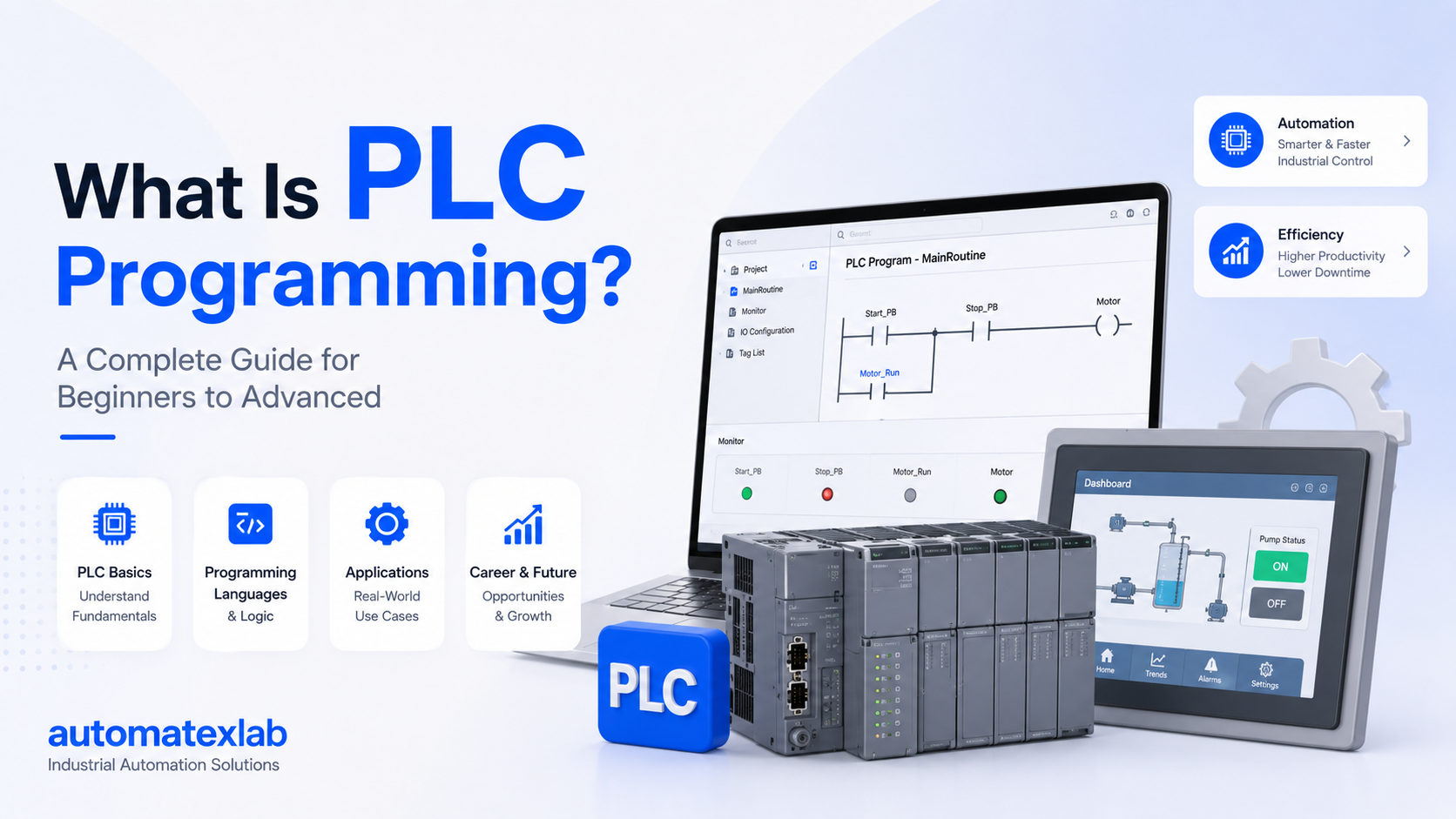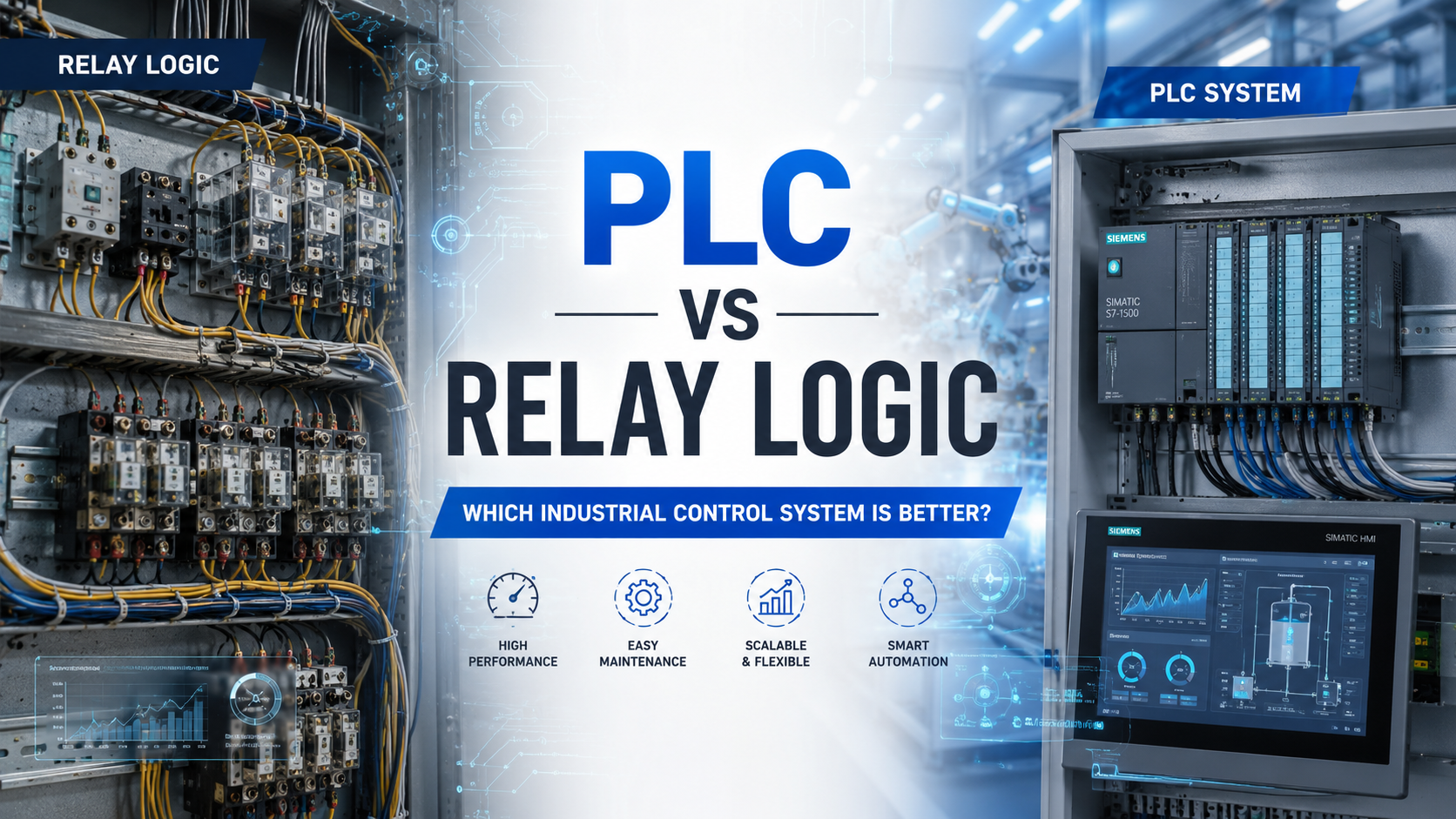
Industrial automation has changed the way factories and plants operate. At the center of this change is a longstanding debate: PLC or relay logic? Both systems control machines and processes, but they work in very different ways. Understanding the difference helps businesses make smarter decisions about their control systems.
This blog breaks down everything you need to know about PLC vs relay logic, including how each works, where each fits best, and which one makes more sense for your operation.
The Quick Answer
PLC (Programmable Logic Controller) is the modern standard for industrial automation. It is flexible, scalable, and built for complex systems. Relay logic is an older, hardware-based approach that still works well for simple, low-budget applications. Most modern industries are moving toward PLC, but relay logic has not disappeared entirely.
What Is a PLC?
A Programmable Logic Controller, or PLC, is a ruggedized digital computer designed specifically for industrial environments. It monitors inputs from sensors and switches, processes that data through a programmed logic, and then controls outputs like motors, valves, and alarms.
PLCs were introduced in the late 1960s to replace hardwired relay panels in automotive manufacturing. Since then, they have become the backbone of industrial automation across nearly every sector.
How a PLC Works
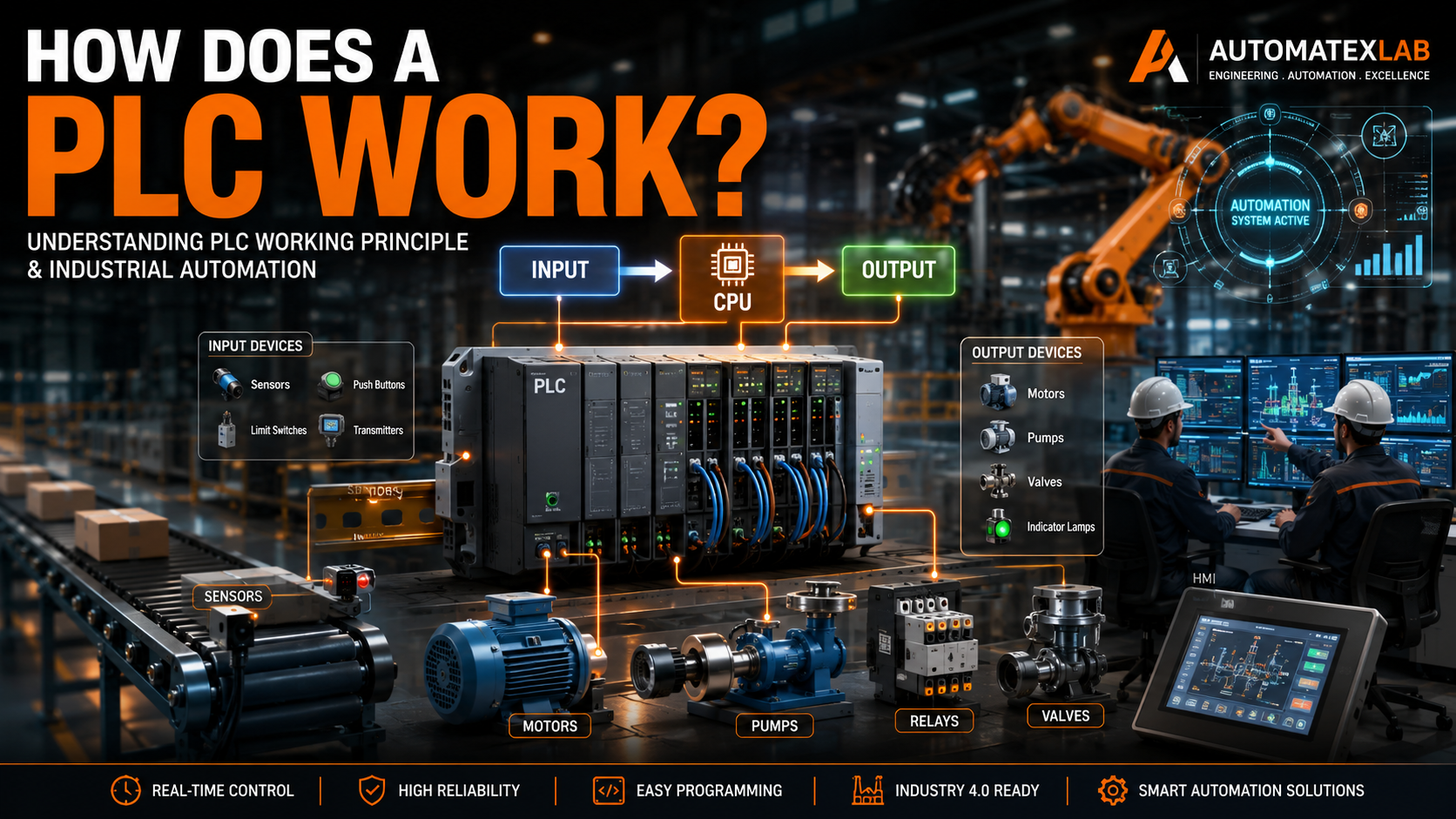
The operation of a PLC follows a simple cycle:
Inputs come in from sensors, switches, and other field devices. The CPU processes those inputs using the logic written in the program. Outputs are then sent to actuators, motors, lights, or any other connected device.
This cycle repeats continuously, often thousands of times per second. That speed and consistency is one of the key reasons PLCs have become so widely adopted.
Main Components of a PLC
CPU: This is the brain of the system. It runs the control program and manages all communication between input and output modules.
Input/Output Modules: These connect the PLC to the physical world. Input modules read signals from sensors and switches. Output modules send signals to motors, solenoids, and indicators.
Power Supply: Converts incoming AC power to the DC voltages needed by the PLC components.
Programming Software: PLCs are programmed using software on a computer. Common languages include Ladder Logic, Function Block Diagram, and Structured Text.
Common PLC Brands
Several manufacturers dominate the PLC market in the US and globally:
Siemens is one of the largest PLC manufacturers in the world, widely used in process industries and manufacturing.
Allen-Bradley by Rockwell Automation is the most popular brand in North America, known for its reliability and strong support network.
Mitsubishi Electric offers a broad range of PLCs from micro to large-scale systems, popular in Asia and globally.
Schneider Electric provides PLCs that integrate well with their broader automation and energy management ecosystems.
What Is Relay Logic?
Relay logic is a traditional control system that uses physical electromechanical relays wired together to perform logical operations. Each relay is a switch that opens or closes based on an electrical signal. By wiring multiple relays together in specific configurations, engineers create control circuits that automate machine behavior.
Before PLCs existed, relay logic was the only option for automated industrial control. Entire panels filled with relays, timers, and contactors were used to control complex machinery.
How Relay Logic Works
Each relay contains a coil and a set of contacts. When electrical current flows through the coil, it creates a magnetic field that physically moves the contacts, either opening or closing a circuit. By combining multiple relays, timers, and switches, engineers can create logic that controls machines automatically.
This is all hardware-based. There is no software, no program, and no CPU involved. The logic is literally built into the wiring.
Main Components of a Relay Logic System
Relays: The core switching devices. Each relay acts like a logic gate based on its wiring configuration.
Timers: Electromechanical or electronic devices that introduce time delays into the control circuit.
Contactors: Heavy-duty relays designed to handle high-current loads like motors.
Switches and Pushbuttons: Manual input devices used to start, stop, or modify machine operation.
Where Relay Logic Is Still Used
Relay logic has not completely disappeared. You will still find it in:
Small machines with simple start/stop functions. Basic motor starter circuits in older facilities. Simple electrical panels where the control logic never changes. Facilities that lack programming expertise or support.
PLC vs Relay Logic: Quick Comparison
| Feature | PLC | Relay Logic |
|---|---|---|
| Technology | Software-based | Hardware-wired |
| Flexibility | High | Low |
| Modification | Easy | Difficult |
| Wiring | Minimal | Extensive |
| Troubleshooting | Faster | Time-consuming |
| Space Required | Compact | Large panels |
| Speed | Fast | Slower |
| Maintenance | Low | Higher |
| Initial Cost | Higher | Lower |
| Long-Term Cost | Lower | Higher |
| Scalability | Excellent | Limited |
PLC vs Relay Logic: Detailed Comparison
Wiring Complexity
PLC systems require minimal field wiring. Inputs and outputs connect directly to I/O modules, and all the logic lives in the software. Control panels are cleaner, easier to document, and faster to build.
Relay logic systems involve extensive wiring. Every logical operation requires physical wire connections between components. In complex systems, this results in large panels packed with wires, which makes documentation difficult and troubleshooting a serious challenge.
For any system with more than a handful of functions, relay logic wiring becomes a serious management problem.
Flexibility and Modifications
With a PLC, changing the control logic means updating the software program. An engineer makes changes on a laptop, downloads the new program to the PLC, and the system runs the updated logic immediately. No rewiring required.
With relay logic, modifying the system means physically rewiring the panel. New relays may need to be added. Existing wires may need to be rerouted. The machine often has to be shut down during modifications, which leads to production downtime.
This difference alone is a major reason why modern facilities prefer PLCs. Markets change, products change, and control systems need to keep up.
Troubleshooting and Maintenance
PLCs offer built-in diagnostics. Most modern PLCs can display the status of every input and output in real time through the programming software or an HMI (Human Machine Interface). When something goes wrong, technicians can see exactly which part of the logic failed and where the problem is in the process.
Relay logic requires manual tracing. When a relay logic system fails, technicians must physically trace wires and test individual components with a multimeter. In a large panel with hundreds of relays and thousands of wire connections, finding a single failed contact can take hours.
Faster troubleshooting means less downtime. In industrial operations, downtime is extremely expensive.
Speed and Performance
PLCs process logic in milliseconds. The CPU scans all inputs, executes the program, and updates all outputs in a scan cycle that typically runs in under 10 milliseconds. This speed supports high-precision automation tasks.
Relay logic has mechanical delays. Every time a relay operates, the physical coil must energize and the contacts must move. This mechanical action introduces delays that can range from a few milliseconds to tens of milliseconds per relay. In systems with multiple relay stages, these delays stack up and limit performance.
For most simple applications, the speed difference does not matter. But in high-speed manufacturing or precision control applications, PLC processing speed is a clear advantage.
Space Requirements
PLCs are compact. A single PLC unit with dozens of I/O points can fit into a space smaller than a shoebox. Modern compact PLCs have made control panel design far more efficient.
Relay logic requires large cabinets. Each relay is a physical device that takes up space. A complex relay logic system may require multiple large electrical cabinets to house all the components. This takes up valuable floor space and adds to installation costs.
As factories become more automated and floor space becomes more valuable, the compact footprint of PLC systems is a significant advantage.
Reliability
PLCs are highly reliable. They have no moving parts in the CPU or logic processing components. Modern PLCs are built to handle extreme temperatures, vibration, electrical noise, and dust. Mean time between failures (MTBF) for industrial PLCs is often measured in decades.
Relay logic has mechanical wear. Every time a relay operates, its contacts experience electrical arcing and mechanical stress. Over time, contacts wear out, corrode, or stick. High-cycle applications can wear out relays in months. This creates ongoing maintenance requirements and unexpected failures.
Scalability
PLCs scale easily. Adding more I/O points means adding more I/O modules. Expanding the program to control more functions is done in software. Some PLCs can handle thousands of I/O points across distributed systems connected by industrial networks.
Relay logic is difficult to expand. Adding new functions means adding more relays, more wiring, and more panel space. In many cases, expanding a relay logic system requires a complete redesign of the panel. This is expensive and time-consuming.
Cost Comparison
Initial Cost: Relay logic components are cheaper upfront. A relay costs a few dollars. A PLC system with hardware and software licensing can cost several hundred to several thousand dollars depending on the application size.
Long-Term Cost: PLC systems consistently win on total cost of ownership. Reduced maintenance, faster troubleshooting, less downtime, and easier modifications add up to significant savings over the life of a machine. The higher upfront cost of a PLC typically pays back within one to three years in most industrial applications.
Advantages of PLC Over Relay Logic
Easier Automation: PLCs allow engineers to automate complex sequences, timing functions, and conditional logic that would require massive relay panels to replicate in hardware.
Better Monitoring: Real-time data from PLCs can be displayed on HMI screens, giving operators full visibility into machine status, production counts, and fault conditions.
Faster Production: Faster scan cycles and reliable execution mean PLCs can support higher production speeds than relay logic systems.
Remote Access Capability: Many modern PLCs support remote monitoring and programming via Ethernet or industrial networks. Engineers can view system status and make program changes without being physically present at the machine.
Data Collection and Analytics: PLCs can log operational data like cycle counts, fault history, and process variables. This data supports predictive maintenance, quality control, and production optimization.
Integration With SCADA and HMI Systems: PLCs connect seamlessly with SCADA (Supervisory Control and Data Acquisition) systems and HMI panels, enabling centralized monitoring and control of entire facilities.
Reduced Downtime: Faster diagnostics, fewer mechanical failures, and easier modifications all contribute to significantly less unplanned downtime.
Advantages of Relay Logic
Simple for Small Applications: For a basic motor starter or a simple two-step control circuit, relay logic is straightforward and gets the job done without any programming.
Easy to Understand for Basic Circuits: Electricians familiar with relay schematics can install and troubleshoot simple relay logic systems without specialized training.
Lower Initial Investment: When budget is extremely tight and the application is truly simple, relay logic costs less upfront.
Works Without Programming Knowledge: You do not need any software or programming expertise to install a relay logic system. This can be an advantage in facilities without automation engineers.
Disadvantages of PLC
Higher Initial Cost: The hardware and software for a PLC system costs more than equivalent relay logic components for simple applications.
Requires Programming Knowledge: Someone on your team needs to know how to write and modify PLC programs. This skill requires training and experience.
Software Dependency: If proprietary programming software becomes discontinued or a software license expires, accessing or modifying the program can become complicated.
Disadvantages of Relay Logic
Large Wiring Complexity: Complex systems become tangled messes of wires that are difficult to manage, document, and modify.
Difficult Troubleshooting: Finding faults in a large relay panel requires significant time and expertise, leading to extended downtime.
High Maintenance: Mechanical contacts wear out and must be regularly inspected and replaced. This creates ongoing maintenance costs and the risk of unexpected failures.
Poor Scalability: Expanding a relay logic system is costly and often requires a complete redesign.
Limited Automation Capability: Relay logic cannot easily implement complex sequences, math functions, data logging, or communication with other systems.
Industries That Use PLC Systems
Manufacturing Plants: PLCs control assembly lines, conveyors, robotic systems, and quality inspection equipment.
Automotive Industry: Virtually every automated function in automotive manufacturing, from stamping to welding to painting, is PLC-controlled.
Food Processing: PLCs manage mixing, filling, pasteurization, and packaging processes with precision timing and sanitation compliance.
Pharmaceutical Industry: PLC-based systems provide the documentation, traceability, and process control required by FDA regulations.
Oil and Gas: PLCs control pumping stations, compressors, valve systems, and safety shutdowns across pipelines and refineries.
Water Treatment Plants: PLCs automate chemical dosing, filtration, pump sequencing, and monitoring across water and wastewater facilities.
Industries That Still Use Relay Logic
Small Workshops: Basic machining or fabrication shops with simple equipment sometimes still run relay-based controls, especially on older machines.
Basic Electrical Systems: Simple lighting control circuits and HVAC systems in older buildings may use relay logic.
Older Industrial Machines: Legacy equipment purchased before PLCs became affordable may still use original relay logic panels.
Simple Motor Starter Circuits: Across/line starters for single motors with basic start/stop control remain common relay logic applications.
When Should You Choose PLC?
Choose PLC If:
Your process involves multiple steps, conditions, or sequences that change based on inputs. You want the ability to modify your control logic without rewiring. Your facility plans to expand production capacity in the future. You need real-time monitoring, data logging, or HMI displays. Minimizing downtime is a priority for your operation. You want to connect your control system to SCADA, MES, or other plant systems. Your industry has regulatory requirements for documentation and traceability.
When Should You Choose Relay Logic?
Choose Relay Logic If:
Your application is truly simple, such as a single motor with basic start/stop and overload protection. Your budget is extremely tight and the application will never need to change. You have no access to PLC programming support or training. The control logic is permanent and will never need modification. You are maintaining existing relay-based equipment where replacement is not yet justified.
PLC Replacing Relay Logic: Industry Trend
The shift away from relay logic and toward PLCs has been happening steadily since the 1970s. Today, that trend has accelerated significantly.
Why Industries Are Moving Toward PLCs
Smart factory adoption is driving automation investment across every sector. Factories that cannot monitor, adjust, and optimize their processes in real time are falling behind competitors that can.
Industry 4.0 connects machines, sensors, and software into integrated systems. PLCs are a core component of Industry 4.0 architecture. Relay logic cannot participate in this connected ecosystem.
Faster production requirements mean that mechanical delays and slow troubleshooting are no longer acceptable. Modern production targets demand the speed and reliability that PLCs deliver.
Better operational efficiency through data collection and predictive maintenance is only possible with PLC-based systems. Facilities using PLCs can identify problems before they cause failures, reducing maintenance costs and unplanned downtime.
Future of Relay Logic
Relay logic is not disappearing overnight, but its role is shrinking. It will remain relevant for the simplest applications and for maintaining legacy equipment. But for any new installation or major upgrade, relay logic is rarely the right choice.
Industry analysts and automation professionals widely agree that relay logic will continue to be phased out in favor of PLC and other programmable control technologies over the next decade.
Real-World Example: Conveyor Belt System
Consider a conveyor belt that moves products through multiple processing stations. Each station has sensors, timers, and interlock conditions.
Using Relay Logic for This Application
You would need dozens of relays, multiple timers, and hundreds of wire connections. Every sensor and interlock condition adds more hardware. If production requirements change and a new station needs to be added, the entire panel may need to be redesigned. Finding a fault means manually tracing every wire connection.
Using PLC for This Application
The PLC reads all sensor inputs through I/O modules. The control sequence, timing, and interlocks are written in software. Adding a new station means adding an I/O module and updating the program. Faults appear as diagnostic messages on the HMI screen. An engineer can identify and resolve most issues within minutes rather than hours.
The PLC solution is faster to commission, easier to modify, and far simpler to maintain.
PLC vs Relay Logic for Small Businesses
Small factories and job shops often assume PLCs are only for large operations. That assumption is outdated.
Is PLC Worth It for Small Factories?
Today, compact PLCs from brands like Allen-Bradley, Siemens, and Mitsubishi are available at price points that make sense for small operations. A basic PLC system for a small machine might cost $500 to $2,000 in hardware, compared to a relay panel that might cost $300 to $800.
The difference in upfront cost is relatively small. But the long-term difference in maintenance, troubleshooting time, and flexibility is significant. For most small factories, a PLC pays for itself quickly through reduced maintenance calls and avoided downtime.
Budget Considerations
When evaluating the cost of a control system, total cost of ownership matters more than purchase price. A relay logic panel that costs $800 upfront but requires two hours of electrician time every six months to replace worn contacts and trace wiring faults will cost far more over five years than a PLC that costs $1,500 upfront and rarely needs attention.
Future scalability is also a financial consideration. If your business grows and you need to expand your automation, a PLC-based system scales with you. A relay logic system may require a complete replacement.
Final Verdict: Which One Should You Choose?
The answer depends on your application, but the choice is clear for most situations.
Choose PLC if your system is anything more than extremely simple. Choose PLC if you want flexibility, scalability, and lower long-term costs. Choose PLC if you need monitoring, diagnostics, or integration with other plant systems. Choose PLC if your business plans to grow.
Choose relay logic only if your application is genuinely simple and fixed, your budget is very limited, and you have no access to PLC programming support. Even then, consider whether a small PLC investment now avoids a larger problem later.
Most industries now prefer PLC-based automation systems because the operational benefits compound over time. Faster troubleshooting, easier upgrades, better data, and lower maintenance costs all add up to a significant competitive advantage. Businesses that invest in PLC automation position themselves to grow faster, operate leaner, and respond more quickly to changing production demands.
Relay logic served the industry well for decades. But modern manufacturing requires modern tools, and PLCs are the clear standard for industrial control in today’s environment.
Need Professional PLC Programming Services?
If you are ready to upgrade your control system or need expert support for a new automation project, working with experienced automation professionals makes a significant difference in outcomes.
Professional PLC programming services cover everything from initial system design and panel build to software development, HMI integration, SCADA setup, and commissioning. Whether you are automating a new machine, upgrading a legacy relay system, or expanding an existing PLC installation, the right expertise saves time and avoids costly mistakes.
FAQs
For most applications, yes. PLC offers flexibility, diagnostics, scalability, and lower long-term costs that relay logic cannot match. Relay logic is only preferable for the simplest, most static applications with very tight budgets.
PLCs offer faster troubleshooting, easier modification, better monitoring, and lower long-term costs. As automation requirements have grown more complex and downtime has become more expensive, the advantages of PLCs have become impossible to ignore.
For complex or growing systems, yes. Relay logic is outdated for modern industrial automation. It remains relevant only for very simple, fixed applications and legacy equipment maintenance.
Relay logic is cheaper upfront. PLC is cheaper over time. For any application that will run for more than a few years or may need modifications, PLC delivers better value.
In terms of logic control, yes. PLCs can replicate any relay logic function in software. However, physical relays are still used as output devices in PLC panels to switch high-current loads. The relay logic control philosophy, meaning using hardwired relays as the primary logic element, is what PLCs replace.
Yes, but in a limited and shrinking capacity. It is found in older equipment, simple fixed-function circuits, and facilities that have not yet invested in modernization.