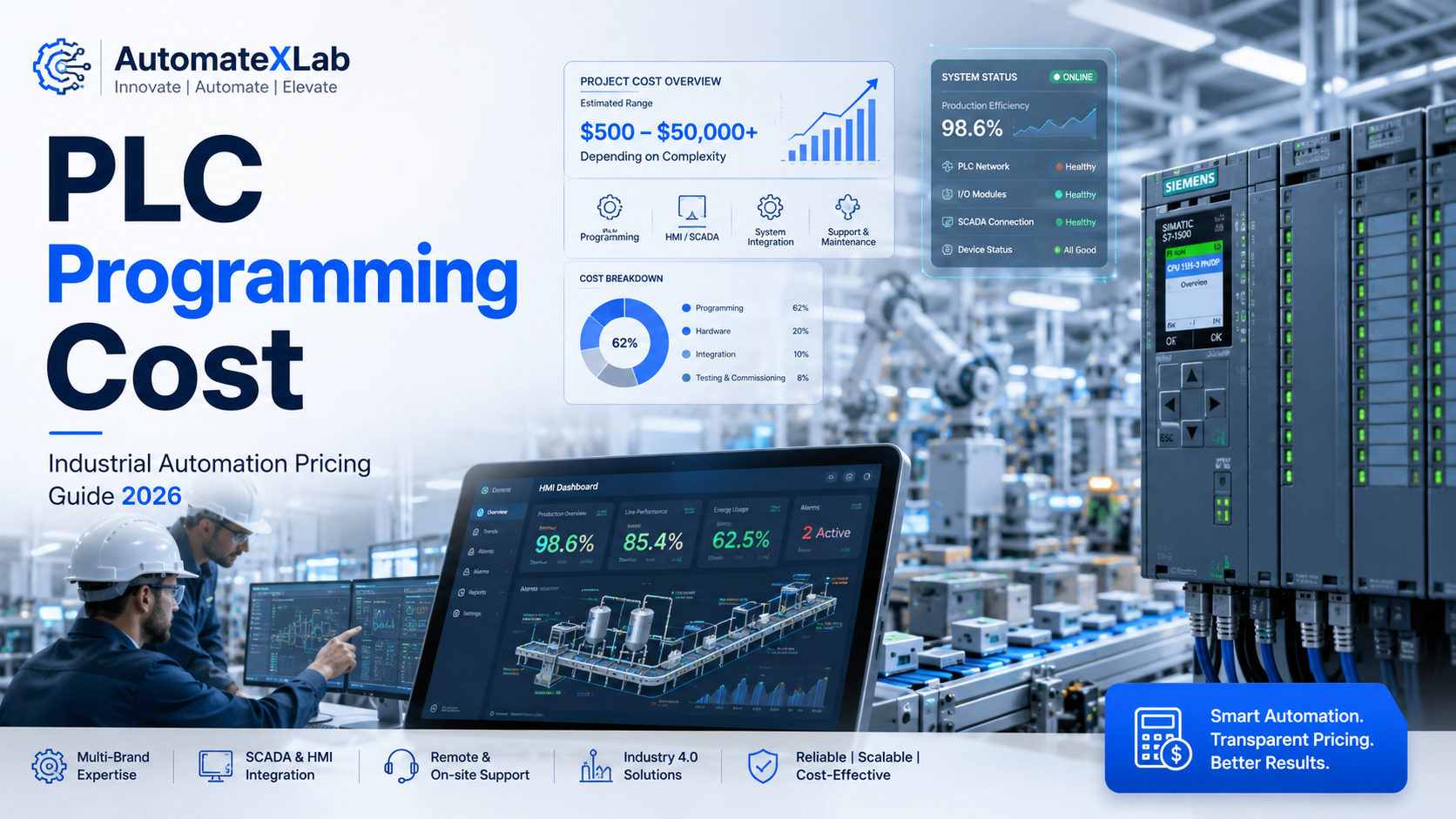
If you are looking for a quick answer, PLC programming costs range from $500 for simple programs to $100,000+ for large-scale industrial automation projects. The wide range exists because no two automation projects are the same.
This guide breaks down every cost factor so factory owners, plant managers, system integrators, and manufacturing companies can budget accurately before starting a project.
What Is PLC Programming?
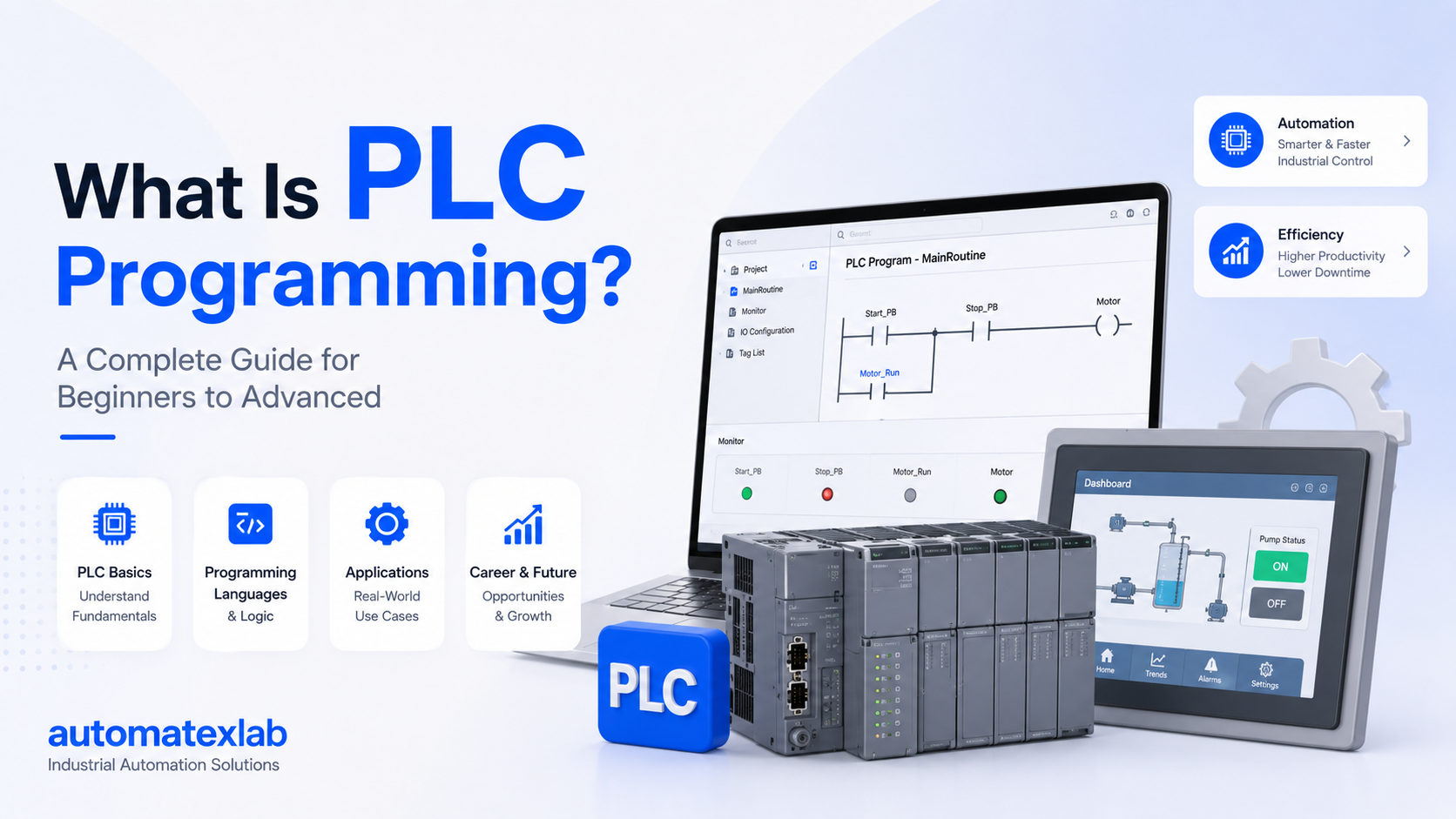
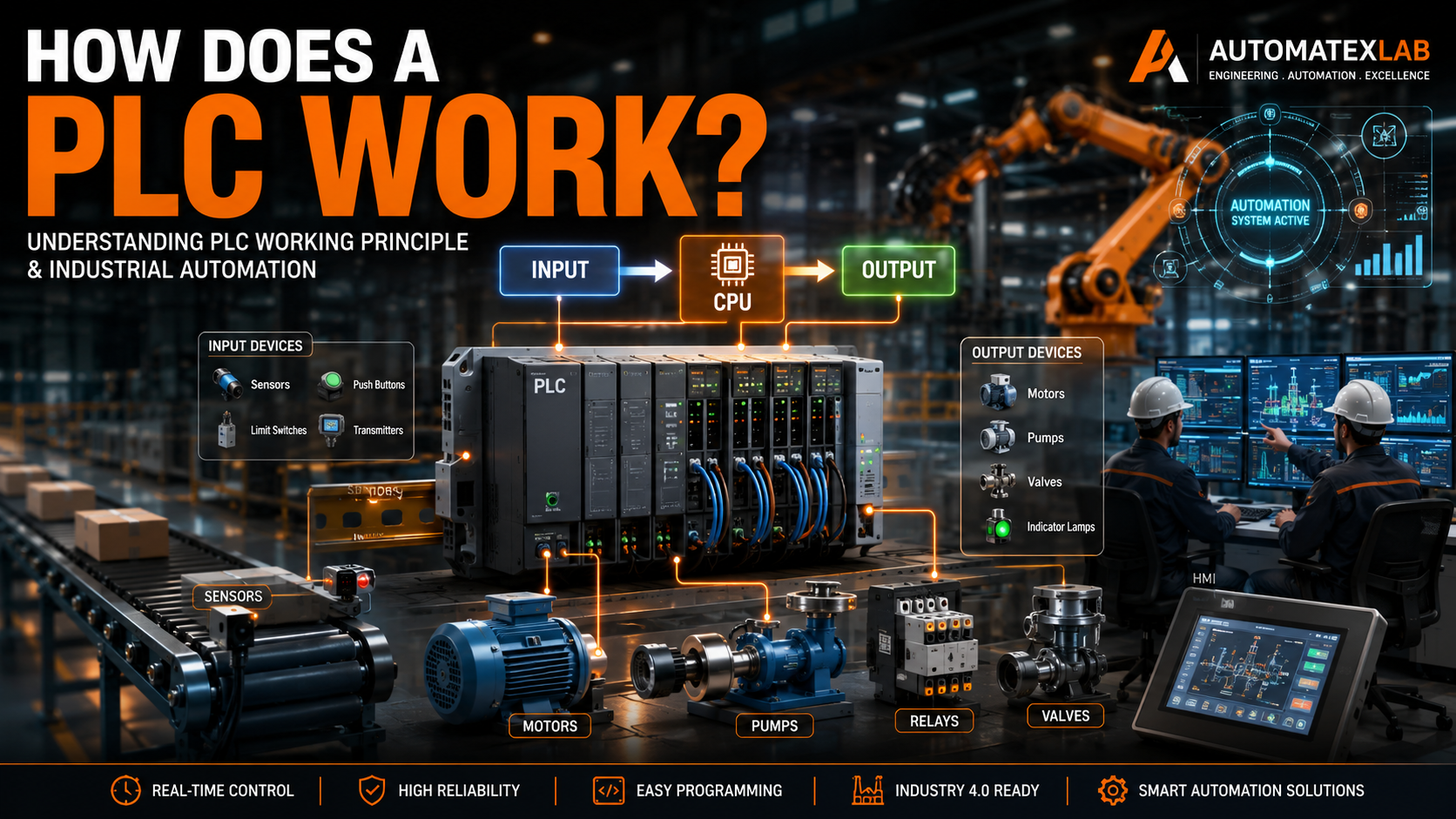
A Programmable Logic Controller (PLC) is an industrial computer that controls machines and automated processes. PLC programming is the process of writing the logic that tells those machines what to do, when to do it, and how to respond to inputs like sensors, switches, and operator commands.
PLCs are the backbone of modern industrial automation. They run assembly lines, control packaging machines, manage water treatment processes, and coordinate robotic systems.
Industries that rely on PLC programming:
- Manufacturing and assembly
- Automotive and robotics
- Food and beverage processing
- Pharmaceutical production
- Packaging and material handling
- Water and wastewater treatment
- Oil and gas facilities
Without properly programmed PLCs, these industries would face higher labor costs, slower production, and more downtime. Good PLC programming directly impacts how efficiently a plant runs.
Average PLC Programming Cost in 2026
Basic Cost Overview
Here is a straightforward breakdown of what you can expect to pay based on project size and complexity.
| Project Type | Estimated Cost |
|---|---|
| Small PLC Program | $500 – $2,000 |
| Medium Automation System | $2,000 – $10,000 |
| Large Industrial Project | $10,000 – $50,000+ |
| Custom SCADA + PLC Integration | $15,000 – $100,000+ |
These numbers reflect typical market rates in the United States in 2026. They cover programming labor but may not include hardware, software licenses, or on-site commissioning fees.
What causes prices to vary:
- Number of inputs and outputs (I/O points)
- PLC brand and software licensing costs
- Level of HMI or SCADA integration
- Safety programming requirements
- Whether work is done remotely or on-site
- Documentation and testing requirements
A simple conveyor start/stop program is nowhere near as complex as a multi-line pharmaceutical batch system with safety PLCs, SCADA integration, and regulatory documentation. Price follows complexity.
Factors That Affect PLC Programming Cost
PLC Brand Selection
The brand of PLC you choose significantly affects your total programming cost. Each brand has its own software ecosystem, licensing structure, and programmer availability.
Siemens uses the TIA Portal platform. It is widely used in Europe and increasingly common in North American manufacturing. Siemens programmers are available but licensing costs for TIA Portal can add $1,500 to $3,000+ to a project.
Allen-Bradley (Rockwell Automation) is the dominant brand in North American manufacturing. Studio 5000 software requires annual licensing that can cost $2,000 to $5,000 per seat. That said, Allen-Bradley programmers are widely available and the ecosystem is mature.
Mitsubishi Electric offers lower licensing costs and competitive hardware pricing. It is common in automotive and food processing. Programmer availability can be slightly lower than Siemens or Allen-Bradley in some US markets.
Schneider Electric is known for cost-effective hardware. Their EcoStruxure and Unity Pro platforms are solid for mid-size automation projects. Licensing is generally more affordable than Rockwell.
Omron is strong in precision manufacturing and robotics. Their Sysmac platform integrates well with motion control. Programmer availability is growing but still less common than Allen-Bradley or Siemens in the US.
Bottom line: Allen-Bradley and Siemens projects often cost more due to licensing. Mitsubishi and Schneider can offer savings on smaller projects.
Number of Inputs and Outputs
Every sensor, switch, actuator, motor, and valve connected to a PLC represents an I/O point. More I/O points mean more wiring, more programming, and more testing hours.
A simple machine might have 20 to 50 I/O points. A medium-sized automated production line might have 200 to 500. A large plant-wide system can exceed 2,000 I/O points.
How I/O affects cost:
- More I/O points require more programming time
- Testing and commissioning time scales with I/O count
- Documentation requirements grow with system complexity
A programmer might spend 40 hours on a 50-point system and 300+ hours on a 500-point system. At typical US rates of $75 to $150 per hour for PLC programming, that difference adds up fast.
Machine Complexity
Not all machines are equal in programming complexity, even when they have similar I/O counts.
Low complexity examples:
- Conveyor start/stop control
- Simple pump control systems
- Basic packaging machines with fixed cycles
Medium complexity examples:
- Multi-axis conveyor systems
- Filling and capping lines
- Automated welding cells
High complexity examples:
- Robotic integration with motion control
- Batch processing systems with recipe management
- Multi-line manufacturing plants with centralized control
- Vision system integration
Robotic systems and batch processors require significantly more logic, more failure handling, and more testing. These projects can easily land in the $20,000 to $75,000+ range just for programming.
HMI and SCADA Integration Costs
An HMI (Human Machine Interface) is the touchscreen or panel display that operators use to interact with machines. SCADA (Supervisory Control and Data Acquisition) is a higher-level system that monitors and controls entire plants or facilities.
Adding HMI and SCADA integration to your PLC project increases cost for several reasons.
HMI development typically adds:
- $1,500 to $8,000 for basic operator panel screens
- $5,000 to $25,000 for complex multi-machine HMI systems
SCADA integration adds:
- $10,000 to $50,000+ depending on scale
- Cloud monitoring setup
- Alarm management configuration
- Historical data logging
- Remote access and cybersecurity setup
Real-time analytics dashboards, remote monitoring capabilities, and multi-site SCADA systems sit at the higher end of that range. These are valuable investments but they represent a significant portion of total project cost.
Safety Programming Requirements
Safety-rated PLC programming is a separate category that costs more than standard automation programming. This is non-negotiable in industries where worker safety or regulatory compliance demands it.
Safety programming includes:
- Emergency stop circuit programming
- Safety-rated I/O configuration
- SIL (Safety Integrity Level) rated logic
- Safety function documentation and validation
- Integration with safety relays and light curtains
Safety PLCs from brands like Siemens (F-CPU), Allen-Bradley (GuardLogix), and Pilz cost more in hardware. The programming itself takes longer because every safety function must be independently validated and documented.
Projects requiring SIL 2 or SIL 3 certification can add $5,000 to $30,000+ to a programming project depending on scope. Pharmaceutical and chemical industries almost always carry these requirements.
On-Site vs Remote PLC Programming
| Type | Cost Impact |
|---|---|
| Remote PLC Programming | Lower cost, no travel expenses |
| On-Site Programming | Higher cost due to travel, lodging, and commissioning time |
Remote PLC programming has become far more common since 2020. Using secure VPN connections, programmers can write, test, and debug code without visiting the facility. This works well for software development phases.
On-site work is still necessary for:
- Initial hardware commissioning
- I/O checkout and wiring verification
- Factory Acceptance Testing (FAT)
- Site Acceptance Testing (SAT)
- Operator training sessions
On-site rates in the US typically run $100 to $200 per hour plus travel expenses. A week of on-site commissioning with travel can add $8,000 to $15,000 to a project budget.
PLC Programming Cost by Industry
Manufacturing Industry
General manufacturing covers a huge range of applications. Assembly lines, material handling, and machining centers are common use cases.
Typical costs run $3,000 to $40,000 depending on line complexity. Most mid-size US manufacturers spend $10,000 to $25,000 on a complete machine automation project including HMI development.
Food Processing Industry
Food processing automation adds cost because of hygiene requirements and compliance with FDA and USDA regulations. Washdown-rated hardware costs more. IP69K enclosures, stainless steel components, and sanitary designs all add up.
Programming must also handle HACCP (Hazard Analysis Critical Control Point) requirements in many cases. Expect to add 20 to 40 percent to standard programming costs for food-grade projects.
Automotive Industry
Automotive plants use heavy robotics integration. PLC programming in automotive often involves coordinating multiple robot arms, conveyor systems, vision inspection systems, and error-proofing (poka-yoke) logic.
Large automotive automation projects routinely cost $50,000 to $200,000+ when you factor in the full system including hardware, programming, integration, and commissioning.
Water Treatment Plants
Water treatment and wastewater systems are SCADA-heavy. The entire plant is typically monitored from a central control room with real-time data on flows, levels, chemical dosing, and pump operations.
PLC programming for water treatment typically runs $15,000 to $75,000 for a full facility depending on size. SCADA development often represents the largest portion of cost in these projects.
Pharmaceutical Industry
Pharmaceutical automation is among the most expensive because of validation requirements. Every software function must be documented according to GAMP 5 guidelines. Projects require User Requirement Specifications (URS), Functional Design Specifications (FDS), and Installation Qualification/Operational Qualification (IQ/OQ) documentation.
This documentation alone can add $10,000 to $40,000 to a project. Pharmaceutical PLC projects commonly range from $30,000 to $150,000+.
PLC Programming Cost by PLC Brand
Siemens PLC Programming Cost
Siemens S7-1200 systems work well for small to medium applications. Programming costs for a standard S7-1200 project run $2,000 to $15,000.
Siemens S7-1500 systems handle larger, more complex applications. These projects commonly run $10,000 to $60,000+ including TIA Portal development, HMI, and commissioning.
TIA Portal licensing adds $1,500 to $3,000 per programmer seat and this cost often passes through to the customer.
Allen-Bradley PLC Programming Cost
Allen-Bradley is the most common PLC brand in US manufacturing. CompactLogix systems are used for smaller applications. ControlLogix handles large, complex systems.
Studio 5000 Logix Designer licensing runs $2,000 to $5,000 annually per seat. This licensing cost is typically included in project pricing.
A complete Allen-Bradley project including programming, HMI, and commissioning commonly runs:
- CompactLogix small project: $3,000 to $20,000
- ControlLogix large project: $15,000 to $100,000+
Mitsubishi PLC Programming Cost
Mitsubishi GX Works software is more affordable to license than Siemens or Rockwell. Programmer rates may also be slightly lower in some markets.
Typical Mitsubishi projects run $2,000 to $30,000 depending on complexity. The brand is strong in automotive supplier plants and food processing.
Schneider Electric PLC Programming Cost
Schneider offers competitive hardware and software pricing. EcoStruxure Machine Expert is their primary development platform.
Projects typically run $2,500 to $35,000. Schneider is a solid choice for mid-size projects where keeping overall system cost down is a priority.
Omron PLC Programming Cost
Omron Sysmac Studio programming costs are comparable to Mitsubishi. Hardware pricing is competitive and the platform integrates well with Omron robotics.
Typical projects run $3,000 to $40,000. Omron is gaining traction in precision manufacturing and automated assembly.
Hidden Costs in PLC Programming Projects
Many customers focus only on programming labor costs and miss several other expenses that are standard parts of industrial automation projects.
Software licenses: TIA Portal, Studio 5000, and other platforms carry annual or per-seat fees. Budget $1,500 to $5,000 per platform.
Factory Acceptance Testing (FAT): Testing the system at the integrator’s facility before shipment. This catches problems early but takes time and adds cost. Budget $2,000 to $10,000.
Site Acceptance Testing (SAT): Final testing at your facility. This requires programmer time on-site and often involves your operations team. Budget $3,000 to $15,000.
Debugging and rework: Complex systems rarely work perfectly on the first pass. Budget 10 to 20 percent of programming cost for debugging and adjustments.
Operator training: Training your team to use the new system. Budget $1,000 to $5,000 for documentation and hands-on training sessions.
Technical documentation: Wiring diagrams, I/O lists, functional descriptions, and as-built drawings. Budget $1,500 to $8,000 depending on project size.
Downtime during installation: Lost production while the system is being installed and commissioned. This is often the biggest hidden cost. Plan installations during scheduled maintenance windows whenever possible.
Future maintenance: Ongoing support costs are real. Factor in annual maintenance contracts or budget for emergency call-out fees.
Cost of PLC Maintenance and Support
Annual Maintenance Contracts
Annual maintenance agreements typically cover scheduled system health checks, software backup verification, minor program adjustments, and priority response to issues.
US pricing for annual maintenance contracts generally runs $3,000 to $15,000 per year depending on system complexity and response time guarantees.
Emergency Troubleshooting Costs
When a machine goes down unexpectedly, emergency troubleshooting rates apply. These are higher than standard rates because of urgency and after-hours requirements.
Emergency PLC troubleshooting typically runs $150 to $300 per hour in the US. A full-day emergency call-out with travel can easily cost $2,000 to $5,000 or more.
PLC Upgrade Costs
Older PLCs eventually go obsolete. Migrating from legacy hardware to modern platforms involves re-engineering existing programs, updating I/O hardware, and re-commissioning the system.
PLC upgrade projects typically cost 40 to 70 percent of what a new project would cost. The savings come from reusing existing mechanical infrastructure and wiring where possible.
Remote Monitoring Support
Remote monitoring support packages give you access to a support team that watches your systems and responds to alarms. These services typically cost $500 to $3,000 per month depending on the number of systems covered and response time guarantees.
PLC Programming Freelancer vs Automation Company
| Factor | Freelancer | Automation Company |
|---|---|---|
| Initial Cost | Lower upfront cost | Higher but comprehensive |
| Long-Term Support | Limited availability | Dedicated support team |
| Scalability | Limited for large projects | Handles plant-wide systems |
| Project Risk | Higher risk of delays | Structured project delivery |
| Documentation | Often minimal | Professional standards |
| Compliance Knowledge | Varies widely | Industry-standard processes |
Freelancers work well for small, well-defined projects where you have internal engineering support. For complex projects, multi-machine systems, or anything requiring safety compliance and documentation, an established automation company is the safer choice.
How to Reduce PLC Programming Costs
These practical steps can meaningfully reduce your total project cost without cutting corners on quality.
Define your requirements clearly upfront. Scope changes mid-project are the biggest driver of cost overruns. Document what you need before work begins.
Avoid last-minute changes. Every change to a program after testing has started costs significantly more than the same change made during the design phase.
Standardize your machine architecture. If you run multiple similar machines, standardizing on one PLC platform and one code library saves money on every future project.
Use reusable code libraries. Good automation companies build function blocks and code templates that can be reused across projects. This reduces programming time significantly.
Choose a scalable PLC platform. Picking a PLC that can grow with your needs avoids expensive platform migrations later.
Plan for future expansion. Adding I/O capacity and network infrastructure now is far cheaper than retrofitting it later.
Consider remote commissioning. Where possible, doing development and testing remotely reduces travel costs and on-site time.
Is PLC Programming Worth the Cost?
Yes, for most industrial applications the return on investment is clear and measurable.
Where you see ROI from PLC automation:
- Reduced direct labor costs from manual operation
- Lower defect rates through consistent automated processes
- Reduced unplanned downtime with built-in diagnostics
- Faster cycle times and higher throughput
- Improved worker safety through automated hazardous tasks
- Better data for maintenance planning and quality control
Simple ROI example:
A food processing company spends $25,000 on a packaging line automation project. The automated system runs at twice the speed of the manual process with one fewer operator per shift. At $18 per hour for that operator position across three shifts, the annual labor savings total $140,000. The system pays for itself in about two months. The equipment runs for ten or more years.
This kind of ROI is common in manufacturing automation. The payback period depends on labor costs, production volume, and how much manual work is being replaced. Most well-planned PLC automation projects pay back within six to twenty-four months.
How to Choose the Right PLC Programming Company
Use this checklist when evaluating automation companies or system integrators.
Industry experience: Do they have documented experience in your specific industry? Food processing and pharmaceutical projects have very different requirements than automotive or water treatment.
Brand expertise: Can they support the PLC brand already in your facility, or are they pushing you toward a brand they prefer?
Commissioning support: Do they provide on-site commissioning or only remote support?
Remote troubleshooting capability: Can they connect remotely to diagnose and fix issues quickly after the project is delivered?
Documentation quality: Ask to see sample documentation from past projects. Poor documentation is a liability when something goes wrong later.
Long-term maintenance: Will they support the system after delivery? Get this in writing.
Safety compliance knowledge: If your application requires safety-rated programming, verify their experience with safety PLCs and SIL ratings specifically.
Why Businesses Choose AutomateXLab for PLC Programming
AutomateXLab provides custom industrial automation solutions for manufacturers across the US. Here is what sets us apart:
Multi-brand PLC expertise. Our team programs across all major platforms including Siemens, Allen-Bradley, Mitsubishi, Schneider, and Omron. You get the best platform for your application, not the one we happen to prefer.
SCADA and HMI integration. We handle the full stack from PLC programming through HMI development to SCADA configuration and cloud monitoring setup.
Remote and on-site support. We offer secure remote troubleshooting for fast response, and our engineers are available for on-site support when the job requires it.
Experienced programmers. Our team has hands-on experience across manufacturing, food processing, automotive, pharmaceutical, and water treatment applications.
Scalable systems. We build systems designed to grow. Adding machines, expanding capacity, or integrating new technology is straightforward when the foundation is done right.
Fast troubleshooting. When something stops your production, response speed matters. We provide priority support to minimize downtime.
Ready to Automate Your Industrial Operations?
Whether you need a small machine automation setup or a complete factory-wide PLC system, AutomateXLab helps businesses build reliable, scalable, and cost-effective industrial automation solutions.
Our team is ready to assess your project, answer your technical questions, and provide a detailed cost estimate with no obligation.
Contact us: contact@automatexlab.com
We respond fast and offer free consultation calls to help you understand your options before you commit to anything.
FAQs
PLC programming costs range from $500 for simple programs to $100,000+ for large-scale industrial systems with SCADA integration. Most mid-size manufacturing projects fall in the $5,000 to $30,000 range.
The main factors are project complexity, number of I/O points, PLC brand and licensing costs, HMI and SCADA requirements, safety programming needs, and whether the work is done remotely or on-site.
Siemens projects tend to cost more than Mitsubishi or Schneider projects primarily due to TIA Portal licensing costs, which can add $1,500 to $3,000 per programmer seat. The programming quality and capabilities are excellent, which makes it worth the cost for many applications.
A simple program might take 20 to 40 hours. A medium automation system typically takes 80 to 200 hours. Large industrial projects with SCADA integration can take 500 to 2,000+ hours across multiple engineers.
Yes. The development and testing phases can typically be done remotely using simulation software and secure VPN connections. On-site presence is still needed for initial commissioning, I/O checkout, and final acceptance testing.
PLC commissioning typically includes I/O verification, program loading and initial startup, system testing against functional specifications, troubleshooting and adjustments, operator training, and final documentation. On-site commissioning in the US typically runs $1,500 to $5,000 per day including engineer time and travel.