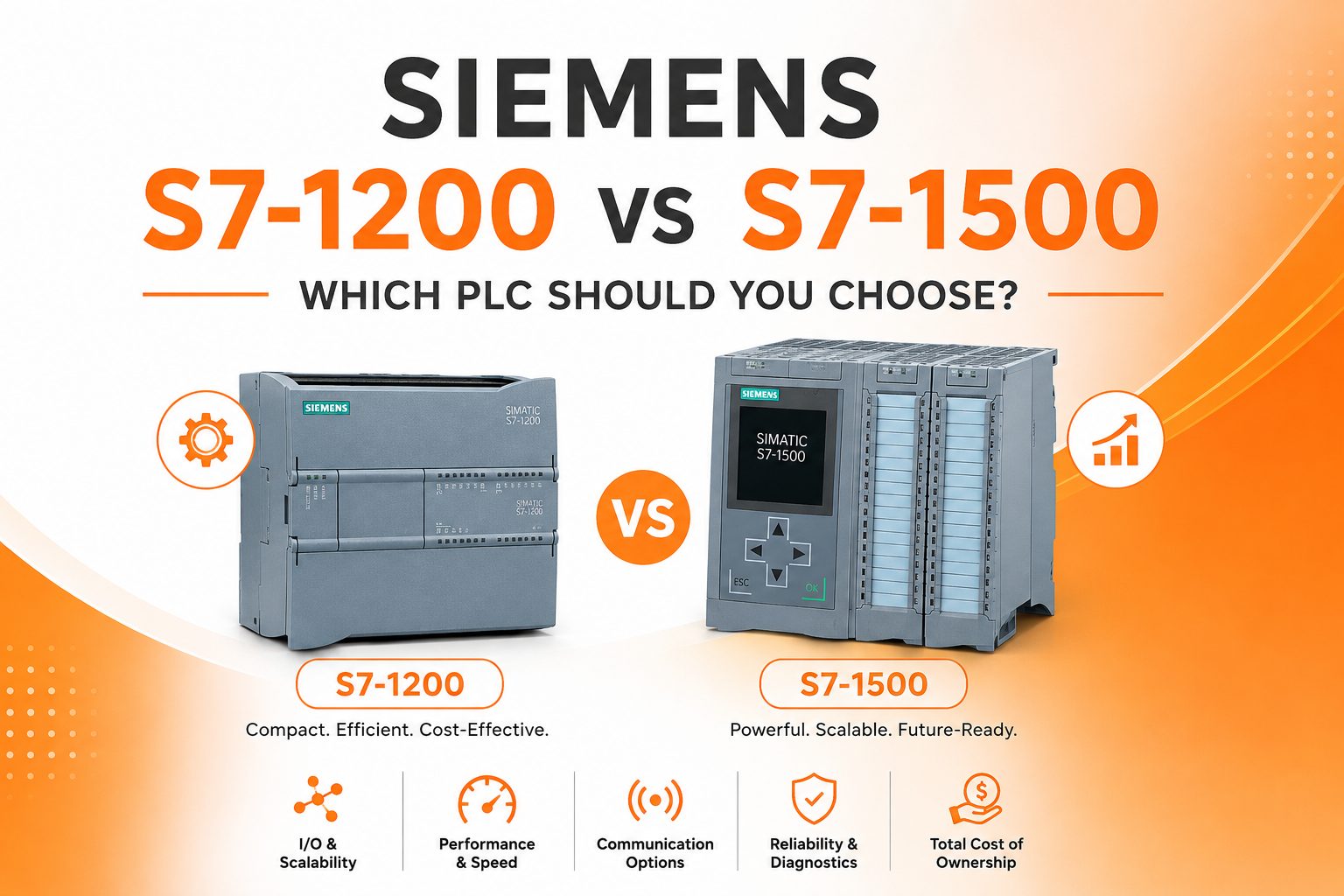
Choosing between the Siemens S7-1200 and S7-1500 is not simply a matter of picking the more powerful PLC. Both are designed for industrial automation, but they target different application sizes, performance requirements, and system architectures.
Choose the S7-1200 for compact and cost-conscious machine automation. Choose the S7-1500 when you need higher performance, greater scalability, advanced diagnostics, or more demanding automation capabilities.
Siemens currently positions the S7-1200 family toward compact, cost-efficient automation, while the S7-1500 is aimed at advanced machine and plant applications with higher performance requirements.
The right choice should depend on your I/O requirements, processing needs, motion control, communication architecture, future expansion, safety requirements, and total project cost.
Siemens S7-1200 vs S7-1500: Quick Comparison
The S7-1200 is generally the better choice for smaller machines, while the S7-1500 is better suited to complex and scalable automation systems.
| Feature | Siemens S7-1200 | Siemens S7-1500 |
|---|---|---|
| Application | Compact automation | Advanced automation |
| Typical system size | Small to medium | Medium to large |
| Processing performance | Good | Higher |
| Expansion | Moderate | High |
| I/O requirements | Small to medium | Medium to large |
| Motion control | Available | Advanced capabilities |
| Diagnostics | Integrated | More advanced |
| Communication | PROFINET and expansion options | Extensive networking options |
| Programming | TIA Portal | TIA Portal |
| Cost | Generally lower | Generally higher |
| Best suited for | Machines and compact systems | Complex machines and plants |
The actual capabilities vary by CPU model, firmware, modules, and application architecture, so the exact CPU should always be selected against the project’s technical requirements.
What Is the Siemens S7-1200 PLC?
The Siemens S7-1200 is a compact PLC family designed primarily for machine automation and smaller control systems.
Siemens describes the S7-1200 as a compact controller for basic automation and cost-efficient applications. Its integrated capabilities and modular expansion make it suitable for a wide range of machine-control tasks.
The S7-1200 can control digital and analog signals, communicate with industrial devices, operate HMIs, and perform technology and motion-related functions depending on the selected CPU and configuration.
Key S7-1200 Features
Important capabilities include:
- Compact CPU architecture
- PROFINET connectivity
- Digital and analog I/O options
- Signal and communication modules
- HMI integration
- Technology functions
- Motion-control capabilities on supported configurations
- TIA Portal engineering
- Diagnostic functions
Its compact architecture can make it attractive when cabinet space and hardware cost are important considerations.
Common S7-1200 Applications
Typical applications can include:
- Packaging machines
- Conveyor systems
- Pump control
- Small assembly machines
- Material-handling equipment
- HVAC control
- Water-treatment skids
- Small production machines
- Machine monitoring systems
For example, a machine with several sensors, valves, motors, a small HMI, and a limited number of controlled axes may not need the additional capacity of an S7-1500.
What Is the Siemens S7-1500 PLC?
The Siemens S7-1500 is a higher-performance PLC platform designed for advanced machine and plant automation.
Siemens positions the S7-1500 for advanced automation tasks, including applications with higher performance requirements and more complex machine or plant designs.
Compared with a compact PLC architecture, the S7-1500 family provides a broader platform for applications that require greater processing capability, scalability, diagnostics, communication, or motion functionality.
Key S7-1500 Features
Depending on the CPU and system configuration, S7-1500 projects can include:
- High-performance CPU options
- Distributed I/O architectures
- PROFINET communication
- Advanced diagnostics
- Technology functions
- Motion-control capabilities
- Safety controller options
- Extensive communication options
- TIA Portal engineering
Siemens also offers specialized S7-1500 variants, including technology CPUs and redundant/high-availability configurations for more demanding applications.
Common S7-1500 Applications
The S7-1500 can be appropriate for:
- Large production lines
- Automotive manufacturing
- Complex packaging systems
- Robotics cells
- High-speed machinery
- Large material-handling systems
- Complex machine cells
- Process-related automation
- Multi-axis motion applications
The important point is that S7-1500 does not automatically mean “better.” It means the platform is generally more appropriate when the application demands more capability.
S7-1200 vs S7-1500: Performance
S7-1500 is generally the better choice when an application requires higher processing performance and more complex control logic.
PLC performance matters when the controller has to process large programs, communicate with many devices, execute calculations, manage high-speed signals, or coordinate complex automation functions.
An S7-1200 can handle many machine-control applications effectively. Moving to S7-1500 makes more sense when the application is approaching the practical limits of the selected S7-1200 CPU.
Consider:
- Program size
- Processing requirements
- Number of devices
- Communication load
- High-speed inputs
- Motion requirements
- Data processing
- Required response time
- Future expansion
Do not select an S7-1500 simply because its specifications look more impressive.
The goal is to select a controller that provides enough performance without creating unnecessary hardware and engineering costs.
S7-1200 vs S7-1500: I/O Capacity and Expansion
S7-1200 is well suited to compact I/O architectures, while S7-1500 is generally better for larger and more scalable systems.
I/O planning should happen before selecting the PLC.
Calculate the expected requirements for:
- Digital inputs
- Digital outputs
- Analog inputs
- Analog outputs
- High-speed signals
- Remote I/O
- Communication modules
- Future machine expansion
A small machine might have a relatively limited number of sensors, actuators, drives, and valves.
A large production line could have hundreds or thousands of signals distributed across multiple stations.
In the second case, the scalability of the S7-1500 architecture can become much more valuable.
Plan for Future Expansion
Do not calculate I/O based only on what the machine needs today.
If a machine may receive another conveyor, additional sensors, more drives, or a new production station later, account for that during the initial design.
A PLC that is slightly more expensive today may prevent a much larger redesign later.
S7-1200 vs S7-1500: Communication
Both PLC families support industrial communication, but the S7-1500 is better suited to complex automation networks with larger communication requirements.
Modern PLCs rarely operate alone.
A typical automation system can involve:
- HMI panels
- Variable-frequency drives
- Servo drives
- Remote I/O
- SCADA
- Robots
- Barcode scanners
- Vision systems
- Other PLCs
- Industrial Ethernet devices
Communication requirements should therefore be evaluated before selecting the PLC.
PROFINET is an important part of Siemens automation architectures, while specific communication options depend on the controller, communication modules, devices, and required protocol.
The key question is not simply:
“Does this PLC support Ethernet?”
Instead ask:
“Can this PLC support every device and communication requirement in my automation architecture?”
S7-1200 vs S7-1500: Motion Control
S7-1200 can handle many machine-motion applications, while S7-1500 is generally a stronger choice for complex, high-performance, and multi-axis motion applications.
Motion requirements can dramatically affect PLC selection.
Consider whether your machine needs:
- Positioning
- Speed control
- Servo control
- Multiple coordinated axes
- Synchronization
- High-speed positioning
- Technology objects
- Complex motion sequences
For a relatively simple machine with limited motion requirements, an S7-1200 may be sufficient.
For a highly dynamic machine with multiple synchronized axes, complex kinematics, or demanding motion performance, an S7-1500 technology-oriented solution may be more appropriate. Siemens specifically positions S7-1500 technology controllers for demanding motion applications.
S7-1200 vs S7-1500: Programming and TIA Portal
Both platforms are engineered within Siemens’ TIA Portal ecosystem, making the engineering environment a major common point between them.
Siemens STEP 7 within TIA Portal is used to configure, program, and manage Siemens automation systems, including PLCs, distributed I/O, motion control, and safety functions.
This means engineers familiar with Siemens automation can work across both controller families within the same general engineering environment.
What Can You Do in TIA Portal?
Depending on the project, engineers can use TIA Portal for:
- PLC programming
- Hardware configuration
- Network configuration
- HMI development
- Diagnostics
- Online monitoring
- Motion configuration
- Safety engineering
- Device management
- Program testing and commissioning
The specific features available depend on the TIA Portal version, licenses, controller, and project configuration.
This common engineering environment is one reason Siemens PLC systems can be easier to standardize across different machines and automation projects.
S7-1200 vs S7-1500: Diagnostics and Troubleshooting
S7-1500 is generally more attractive when advanced diagnostics and troubleshooting are important parts of the automation strategy.
Unplanned downtime can be more expensive than the PLC hardware itself.
When a machine stops, maintenance teams need to determine whether the problem is related to:
- Sensors
- Actuators
- PLC logic
- Network communication
- I/O modules
- Drives
- Power
- HMI commands
- Safety circuits
Siemens’ TIA Portal environment provides integrated diagnostic capabilities intended to help identify automation problems and simplify troubleshooting.
For complex production systems, better diagnostic visibility can help maintenance teams identify faults faster.
That can translate into lower downtime and faster machine recovery.
S7-1200 vs S7-1500: Safety PLC Options
Choose a fail-safe PLC architecture when the machine’s safety functions require programmable safety control.
Safety should not be treated as an optional PLC feature.
Depending on the machine and applicable safety standards, the system may need to manage functions such as:
- Emergency stops
- Safety doors
- Light curtains
- Safe motion
- Safety inputs
- Safety outputs
- Guard monitoring
Siemens provides safety-capable versions and solutions within its SIMATIC portfolio. The exact safety architecture should be selected based on the machine risk assessment and applicable standards.
A standard PLC should not be treated as a replacement for a properly engineered functional-safety system.
S7-1200 vs S7-1500: Cost
S7-1200 is generally the more economical choice for smaller automation systems, while S7-1500 can deliver better value when its additional performance and scalability are actually required.
The mistake is to compare only the CPU purchase price.
A realistic automation budget should consider:
- PLC CPU
- I/O modules
- Communication modules
- HMI
- Drives
- Engineering
- Programming
- Commissioning
- Testing
- Maintenance
- Spare parts
- Future upgrades
For example, choosing an inexpensive PLC that later requires an architecture redesign can cost substantially more than selecting the appropriate controller from the beginning.
Think About Total Cost of Ownership
A better question is:
“Which PLC gives me the lowest total project and lifecycle cost for this application?”
Not:
“Which PLC has the lowest CPU price?”
That distinction matters when designing industrial automation systems.
S7-1200 vs S7-1500: Ease of Maintenance
The best PLC for maintenance is the one your maintenance team can diagnose, support, document, and replace efficiently.
Consider:
- Technician experience
- Existing Siemens PLC knowledge
- Spare-parts availability
- Program documentation
- Remote diagnostics
- Backup procedures
- Hardware replacement
- Troubleshooting time
If a facility already has engineers and technicians experienced with Siemens PLCs, maintaining either platform can be straightforward.
The bigger issue is whether the automation project has proper documentation.
A powerful PLC does not compensate for poorly documented logic.
When Should You Choose S7-1200?
Choose an S7-1200 when you need a compact, capable PLC for a relatively small or moderately complex machine.
S7-1200 is a strong candidate when:
- The machine has a limited I/O count.
- Control logic is relatively straightforward.
- Processing requirements are moderate.
- Basic or moderate motion is sufficient.
- The automation budget is constrained.
- Cabinet space matters.
- The system does not require extensive expansion.
Example: Small Packaging Machine
Imagine a packaging machine with:
- Sensors
- Pneumatic valves
- Several motors
- A few drives
- One HMI
- Limited analog signals
- Basic positioning
An S7-1200 may provide an appropriate balance between capability, physical size, and project cost.
There may be no reason to use a larger controller if the machine does not need its additional capabilities.
When Should You Choose S7-1500?
Choose an S7-1500 when your automation system requires higher performance, more scalability, advanced motion, or greater system complexity.
Consider S7-1500 when:
- The machine has substantial I/O.
- Processing requirements are high.
- Many automation devices must communicate.
- Advanced motion control is required.
- The system will expand significantly.
- Advanced diagnostics are important.
- The machine is part of a larger production architecture.
Example: Large Production Line
Consider an automated production line containing:
- Multiple machine stations
- Distributed I/O
- Several servo drives
- Robots
- Multiple HMIs
- SCADA
- High-speed sensors
- Complex interlocks
- Extensive communication
An S7-1500 can be a better architectural fit because the system has more demanding control and integration requirements.
S7-1200 vs S7-1500: Decision Matrix
Use the S7-1200 for compact automation and the S7-1500 for larger, more demanding systems.
| Requirement | Recommended PLC |
|---|---|
| Small machine | S7-1200 |
| Compact control cabinet | S7-1200 |
| Cost-sensitive automation | S7-1200 |
| Basic machine control | S7-1200 |
| Moderate motion | S7-1200, depending on requirements |
| Large production line | S7-1500 |
| Complex automation | S7-1500 |
| High processing requirements | S7-1500 |
| Advanced motion | S7-1500 |
| Large I/O architecture | S7-1500 |
| High scalability | S7-1500 |
| Complex automation network | S7-1500 |
This is a starting point, not a substitute for detailed PLC sizing.
Siemens itself provides a controller selection tool to help match controller families to application requirements.
Can You Upgrade From S7-1200 to S7-1500?
Yes, migration from S7-1200 to S7-1500 is possible, but it requires engineering work and should not be treated as a simple CPU replacement.
A migration project may involve:
- Hardware configuration
- I/O mapping
- PLC program changes
- Communication configuration
- HMI integration
- Motion configuration
- Technology objects
- Address changes
- Testing
- Commissioning
Before starting a migration, document the existing machine architecture.
Identify every device communicating with the PLC and every function controlled by the existing program.
Then determine which S7-1500 CPU, I/O architecture, communication modules, and software configuration can reproduce or improve the existing functionality.
Proper testing is essential before putting the upgraded system back into production.
Common Mistakes When Choosing Between S7-1200 and S7-1500
Choosing Based Only on PLC Price
The lowest CPU price does not necessarily mean the lowest project cost.
Consider engineering, modules, commissioning, maintenance, and future expansion.
Choosing S7-1500 for Every Application
More powerful hardware is not automatically better.
If a small machine can be effectively controlled by an S7-1200, selecting a significantly larger platform may add unnecessary cost and complexity.
Ignoring Future Expansion
A machine that is expected to double in size or receive additional stations should be designed with expansion in mind.
Underestimating Motion Requirements
Motion requirements should be identified before selecting the PLC.
The number of axes, synchronization requirements, positioning accuracy, and required cycle performance can influence controller selection.
Ignoring Communication Requirements
Make a complete device list before choosing the controller.
Include:
- Drives
- HMI
- SCADA
- Robots
- Remote I/O
- Vision systems
- Sensors
- Other controllers
Then verify that the selected architecture can support the required communication.
Selecting the PLC Without Considering Maintenance
Your maintenance team will eventually need to troubleshoot the system.
Consider their existing skills, spare-parts strategy, diagnostics, documentation, and remote-support requirements.
S7-1200 vs S7-1500: Which PLC Should You Choose?
Choose the Siemens S7-1200 for compact, cost-conscious machine automation. Choose the S7-1500 for higher-performance, complex, scalable, and demanding industrial automation systems.
A simple decision framework is:
Choose S7-1200 if:
- Your machine is relatively compact.
- I/O requirements are moderate.
- Processing requirements are manageable.
- Motion requirements are limited or moderate.
- Budget and cabinet space are important.
Choose S7-1500 if:
- The application has substantial I/O.
- Processing requirements are high.
- Advanced motion is required.
- The automation network is complex.
- The system needs significant scalability.
- Advanced diagnostics or specialized S7-1500 capabilities are important.
The best PLC is therefore not the most powerful PLC you can afford.
It is the controller that provides the required performance and functionality while leaving appropriate room for expansion without creating unnecessary cost.
How AutomatexLab Can Help With Siemens PLC Projects
AutomatexLab can support businesses with Siemens PLC programming, troubleshooting, upgrades, HMI, SCADA, and industrial automation projects.
Choosing the right PLC is only the first step.
A successful automation project also requires proper programming, hardware configuration, communication setup, testing, commissioning, and troubleshooting.
AutomatexLab can support projects involving:
- Siemens PLC programming
- S7-1200 programming
- S7-1500 programming
- HMI programming
- SCADA integration
- PLC troubleshooting
- PLC modifications
- PLC upgrades
- Machine automation
- PLC migration
- Remote PLC support
- Industrial automation engineering
Need help deciding between S7-1200 and S7-1500 for your machine or production system? Contact AutomatexLab to discuss your PLC requirements and automation architecture.
Final Takeaway
The Siemens S7-1200 vs S7-1500 decision comes down to application complexity, performance, scalability, and cost.
The S7-1200 is a practical choice for many compact and medium-sized machine automation projects. The S7-1500 becomes more attractive as the system grows in processing requirements, I/O, communication, motion complexity, and scalability.
Siemens continues to position the S7-1200 for compact/basic automation and the S7-1500 for advanced automation applications, while newer controller variants expand the capabilities available within both platform families.
Before purchasing hardware, define the complete automation architecture.
The right PLC is the one that meets today’s requirements, supports tomorrow’s expansion, and can be maintained efficiently throughout the machine’s lifecycle.
Frequently Asked Questions
Is S7-1500 better than S7-1200?
S7-1500 is more suitable for many advanced and demanding applications, but it is not universally better. S7-1200 can be the better choice for compact machines and cost-sensitive automation projects.
Which is cheaper, S7-1200 or S7-1500?
S7-1200 is generally positioned as the more cost-efficient option. However, the final project cost depends on the CPU, I/O, communication modules, engineering, commissioning, and other system components.
Can S7-1200 handle motion control?
Yes. Supported S7-1200 configurations provide motion-control capabilities. The exact capability depends on the CPU, technology functions, drives, and motion requirements.
Can S7-1200 and S7-1500 use the same TIA Portal?
Both are engineered through Siemens’ TIA Portal ecosystem, but exact compatibility depends on the TIA Portal version and the specific hardware and firmware. Siemens continues to update its TIA Portal platform and controller support.
Which PLC is better for a production line?
S7-1500 is often the stronger choice for complex production lines with extensive I/O, communication, motion, and processing requirements. Smaller production lines may be adequately served by S7-1200.
Can S7-1200 be upgraded to S7-1500?
Yes, but migration requires engineering and testing. Hardware, software, I/O mapping, communications, HMI, motion functions, and commissioning all need to be evaluated.
Which PLC is better for SCADA?
Both can be integrated with SCADA systems. The appropriate choice depends on the number of devices, data volume, communication architecture, processing requirements, and overall system complexity.
Which Siemens PLC should I choose for a new machine?
Start with the machine requirements, not the PLC model. Define I/O, processing, communication, motion, safety, expansion, and maintenance requirements first. Then select the appropriate S7-1200 or S7-1500 CPU.