Choosing the right programmable logic controller (PLC) platform is one of the most critical decisions in industrial automation. The PLC serves as the brain of your manufacturing operation, controlling everything from simple conveyor belts to complex robotic work cells. Select the wrong platform, and you could face higher costs, longer downtime, and integration headaches that persist for years.
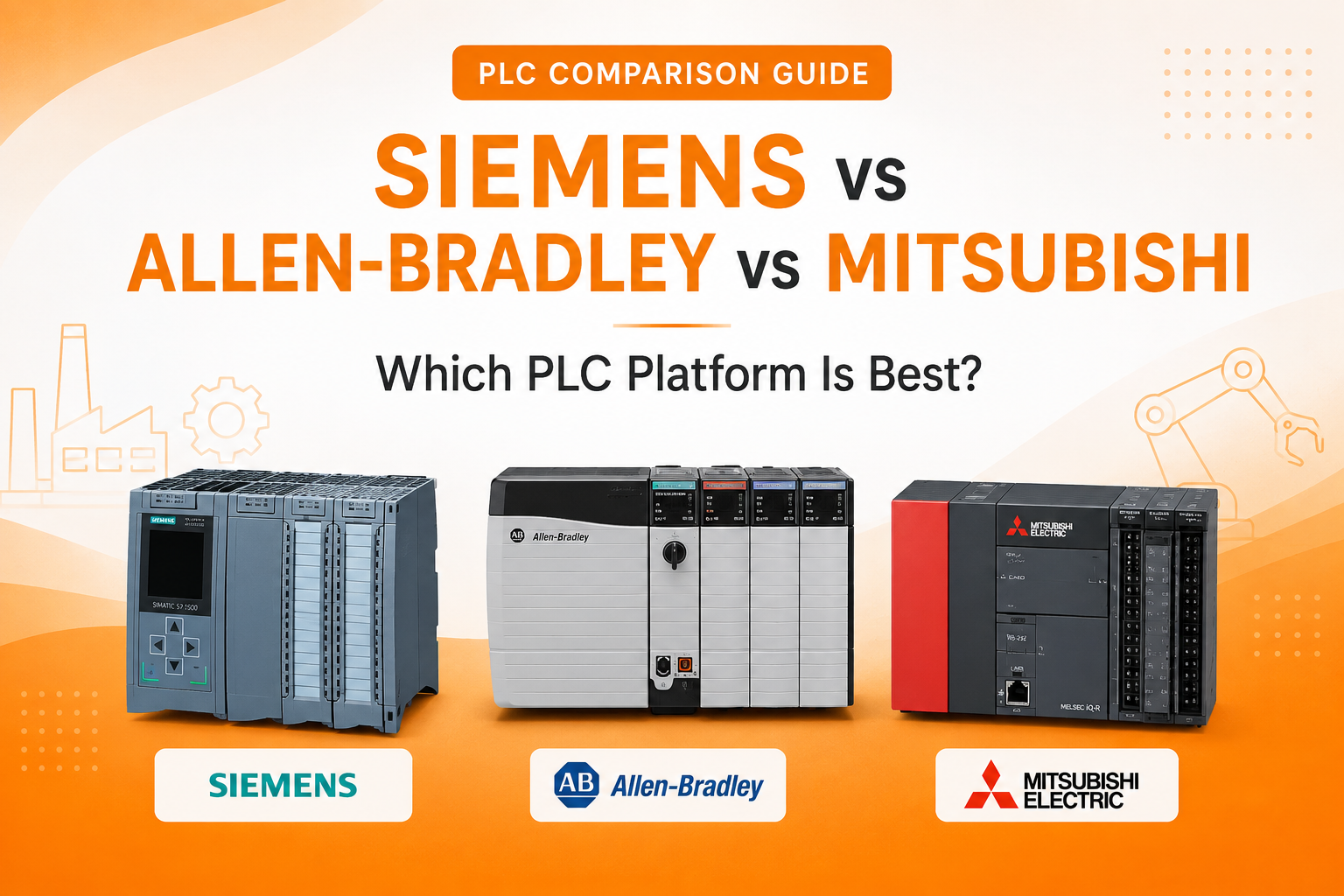
The three dominant players in the global PLC market are Siemens, Allen-Bradley (Rockwell Automation), and Mitsubishi Electric. Each platform has earned its reputation through decades of innovation and has become deeply embedded in specific industries and geographic regions.
Let’s be clear from the start: there is no universally best PLC. The right choice depends entirely on your industry, location, machine complexity, budget, engineering ecosystem, and existing plant infrastructure. This guide will help you cut through the marketing noise and make a practical, informed decision for your specific automation needs.
Throughout this comparison, we’ll examine programming software, hardware capabilities, networking, costs, and real-world applications. By the end, you’ll have a clear decision framework to choose the platform that best serves your operation.
Siemens vs Allen-Bradley vs Mitsubishi: Quick Comparison
Before diving into the details, here is a high-level comparison of the three major PLC platforms:
| Feature | Siemens | Allen-Bradley | Mitsubishi |
|---|---|---|---|
| Market Presence | Strong globally, dominant in Europe | Dominant in North America | Strong in Asia, growing globally |
| Typical Industries | Automotive, process, packaging, manufacturing | Automotive, food & beverage, material handling | Machine tools, packaging, robotics, OEM |
| Programming Software | TIA Portal | Studio 5000 | GX Works |
| Programming Languages | Ladder, FBD, ST, SFC | Ladder, FBD, ST, SFC | Ladder, FBD, ST, SFC |
| Hardware Scalability | Excellent from small to large | Excellent from small to large | Good, with strong compact options |
| Motion Control | Very good | Good | Excellent |
| Networking | PROFINET | EtherNet/IP | CC-Link, Ethernet |
| HMI/SCADA Integration | Native with Siemens ecosystem | Native with Rockwell ecosystem | Good with third-party options |
| Ease of Programming | Steeper learning curve | Moderate | Moderate |
| Cost | Higher for full systems | Higher for full systems | More competitive |
| Best Use Case | Integrated plant automation | North American facilities | Machine automation, motion control |
Key Takeaway: Your choice should align with your industry standards, geographic location, and existing plant infrastructure rather than chasing theoretical performance metrics.
Siemens PLC: Overview
What Is Siemens PLC?
Siemens has been a cornerstone of industrial automation for decades, with its programmable logic controllers powering facilities across Europe, Asia, and increasingly the Americas. The company’s PLC portfolio is built around the SIMATIC family, with the S7-1200 serving as the entry-level option and the S7-1500 providing high-end processing power for complex automation tasks.
Siemens controllers are known for their robust construction, comprehensive diagnostics, and ability to handle both discrete manufacturing and process automation applications. The platform has earned particular respect in industries that demand integrated automation across multiple disciplines, from conveyor control to chemical processing.
Siemens TIA Portal
The Totally Integrated Automation (TIA) Portal is Siemens’ flagship engineering software. Unlike earlier generation tools that required separate applications for PLC programming, HMI configuration, and drive setup, TIA Portal consolidates everything into a single environment.
This integrated approach delivers several practical benefits:
- Unified project management across all automation components
- Consistent data handling that reduces errors from manual data transfer
- Integrated diagnostics that pinpoint issues across the entire automation chain
- Simplified version control and change management
The TIA Portal has evolved significantly over recent versions, with improved user interfaces, faster compilation times, and better simulation capabilities. However, the sheer breadth of functionality means new users typically face a steeper learning curve compared to some competitors.
Key Advantages of Siemens
Global Support and Standardization: Siemens’ worldwide presence means you can typically find technical support and spare parts in most industrial regions. This global consistency is particularly valuable for multinational companies standardizing on a single platform.
Deep Integration Capabilities: When you build an entire system with Siemens components, from the PLC to the HMI to the drives and safety systems, the integration is seamless. This reduces commissioning time and simplifies troubleshooting.
Powerful Diagnostics: The diagnostic capabilities built into Siemens PLCs and TIA Portal are exceptional. The system can identify issues at the module, channel, or even individual signal level, dramatically reducing downtime.
Scalability: You can start with a small S7-1200 for a simple machine and scale up to a distributed S7-1500 system for an entire production line, maintaining programming consistency across the entire facility.
Limitations of Siemens
Steep Learning Curve: The TIA Portal environment is incredibly powerful, but that power comes with complexity. Engineers new to Siemens often need significant training and hands-on experience before they become productive.
Higher Costs: While entry-level hardware is competitively priced, building a complete Siemens system with software licenses, HMIs, and drives can be more expensive than some alternatives. The software licensing structure, in particular, requires careful planning.
Overkill for Simple Applications: For basic machine control with minimal integration requirements, Siemens may be more platform than you need. Smaller regional competitors sometimes offer more cost-effective solutions for straightforward applications.
Best Use Cases for Siemens
- Large manufacturing plants with integrated automation requirements
- Process automation and continuous production environments
- Complex packaging lines with multiple axes of motion
- Automotive manufacturing facilities
- Large-scale machine building projects
- Any facility standardizing on a single global automation platform
Allen-Bradley PLC: Overview
What Is Allen-Bradley?
Allen-Bradley, now part of Rockwell Automation, has been the dominant PLC brand in North American manufacturing for generations. The brand name remains so strong that many maintenance technicians and engineers simply refer to any PLC as “an Allen-Bradley,” regardless of the actual manufacturer.
The current product family includes the Micro800 series for simple applications, the CompactLogix line for medium-sized systems, and the ControlLogix platform for large, complex automation tasks. The Logix architecture, introduced in the late 1990s, revolutionized the industry with its tag-based programming model and integrated motion control.
Studio 5000
Studio 5000 serves as the integrated engineering environment for Allen-Bradley systems. The software packages together the controller programming, HMI configuration, and network setup into a unified experience.
Key features of Studio 5000 include:
- Tag-based programming that simplifies data management
- Integrated motion configuration for servo and VFD control
- Add-on instructions that allow reusable code libraries
- Controller-organizer view that presents system architecture intuitively
Many engineers find the Studio 5000 interface more approachable than Siemens TIA Portal, particularly those transitioning from older Rockwell platforms like RSLogix 5000.
Key Advantages of Allen-Bradley
North American Dominance: If you are installing automation in the United States or Canada, you will find Allen-Bradley equipment in most facilities. This means easier access to parts, more available technicians, and better alignment with local engineering standards.
Massive Installed Base: The sheer number of Allen-Bradley PLCs in operation means you can typically find application examples, code libraries, and troubleshooting guides online. This mature ecosystem reduces project risk.
Strong Support Network: Rockwell has invested heavily in its technical support infrastructure and partner network. Whether you need phone support, on-site assistance, or training, you can generally find it.
Excellent with Rockwell Ecosystem: When you build a complete Rockwell system with controllers, drives, HMIs, and networks, the integration is world-class. This is particularly valuable for facilities already standardized on Rockwell.
Limitations of Allen-Bradley
Higher Overall Cost: Allen-Bradley hardware and software are consistently at the premium end of the pricing spectrum. While the quality is excellent, the total cost of ownership can be significantly higher than alternatives for comparable functionality.
Software Licensing Complexity: Rockwell’s licensing structure has been a source of frustration for many users. Keeping track of licenses, managing activations, and paying for upgrades can be administratively burdensome.
Regional Limitations: Outside North America, the Allen-Bradley ecosystem is less comprehensive. Support, parts availability, and local expertise may be more limited in Europe, Asia, or South America.
Best Use Cases for Allen-Bradley
- Facilities in North America where maintenance staff are already trained
- Automotive manufacturing plants with Rockwell standards
- Food and beverage processing facilities
- Material handling and logistics operations
- Large production facilities using Rockwell’s broader automation ecosystem
- Projects where local support and parts availability are critical
Mitsubishi PLC: Overview
What Is Mitsubishi PLC?
Mitsubishi Electric has been a powerhouse in factory automation, particularly in Asia, for decades. The company’s PLC portfolio offers compelling alternatives for machine builders and manufacturers who prioritize performance, cost, and motion control capabilities.
The product line includes the FX series for simple relay replacement, the iQ-F series for compact machine control, and the iQ-R series for high-performance, scalable automation. Mitsubishi has built a reputation for exceptional reliability in demanding machine environments.
Mitsubishi GX Works
GX Works is Mitsubishi’s engineering software suite, with GX Works2 supporting earlier controller generations and GX Works3 serving as the current flagship environment. The software integrates PLC programming, parameter configuration, and troubleshooting into a single platform.
Key capabilities include:
- Structured programming with support for multiple languages
- Label-based programming for easier code maintenance
- Integrated simulation to test logic before hardware deployment
- System configuration tools for I/O and network setup
While GX Works is quite capable, some engineers find the interface less polished than TIA Portal or Studio 5000. The software has a distinctly Japanese engineering flavor that may take some getting used to for Western programmers.
Key Advantages of Mitsubishi
Superior Motion Control: Mitsubishi has invested heavily in motion control technology, and it shows. The company’s servo systems and motion controllers are widely regarded as some of the best in the industry. For applications requiring precise, coordinated motion, Mitsubishi is often the go-to choice.
Competitive Pricing: Mitsubishi hardware tends to be priced lower than comparable Siemens or Allen-Bradley equipment, making it attractive for cost-sensitive projects and OEM machine builders.
Compact Solutions: The iQ-F and FX series offer excellent performance in very compact packages, which is valuable for machine builders with limited cabinet space.
Strong Asian Presence: If your manufacturing operations are in Asia or you are building equipment for Asian markets, Mitsubishi offers excellent local support and parts availability.
High-Speed Performance: Mitsubishi PLCs often deliver impressive scan times and rapid I/O response, which is critical for high-speed packaging and processing applications.
Limitations of Mitsubishi
Smaller Ecosystem in Some Regions: Outside Asia, the support network for Mitsubishi is thinner than for Siemens or Allen-Bradley. This means fewer trained technicians, less local spare parts inventory, and potentially longer support response times.
Regional Variability in Support: Even within countries, support quality can vary significantly. Some regions have strong Mitsubishi distributors with excellent engineering support, while others have minimal local capabilities.
Software Experience Difference: Engineers accustomed to TIA Portal or Studio 5000 may find GX Works less intuitive. The transition requires some adjustment, though the learning curve is manageable.
Best Use Cases for Mitsubishi
- Packaging machines requiring precise motion
- CNC and machine tool applications
- Robotics-related automation
- High-speed manufacturing equipment
- OEM machinery where cost matters
- Manufacturing operations in Asian markets
Programming Software Comparison
The programming software environment is often the deciding factor for engineering teams. You will spend hundreds of hours working with this software, so usability matters.
Siemens TIA Portal
TIA Portal presents an integrated environment where you configure the PLC, HMI, drives, and networks. The software has a consistent look and feel across all components, which simplifies training once you understand the basic principles. The tagging system is powerful, allowing you to define data structures once and reuse them throughout the project.
The diagnostic capabilities are particularly impressive. When something goes wrong, TIA Portal often points you directly to the problem, from a communication failure to a specific rung of ladder logic that is causing an issue.
Allen-Bradley Studio 5000
Studio 5000 uses a tag-based programming model that many engineers find more intuitive than memory-based addressing. You define descriptive tags for your data points, then use those names throughout the programming, making the code more readable and maintainable.
The controller organizer view presents your entire system architecture visually, making it easy to navigate complex projects. The software also integrates well with Rockwell’s HMI and drive products, creating a cohesive development experience.
Mitsubishi GX Works
GX Works provides the core programming and configuration functionality you need, though the interface can feel more utilitarian than the competition. The label-based programming approach, introduced in GX Works3, represents a significant improvement over earlier versions that used numeric addressing.
Mitsubishi has invested in making the software more accessible, but it still retains some of the quirks that reflect its Japanese engineering heritage. Engineers working primarily in Asian markets often find the environment perfectly comfortable.
Which Software Is Easiest to Learn?
The answer depends on your background. Allen-Bradley Studio 5000 generally gets the highest marks for approachability, with its tag-based system and intuitive navigation. Siemens TIA Portal is more powerful but has a steeper learning curve. Mitsubishi GX Works falls somewhere in the middle, with a functional but less polished interface.
However, your existing plant standards matter far more than general usability. If your facility already uses Siemens, you should continue with Siemens regardless of theoretical ease of use. Learning a new platform while maintaining production is always more difficult than learning a new platform from scratch.
Programming Languages
All three major PLC platforms support the IEC 61131-3 programming standard, though implementation details vary. The standard defines several programming languages, each suited to different types of logic.
Ladder Logic remains the most common language in industrial automation. It resembles electrical relay logic diagrams, making it accessible to electricians and maintenance technicians. All three platforms implement ladder logic effectively, though the syntax and editing experience vary.
Function Block Diagram is popular for process control and repetitive logic. You build programs by connecting function blocks that perform specific operations. This approach can be more efficient than ladder logic for complex calculations or process loops.
Structured Text provides a high-level programming language similar to Pascal or C. It is excellent for complex algorithms, mathematical operations, and data handling. Structured Text is supported on all platforms, though its use varies by application.
Sequential Function Chart is valuable for state-based logic, such as machine sequencing. It helps visualize the flow of operations and is particularly useful for complex startup and shutdown sequences.
For machine control applications, a combination of ladder logic and function block diagrams often provides the best balance of readability and capability. Process control may lean more heavily on function blocks and structured text.
Hardware and Performance Comparison
CPU Performance
Performance comparisons are tricky because each manufacturer measures capacity differently. Siemens uses a performance point system, Allen-Bradley uses a combination of memory and processing metrics, and Mitsubishi references scan time and execution speed.
What matters more than raw numbers is whether the PLC can handle your application. A small machine with 50 I/O points and simple logic can run on almost any PLC. A large manufacturing line with thousands of I/O points, complex safety systems, and integrated motion control requires a high-end controller from any brand.
Scan time affects how quickly the PLC responds to inputs. For most applications, scan times in the single-digit millisecond range are more than adequate. High-speed applications like packaging machines may require faster response, which is where Mitsubishi often shines.
Memory capacity determines how much logic and data you can store. All three platforms offer scalable memory across their product families, with the high-end controllers providing ample capacity for large applications.
Digital and Analog I/O
All three platforms offer extensive I/O expansion options. You can start with a compact controller and expand with local or remote I/O modules as requirements grow.
High-speed I/O is critical for applications like high-speed counting, position sensing, and rapid actuator control. All three platforms support high-speed inputs and outputs, though the specific capabilities vary by model.
Remote I/O allows you to place I/O modules distributed throughout a facility, reducing wiring costs and improving flexibility. Siemens uses PROFINET for remote I/O, Allen-Bradley uses EtherNet/IP, and Mitsubishi uses CC-Link IE and other technologies. All solutions work well, though your choice may be influenced by existing plant infrastructure.
Motion Control
This is where the platforms diverge significantly.
Mitsubishi has the strongest motion control capabilities, with servo systems that are widely respected for precision and speed. The integration between the PLC and servo drives is seamless, making Mitsubishi the preferred choice for machine builders with demanding motion requirements.
Siemens offers strong motion control through its SIMATIC S7-1500 T-CPU and SINAMICS drives. The system is capable and well-integrated but may be more complex to configure than Mitsubishi.
Allen-Bradley provides good motion control through its integrated motion features. The system works well for many applications, particularly when combined with Rockwell’s servo drives.
Safety PLC Options
All three platforms offer functional safety controllers certified to international standards like ISO 13849 and IEC 61508. Safety PLCs handle critical safety functions like emergency stops, light curtains, and two-hand controls.
When evaluating safety options, consider the total safety ecosystem, including safety I/O, safety drives, and safety networking. All three manufacturers provide comprehensive safety solutions, though you should evaluate each based on your specific requirements.
Networking and Communication
Industrial networking has become increasingly standardized on Ethernet technologies, simplifying communication between devices from different manufacturers.
Siemens uses PROFINET as its primary industrial Ethernet protocol. PROFINET is widely adopted in Europe and offers excellent performance for both standard and motion control applications. Siemens also supports MODBUS TCP and other protocols for interoperability.
Allen-Bradley relies on EtherNet/IP, the industrial protocol developed by Rockwell Automation and supported by the ODVA organization. EtherNet/IP is the dominant protocol in North America and offers good performance for most applications.
Mitsubishi uses CC-Link IE as its primary industrial Ethernet technology. CC-Link IE is particularly strong in Asia and offers excellent performance for both standard and motion applications. Mitsubishi also supports MODBUS TCP and other open protocols.
For facilities that need to integrate PLCs from multiple manufacturers, OPC UA has become the go-to solution. OPC UA provides a standardized interface for data exchange, allowing Siemens, Allen-Bradley, and Mitsubishi PLCs to communicate with SCADA systems and each other.
HMI and SCADA Integration
Siemens Integration
Siemens HMIs, including the SIMATIC HMI Comfort and Basic panels, integrate seamlessly with Siemens PLCs through TIA Portal. You can share tags, diagnose issues, and configure both devices in the same software environment. This integration reduces development time and simplifies commissioning.
Siemens also offers its own SCADA solution, WinCC, which provides comprehensive visualization and data management capabilities. When you build a complete Siemens system, the integration is hard to beat.
Allen-Bradley Integration
Rockwell Automation offers a full suite of HMI products, from basic PanelView terminals to high-performance HMIs with graphical capabilities. The integration with Studio 5000 is strong, with shared tags and consistent configuration.
Rockwell’s SCADA platform, FT View SE (FactoryTalk View Site Edition), provides plant-wide visualization and data management. The platform integrates well with ControlLogix and CompactLogix controllers.
Mitsubishi Integration
Mitsubishi offers its own HMI products, including the GOT series, which integrates well with Mitsubishi PLCs. The GT Designer software allows you to create visualization screens with minimal programming effort.
For SCADA integration, Mitsubishi PLCs work well with third-party platforms like Ignition, Wonderware, and Citect. The support for OPC UA and MODBUS TCP simplifies integration with non-Mitsubishi systems.
Which Platform Has the Best HMI/SCADA Integration?
If you are building a complete system from a single manufacturer, all three platforms offer excellent integration. The key question is whether you need to integrate with existing HMIs or SCADA systems.
For greenfield projects, the native ecosystem advantage of Siemens, Allen-Bradley, or Mitsubishi is valuable. For facilities with existing visualization systems, the ability to communicate through OPC UA or MODBUS TCP is more important.
Cost Analysis
Hardware Cost
Entry-level PLCs from all three manufacturers are competitively priced, with differences often in the single-digit percentage range. As you move up to larger systems, the price differences become more pronounced.
Mitsubishi generally offers the most competitive pricing, particularly for machine automation applications. The company’s focus on OEM customers has driven efficient manufacturing and competitive pricing.
Siemens and Allen-Bradley tend to be more expensive for comparable hardware, though the gap varies by product family and configuration. The higher price often reflects more comprehensive software features and stronger support networks.
Software and Licensing Cost
Software costs can significantly impact the total project budget. Siemens TIA Portal licenses are available in various tiers, with higher tiers providing access to additional features. Allen-Bradley Studio 5000 has similar tiered licensing, with prices that can add up quickly. Mitsubishi GX Works is generally less expensive, making it attractive for budget-conscious projects.
Total Cost of Ownership
The cheapest PLC is not necessarily the cheapest automation solution. Consider these factors:
- Training: Siemens and Allen-Bradley have more training resources available, potentially reducing training costs.
- Spare Parts: The cost and availability of spare parts vary by region and brand.
- Engineering Time: The total engineering time required for programming and commissioning varies by platform.
- Downtime Costs: A platform with better diagnostics and more available support can reduce downtime.
- Lifecycle Support: Manufacturers support their products for different periods, affecting long-term maintainability.
Industry-Specific Recommendations
Manufacturing and Automotive
In North American automotive manufacturing, Allen-Bradley is the default choice, with most plants standardized on Rockwell equipment. European automotive plants typically prefer Siemens, while Asian automotive facilities may use a mix of Mitsubishi and Siemens.
Packaging Machines
Mitsubishi is frequently the best choice for packaging machines due to its excellent motion control and competitive pricing. Siemens and Allen-Bradley also work well, particularly for larger packaging lines with complex automation requirements.
Process Automation
Siemens has a strong position in process automation, with deep integration between the PLC and distributed control system (DCS) offerings. Allen-Bradley also offers process automation solutions, though the ecosystem is less comprehensive than Siemens.
Machine Builders
Machine builders often prefer Mitsubishi for its motion control, compact hardware, and competitive pricing. Siemens and Allen-Bradley are also popular, particularly for machines destined for facilities already using these platforms.
Water and Wastewater
All three platforms work well in water and wastewater applications. Siemens has strong offerings in this sector, with robust remote I/O and SCADA integration. Allen-Bradley and Mitsubishi also provide reliable solutions.
Regional Preferences
North America
Allen-Bradley dominates North American manufacturing, with Siemens holding a smaller but growing share. If you are installing equipment in the United States or Canada, Allen-Bradley is often the path of least resistance due to parts availability and trained technicians.
Europe
Siemens is the clear leader in European industrial automation. The company’s strong presence, combined with European engineering preferences, makes Siemens the default choice for most European projects.
Asia-Pacific
Mitsubishi is strong throughout Asia, though Siemens has a significant presence in China and other major markets. In Japan and Southeast Asia, Mitsubishi often has the edge due to local support and market penetration.
India
PLC selection in India follows similar patterns, with the choice influenced by the parent company’s standards, OEM equipment specifications, and local availability of spares and trained engineers. Allen-Bradley is common in facilities with US-based parent companies, Siemens is prevalent in European-owned plants, and Mitsubishi is found in Asian-owned facilities and machine tool applications.
Which PLC Is Easiest for Beginners?
Allen-Bradley Studio 5000 is generally considered the most approachable platform for beginners, with its tag-based system and intuitive navigation. Siemens TIA Portal is more complex but offers extensive training resources. Mitsubishi GX Works is functional but may be less intuitive for Western engineers.
Rather than trying to learn all three, focus on the platform most relevant to your target job market or industry. Learning Ladder Logic fundamentals will make switching between platforms easier, as the core concepts remain consistent.
Pros and Cons Summary
Siemens
Pros:
- Strong integrated automation ecosystem
- Excellent diagnostics
- Global adoption
- Powerful engineering environment
Cons:
- Steeper learning curve
- Higher system cost
Allen-Bradley
Pros:
- Dominant in North America
- Large installed base
- Excellent support network
- Tag-based programming
Cons:
- Higher cost
- Licensing complexity
- Weaker outside North America
Mitsubishi
Pros:
- Strong motion control
- Competitive pricing
- Compact hardware
- Strong in Asia
Cons:
- Smaller ecosystem in some regions
- Variable support quality
- Less polished software
Which PLC Platform Is Best?
Choose Siemens for integrated, scalable automation in European or global applications requiring comprehensive diagnostics and strong process capabilities.
Choose Allen-Bradley when working with North American plants or Rockwell-standardized facilities where support and parts availability are critical.
Choose Mitsubishi for machine automation, motion-heavy applications, and cost-conscious industrial equipment, particularly in Asian markets.
Plant standardization often outweighs small technical differences. If your facility already uses a platform, that is likely the best choice for consistency.
Decision Framework
Use this practical checklist to evaluate your options:
- What industry are you operating in?
- What PLC platform does the existing plant use?
- Where will the machine or plant be installed?
- How many I/O points are required?
- Is motion control required?
- Is functional safety required?
- What communication protocols are needed?
- Which HMI/SCADA system will be used?
- What is the available hardware and software budget?
- Are local PLC programmers and service engineers available?
- How easily can spare parts be sourced?
- What is the expected system lifecycle?
Real-World Example
Consider a packaging machine manufacturer in India. The company builds machines for a customer with plants in both India and the United States. The machine requires six axes of motion, 200 I/O points, and must integrate with the customer’s existing HMI.
For the Indian plant, all three platforms are viable. Mitsubishi offers the best motion control and competitive pricing, making it attractive. Siemens provides excellent integration and global support. Allen-Bradley may be more expensive but aligns with the US customer’s standards.
The final choice depends on the customer’s preference. If the US plant is Allen-Bradley, that platform becomes the logical choice despite the higher cost. If the customer is flexible, Mitsubishi offers the best technical fit and value.
Conclusion
The Siemens, Allen-Bradley, and Mitsubishi PLC platforms each offer compelling advantages for specific applications and markets. There is no single best PLC for every factory or machine.
Choose Siemens for integrated plant automation in European or global applications.
Choose Allen-Bradley for North American facilities and Rockwell-standardized plants.
Choose Mitsubishi for machine automation and motion-focused applications.
The most important recommendation is to evaluate your existing plant ecosystem, industry standards, and geographic location before making a decision. Consistency across your facility often provides more value than chasing marginal performance improvements from a different platform.
Need Help With PLC or SCADA Automation?
Upgrade, troubleshoot, or optimize your industrial automation system with professional PLC programming, HMI/SCADA development, control panel integration, and automation support from AutomatexLab.
Get Your Automation Project Evaluated →
Contact AutomatexLab Today for a consultation.
Frequently Asked Questions
Is Siemens better than Allen-Bradley?
The answer depends on your industry, location, existing infrastructure, and engineering ecosystem. Both platforms are excellent in their respective markets.
Is Mitsubishi PLC better than Siemens?
For machine automation and motion control, Mitsubishi is often the better choice. For large-scale plant automation and process control, Siemens has the edge.
Which PLC is cheaper?
Mitsubishi generally offers the most competitive pricing, though the total project cost depends on hardware, software, training, and support requirements.
Which PLC is best for beginners?
Allen-Bradley Studio 5000 is often considered the most approachable, though learning Ladder Logic fundamentals provides a foundation for any platform.
Which PLC is most popular?
Popularity varies by region. Allen-Bradley is most popular in North America, Siemens in Europe, and Mitsubishi in Asia.
Which PLC is best for SCADA integration?
All three platforms work well with major SCADA systems through OPC UA and other protocols. Siemens and Allen-Bradley have native advantages with their own SCADA offerings.
Which PLC is best for motion control?
Mitsubishi has the strongest reputation for motion control, though Siemens and Allen-Bradley also provide capable solutions.
Can these PLCs communicate with each other?
Yes, through industrial gateways, OPC UA, MODBUS TCP, and other integration methods, you can connect PLCs from different manufacturers.