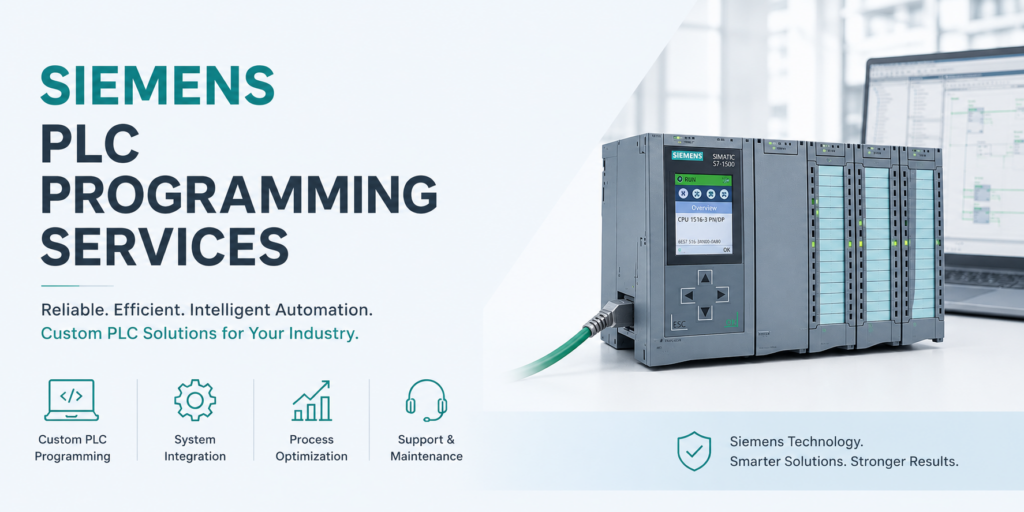
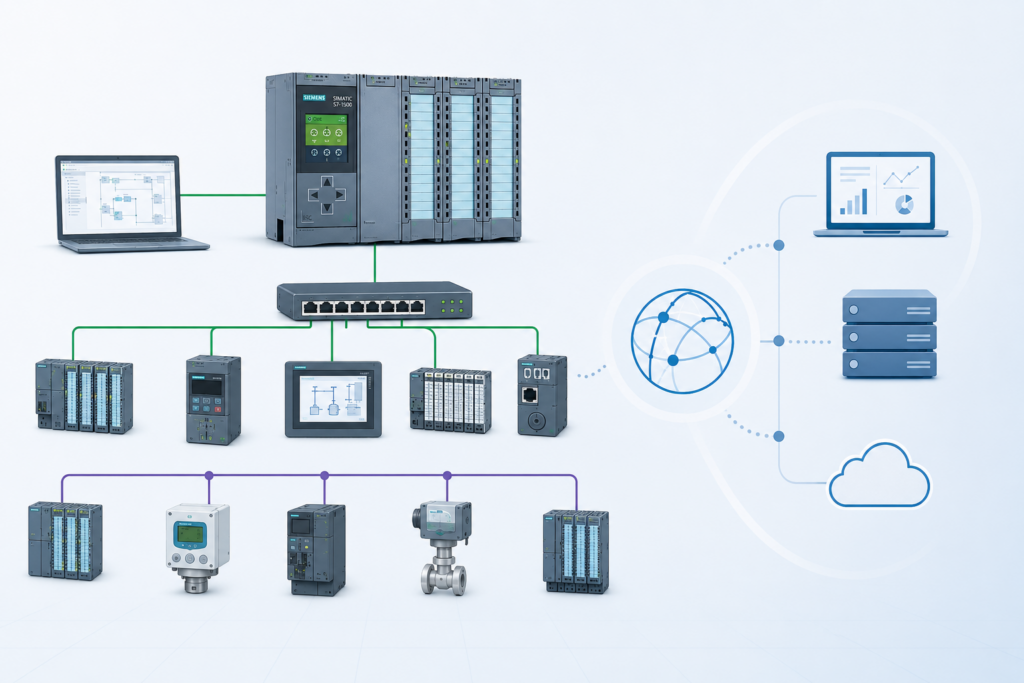
The SIMATIC product range spans several generations of hardware, each with different software environments, communication protocols, and capability ceilings. Our engineers work across all platforms currently in active industrial use.
| Platform | Programming Environment | Communication Protocol | Primary Use Case |
|---|---|---|---|
| S7-1500 / ET 200SP CPU | TIA Portal V15.1 – V18 | PROFINET, OPC UA | New installations, safety applications, IIoT-connected systems |
| S7-1200 | TIA Portal V15.1 – V18 | PROFINET, Modbus TCP | Compact machines, standalone equipment, small process control |
| S7-300 | STEP 7 V5.7 / TIA Portal | PROFIBUS DP, PROFINET | Existing systems, partial upgrades, legacy support |
| S7-400 | STEP 7 V5.7 | PROFIBUS DP, Industrial Ethernet | High-availability systems, process industry, large I/O counts |
| S7-1500F / S7-300F | TIA Portal + F-Libraries | PROFINET PROFIsafe | Functional safety applications, SIL 2 / SIL 3, PLd / PLe |
| ET 200SP / ET 200M | TIA Portal | PROFINET / PROFIBUS | Distributed I/O, remote panel mounting |
| LOGO! | LOGO! Soft Comfort | Ethernet | Small auxiliary control, simple interlocks |
For plants still running S7-200 hardware, we provide migration assessments to S7-1200 that include reusable logic conversion and an I/O-for-I/O mapping document before any physical work begins.
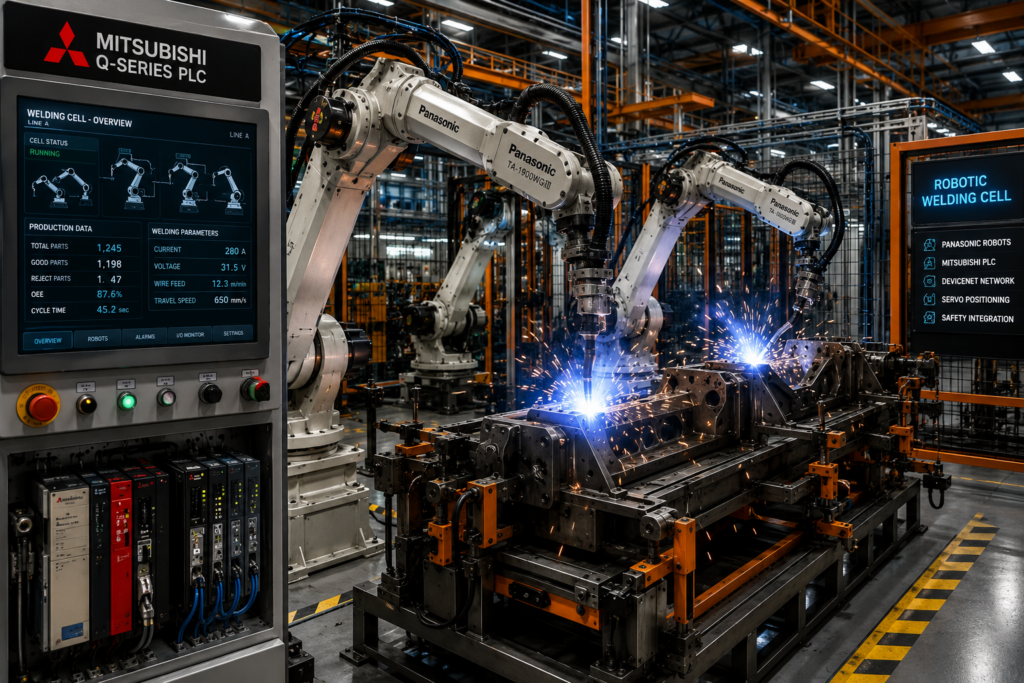
Robotic Welding Automation Cell
Designed and supported a high-performance robotic welding automation cell integrating Panasonic welding robots with Mitsubishi PLC architecture and DeviceNet communication. The system was engineered for synchronized welding operations, stable motion control, and reliable production performance for heavy equipment manufacturing applications. The project contributed to approximately 20% reduction in synchronization-related interruptions, improved welding cycle consistency, and enhanced overall automation reliability during continuous production operations.
Key Outcomes
20% reduction in synchronization-related interruptions
Improved robotic welding cycle consistency
Stable PLC-to-robot communication architecture
Enhanced production reliability during continuous operation
Automatic Bottle Packaging Line Automation
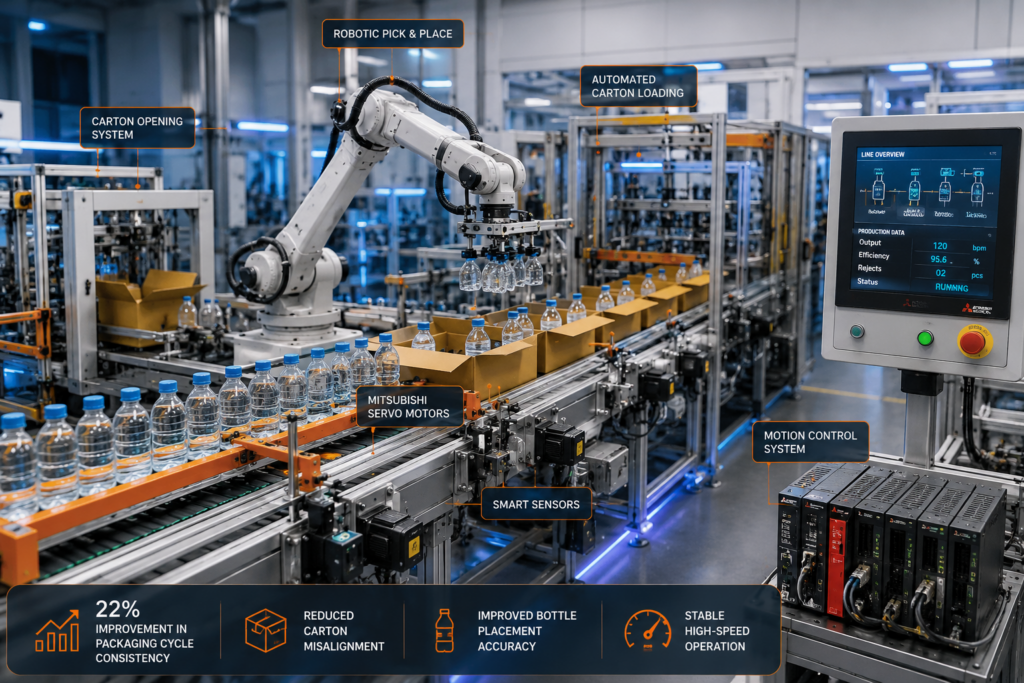
Worked on a fully automated bottle packaging system featuring servo-driven carton handling, robotic bottle pick-and-place operations, and synchronized motion control using Mitsubishi servo technology. The automation system was developed to achieve accurate high-speed packaging, stable cycle timing, and reliable production flow. The project helped improve packaging cycle consistency by approximately 22%, reduced carton alignment issues, and enhanced overall packaging efficiency during continuous operation.
Key Outcomes
22% improvement in packaging cycle consistency
Reduced carton misalignment during production
Improved bottle placement accuracy
Stable high-speed packaging operation
Engineering-first approach
We treat PLC programming as a software engineering discipline with version control, documentation standards, and structured code review. This produces programs that work correctly at startup and are maintainable long-term.
Modular programming practices
We write programs using reusable function blocks and Add-On Instructions rather than duplicated rungs. This makes modifications faster, reduces the risk of introducing errors, and makes your maintenance team’s job easier.
Multi-platform expertise
Most PLC companies specialize in one brand. We work across Allen-Bradley, Siemens, Mitsubishi, Schneider Electric, Omron, and Delta — which matters when you’re running a mixed-platform facility or working with multiple machine suppliers.
Documentation included
Every project includes complete program documentation: I/O lists, network diagrams, program descriptions, and as-built notes. You won’t be left with an undocumented black box.
Scalable solutions
We build programs that can be expanded. Adding a new zone, station, or process line should require adding to the program not rewriting it.