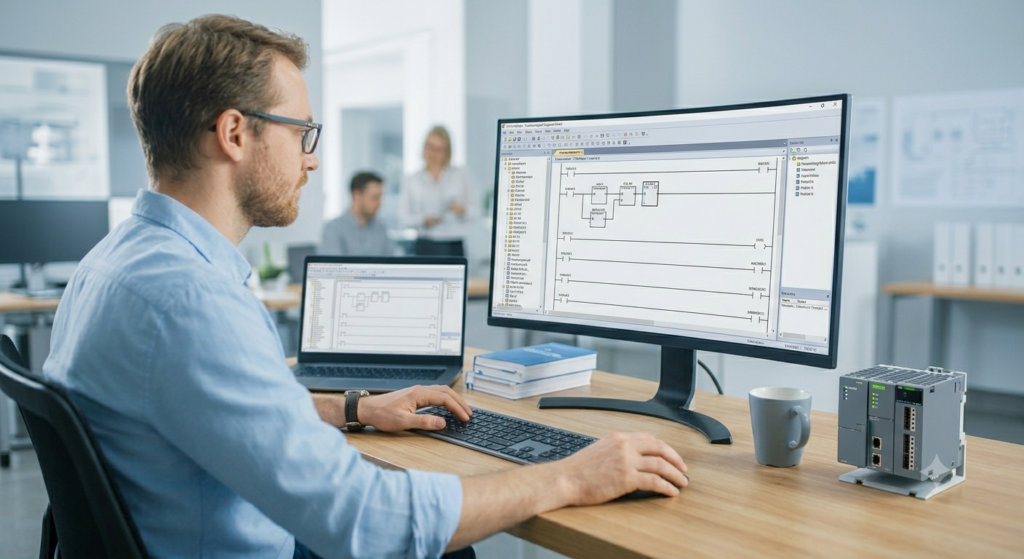

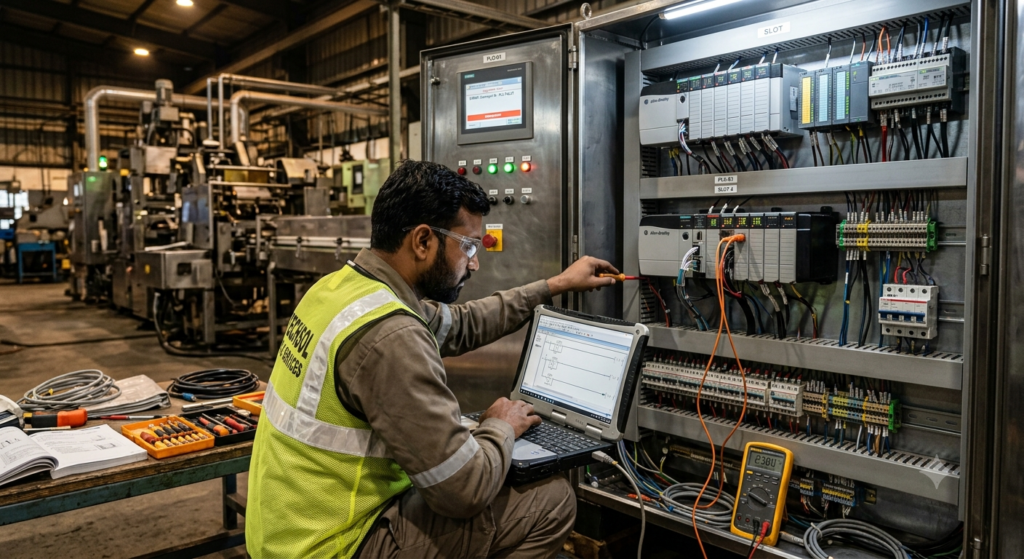
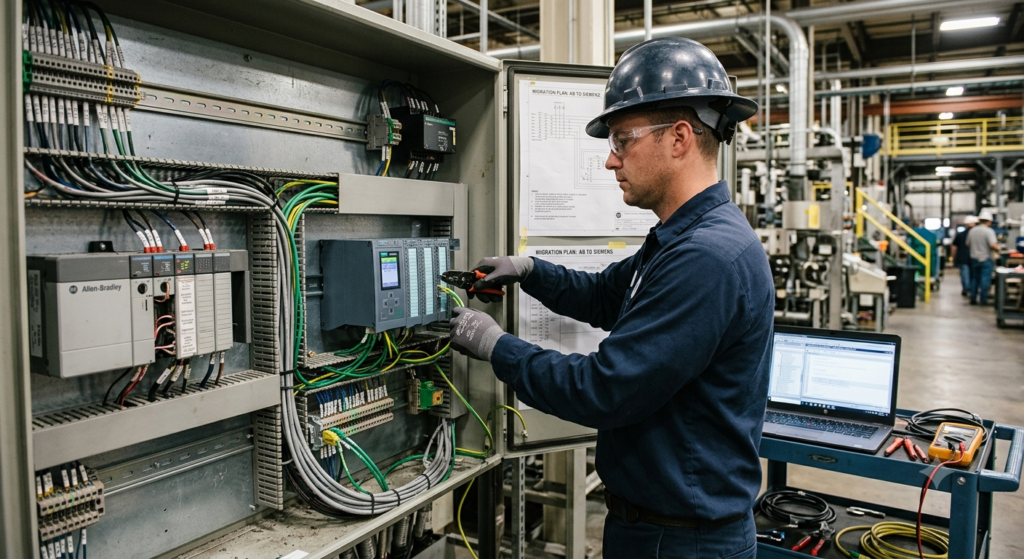
A structured Allen Bradley PLC programming project generally follows these stages:
Engineering-first approach
We treat PLC programming as a software engineering discipline with version control, documentation standards, and structured code review. This produces programs that work correctly at startup and are maintainable long-term.
Modular programming practices
We write programs using reusable function blocks and Add-On Instructions rather than duplicated rungs. This makes modifications faster, reduces the risk of introducing errors, and makes your maintenance team’s job easier.
Multi-platform expertise
Most PLC companies specialize in one brand. We work across Allen-Bradley, Siemens, Mitsubishi, Schneider Electric, Omron, and Delta — which matters when you’re running a mixed-platform facility or working with multiple machine suppliers.
Documentation included
Every project includes complete program documentation: I/O lists, network diagrams, program descriptions, and as-built notes. You won’t be left with an undocumented black box.
Scalable solutions
We build programs that can be expanded. Adding a new zone, station, or process line should require adding to the program not rewriting it.
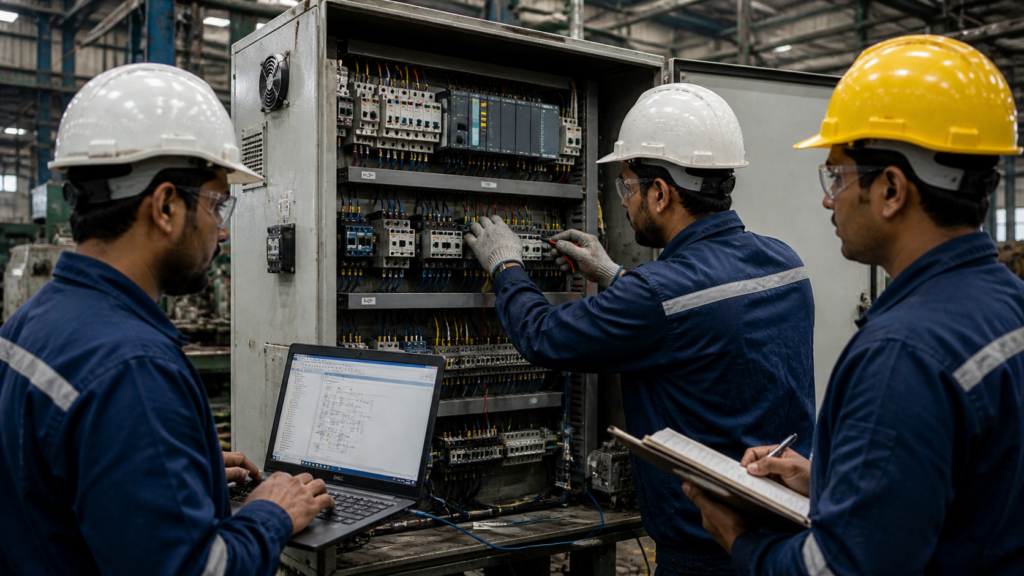


Fill the Form Below
FAQs
We program ControlLogix, CompactLogix, MicroLogix 1000/1100/1400/1500, SLC 500, and PLC-5 systems. We also work with Micro800 series controllers using Connected Components Workbench for smaller applications.
Yes. We provide secure remote support for troubleshooting, program modifications, PID tuning, and commissioning assistance. Remote sessions are conducted through VPN connections with customer authorization.
Yes. We handle both SLC 500 to CompactLogix and PLC-5 to ControlLogix migrations, including program conversion, hardware replacement, I/O mapping, and acceptance testing.
Yes. We develop operator interfaces for PanelView Plus terminals, FactoryTalk View ME and SE applications, and Ignition SCADA projects. Third-party SCADA integration is also available.
EtherNet/IP, DeviceNet, ControlNet, Modbus TCP, and PROFINET. We also configure OPC-UA communication for SCADA integration.
Yes. Remote troubleshooting is available for urgent production issues. Most communication and software faults can be diagnosed remotely within hours.
Yes. On-site commissioning is part of our standard project process for new installations and major upgrades. We work on-site until the system is running in production.
Program backups, I/O lists, network diagrams, and operational documentation are included in every project. For regulated industries, we can provide validation documentation and change control records.
We work with manufacturing, packaging, food and beverage, pharmaceutical, automotive, water and wastewater, chemical processing, material handling, and oil and gas facilities.
We review the existing program before making any changes, document what we find, and make modifications in a way that does not disturb logic that is working correctly. If the existing program has quality issues, we flag them and discuss the appropriate remediation with the customer.