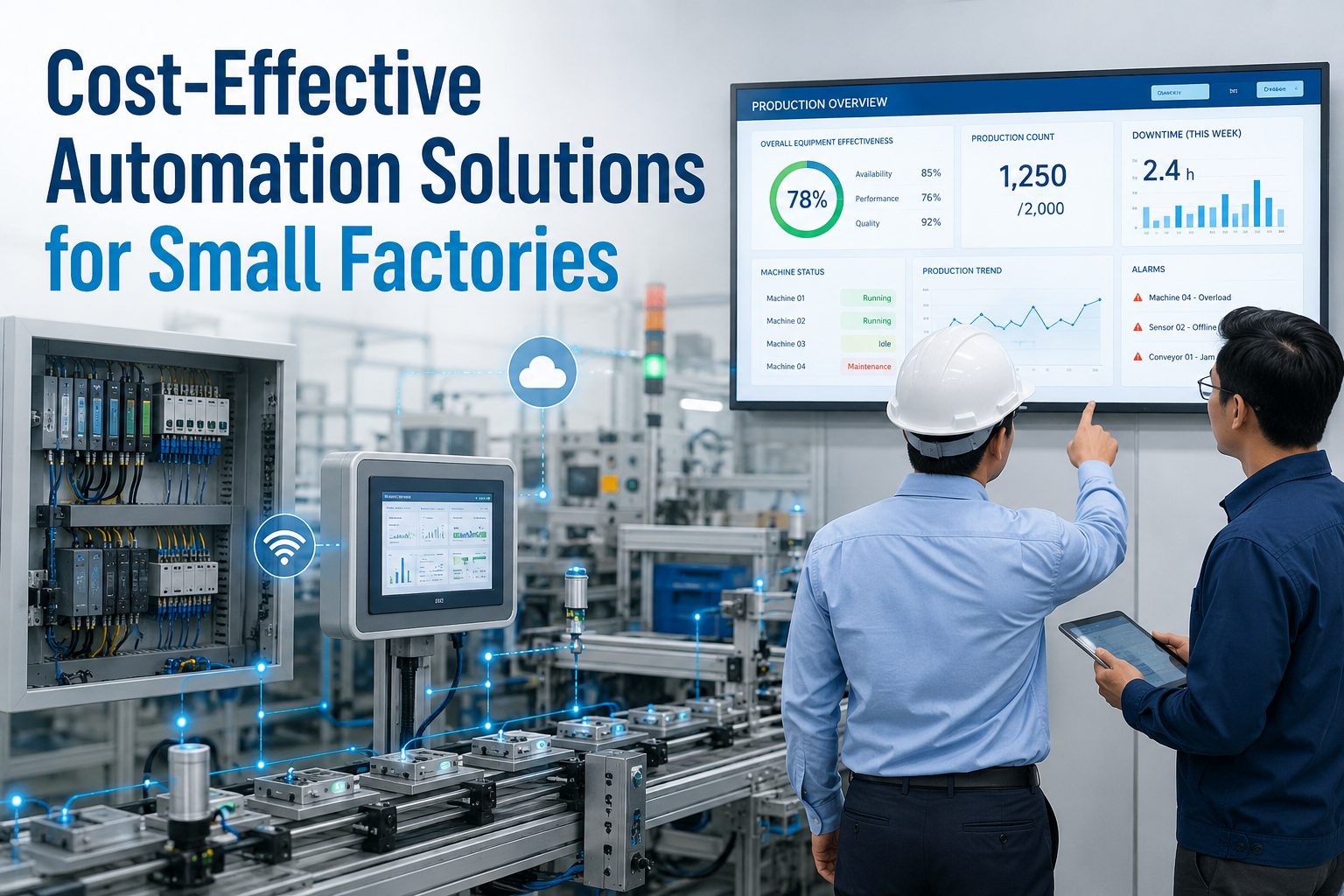
Small factories can implement automation without investing millions. PLC upgrades, HMI systems, sensor-based monitoring, industrial IoT, automated reporting, and predictive maintenance can improve productivity, reduce downtime, and lower operational costs while staying within budget.
What Are Cost-Effective Automation Solutions?
Cost-effective automation solutions are technologies that deliver measurable operational improvements without requiring massive capital investment. The goal is to get real productivity gains, faster ROI, and lower operating costs through targeted, scalable upgrades rather than full facility overhauls.
These solutions are designed to fit the budget realities of small and mid-size manufacturers while solving the same core problems that larger plants solve with bigger systems.
Why Do Small Factories Need Affordable Automation?
Small manufacturers face growing pressure from multiple directions at once.
Labor costs are rising while skilled workers are harder to find. Production demand is increasing, but most small factories still rely on manual processes that slow throughput and introduce errors. Machine downtime goes untracked until it becomes a serious problem. Quality inconsistencies happen because inspections depend on individual operators rather than consistent systems.
Meanwhile, larger competitors are running leaner, faster, and smarter operations. Without automation, small factories lose ground every year.
The good news is that automation no longer means a multi-million dollar project. Targeted upgrades to existing systems can solve specific problems at a fraction of the cost most factory owners expect.
What Are the Biggest Automation Myths Holding Small Factories Back?
Several misconceptions keep small manufacturers from even starting an automation conversation.
Automation is only for large factories. This is false. Many affordable solutions are built specifically for smaller operations. PLC controllers, low-cost HMIs, and IIoT sensors are all accessible to plants running five machines or fifty.
Every automation project costs millions. Not true. A single machine PLC upgrade or an automated production reporting system can cost a fraction of that and still deliver measurable ROI within months.
Existing machines must be replaced. In most cases, existing equipment can be retrofitted with modern automation components rather than replaced. This reduces both cost and installation downtime.
Automation eliminates jobs completely. Automation typically reallocates labor from repetitive tasks to higher-value work. Most small factory implementations result in better jobs, not fewer.
Why Do Small Factories Struggle to Invest in Automation?
Understanding the real barriers helps identify where to start.
Limited capital budgets are the most common obstacle. Upfront costs look large compared to monthly cash flow, especially when ROI is uncertain. Many factory owners delay decisions because they cannot see a clear payback timeline.
Aging equipment creates another challenge. Legacy machines often lack communication ports or digital interfaces, making integration seem complicated or impossible. In reality, retrofit solutions exist for most older equipment.
Lack of in-house expertise is a real concern. Without a PLC or SCADA specialist on staff, small factories have no one to evaluate options, manage installation, or troubleshoot after go-live. This creates dependency on external vendors and increases perceived risk.
Fear of production disruption is also a common hesitation. Any downtime during installation directly impacts output and revenue. This is a legitimate concern, but it is manageable through phased implementation and pilot projects.
How Do You Identify the Right Automation Opportunities in a Small Factory?
The best automation projects target processes that are repetitive, error-prone, downtime-heavy, or time-consuming to report on manually.
Start by walking the floor and asking these questions: Where do operators spend the most time on tasks a machine or system could handle? Where do stoppages happen most often, and how long does it take to identify the cause? Where is data still being recorded on paper or in spreadsheets?
Manual data collection is one of the clearest indicators. If operators are writing down production counts, logging downtime events by hand, or building shift reports in Excel, that is a direct automation opportunity with fast ROI.
Repetitive start and stop sequences on production machines are strong candidates for PLC automation. These sequences run the same way every cycle, which means they are predictable, programmable, and easy to automate reliably.
Quality inspection steps that depend entirely on human judgment introduce variability. Automated sensor checks or vision systems can catch defects consistently at any production speed.
Energy consumption is often invisible in small factories. Without metering or monitoring, power costs are unknown until the utility bill arrives. Automated energy dashboards can identify waste quickly.
Reactive maintenance is one of the most expensive hidden costs. If equipment failures are surprises, the plant is losing money on unplanned downtime, emergency labor, and expedited parts. Predictive monitoring changes this.
What Are the Top Cost-Effective Automation Solutions for Small Factories?
Not every automation upgrade requires robots or complex systems. These solutions deliver strong results at realistic costs.
PLC-Based Machine Automation
PLC systems replace outdated relay logic with programmable, flexible control. A PLC upgrade improves machine reliability, makes troubleshooting faster, and reduces maintenance costs over time.
PLCs are well-suited for packaging machines, conveyors, pump control systems, and any process with repeatable sequences. Modern entry-level PLCs from brands like Allen-Bradley, Siemens, and Mitsubishi are affordable and widely supported.
The bigger benefit is long-term. Once a machine runs on a PLC, connecting it to an HMI or SCADA system becomes straightforward. This makes PLC upgrades the logical first step in any automation roadmap.
HMI Systems for Machine Operators
HMI panels give operators a visual interface to monitor and control machines without navigating electrical panels or reading indicator lights. Touchscreen displays show real-time status, alarm conditions, and production data in a format that any operator can understand quickly.
The operational benefit is immediate. Operators respond faster to faults, make fewer mistakes during setup, and spend less time guessing about machine status. Production supervisors get better visibility without walking the floor every thirty minutes.
HMIs are standard additions to any PLC-controlled machine and do not require complex integration work when both components are planned together.
SCADA for Small Manufacturing Plants
SCADA stands for Supervisory Control and Data Acquisition. It is a centralized software platform that monitors multiple machines or systems from a single screen.
For small factories, SCADA provides real-time production visibility, alarm management, and historical reporting. When a machine stops, the SCADA system logs the time, duration, and cause. This data is invaluable for identifying patterns and reducing repeat failures.
The ROI from SCADA comes primarily from reduced downtime and faster fault identification. Plants that previously took thirty to sixty minutes to diagnose a stoppage can cut that to five minutes with proper alarm configuration.
Modern SCADA platforms include affordable licensing tiers for small operations. Some cloud-based options eliminate the need for dedicated server hardware entirely.
Industrial IoT Monitoring
Industrial IoT connects machines and sensors to a network that collects operational data continuously. This data feeds dashboards showing machine runtime, production counts, energy consumption, and equipment health.
IIoT is especially valuable in factories where machines are older and lack built-in communication capability. IoT gateways can pull data from existing PLCs, meters, and sensors without replacing the underlying equipment.
Practical IIoT applications for small factories include machine runtime monitoring to calculate actual uptime versus scheduled production time, energy monitoring to track power usage by machine or department, and production counter dashboards that replace manual tally systems.
The data collected through IIoT supports better scheduling, maintenance planning, and management decisions without requiring a dedicated analyst.
Automated Production Reporting
Manual production reports are slow, inaccurate, and expensive. Operators spend time filling out forms that supervisors spend time compiling, and the final numbers are often incomplete or delayed.
Automated reporting replaces this cycle with dashboards that update in real time. Production counts, downtime events, scrap rates, and shift summaries are generated automatically from machine data.
The direct savings come from reduced administrative time. The indirect benefit is better decision-making. Managers who see accurate data the same day can act on it. Managers who see summarized reports two days later are always reacting to the past.
Predictive Maintenance Solutions
Predictive maintenance uses sensors to monitor equipment health and alert maintenance teams before failures occur. Instead of waiting for a breakdown or following a fixed schedule, maintenance happens when data indicates it is actually needed.
Common sensors include vibration sensors that detect bearing wear or imbalance, temperature sensors that identify overheating in motors or drives, and current monitoring devices that flag changes in motor load patterns.
The cost savings are significant. Unplanned downtime typically costs more per hour than planned maintenance. Catching a failing bearing before it destroys a motor saves the cost of the repair plus the lost production time.
Which Low-Cost Automation Projects Deliver the Fastest ROI?
Some projects pay for themselves within months rather than years. These are the best starting points for factories with limited budgets.
Automated pump control reduces energy consumption and prevents failures from running pumps in the wrong conditions. It is one of the most straightforward PLC applications with clear, measurable savings.
Motor monitoring systems track current draw and temperature on critical motors. When readings drift outside normal ranges, maintenance teams get an alert before the motor fails. This prevents emergency repair costs and lost production.
Automated shift reports replace manual logging entirely. With data coming directly from machines, operators stop spending the last twenty minutes of every shift filling out paperwork, and supervisors get accurate numbers without data entry delays.
Alarm notification systems send text or email alerts when machines fault or process conditions go out of range. Faster response to faults means less total downtime per event. This is a low-cost addition to any SCADA or HMI system.
Energy monitoring dashboards identify where power is being wasted during idle periods, peak demand windows, or inefficient equipment operation. Most plants that install energy monitoring find savings opportunities they had no visibility into before.
Can Existing Machines Be Automated Without Replacement?
Yes. Retrofitting is the standard approach for most small factory automation projects.
Replacing working machinery to add automation is expensive and unnecessary in most cases. Modern automation components are designed to integrate with existing equipment.
PLC upgrades replace relay panels and hardwired logic without touching the mechanical system. The machine operates the same way but is now controlled by programmable logic that can be modified, monitored, and connected.
HMI installation adds an operator interface to machines that previously had only push buttons and indicator lights. This does not change how the machine operates, but gives operators and supervisors better visibility and control.
Sensor integration adds monitoring capability to machines without built-in sensing. Vibration sensors, temperature probes, and current transducers attach to existing equipment and feed data to monitoring systems.
IIoT gateways connect older PLCs and equipment to modern networks. Even machines running twenty-year-old controls can be connected to data collection systems through the right gateway hardware.
The advantage of retrofitting is cost. A retrofit project typically costs significantly less than new equipment purchases, takes less time to implement, and creates less disruption to ongoing production.
How Much Does Small Factory Automation Actually Cost?
Costs vary depending on project scope, but the range is broader than most factory owners assume.
The key cost factors are the number of machines being automated, PLC hardware requirements, HMI panel size and features, SCADA software licensing, sensor quantity and type, and integration complexity.
Starter automation projects targeting a single machine or process can be completed at a relatively modest investment. A PLC upgrade with a basic HMI, installed and commissioned, can fall into a range that many small factories can fund from operating budgets rather than capital expenditure requests.
Department-level automation covering multiple machines with a connected SCADA system is a mid-range investment. At this level, the ROI calculation becomes easier because the scope of savings is larger.
Plant-wide visibility systems covering all major equipment with centralized reporting and dashboards represent the largest investment, but also the most complete picture of factory performance. These projects are typically phased over one to three years rather than implemented all at once.
The most important point is that automation does not have to be all-or-nothing. A phased roadmap that starts with one high-impact project and expands gradually is both more affordable and more manageable than a single large project.
How Do You Calculate Automation ROI?
ROI comes from reducing downtime, labor costs, energy consumption, and quality losses.
The basic formula is straightforward:
ROI = Annual Savings divided by Project Cost, multiplied by 100
To apply this formula, identify all measurable savings the project will deliver. Reduced unplanned downtime, lower maintenance costs, eliminated manual reporting time, reduced scrap rates, and lower energy bills all contribute to the savings figure.
For example, if a motor monitoring system prevents two unexpected failures per year at a combined cost of downtime and repair, and the system itself costs a fraction of that amount, the ROI calculation is clear and compelling.
The key is being conservative in the savings estimate. Use historical data where it exists. If the plant does not track downtime costs, start there before calculating ROI on anything else.
What Is the Step-by-Step Automation Roadmap for Small Factories?
Start small, prove ROI, and expand gradually. This approach reduces risk and builds internal confidence in automation investments.
Conduct a factory assessment first. Walk every process, document manual steps, and collect whatever downtime and production data already exists. This establishes a baseline and identifies candidates for automation.
Identify bottlenecks next. Not every process needs automation. Focus on the constraints that limit throughput, increase cost, or create quality problems. These are the projects that will deliver the clearest results.
Select high-impact projects based on a combination of ROI potential and implementation risk. The best starting projects are those with clear savings calculations and straightforward technical requirements.
Implement a pilot project on a single machine or process before expanding. A successful pilot generates real data, builds operator confidence, and makes the case for future investment.
Measure results against the baseline established in the assessment. Document what changed, what the numbers show, and what additional opportunities the project revealed.
Scale across operations based on what the pilot proved. Use the documented results to prioritize the next project and build a multi-year automation roadmap.
What Mistakes Do Small Factories Make With Automation?
Many automation projects fail or underdeliver because of avoidable mistakes.
Automating everything at once is the most common error. Large-scope projects are harder to manage, take longer to deliver results, and create more disruption during implementation. Starting with a focused pilot project is always more effective.
Ignoring ROI calculations leads to projects that cannot be justified to ownership or that fail to demonstrate value after completion. Every project should have a clear savings estimate and a defined payback period before work begins.
Choosing overly complex systems for simple problems adds cost and risk without proportional benefit. A basic PLC and HMI can solve most small factory control problems without needing a full SCADA deployment from day one.
Skipping operator training undermines automation investments. If operators do not understand how to use the HMI, interpret alarms, or interact with new systems, the technology cannot deliver its full benefit. Training is not optional.
Neglecting maintenance planning for new automation systems creates new problems. PLCs, HMIs, and sensors require basic upkeep. Factories that treat automation as install-and-forget eventually face failures in the automation systems themselves.
What Automation Trends Are Making Factory Automation More Affordable?
Automation technology is becoming more accessible every year, and the trends favor small manufacturers.
Cloud SCADA platforms eliminate the need for expensive on-site servers. Subscription-based licensing models make enterprise-level monitoring accessible at small factory budgets. Data is accessible from any browser, which makes remote monitoring practical even for single-site operations.
Low-cost IIoT sensors have dropped in price significantly as wireless industrial sensors have become mainstream. Connecting machines to monitoring systems no longer requires extensive hardwiring or high-end hardware.
AI-powered maintenance tools are beginning to appear at affordable price points. Platforms that analyze sensor data and predict failures were previously enterprise-only products. They are increasingly available to smaller operations through cloud-based subscription models.
Edge computing devices process data locally before sending it to the cloud, reducing connectivity requirements and improving response times. These devices make IIoT practical even in factories with limited or unreliable network infrastructure.
Wireless industrial monitoring removes the wiring cost that made sensor-based monitoring expensive in older facilities. Battery-powered wireless sensors can be installed without conduit runs or electrical work, cutting installation costs significantly.
Conclusion
Small factories do not need massive budgets to benefit from automation. By focusing on practical solutions such as PLC upgrades, HMI systems, SCADA monitoring, IIoT connectivity, predictive maintenance, and automated reporting, manufacturers can improve productivity, reduce downtime, and build a foundation for long-term smart manufacturing growth while keeping costs under control.
The most important step is the first one. Pick one high-impact problem, build a clear ROI case, implement a focused pilot, and measure the results. Every successful automation project makes the next one easier to justify, plan, and execute.
Ready to Automate Your Factory Without Overspending?
Start with the Right Automation Project
Many small factories delay automation because they assume it requires a large budget or complete machine replacement. In reality, the most successful automation projects often begin with a single production line, a PLC upgrade, an HMI implementation, or a machine monitoring system.
At AutomatexLab, we help manufacturers identify practical automation opportunities that deliver measurable ROI without unnecessary complexity or excessive costs.
Our Automation Services Include
- PLC Programming and Upgrades
- SCADA Development and Integration
- HMI Design and Implementation
- Industrial IoT Solutions
- Machine Monitoring Systems
- Automation Troubleshooting
- Factory Automation Consulting
- Legacy Machine Retrofit Solutions
- Predictive Maintenance Systems
- Smart Manufacturing Solutions
Why Work With AutomatexLab?
✅ Cost-effective automation strategies
✅ Solutions tailored for small and medium factories
✅ Retrofit-first approach to reduce investment costs
✅ Focus on productivity, downtime reduction, and ROI
✅ End-to-end support from planning to implementation
Get a Free Automation Assessment
Not sure where to start?
AutomatexLab can evaluate your current production process, identify automation opportunities, and recommend the most cost-effective solutions for your factory.
Contact AutomatexLab today to discuss your automation goals and discover how affordable factory automation can improve efficiency, reliability, and long-term growth.
FAQs
Yes. Many automation projects start with a single machine and expand gradually. The key is identifying high-impact projects with clear ROI rather than trying to automate everything at once.
PLC retrofits, HMI upgrades, automated reporting systems, and machine monitoring solutions are among the most accessible options. These can often be implemented without major capital expenditure.
In most cases, yes. Existing equipment can be upgraded with PLCs, sensors, HMI panels, and IIoT gateways without full replacement. Retrofitting is the standard approach in small factory automation.
Depending on the application, payback periods range from several months to a few years. Projects targeting high-cost downtime problems or significant labor savings tend to pay back the fastest.
Not necessarily at first. SCADA becomes valuable when multiple machines need centralized monitoring and reporting. Single-machine projects can start with a PLC and HMI and add SCADA later as the operation scales.
Start with whatever costs the most money right now. If unplanned downtime is the biggest problem, start with monitoring and predictive maintenance. If manual reporting consumes too much time, start with automated data collection. Follow the money.