What Is IIoT Architecture?
Manufacturing floors have always generated enormous amounts of data. Every motor rotation, temperature spike, pressure fluctuation, and production count tells a story about what is happening inside a facility. For decades, most of that data went unread, stored in isolated systems or simply ignored because there was no practical way to connect it all together.
That is exactly the problem IIoT architecture solves.
Industrial Internet of Things (IIoT) architecture is the framework that connects industrial equipment, sensors, PLCs, SCADA systems, edge devices, cloud platforms, and business applications to collect, process, analyze, and act on manufacturing data in real time. Think of it as the nervous system of a modern manufacturing facility. It takes raw signals from machines and transforms them into operational intelligence that maintenance engineers, plant managers, and executives can actually use.
The core value of IIoT architecture is not the technology itself. It is what the technology enables: predictive maintenance that catches failures before they happen, energy monitoring that identifies waste at the machine level, production visibility that gives every stakeholder a real-time view of factory performance, and quality systems that catch defects before they reach customers.
For manufacturers pursuing Industry 4.0 initiatives, IIoT architecture is the foundational layer that makes everything else possible. Without a well-designed architecture connecting your machines to your data systems, digital transformation remains a collection of disconnected pilot projects rather than a cohesive operational strategy.
How Does IIoT Architecture Actually Work?
At its core, IIoT architecture works by collecting data from industrial devices, securely transmitting it through communication networks, processing it either at the edge or in the cloud, and delivering actionable insights through business applications.
The data flow looks like this in its simplest form:
Sensor → PLC → Gateway → Edge Device → Cloud Platform → Analytics Dashboard → Business Action
To make this concrete, consider a practical manufacturing example. A vibration sensor is installed on a critical motor in an automotive assembly plant. Under normal operating conditions, the motor produces consistent vibration patterns within an acceptable range. As bearings begin to wear, vibration signatures change in ways that are measurable but not yet visible to the human eye or ear.
The vibration sensor continuously captures this data. That data flows through the PLC controlling the motor, then through an edge gateway that performs initial analysis, then up to a cloud platform where historical patterns are compared against current readings. A predictive maintenance dashboard flags an anomaly and sends an alert to the maintenance team. The bearing gets replaced during a planned maintenance window instead of failing mid-shift and causing hours of unplanned downtime.
This is IIoT architecture working exactly as intended. The machine generated the data. The architecture captured, transported, analyzed, and acted on it. The outcome was a failure prevented rather than a failure managed.
The 5 Layers of IIoT Architecture
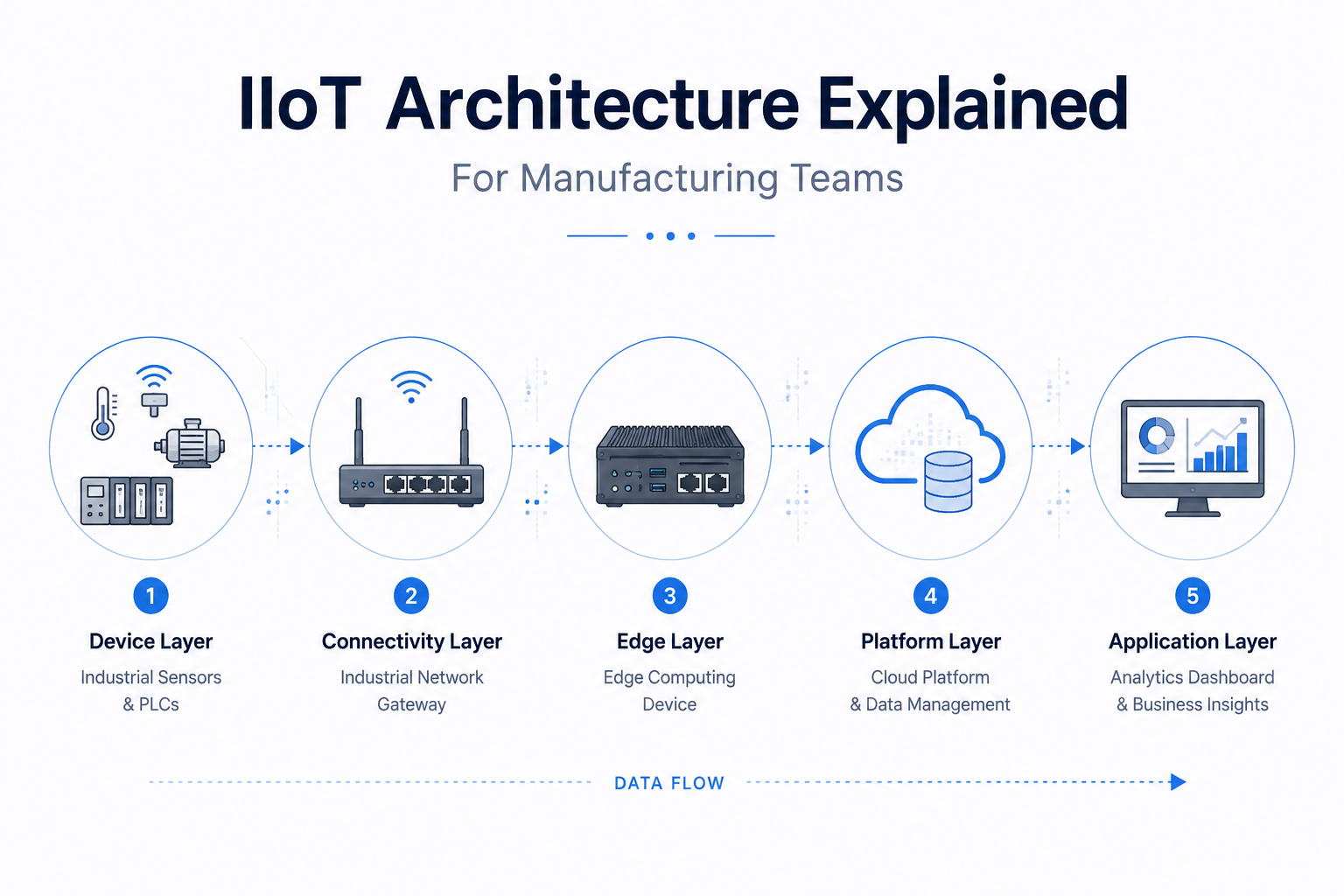
IIoT architecture is most clearly understood when broken into its five distinct layers. Each layer has a specific function, and together they form a complete system that moves data from the physical world of machines into the digital world of business intelligence.
Layer 1: The Device Layer
The Device Layer is where everything starts. This layer contains the physical assets on the factory floor: sensors, machines, PLCs, actuators, industrial robots, CNC machines, variable frequency drives, and smart meters. These are the assets that generate the raw operational data that feeds the entire architecture.
Sensors in the device layer collect a wide range of measurements. Temperature sensors monitor furnace conditions, cooling systems, and motor heat. Pressure sensors track hydraulic systems and pneumatic lines. Vibration sensors watch rotating equipment for early signs of mechanical wear. Flow rate sensors monitor liquids and gases moving through production processes. Energy meters capture consumption at the machine level. Production counters track throughput in real time.
The key challenge at the device layer is the sheer variety of equipment found in real manufacturing environments. A facility might operate machines purchased across four decades, from different manufacturers, running different control systems, communicating over different protocols. A well-designed IIoT architecture accounts for this reality from the ground up.
Practical example: A temperature sensor continuously monitors a heat treatment furnace. It sends readings every two seconds to the PLC controlling the furnace. Those readings become the foundation for everything that happens further up the architecture stack.
Layer 2: The Connectivity Layer
Data generated at the device layer is useless if it cannot travel reliably to where it needs to go. The Connectivity Layer is the industrial network infrastructure that makes that travel possible.
This layer includes industrial gateways, routers, switches, firewalls, and wireless access points. It also encompasses the protocols that define how devices communicate. Common protocols in IIoT environments include MQTT, OPC UA, Modbus TCP, Ethernet/IP, PROFINET, and DDS. Each protocol has its own strengths and typical use cases, which is why protocol selection is an important architectural decision.
MQTT is lightweight and well-suited for high-volume, low-bandwidth sensor data transmission. OPC UA is the dominant standard for machine-to-machine communication in industrial settings, offering both communication and a standardized data model. Modbus TCP remains widely used because of the enormous installed base of legacy equipment that supports it. Ethernet/IP and PROFINET are common in automation-heavy environments from specific vendor ecosystems.
The connectivity layer matters enormously in manufacturing environments because production cannot stop for network maintenance. Industrial networks must be reliable, resilient, and capable of handling traffic from dozens or hundreds of devices simultaneously. They must also operate in electrically noisy environments where motors, welders, and other equipment create interference that would disrupt consumer-grade networking equipment.
Manufacturing environments often contain equipment from multiple vendors that was never designed to communicate with each other. The connectivity layer solves this by standardizing how data moves through the facility, regardless of what is generating it.
Layer 3: The Edge Computing Layer
The Edge Computing Layer is where local intelligence lives. Rather than sending every piece of raw data to the cloud for processing, edge computing performs analysis close to the source of the data.
Edge computing hardware includes industrial PCs, edge gateways, edge servers, and embedded controllers positioned at or near the machines they serve. These devices run software capable of filtering data, aggregating readings, running analytics, executing machine learning inference, and generating alarms.
The practical value of edge computing becomes clear when you consider the latency requirements of real manufacturing operations. A packaging line running at 600 units per minute cannot wait 200 milliseconds for a cloud response to determine whether a package is defective and should be rejected. That decision needs to happen in milliseconds, locally, without any dependence on a network connection or cloud platform availability.
Edge computing also reduces bandwidth consumption significantly. A single production line might generate gigabytes of raw sensor data per hour. Sending all of that data to the cloud is expensive and often unnecessary. Edge processing filters and aggregates the data, sending only meaningful summaries and exception events upstream while acting on real-time data locally.
A manufacturing example worth considering: A machine vision system on a bottling line captures images of every bottle passing through inspection. The edge device runs an AI inference model that evaluates each image in under 10 milliseconds, identifies defective bottles, and triggers the rejection mechanism. Only summary data, such as total bottles inspected, total rejected, and defect type classifications, travels to the cloud platform. The real-time decisions happen entirely at the edge.
Layer 4: The Platform Layer
The Platform Layer is the central data hub where industrial data is stored, organized, cleaned, and analyzed at scale. This is typically cloud infrastructure, though some manufacturers operate on-premises platform environments for data sovereignty or latency reasons.
Platform layer components include cloud infrastructure, time-series databases optimized for industrial data, data lakes for long-term storage, analytics engines, and AI services. Time-series databases are particularly important in manufacturing IIoT because sensor data is inherently time-stamped and queried by time ranges.
The functions performed at the platform layer include data storage and retrieval, data cleaning and normalization, data modeling, trend analysis, and predictive analytics. Machine learning models trained on historical production data can identify patterns that precede failures, quality deviations, or efficiency losses. These models improve over time as they accumulate more data.
One of the most valuable capabilities enabled at the platform layer is enterprise-wide visibility. A manufacturer operating ten production facilities can consolidate data from all ten sites into a single platform, enabling direct performance comparisons, fleet-level predictive maintenance, and centralized reporting that was simply not possible when data lived in isolated on-site systems.
Platform layer architecture decisions include whether to use a purpose-built industrial IoT platform, a general-purpose cloud data platform adapted for industrial use, or a combination. Purpose-built platforms typically offer pre-built connectors for common industrial protocols and pre-configured analytics for manufacturing use cases. General-purpose platforms offer greater flexibility and often lower cost at scale.
Layer 5: The Application Layer
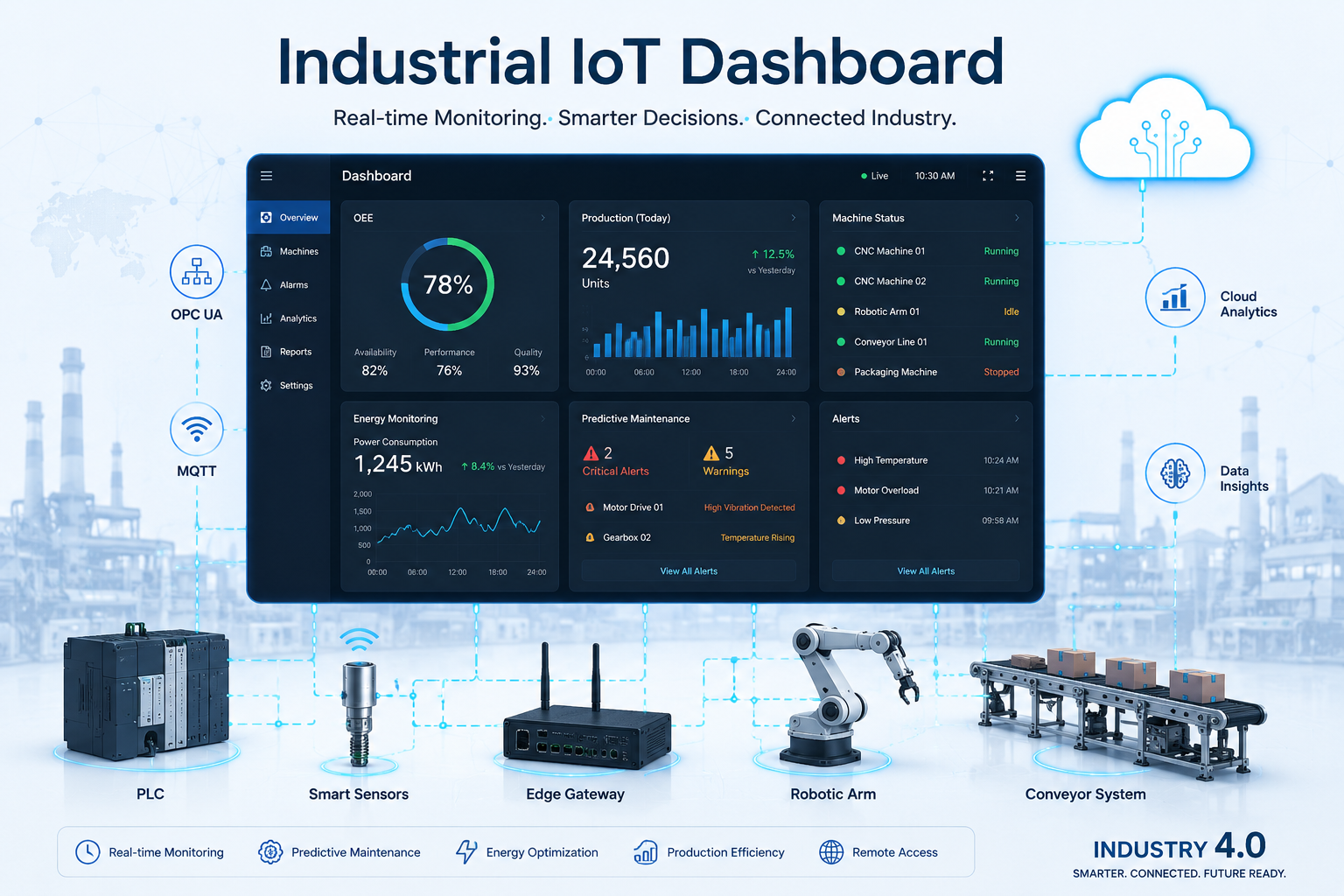
The Application Layer is where industrial data becomes business value. This is the layer that users interact with directly: dashboards showing real-time OEE, predictive maintenance platforms flagging at-risk assets, energy management tools tracking consumption against targets, digital twin environments simulating production scenarios.
Application layer components include visualization dashboards, digital twins, Manufacturing Execution Systems, ERP integrations, maintenance management platforms, and mobile applications that put operational data in the hands of field technicians.
The users served by the application layer span the organization. Plant managers monitor overall equipment effectiveness and production attainment. Maintenance engineers review asset health trends and work order queues. Production supervisors track throughput and identify bottlenecks. Reliability teams analyze failure patterns to improve maintenance strategies. Executives review cross-site performance metrics and energy costs.
The quality of the application layer determines how much of the value created by the lower layers actually reaches the people who need it. Even a perfectly engineered data architecture fails to deliver ROI if the dashboards are confusing, the alerts are poorly calibrated, or the integration with existing ERP and MES systems is incomplete.
Where SCADA Fits Into IIoT Architecture
Many manufacturing facilities already operate SCADA systems. Understanding how SCADA relates to IIoT architecture is essential for teams planning their digital transformation strategy.
SCADA systems were designed to monitor industrial operations, provide supervisory control, manage alarms, and log historical data. They have served manufacturing facilities well for decades and continue to play an important role. The question is not whether to replace SCADA with IIoT but how to integrate SCADA into a modern IIoT architecture.
In a modern architecture, SCADA acts as the operational visibility layer that bridges industrial control systems with IIoT platforms. SCADA data, including process values, alarm histories, and production records, feeds into cloud analytics, AI platforms, digital twins, and predictive maintenance systems. The SCADA system continues to provide real-time operator visibility and supervisory control at the plant level while IIoT extends the reach of that data across the enterprise.
The relationship between PLCs, SCADA, and IIoT can be understood through their distinct but complementary roles. PLCs control machines, executing the logic that governs how equipment behaves. HMIs give operators a local interface to monitor and interact with processes. SCADA provides plant-level monitoring and supervision. IIoT expands connectivity and analytics capabilities beyond the plant floor. Cloud infrastructure delivers enterprise-level intelligence. These are not competing technologies. They are layers of a complete architecture.
Security Architecture in IIoT Systems
Security in IIoT is not a feature to be added after the architecture is designed. It is a requirement that must be built into every layer from the beginning.
Manufacturing facilities that connect operational technology to information technology networks fundamentally change their risk profile. Previously isolated systems become reachable from corporate networks, and potentially from the internet. The consequences of a security breach in a manufacturing environment can go far beyond data theft. Ransomware can stop production lines. Unauthorized access to control systems can compromise product quality or create safety hazards.
Security requirements span every architectural layer. At the device layer, secure boot processes verify firmware integrity before devices are allowed to operate. Device authentication ensures that only authorized hardware can connect to the network. At the connectivity layer, VPNs encrypt data in transit, firewalls control traffic between network segments, and network segmentation isolates OT networks from IT networks. At the platform layer, data is encrypted at rest. Identity management systems enforce multi-factor authentication and role-based access control.
A security mesh architecture distributes security controls across all devices, networks, applications, and cloud resources rather than relying on a single perimeter defense. This approach is particularly well-suited to IIoT environments because the attack surface is distributed. Zero trust principles require that every access request be verified regardless of where it originates. Continuous verification, device authentication, micro-segmentation, and centralized monitoring are the operational pillars of this approach.
The security architecture must also account for the long operational life of industrial equipment. A PLC installed today may still be operating in fifteen years. Security strategies must be designed to remain effective over that time horizon, which means prioritizing network-level controls and gateway security rather than relying solely on endpoint security that may become difficult to maintain on aging hardware.
IIoT Architecture Deployment Models
There is no single correct architecture for every manufacturing environment. Deployment models vary based on operational requirements, infrastructure constraints, data sovereignty requirements, and latency sensitivity.
Cloud-centric architecture centralizes data storage and analytics in the cloud, with edge devices serving primarily as data collectors and forwarders. This model works well for multi-site manufacturers who prioritize centralized reporting and enterprise visibility. It benefits from the scalability and cost economics of cloud infrastructure and simplifies the management of analytics and AI workloads.
Edge-centric architecture keeps processing as close to the machines as possible, with cloud used primarily for aggregation and long-term storage. This model is appropriate for real-time manufacturing environments where latency is critical and cloud connectivity cannot be guaranteed. High-speed production lines, safety-critical processes, and facilities in locations with unreliable internet connectivity are natural fits for edge-centric approaches.
Hybrid architecture combines edge processing for real-time decisions with cloud processing for analytics, reporting, and AI model training. Most modern manufacturing facilities benefit from this approach because it delivers both the speed of edge computing and the scalability of cloud infrastructure. Edge handles what needs to happen in milliseconds. Cloud handles what requires historical context, cross-site comparison, or advanced analytics.
The choice between these models is not permanent. Many manufacturers begin with a cloud-centric approach during early IIoT deployments when simplicity and speed of implementation are priorities, then evolve toward hybrid architectures as operational requirements become clearer and the volume of data from connected assets grows.
Real Manufacturing Use Cases of IIoT Architecture
Understanding IIoT architecture in abstract terms is valuable. Understanding what it enables in practice is more compelling.
Predictive maintenance is the use case that drives most IIoT investments. By continuously monitoring vibration, temperature, electrical current draw, and other indicators of machine health, manufacturers can identify failure signatures weeks before a breakdown occurs. The architecture collects sensor data at the device layer, analyzes it at the edge for immediate anomalies, and sends it to cloud platforms for trend analysis and predictive model scoring. Maintenance teams receive prioritized alerts through the application layer and can schedule repairs during planned downtime.
Energy monitoring at the machine level reveals consumption patterns that aggregate utility bills cannot show. Understanding which machines consume the most energy, how consumption varies by product type or shift, and where efficiency losses are occurring enables targeted interventions. Many manufacturers find that machine-level energy monitoring pays for itself within the first year through the inefficiencies it exposes.
OEE monitoring gives production teams real-time visibility into availability, performance, and quality metrics. When OEE drops, the architecture can help identify whether the root cause is downtime, speed loss, or quality rejection, enabling faster and more accurate problem-solving. Over time, OEE data supports continuous improvement initiatives by making performance trends visible.
Quality inspection using machine vision and AI models can evaluate products at production speeds with consistency that manual inspection cannot match. The architecture connects vision systems to edge computing for real-time defect detection and to cloud platforms for quality trend analysis.
Asset tracking across large facilities reduces the time technicians spend searching for tools, materials, and portable equipment. Real-time location data integrated with maintenance and production systems improves workflow efficiency.
How to Build an IIoT Architecture Roadmap
The architecture framework is clear in concept, but implementation requires a structured approach. Many IIoT initiatives stall because they begin with technology selection rather than business objective definition.
Step 1: Define business objectives. What specific operational outcomes does the initiative need to deliver? Predictive maintenance, energy reduction, OEE improvement, and quality control each drive different architecture requirements. Starting with outcomes keeps the technical decisions grounded in business value.
Step 2: Assess existing infrastructure. Take inventory of PLCs, SCADA systems, network infrastructure, and sensors already in place. Understand what data is already being collected and what gaps exist. This assessment prevents the common mistake of designing an architecture that ignores valuable existing investments.
Step 3: Establish connectivity. Deploy the industrial networking and gateway infrastructure needed to reliably move data from the device layer upward. This step often requires upgrading network infrastructure in older facilities and selecting appropriate protocols for the equipment mix.
Step 4: Implement edge computing. Deploy edge hardware and software where real-time local analytics are needed. Configure filtering and aggregation rules to manage data volumes and reduce bandwidth requirements.
Step 5: Deploy the cloud platform. Select and configure the platform layer for data storage, analytics, and AI workloads. Establish data pipelines from edge systems to the platform.
Step 6: Build dashboards and applications. Develop the application layer tools that deliver insights to the users who need them. Prioritize usability and integration with existing MES and ERP systems.
Step 7: Secure every layer. Apply zero trust principles throughout the architecture. Implement device authentication, network segmentation, encryption, and identity management at every layer.
Challenges Manufacturing Teams Face
No honest discussion of IIoT architecture is complete without acknowledging the challenges that cause real-world implementations to fall short of their potential.
Legacy equipment integration is the most common challenge. Manufacturing facilities often operate equipment that was designed before connectivity was a consideration. These machines may lack digital outputs, communicate over obsolete protocols, or require physical retrofitting to enable sensor installation. Industrial gateways and protocol converters can address many of these challenges, but the process requires careful engineering.
Data silos persist even in facilities that have made significant IIoT investments. Information generated by one system often remains inaccessible to others because integration work was not completed or because organizational structures discourage data sharing across functions. Breaking down data silos requires both technical integration and organizational alignment.
Cybersecurity risks grow with every new connection. As OT and IT networks converge, the attack surface expands. Manufacturing organizations that managed cybersecurity primarily at the IT layer must now extend security practices into the operational technology environment, which often requires new skills and new organizational responsibilities.
Network reliability requirements in manufacturing are unforgiving. Production lines run around the clock. The network infrastructure supporting IIoT systems must be designed for high availability with redundancy and failover capabilities.
Scalability from pilot to full deployment is where many promising IIoT initiatives fail. A successful proof of concept on a single production line does not automatically translate to a plant-wide deployment. Architecture decisions that work at small scale may not hold up when applied across hundreds of assets in a complex facility.
The Bottom Line
IIoT architecture is not a product you purchase. It is a framework you design, build, and evolve over time to meet the specific operational needs of your manufacturing environment.
The five-layer model of Device, Connectivity, Edge Computing, Platform, and Application provides a clear structure for thinking about how industrial data flows from machines to business decisions. Security must be woven through every layer rather than treated as an afterthought. Deployment models should reflect the actual operational requirements of your environment rather than a generic best practice from outside your industry.
The manufacturers who get the most value from IIoT architecture are those who start with clear business objectives, assess their existing infrastructure honestly, build incrementally rather than attempting to deploy everything at once, and treat the architecture as a living system that improves as operational experience accumulates.
The technology is mature. The use cases are proven. The challenge for most manufacturing organizations is not whether IIoT architecture can deliver value but whether they have the organizational commitment and implementation discipline to realize it.
Ready to Build a Scalable IIoT Architecture?
Whether you’re planning a new Industry 4.0 initiative or modernizing existing manufacturing systems, AutomatexLab helps manufacturers design, integrate, and optimize IIoT solutions that connect machines, data, and business operations.
From PLC and SCADA integration to Edge Computing, Industrial IoT, and factory analytics, we help turn industrial data into actionable insights.
Contact AutomatexLab today to discuss your automation and digital transformation goals.