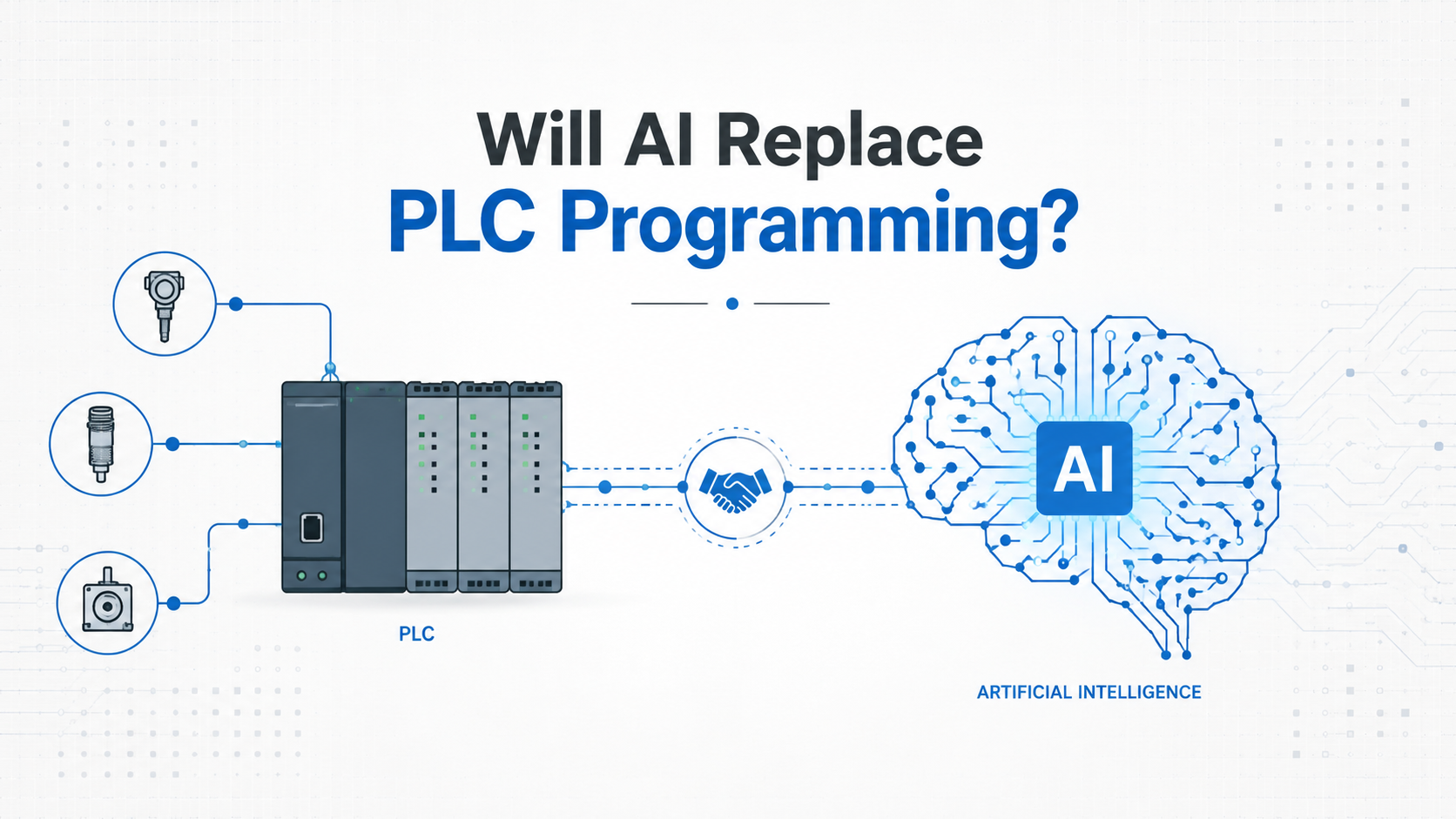
AI can automate parts of PLC programming, but it cannot fully replace PLC programmers. Industrial automation depends on safety engineering, deep process knowledge, real-world commissioning, troubleshooting, and regulatory compliance. These are human responsibilities that AI is not equipped to handle on its own.
The future of this field is not AI replacing engineers. It is AI-assisted PLC programming, where automation professionals use AI tools to move faster, reduce repetitive work, and focus their expertise where it matters most.
Manufacturing teams need to understand what AI can do, what it cannot do, and why qualified engineers remain essential to safe and reliable production systems.
What Is PLC Programming?
PLC programming is the process of creating control logic that operates industrial machines, manufacturing lines, and automation systems.
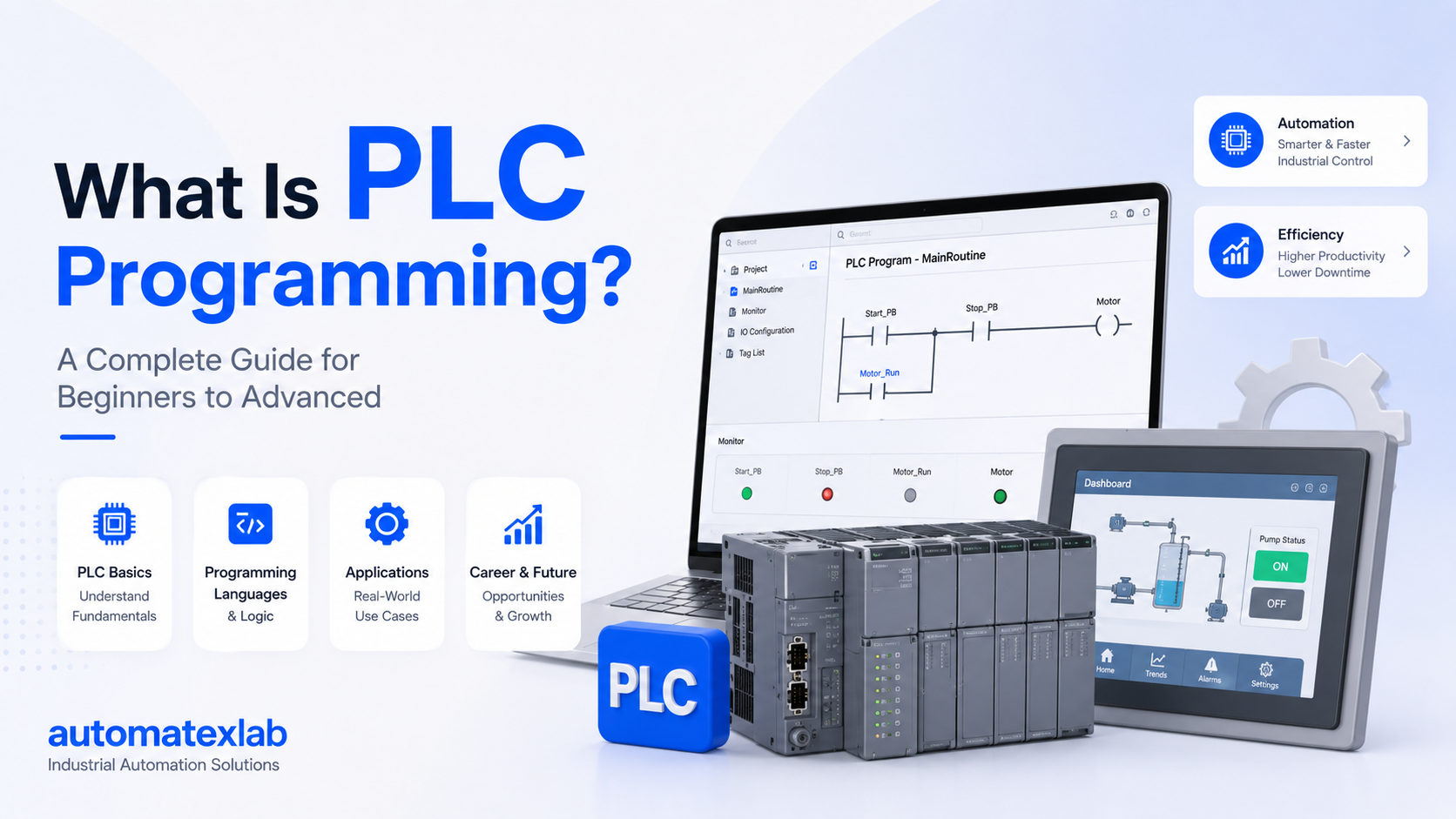
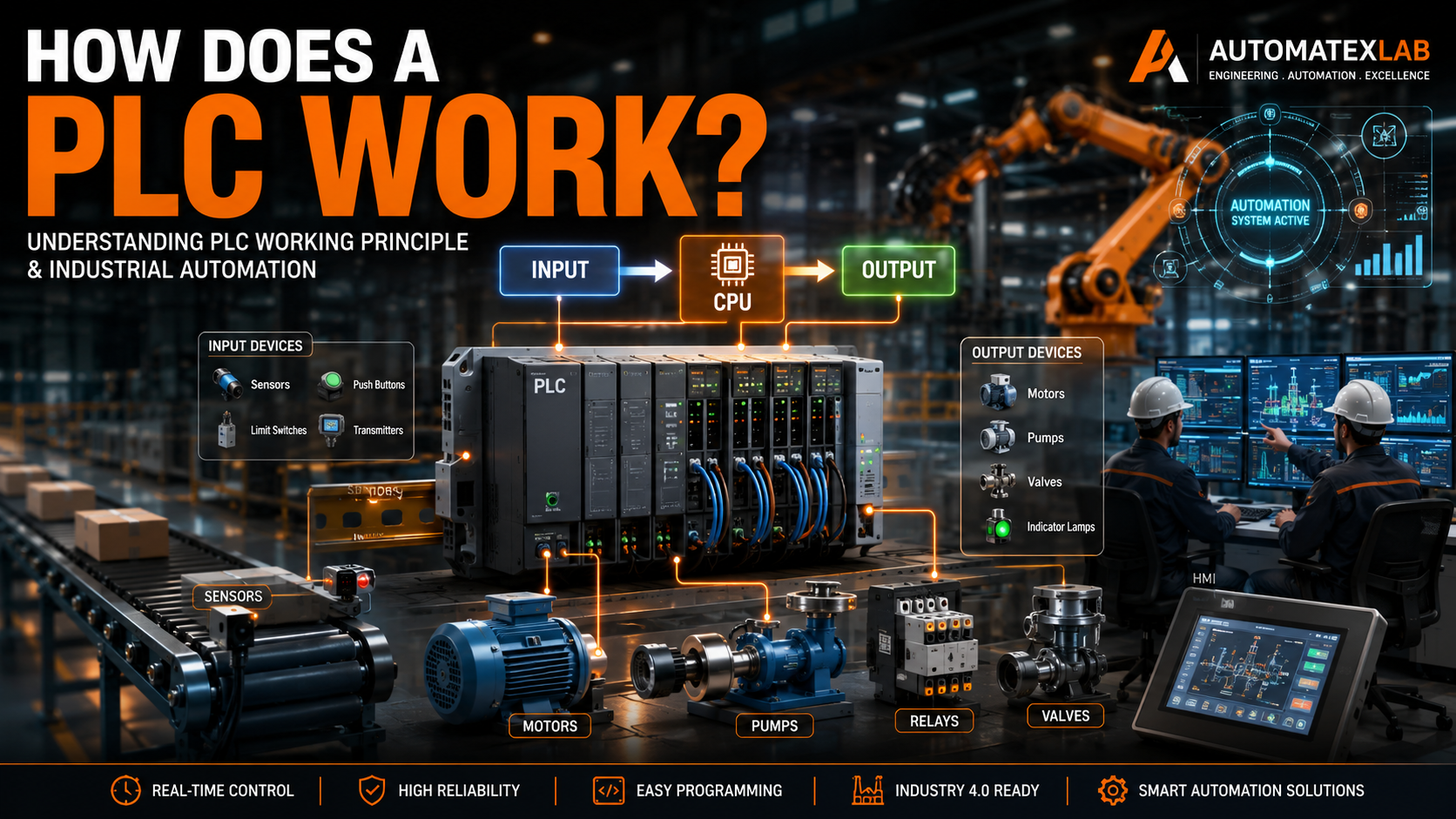
A Programmable Logic Controller (PLC) is a ruggedized industrial computer designed to monitor inputs, execute control logic, and drive outputs in real time. PLCs are the backbone of factory automation, running everything from conveyor belts and robotic arms to mixing tanks and packaging lines.
PLC programs are written in several standard languages defined by the IEC 61131-3 standard:
Ladder Logic (LD) is the most widely used language in North America. It visually resembles relay ladder diagrams, making it accessible to electricians and control engineers familiar with relay-based systems. Rockwell Automation’s Studio 5000 and Allen-Bradley PLCs rely heavily on Ladder Logic.
Function Block Diagram (FBD) represents logic as interconnected blocks, making it well suited for process control and continuous systems. Siemens TIA Portal and Schneider Electric platforms support FBD extensively.
Structured Text (ST) is a high-level text-based language similar to Pascal. It is preferred for complex calculations, data manipulation, and algorithmic control. Engineers working with Mitsubishi Electric, Siemens, and Beckhoff systems frequently use Structured Text.
Instruction List (IL) is an assembly-like language used in legacy systems, though it is being phased out in newer applications.
Sequential Function Chart (SFC) organizes program flow into steps and transitions, making it ideal for batch processes and sequential operations.
In real industrial environments, PLC programs control motor starters, variable frequency drives, safety interlocks, process instruments, valve actuators, conveyor systems, robotic cells, and entire production lines. A single PLC program for a complex machine may contain thousands of rungs, hundreds of function blocks, and extensive I/O mapping across multiple hardware modules.
What Is AI in Industrial Automation?
AI helps machines analyze data, identify patterns, generate code, and support decision-making in industrial environments.
The term artificial intelligence covers a broad range of technologies now entering the industrial automation space. Understanding what each technology does helps manufacturers evaluate where AI adds genuine value.
Machine Learning (ML) is a category of AI where systems learn from historical data to make predictions or identify patterns. In manufacturing, ML powers predictive maintenance systems that forecast equipment failure before it occurs, quality inspection systems that detect defects from camera images, and energy optimization tools that adjust consumption based on production patterns.
Generative AI is the category behind tools like ChatGPT, GitHub Copilot, and similar platforms. These systems generate new content including text, code, and designs based on training data. In industrial automation, generative AI can produce PLC code drafts, documentation, and alarm logic from written descriptions.
Industrial AI refers to AI systems specifically designed or adapted for factory environments. These platforms integrate with SCADA systems, historians, and control networks to deliver real-time analytics, anomaly detection, and process optimization recommendations.
AI Copilots are embedded AI assistants inside engineering software. Several major automation vendors including Siemens and Rockwell Automation have announced or are developing AI copilot features within their PLC programming environments. These tools suggest code completions, flag potential errors, and assist with documentation.
Predictive Analytics platforms analyze production data from PLCs, SCADA systems, and industrial IoT devices to surface actionable insights. These tools reduce unplanned downtime, improve yield, and optimize maintenance scheduling without requiring engineers to manually analyze large datasets.
Can AI Write PLC Programs Today?
Yes. Modern AI tools can generate basic PLC code, ladder logic examples, and automation templates.
If you ask ChatGPT or a similar large language model to write a motor start/stop ladder logic rung, it will produce something that resembles valid PLC code. Ask for a PID control template in Structured Text and it will generate one. Ask for a conveyor belt interlocking sequence and you will receive a reasonable starting point.
What AI Can Generate Today
- Basic Ladder Logic rungs for motor control, interlocking, and sequencing
- Structured Text functions for mathematical operations, timers, and counters
- Alarm logic templates based on common industrial patterns
- Motor control sequences including star-delta starters and VFD control
- PID loop templates with standard tuning parameters
- Function block structures for repetitive control modules
- Documentation drafts and code comments from program descriptions
- Tag naming suggestions based on device descriptions
What AI Cannot Do
AI does not know your plant conditions. It has no knowledge of your equipment specifications, process constraints, electrical panel layouts, field device ratings, or site-specific safety requirements.
AI does not understand machine behavior. Generating syntactically correct code is very different from generating code that operates a real machine safely and efficiently. AI cannot evaluate whether a generated sequence will cause mechanical interference, process upsets, or equipment damage.
AI can generate unsafe logic. Without knowledge of safety standards such as IEC 62061, ISO 13849, or NFPA 79, AI tools can produce code that appears functional but lacks the safety interlocks, emergency stop logic, or fault detection required for industrial use.
AI cannot validate field devices. Commissioning requires verifying that every sensor, actuator, motor, and instrument behaves as expected in the physical environment. This cannot be done remotely or through code generation.
Which Parts of PLC Programming Can AI Automate?
AI is best at repetitive programming tasks and documentation generation.
Boilerplate Code Creation
A large portion of PLC programming involves writing similar structures repeatedly: motor starters, valve controls, analog scaling, timer logic, and counter functions. AI tools can generate these standard building blocks quickly, reducing the time engineers spend on routine coding tasks.
Standard Function Blocks
Automation engineers frequently build libraries of reusable function blocks for common devices such as pumps, fans, conveyors, and actuators. AI can accelerate the initial drafting of these blocks based on written specifications, giving engineers a starting point to refine rather than a blank page.
Alarm Generation
Industrial systems require hundreds of alarms covering equipment faults, process deviations, communication errors, and safety conditions. AI can generate alarm logic templates based on standard industrial practices, which engineers then review and adapt to specific plant conditions.
Documentation Writing
Generating I/O lists, functional descriptions, program narratives, and as-built documentation is time-consuming but essential. AI tools can draft these documents from program structures and descriptions, significantly reducing documentation effort.
Comment Generation
Well-commented PLC code is critical for maintenance teams and future engineering changes. AI can review existing code and suggest or generate inline comments that explain logic, improving long-term maintainability.
Tag Mapping
Translating an I/O schedule or electrical drawing into a consistent tag naming structure is a repetitive task. AI tools can assist by suggesting tag names based on device descriptions and established naming conventions.
HMI Screen Suggestions
AI can propose HMI screen layouts, navigation structures, and control element placements based on process descriptions, giving HMI developers a starting framework to work from.
SCADA Template Creation
Creating SCADA graphic templates, trending screens, alarm displays, and report structures involves considerable repetitive work. AI can accelerate this process by generating initial templates that engineers customize for specific processes.
Which Parts of PLC Programming Cannot Be Replaced by AI?
Real-world engineering decisions still require human expertise.
Safety System Design
Safety-rated PLC programming requires compliance with IEC 62061, ISO 13849, and regional safety regulations. Designing safety functions, calculating Performance Levels and Safety Integrity Levels, and implementing safety-rated stop categories requires specialized engineering knowledge. Errors in safety logic can result in injury, death, regulatory violations, and massive liability. AI cannot carry this responsibility.
Machine Commissioning
Commissioning is the process of verifying that every physical component of a system functions correctly within the complete control architecture. It requires an engineer to be present at the machine, checking I/O points, verifying sensor calibrations, tuning control loops, observing machine behavior, and confirming that all safety functions operate as designed. No AI tool can commission physical equipment remotely.
Troubleshooting Live Equipment
When a production line stops unexpectedly, engineers diagnose faults in real time by observing PLC status indicators, measuring electrical signals, reviewing fault logs, and applying knowledge of both the machine and the process. This diagnostic process requires hands-on experience, systematic thinking, and physical access to equipment.
Factory Acceptance Testing (FAT)
FAT is a formal verification process conducted at the machine builder’s facility before equipment ships to site. Engineers systematically test every control function, safety circuit, alarm, and sequence against a defined test protocol. This requires engineering judgment, documentation, and direct interaction with the customer’s technical team.
Site Acceptance Testing (SAT)
SAT repeats acceptance testing at the customer’s facility after installation, verifying that the system performs correctly in its final operating environment. It involves coordination between the automation engineer, electrical team, process engineers, and plant operations staff.
Process Optimization
Optimizing a control system for maximum productivity, minimum energy consumption, and consistent product quality requires understanding the process physics, the equipment capabilities, and the production objectives. This knowledge comes from engineering experience and direct observation, not code generation.
Electrical Integration
PLC programs do not exist in isolation. They interface with motor control centers, variable frequency drives, safety relays, instrumentation loops, power distribution systems, and communication networks. Integrating these systems correctly requires electrical engineering expertise.
Sensor Selection
Specifying the correct sensor type, range, accuracy class, process connection, and communication protocol for each measurement point requires application knowledge that AI cannot reliably supply without verified plant data.
Understanding Customer Requirements
Translating vague or evolving customer requirements into precise control specifications is one of the most important skills an automation engineer brings to a project. This involves technical communication, clarifying ambiguity, managing expectations, and documenting agreed solutions in a way that protects both parties.
“AI can generate code. Engineers are responsible for ensuring that code operates safely and reliably in real industrial environments.”
Why Manufacturing Facilities Still Need PLC Engineers
Manufacturing operations depend on control systems that are safe, reliable, and compliant with regulatory requirements. These are not qualities that can be generated by a language model.
Safety regulations such as OSHA machine guarding standards, NFPA 79 electrical standards, and IEC 62061 functional safety requirements mandate that qualified engineers design, validate, and document control systems. Regulatory compliance requires human accountability.
Production reliability depends on control systems that are correctly tuned, thoroughly tested, and well maintained. Downtime on a production line can cost manufacturers thousands to hundreds of thousands of dollars per hour. The cost of an engineering error or a poorly validated AI-generated program far exceeds any development savings.
Compliance requirements in industries including food and beverage, pharmaceuticals, automotive, and chemicals require detailed documentation of control system design, testing, and change management. Engineers produce and sign off on this documentation.
Equipment integration across multiple vendors, communication protocols, and hardware generations requires an engineer who understands the technical landscape and can solve integration problems that no AI tool can anticipate.
A Real Factory Example
Consider a simple motor start sequence. An AI tool might generate this Structured Text code in seconds:
IF StartButton AND NOT FaultActive THEN
    MotorRun := TRUE;
END_IF;
Before this logic goes anywhere near a real motor, a qualified engineer must verify:
- Motor ratings: Does the code correctly account for overload protection, full load current, and thermal limits?
- Interlocks: Are all mechanical interlocks, process permissives, and sequential conditions included?
- Emergency stops: Is the emergency stop function implemented in a safety-rated channel with the correct stop category?
- Safety relays: Are safety relay outputs correctly monitored and integrated with the PLC program?
- Field wiring: Does the I/O assignment match the electrical drawings? Are cable shields, grounding, and terminations verified?
The AI generated the starting point. The engineer is responsible for everything that makes it safe and functional.
AI vs PLC Programmers Comparison
| Factor | AI | PLC Engineer |
|---|---|---|
| Code Generation | Yes | Yes |
| Process Knowledge | Limited | High |
| Safety Decisions | No | Yes |
| Machine Commissioning | No | Yes |
| Troubleshooting | Limited | Yes |
| Customer Interaction | No | Yes |
| On-Site Work | No | Yes |
| Regulatory Accountability | No | Yes |
| Documentation Sign-Off | No | Yes |
| Sensor and Hardware Selection | Limited | Yes |
How AI Is Changing PLC Programming Jobs
AI is reducing repetitive work while increasing demand for higher-level automation skills.
The most immediate change is speed. Engineers who use AI tools to generate boilerplate code, draft documentation, and create alarm logic templates can complete projects faster. This is a productivity gain, not a replacement.
As AI handles more routine coding tasks, the engineering work shifts toward system architecture, safety validation, process optimization, and customer engagement. These are areas where experience and judgment matter most, and where AI adds the least value.
The demand for AI literacy is also rising. Engineers who understand how to prompt AI tools effectively, evaluate generated code critically, and integrate AI assistance into a disciplined engineering workflow will have a competitive advantage. This is a new skill set, not a replacement for existing expertise.
SCADA systems, HMI platforms, and industrial IoT infrastructure are becoming more complex as factories move toward Industry 4.0 architectures. The integration work required to connect these systems is growing, and qualified automation engineers are central to making it work.
Will PLC Programmers Lose Their Jobs Because of AI?
Most PLC programmers are unlikely to be replaced, but engineers who effectively use AI may outperform those who do not.
This pattern has appeared repeatedly throughout the history of industrial automation. When CAD software replaced hand drafting in the 1980s, draftsmen did not disappear. The role evolved into a more productive, higher-value engineering position. When SCADA systems automated data collection and reporting, control room operators did not disappear. Their roles shifted toward analysis and decision-making.
PLC programming has followed the same trajectory. Early PLCs replaced physical relay panels. Programming software with diagnostic tools replaced manual ladder logic entry. Simulation environments reduced commissioning time on the factory floor. Each of these changes made engineers more productive rather than obsolete.
AI is the next step in this progression. The engineers most at risk are not those who use AI tools, but those who refuse to adapt to a changing workflow while competitors move faster and deliver more value.
The core functions of a PLC engineer, including safety validation, commissioning, troubleshooting, customer collaboration, and system integration, are not going to be automated by current or near-future AI technology. These functions require physical presence, engineering judgment, legal accountability, and the kind of tacit knowledge that only comes from years of hands-on experience.
Future of AI-Assisted PLC Programming
Natural Language to Ladder Logic
Several research projects and early commercial tools are exploring the ability to generate PLC code from plain English descriptions. An engineer could describe a process step in natural language and receive a draft Ladder Logic or Structured Text module to review and refine. This capability is developing, though the output still requires expert validation.
Automated Testing
AI-assisted automated testing frameworks could run systematic checks against PLC programs before commissioning, flagging missing interlocks, inconsistent tag usage, or deviations from programming standards. This would reduce the time spent on manual code review.
Digital Twin Validation
Digital twins are virtual models of physical machines and processes. AI tools integrated with digital twin platforms could simulate PLC program behavior in a virtual environment before deployment, identifying logic errors that would otherwise only appear during physical commissioning.
AI Copilot for PLC Development
Major vendors including Siemens and Rockwell Automation are developing AI copilot features embedded in their PLC development environments. These tools will suggest code completions, identify common mistakes, and help engineers navigate large, complex programs more efficiently.
Automatic Documentation
Generating up-to-date as-built documentation from live PLC programs is a persistent challenge in industrial automation. AI tools could analyze program structure and automatically produce functional descriptions, I/O summaries, and change logs that reflect the current state of the system.
Predictive Debugging
By analyzing historical fault data alongside PLC program logic, AI systems could predict which program elements are most likely to cause future faults, allowing engineers to proactively address issues before they interrupt production.
How Automation Companies Can Use AI Responsibly
Using AI tools in PLC development requires a disciplined approach that preserves the safety and reliability standards industrial environments demand.
Human review is mandatory. Every line of AI-generated code must be reviewed by a qualified automation engineer before it enters a production system. AI output is a starting point, not a finished product.
Safety validation cannot be delegated to AI. Safety functions must be designed, documented, and validated by engineers with appropriate functional safety qualifications. This is a regulatory and ethical requirement, not a preference.
Testing procedures remain unchanged. AI assistance in the development phase does not eliminate the need for thorough FAT and SAT processes. Formal testing protocols exist because the consequences of untested automation are severe.
Cybersecurity must be considered. Using cloud-connected AI tools with proprietary plant data raises legitimate cybersecurity questions. Automation companies should establish clear policies about what information can be shared with external AI platforms.
Version control is essential. AI-assisted development can accelerate code changes, which increases the importance of disciplined version control. Every change to a production PLC program must be tracked, documented, and authorized.
Should Manufacturers Trust AI-Generated PLC Code?
AI-generated PLC code should always be reviewed, tested, and validated by qualified automation engineers before deployment.
The question of trust is really a question of process. AI-generated code is not inherently untrustworthy, but it is also not inherently correct, safe, or suitable for a specific application. It is a starting point that requires professional evaluation.
Manufacturers who deploy AI-generated PLC code without proper engineering review are accepting risks that extend beyond technical malfunction. In regulated industries, using unvalidated control code can create compliance failures. In safety-critical applications, it can create liability exposure. In high-throughput production environments, it can cause costly downtime.
The correct approach is straightforward: use AI tools to accelerate development, reduce repetitive work, and improve documentation quality. Require human engineering review and formal testing for every program before it touches production equipment. This approach captures the productivity benefits of AI without compromising the standards that industrial automation requires.
Key Takeaways
- AI can assist PLC programming by handling repetitive tasks, generating boilerplate code, and drafting documentation.
- AI cannot replace the process knowledge, safety engineering, and commissioning expertise that industrial automation requires.
- Safety system design, machine commissioning, troubleshooting, and customer collaboration remain human responsibilities.
- AI will become a productivity tool for automation engineers, not a replacement for them.
- The future belongs to AI-assisted engineers, and those who adapt to this workflow will have a clear competitive advantage.
- Every piece of AI-generated PLC code must be reviewed, tested, and validated by qualified engineers before deployment.
- Manufacturing facilities that invest in skilled automation engineers while adopting AI tools responsibly are best positioned for reliable, safe, and efficient production.
Need Expert PLC Programming Support?
Whether you are implementing a new automation system, upgrading legacy PLCs, integrating SCADA, or exploring AI-assisted industrial automation, AutomatexLab provides practical engineering support for manufacturing operations.
Services include:
- PLC Programming
- SCADA Development
- HMI Design
- Industrial IoT Integration
- Automation Troubleshooting
- System Integration
- Factory Automation Consulting
Contact AutomatexLab to discuss your automation project and identify where AI can improve productivity without compromising reliability or safety.
FAQs
Yes. ChatGPT can generate basic PLC code including Ladder Logic, Structured Text, and Function Block Diagram examples. The output requires review and validation by a qualified engineer before use in any industrial application.
Yes. Current AI tools can generate ladder logic for common tasks including motor control, interlocking, timing functions, and counter logic. The generated code does not account for specific plant conditions, safety requirements, or equipment ratings unless those details are explicitly provided and verified by an engineer.
No. Siemens TIA Portal engineers bring process knowledge, system integration expertise, and commissioning experience that AI cannot replicate. Siemens has introduced AI-assisted features in its engineering tools to make programmers more productive, not to replace them.
No. Rockwell Automation Studio 5000 and FactoryTalk development require engineers who understand Allen-Bradley hardware, motion control, safety systems, and the EtherNet/IP communication architecture. AI tools may assist with routine coding tasks, but the engineering expertise remains essential.
No. Machine commissioning requires physical presence, hands-on testing, I/O verification, safety function validation, and real-time observation of machine behavior. These tasks cannot be performed remotely or through software generation.
In a limited way. AI analytics tools can analyze fault logs and suggest probable causes based on historical data. However, diagnosing an active fault on a production machine requires an engineer with knowledge of the machine, access to the control panel, and the ability to measure and observe in real time.
Yes. Demand for skilled automation engineers is growing as manufacturers invest in modernizing production facilities, implementing Industry 4.0 technologies, and addressing aging infrastructure. AI tools will make individual engineers more productive, not redundant.
PLC engineers should develop familiarity with AI-assisted development tools, industrial IoT platforms, digital twin technology, data analytics, and cybersecurity practices. Functional safety qualification, such as TÜV Rheinland Functional Safety Engineer certification, also increases career value significantly.