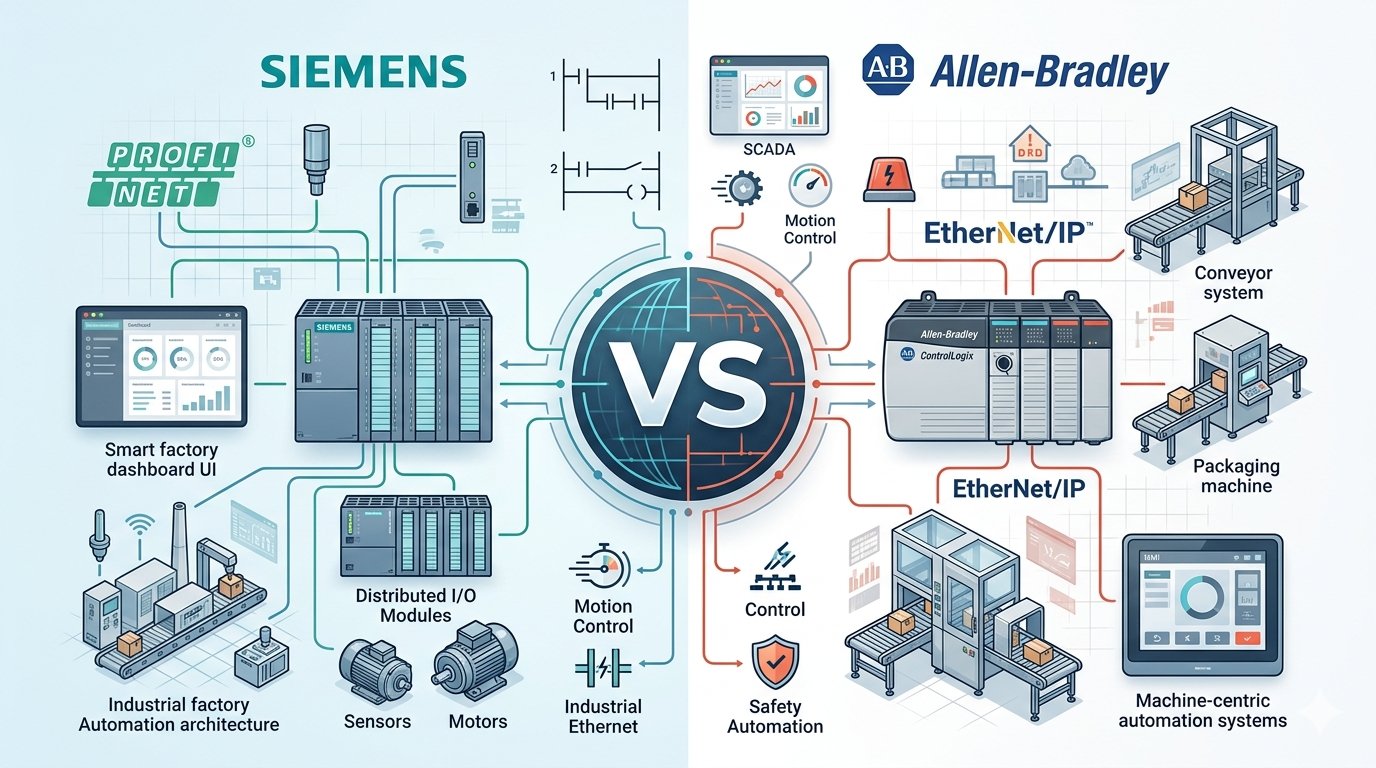
If you’re choosing between Siemens and Allen-Bradley PLCs, here’s the short version: Siemens wins for large-scale industrial automation, process industries, and smart factory integration. Allen-Bradley wins for North American machine builders, maintenance-friendly environments, and discrete manufacturing.
Both platforms are industry leaders. But they serve different engineering needs, team skill sets, and factory environments. This guide breaks down every major difference so you can make the right call.
What Is a Siemens PLC?
Siemens PLCs fall under the SIMATIC product family and are built for complex, large-scale industrial automation. They’re the go-to choice across Europe, Asia, and process-heavy industries worldwide.
Popular Siemens PLC Series:
| PLC Series | Typical Use Case |
|---|---|
| SIMATIC S7-1200 | Small automation systems |
| SIMATIC S7-1500 | Advanced industrial automation |
| SIMATIC S7-300 | Legacy industrial systems |
| SIMATIC S7-400 | Large process plants |
| ET 200SP Open Controller | Distributed automation |
Siemens is heavily deployed in automotive manufacturing, pharmaceuticals, oil and gas, food processing, and smart factory environments. If your facility runs a distributed architecture with dozens of field devices across multiple production zones, Siemens is built for that.
What Is an Allen-Bradley PLC?
Allen-Bradley PLCs are manufactured by Rockwell Automation and dominate North American industrial markets. They’re known for a tight ecosystem, user-friendly software, and strong support networks across the US.
Popular Allen-Bradley PLC Series:
| PLC Series | Typical Use Case |
|---|---|
| MicroLogix | Small legacy applications |
| CompactLogix | Mid-range automation |
| ControlLogix | Enterprise automation |
| Micro800 | Entry-level systems |
| GuardLogix | Safety-critical applications |
Allen-Bradley is widely used in packaging, material handling, assembly lines, warehousing, and discrete manufacturing. If your team includes technicians and electricians who need to troubleshoot machines quickly without deep engineering knowledge, Allen-Bradley delivers that experience.
Siemens vs Allen-Bradley: Side-by-Side Comparison
| Feature | Siemens PLC | Allen-Bradley PLC |
|---|---|---|
| Primary Market | Europe, Asia | North America |
| Software Platform | TIA Portal | Studio 5000 |
| Communication Protocol | PROFINET, PROFIBUS | EtherNet/IP |
| Hardware Flexibility | Very High | Moderate |
| Learning Curve | Steeper | Easier |
| Diagnostics | Advanced | Strong |
| Motion Integration | Excellent | Excellent |
| Industry 4.0 Readiness | Very Strong | Strong |
| Initial Cost | Often Lower | Often Higher |
| Modular Scalability | Extensive | Extensive |
| Third-Party Compatibility | High | Moderate |
| Global Availability | Very Strong | Strong |
How Does the Hardware Architecture Compare?
Siemens PLC Hardware
Siemens hardware is built for modular, distributed industrial environments. The architecture supports large-scale deployments where I/O devices, field instruments, and controllers are spread across wide plant areas.
Key characteristics include compact modular design, strong distributed I/O through ET200 series devices, redundancy options for critical processes, fail-safe CPU integration, and high-speed communication backplanes. Siemens excels in chemical plants, continuous process industries, and high-temperature manufacturing environments where reliability under harsh conditions is non-negotiable.
Allen-Bradley PLC Hardware
Allen-Bradley uses a chassis-based architecture that prioritizes integration simplicity and fast deployment. The system is designed so that maintenance teams can swap modules, add expansion cards, and troubleshoot faults without needing deep engineering expertise.
Strengths include strong modular expansion, excellent integrated motion support, and a clean maintenance workflow. The hardware integrates tightly with Rockwell’s broader ecosystem including HMIs, drives, safety systems, and SCADA platforms. That tight integration makes Allen-Bradley a strong choice for machine builders who want everything from one vendor.
TIA Portal vs Studio 5000: Which Software Is Better?
This is one of the biggest decision points when choosing between the two platforms.
Siemens TIA Portal
TIA Portal is a unified engineering environment that combines PLC programming, HMI development, SCADA configuration, motion control, networking, and diagnostics inside a single software platform.
That unification is a major advantage for large automation projects. Engineers manage the entire system from one place, reducing integration errors and simplifying version control. TIA Portal handles complex multi-device projects well and scales efficiently as plant size grows.
The downsides are real though. TIA Portal is resource-heavy, has longer compile times on large projects, and has a steeper learning curve than Studio 5000. New engineers typically need more time to become productive compared to the Allen-Bradley environment.
Allen-Bradley Studio 5000
Studio 5000 is known for cleaner navigation, faster onboarding, and a ladder logic experience that electricians and technicians find intuitive. Tag-based programming reduces complexity at the field level, and troubleshooting workflows are straightforward.
For discrete manufacturing and machine automation projects, Studio 5000 gets teams productive faster. The tradeoff is cost. Rockwell’s licensing model is expensive, and managing very large projects can become cumbersome compared to TIA Portal’s centralized approach.
Bottom Line: TIA Portal wins for large integrated systems. Studio 5000 wins for faster deployment and easier maintenance.
Programming Language Support: What Are the Differences?
Both platforms support IEC 61131-3 programming standards, but the depth of support varies.
| Programming Language | Siemens | Allen-Bradley |
|---|---|---|
| Ladder Logic | Yes | Yes |
| Function Block Diagram | Yes | Yes |
| Structured Text | Yes | Yes |
| Sequential Function Chart | Yes | Limited |
| Statement List | Legacy Support | Limited |
| Advanced Libraries | Extensive | Strong |
Siemens gives engineers more flexibility with SFC and deeper library support. Allen-Bradley’s strength is in its ladder logic implementation, which is cleaner and more accessible for technicians and electricians who make up a large portion of the North American maintenance workforce.
Siemens Ladder Logic
Siemens ladder logic is engineering-oriented. It supports strong symbolic addressing, better modularization, and reusable function blocks that work well across complex multi-machine systems. It’s the right tool for automation engineers managing large, multi-line manufacturing environments.
Allen-Bradley Ladder Logic
Allen-Bradley ladder logic is built with the electrician in mind. Rung visualization is cleaner, troubleshooting is more intuitive, and development cycles are shorter for standard machine applications. Packaging machines, conveyors, and standalone industrial equipment are natural fits.
Communication Protocols: PROFINET vs EtherNet/IP
Network infrastructure is a critical factor in platform selection, especially if you’re expanding an existing facility.
| Protocol | Siemens | Allen-Bradley |
|---|---|---|
| PROFINET | Native Strength | Supported |
| PROFIBUS | Strong Legacy Support | Limited |
| EtherNet/IP | Supported | Native Strength |
| OPC UA | Excellent | Excellent |
| Modbus TCP | Supported | Supported |
| MQTT | Supported | Supported |
Siemens dominates PROFINET environments. Allen-Bradley dominates EtherNet/IP environments. If your facility already has infrastructure built around one of these protocols, switching platforms gets expensive fast.
Siemens Networking Strengths
Siemens handles large, multi-layer industrial networks extremely well. PROFINET supports redundant ring architectures, fast device replacement, and distributed field device communication across wide plant areas. For Industry 4.0 deployments, Siemens also supports edge computing, digital twin integration, industrial AI, and cloud-connected factory architectures through its MindSphere and Xcelerator platforms.
Allen-Bradley Networking Strengths
Allen-Bradley’s EtherNet/IP implementation integrates seamlessly with the Rockwell FactoryTalk ecosystem. For North American facilities already running Rockwell infrastructure, the networking stack is straightforward to deploy and maintain. Integration with Rockwell HMIs, drives, and analytics platforms is tighter than almost any other vendor combination.
Motion Control: Which Platform Handles It Better?
Both Siemens and Allen-Bradley deliver strong motion control capabilities. The difference is in complexity and commissioning time.
Siemens Motion Control
Siemens excels in multi-axis synchronized motion, CNC machine integration, robotics interfacing, and high-speed servo control. For manufacturers running complex coordinated motion sequences across multiple axes, Siemens provides more engineering flexibility and tighter synchronization performance.
Allen-Bradley Motion Control
Allen-Bradley makes motion commissioning easier. Servo configuration is more straightforward, and the Kinetix drive family integrates cleanly within Studio 5000. For packaging machine builders and food processing lines where motion needs to be functional and reliable without extreme complexity, Allen-Bradley is the more practical choice.
Safety Systems: How Do They Compare?
Siemens Safety: SIMATIC Safety Integrated
Siemens builds safety directly into its standard automation architecture. Fail-safe CPUs run safety and standard logic on the same hardware platform. The system supports SIL-rated configurations for process industries and includes distributed safety architecture for large plant environments.
This approach works well in chemical plants, oil and gas facilities, and pharmaceutical manufacturing where process safety requirements are stringent and distributed across wide areas.
Allen-Bradley Safety: GuardLogix
GuardLogix is Rockwell’s integrated safety controller. It’s designed for machine-level safety with straightforward programming and simplified diagnostics. Safety logic runs alongside standard control logic, and the system integrates cleanly with Allen-Bradley’s broader machine safety ecosystem.
For machine builders who need to meet functional safety requirements without the complexity of process industry safety systems, GuardLogix is a practical, well-supported solution.
Diagnostics and Troubleshooting Capabilities
Field teams care a lot about this. The platform your technicians can troubleshoot fast directly affects downtime costs.
| Feature | Siemens | Allen-Bradley |
|---|---|---|
| Diagnostic Depth | Excellent | Strong |
| Maintenance Simplicity | Moderate | Excellent |
| Alarm Handling | Advanced | Strong |
| Remote Diagnostics | Excellent | Excellent |
| Fault Visualization | Advanced | Cleaner |
Siemens provides deeper engineering diagnostics. Root cause analysis, system-wide fault tracing, and network-level diagnostics are more powerful in TIA Portal. But that depth comes at the cost of simplicity.
Allen-Bradley’s diagnostics are designed for the field. Fault messages are clearer, the interface is more navigable for technicians without engineering degrees, and troubleshooting workflows get machines back online faster in real-world plant environments. For facilities where maintenance is handled by multi-craft technicians rather than automation engineers, that matters.
Cybersecurity: How Do Both Platforms Handle Industrial Security?
Siemens Cybersecurity Features
Siemens integrates security across its automation architecture. Features include secure communication protocols, user authentication and role-based access, network segmentation support, and security-integrated system design. Siemens also follows the IEC 62443 industrial cybersecurity standard closely and provides dedicated security guidance through its ProductCERT program.
Allen-Bradley Cybersecurity Features
Rockwell Automation’s approach includes secure firmware, role-based access control, industrial firewall integration, and secure remote access solutions. Rockwell works with Cisco on network security architectures designed specifically for EtherNet/IP environments, which is a strong combination for North American manufacturers with existing Cisco infrastructure.
Both platforms take cybersecurity seriously. Neither has a major gap here, but Siemens tends to integrate security deeper into the system architecture out of the box.
Performance at Scale: Which PLC Handles Bigger Systems Better?
For enterprise-scale automation, Siemens has a performance edge in raw scalability and processing capacity.
Siemens S7-1500 CPUs handle complex logic, large tag databases, and high-speed communication without performance degradation across massive plant deployments. The architecture supports multi-controller coordination, redundant systems, and plant-wide integration that scales from a single machine to an entire factory without redesigning the network.
Allen-Bradley ControlLogix performs extremely well for machine and line-level automation. It handles mid-to-large scale manufacturing environments with no issues. Where it starts to show limits is in very large distributed plant architectures where Siemens’ networking and scalability advantages become more apparent.
Cost Comparison: Siemens vs Allen-Bradley
| Cost Area | Siemens | Allen-Bradley |
|---|---|---|
| Hardware Cost | Moderate | Higher |
| Software Licensing | Moderate | Expensive |
| Expansion Cost | Moderate | Higher |
| Training Cost | Higher | Lower |
| Maintenance Cost | Moderate | Moderate |
Allen-Bradley systems cost more. Hardware is priced higher, Studio 5000 licensing is expensive, and expanding existing systems adds up fast. Siemens costs more on the training side because the platform takes longer to learn. Over the lifecycle of a large facility, Siemens often delivers better total cost of ownership for complex systems. For smaller machine applications, Allen-Bradley’s ease of use can offset the higher upfront cost.
Which PLC Is Easier to Learn?
Allen-Bradley is easier to learn, and that’s not a close comparison.
Studio 5000 onboards faster, ladder logic is more intuitive for technicians and electricians, and the troubleshooting workflows require less deep engineering knowledge. Many North American trade schools and community colleges teach Allen-Bradley as part of their automation curriculum, which means a larger pool of workers already familiar with the platform.
Siemens requires deeper engineering understanding. TIA Portal is more powerful, but that power comes with complexity. New engineers typically need significantly more time to become proficient compared to Allen-Bradley environments.
Who Should Learn Siemens
Automation engineers, process control specialists, system integrators managing large plant deployments, and engineers working in European or Asian manufacturing environments.
Who Should Learn Allen-Bradley
Maintenance technicians, electricians, machine builders, and anyone working primarily in North American manufacturing environments.
Industry Fit: Where Does Each Platform Belong?
Best Industries for Siemens PLC
- Automotive manufacturing plants
- Chemical and petrochemical facilities
- Pharmaceutical manufacturing
- Smart factory and Industry 4.0 environments
- Semiconductor fabrication plants
- Water and wastewater treatment
- Oil and gas operations
Best Industries for Allen-Bradley PLC
- Packaging systems and OEM machine building
- Warehousing and logistics automation
- Food and beverage production
- Conveyor and material handling systems
- Assembly line automation
- Discrete manufacturing facilities
Siemens vs Allen-Bradley for Smart Factories
Siemens currently leads large-scale smart factory integration. The combination of PROFINET, OPC UA, edge computing support, digital twin capabilities, and MindSphere cloud connectivity gives Siemens a more complete Industry 4.0 technology stack.
Siemens smart factory strengths include native digital twin integration, industrial edge computing through the SIMATIC Edge platform, factory-wide data analytics, and advanced industrial networking that supports plant-wide connectivity.
Allen-Bradley’s smart factory capabilities are strong but more focused on production visibility and operator usability. The FactoryTalk suite provides solid manufacturing analytics, and Rockwell’s partnership with PTC for digital twin technology closes some of the gap with Siemens. For North American manufacturers moving toward connected operations, Allen-Bradley provides a practical and well-supported path.
Siemens PLC Pros and Cons
Pros:
- Strong Industry 4.0 and smart manufacturing integration
- Excellent industrial networking with PROFINET
- Better architecture for distributed automation systems
- Powerful and unified engineering environment in TIA Portal
- Advanced diagnostics and system-level fault tracing
- Lower hardware and software costs compared to Allen-Bradley
- Stronger global availability and third-party device compatibility
Cons:
- Steeper learning curve for new engineers and technicians
- TIA Portal is resource-intensive and complex for smaller projects
- Can overwhelm facilities with limited engineering resources
Allen-Bradley PLC Pros and Cons
Pros:
- Easier troubleshooting and faster field maintenance
- Cleaner ladder logic experience for electricians
- Better beginner and technician onboarding
- Strong North American support network and parts availability
- Tight ecosystem integration across drives, HMIs, safety, and SCADA
- Large trained workforce in the US market
Cons:
- Higher hardware and software licensing costs
- Less flexible networking architecture for large distributed systems
- Less scalable for very large plant-wide automation deployments
Which PLC Should You Choose?
Choose Siemens If:
- Your facility is large-scale with distributed automation across wide areas
- You need advanced industrial networking and plant-wide communication
- Industry 4.0, digital twin, or smart manufacturing integration is on the roadmap
- You operate in process industries like oil and gas, chemicals, or pharmaceuticals
- Your team includes experienced automation engineers
- Budget optimization over system lifecycle is a priority
- Your market is primarily outside North America
Choose Allen-Bradley If:
- You build standalone machines or manage line-level automation
- Your maintenance team is made up of technicians and electricians
- Your facility already runs Rockwell infrastructure
- Fast deployment and easy field troubleshooting are priorities
- You operate primarily in North American manufacturing environments
- Ecosystem simplicity matters more than engineering flexibility
Final Verdict
Siemens PLCs are the stronger choice for large-scale industrial automation, distributed systems, process industries, and smart factory environments. Allen-Bradley PLCs are the stronger choice for machine automation, field maintenance simplicity, and North American manufacturing operations.
The best platform is the one that fits your team’s skill level, your existing infrastructure, your industry requirements, and your long-term scalability goals. Both Siemens and Allen-Bradley are reliable, well-supported, and capable of handling serious industrial automation work.
For future-ready Industry 4.0 manufacturing at scale, Siemens holds the edge. For practical machine automation with easy field maintenance, Allen-Bradley remains one of the most trusted platforms in global manufacturing.
Ready to Modernize Your Industrial Automation Systems?
At AutomatexLab, we help factories, manufacturers, and industrial businesses build smarter automation systems using PLCs, SCADA, HMI, Industrial IoT, and Industry 4.0 technologies.
Whether you need Siemens PLC programming, Allen-Bradley integration, SCADA development, factory automation consultation, or industrial troubleshooting, we design practical automation solutions built for real production environments.
Need help with your automation project?
Contact AutomatexLab to discuss your factory automation requirements and industrial control system goals.
FAQs
Neither is universally better. Siemens is the stronger platform for large industrial systems, process industries, and Industry 4.0 environments. Allen-Bradley is stronger for machine automation, easier maintenance, and North American deployments. The right choice depends on your factory architecture, team expertise, and long-term integration goals.
Allen-Bradley systems cost more across hardware, software licensing, and ecosystem expansion. Siemens has a higher training cost due to the steeper learning curve, but typically lower total system cost for large deployments.
Allen-Bradley is easier, particularly for technicians and electricians. Studio 5000 and its ladder logic implementation are more accessible for users without deep automation engineering backgrounds.
Siemens has stronger global adoption, particularly in Europe, Asia, and process industries. Allen-Bradley dominates the North American market.
Yes. Both platforms support Industrial IoT, OPC UA, cloud connectivity, and smart manufacturing systems. Siemens has a more mature and integrated Industry 4.0 technology stack, while Allen-Bradley’s FactoryTalk suite and PTC partnership provide strong capabilities for connected manufacturing.
Both platforms have solid industrial cybersecurity features. Siemens integrates security deeper into its system architecture and follows IEC 62443 standards closely. Allen-Bradley’s Cisco partnership provides strong network-level security for EtherNet/IP environments.