Manufacturing plant owners, production managers, and automation engineers are facing mounting pressure in today’s competitive industrial landscape. Customers demand faster delivery, higher quality, and more competitive pricing. Meanwhile, production managers must balance labor costs, equipment reliability, and operational efficiency.
This is why manufacturers are investing heavily in automation. Programmable Logic Controllers, or PLCs, have become the brain of modern manufacturing systems. They provide the intelligence needed to automate machines, reduce human error, improve production consistency, and monitor processes in real time.
PLC programming helps manufacturers automate machines, reduce human error, improve production consistency, and monitor processes in real time. In this guide, we’ll explain both the technical benefits of PLC programming and how to implement it effectively in your manufacturing operation. We’ll also show how AutomatexLab’s industrial automation services can help you achieve measurable production improvements.
What Is PLC Programming in Manufacturing?
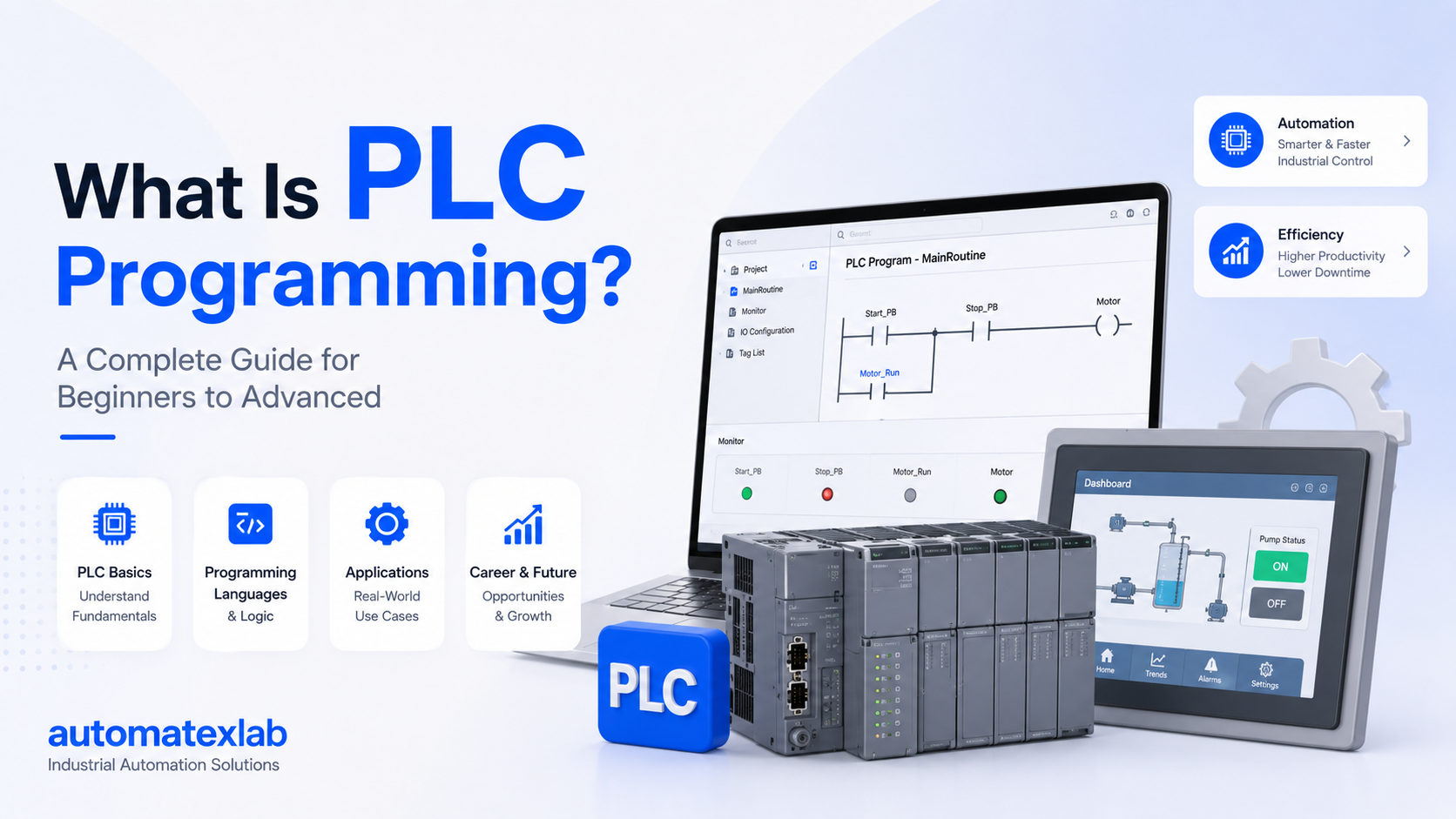
A Programmable Logic Controller is an industrial digital computer designed for the control of manufacturing processes. Unlike standard computers, PLCs are built to withstand harsh factory environments and operate reliably for years.
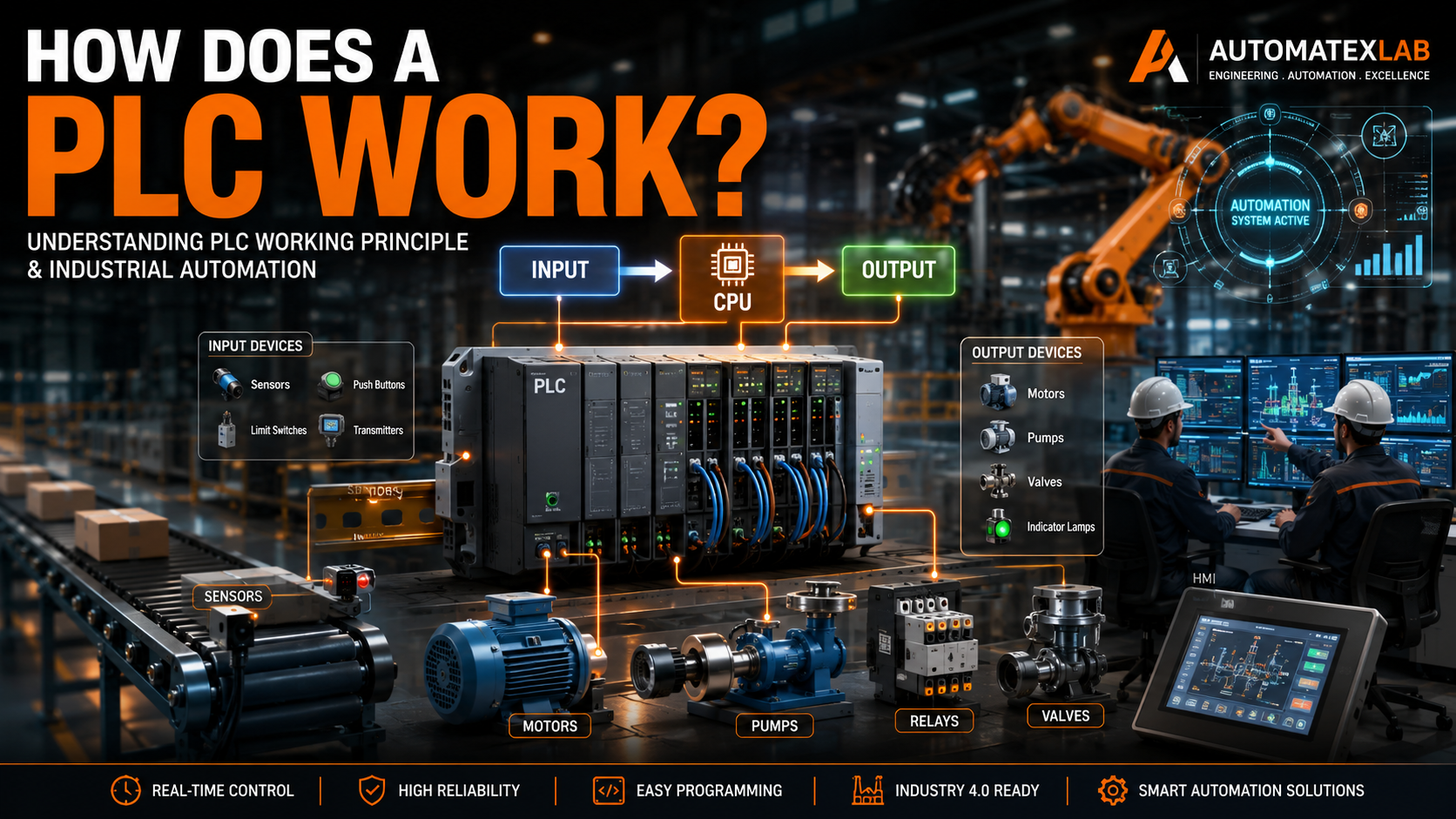
PLC programming is the process of creating the logic that tells industrial machines what to do and when to do it. The PLC receives input signals from sensors, switches, and other devices, processes this information according to the programmed logic, and sends output commands to actuators, motors, valves, and other equipment.
The difference between manual control and PLC-based automation is substantial. With manual control, operators must physically monitor and adjust equipment. PLC-based automation handles these tasks automatically, with greater speed and precision.
Common PLC platforms used in manufacturing include Siemens, Allen-Bradley, Mitsubishi, Omron, and Schneider Electric. Each platform has its strengths, and the right choice depends on your specific application, existing equipment, and integration requirements.
Why PLC Programming Is Critical for Manufacturing Plants
Higher Production Efficiency
PLC programming enables faster machine cycles by eliminating the delays inherent in manual operations. When multiple machines must coordinate their actions, PLCs ensure precise synchronization for seamless material flow. The result is reduced idle time and higher overall throughput. Research on modular production systems shows that optimized PLC programming can achieve 100% accuracy in automated pick and place operations.
Consistent Product Quality
Manual processes inevitably introduce variability. PLCs provide repeatable process control through precise timing, accurate sequence execution, and sensor-based verification. Each product follows the same exact process, eliminating the quality variations that plague manual production.
Reduced Downtime
Modern PLC systems include sophisticated fault detection and diagnostic monitoring capabilities. When issues arise, the PLC can identify the problem quickly, often before it causes a production stoppage. Alarm handling and error logging help maintenance teams respond faster and prevent recurring issues.
Improved Worker Safety
Safety is paramount in manufacturing environments. PLC programming enables safety interlocks that prevent machines from operating when guards are open. Emergency stop logic ensures immediate shutdown when needed. Safety sequencing coordinates machine movements to prevent hazardous situations. These capabilities protect workers while maintaining productivity.
Typical Manufacturing Applications of PLCs
| Manufacturing Area | PLC Application |
|---|---|
| Packaging | Conveyor synchronization and product routing |
| Bottling | Fill level control and capping sequence management |
| Automotive | Assembly sequencing and robotic coordination |
| Food Processing | Batch control and temperature regulation |
| Textile | Motor speed coordination and tension control |
| Chemical | Recipe management and safety interlocking |
PLC Programming Workflow in a Manufacturing Project
Process Study
The first step is understanding your manufacturing process in detail. What machines are involved? What sequence of operations is required? What are the critical parameters? This analysis forms the foundation for effective PLC programming.
I/O List Preparation
Next, we identify all input and output devices the PLC must interface with. Inputs include sensors, push buttons, limit switches, and safety devices. Outputs include motors, valves, solenoids, indicator lights, and alarms. This I/O list becomes the blueprint for hardware configuration.
Control Strategy Design
With the process understood and I/O defined, we design the control strategy. How should the system respond to different inputs? What sequences must be followed? What happens in fault conditions? This phase establishes the logical framework for programming.
PLC Logic Development
This is where programming happens. Using ladder logic, structured text, or other programming languages, we translate the control strategy into executable code. Experienced programmers follow modular approaches that make the code easier to maintain and modify.
HMI Integration
Human Machine Interfaces allow operators to monitor and interact with the automation system. HMI screens display process information, alarm conditions, and production data. They also provide controls for starting, stopping, and adjusting operations.
SCADA Connectivity
For plants with multiple machines or entire production lines, SCADA systems provide centralized monitoring and control. SCADA collects data from PLCs, displays it in real time, and enables supervisory control from a central location.
Factory Acceptance Testing (FAT)
Before shipping to your facility, the system undergoes factory acceptance testing. We simulate your process and verify that all logic works correctly under all conditions. This catches issues early when they are easier and cheaper to fix.
Site Commissioning
On-site and remote commissioning involves installing the system, connecting to your equipment, and fine-tuning parameters. We work alongside your team to ensure smooth startup and minimize production disruption.
Operator Training
Your operators need to understand the new system. We provide comprehensive training covering normal operations, fault handling, and basic troubleshooting. This ensures your team can run the system confidently.
Practical Example: Automating a Conveyor and Packaging Line
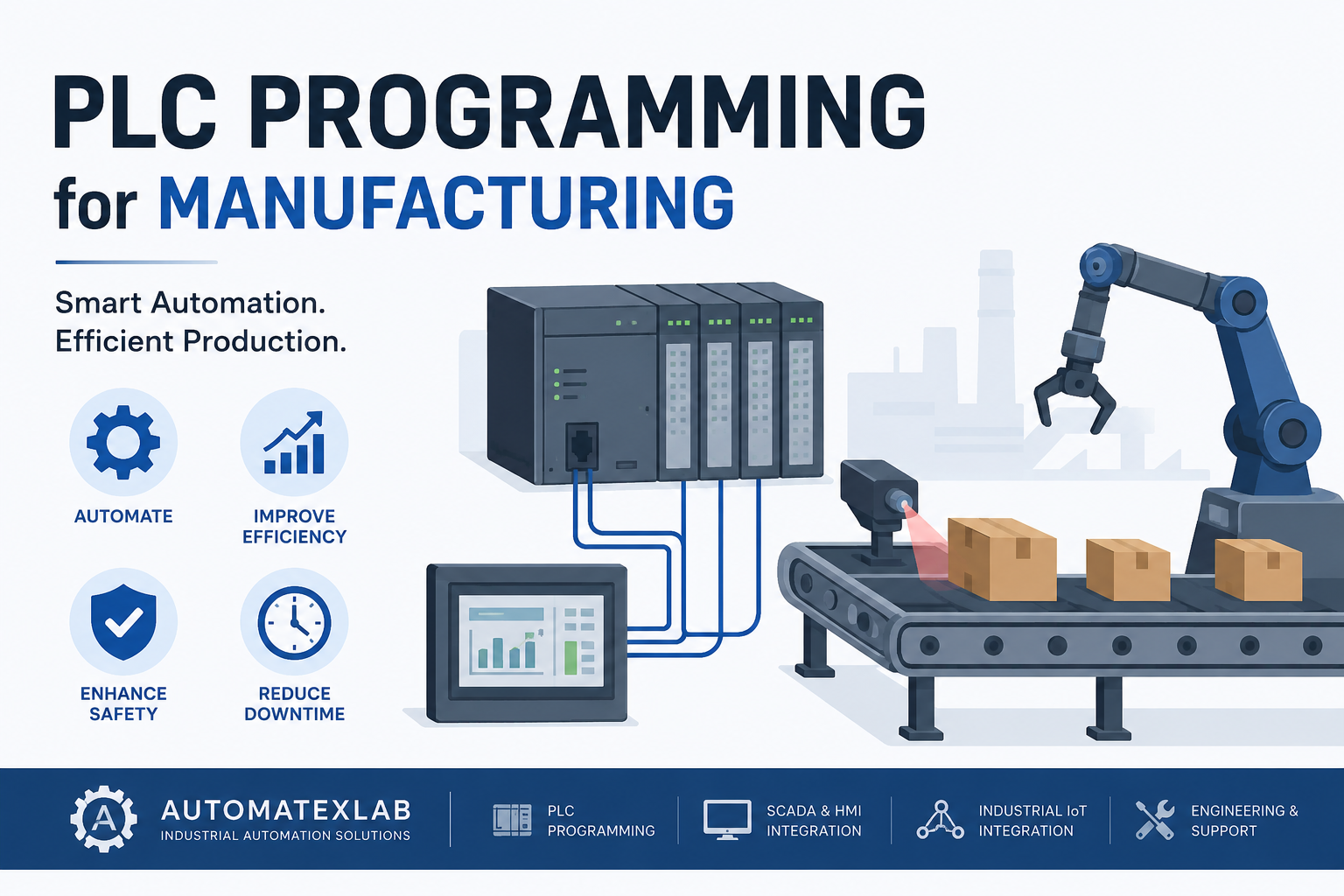
Consider a packaging line where products move on a conveyor to a boxing station. The PLC controls conveyor speed based on product flow, coordinates the box erecting and sealing stations, verifies fill levels using sensors, and rejects defective products automatically. The result is a smooth, high-speed packaging operation that requires minimal operator intervention.
Ladder Logic vs Structured Text: Which Is Better?
| Feature | Ladder Logic | Structured Text |
|---|---|---|
| Ease of maintenance | High | Medium |
| Complex calculations | Limited | Excellent |
| Troubleshooting | Easy | Moderate |
| Manufacturing adoption | Very common | Growing |
Ladder logic has been the standard in manufacturing for decades because of its visual nature and ease of troubleshooting. Maintenance technicians can quickly understand ladder diagrams and trace problems. Structured text offers more power for complex mathematical operations and data handling. Many modern plants use a hybrid approach, using ladder logic for discrete control and structured text for complex functions.
Common PLC Programming Mistakes in Manufacturing
Poor Alarm Design results in operators ignoring critical warnings because of frequent nuisance alarms.
Hard-Coded Values make systems rigid and difficult to adjust when production requirements change.
No Modular Programming leads to monolithic code that is difficult to maintain, debug, and modify.
Missing Safety Interlocks can expose workers to unnecessary risks and potential regulatory violations.
Inadequate Documentation makes future upgrades and troubleshooting much more difficult and expensive.
Ignoring Future Expansion means new equipment integration becomes a major reengineering project.
At AutomatexLab, we follow industrial programming standards and scalable architecture. Our modular approach ensures your automation system remains maintainable, flexible, and ready for future expansion.
PLC Programming + SCADA + IIoT: The Modern Manufacturing Stack
Industry 4.0 has transformed manufacturing automation. Here is how the modern stack works together:
PLC provides machine-level control, executing logic in real time to operate equipment.
HMI gives operators visibility into machine status and controls for intervention when needed.
SCADA enables plant-wide monitoring, data collection, and supervisory control across multiple machines and production lines.
IIoT connectivity allows PLCs to transmit production data to cloud platforms for storage, analysis, and remote access.
Analytics transform production data into actionable insights for continuous improvement, predictive maintenance, and quality optimization.
This integrated approach delivers real-time visibility, data-driven decision making, and the agility to respond quickly to changing production requirements.
When Should a Manufacturer Upgrade PLC Logic?
Frequent Production Stoppages indicate your current logic may not be handling edge cases effectively.
Obsolete PLC Hardware makes spare parts difficult to find and support nearly impossible to obtain.
Manual Data Recording means you are missing opportunities for data-driven improvement and quality tracking.
Inconsistent Cycle Times suggest your control logic may be inefficient or not accounting for variations.
Difficulty Integrating New Machines indicates your existing architecture was not designed for scalability.
Lack of Remote Monitoring prevents quick diagnosis and response when production issues occur off-hours.
If these signs sound familiar, it is time to evaluate your automation infrastructure.
How AutomatexLab Helps Manufacturing Plants
PLC Programming Services for Manufacturing
PLC Logic Development creates robust, efficient control programs that optimize machine performance.
Machine Automation delivers complete automation solutions for individual machines or entire production lines.
SCADA and HMI Integration provides plant-wide visibility and operator interfaces that improve decision making.
Industrial Communication Setup handles Modbus, PROFINET, EtherNet/IP, and other protocols for reliable device connectivity.
PLC Migration and Upgrades modernizes legacy systems with minimal production disruption.
Commissioning and Troubleshooting ensures your system starts up smoothly and performs reliably.
Remote Support for Manufacturing Plants provides rapid assistance when issues arise, minimizing downtime.
Why Manufacturers Choose AutomatexLab
Practical Factory-Floor Experience means we understand the realities of production environments.
Vendor-Neutral Automation Approach ensures we recommend solutions based on your needs, not our preferences.
Scalable PLC Architecture accommodates future expansion and new equipment integration.
Clear Documentation makes your system easy to understand, maintain, and modify.
Faster Commissioning reduces startup time and gets your production running sooner.
Focus on Production Reliability means your system stays operational with minimal interruptions.
Real-World Example: Packaging Line Automation
Challenge
A packaging manufacturer was experiencing frequent jams and inconsistent product spacing on their packaging line. Production output was inconsistent, and maintenance teams spent excessive time clearing jams and resetting the system.
Solution
Our team implemented a PLC-based automation solution with sensor feedback and variable-speed conveyor control. The PLC monitors product flow using sensors and adjusts conveyor speeds dynamically to maintain consistent spacing. The control logic coordinates upstream and downstream equipment to prevent bottlenecks.
Result
- 18% higher throughput from eliminating jams and optimizing conveyor speeds
- 40% reduction in downtime from fewer jams and faster recovery when issues occur
- Significantly reduced maintenance calls for jam clearing and system resets
- Improved product quality from consistent handling and reduced damage
Conclusion
PLC programming is a productivity investment that delivers measurable returns through higher efficiency, consistent quality, reduced downtime, and improved safety. Manufacturers who embrace automation gain competitive advantages that are increasingly difficult to match with manual processes.
If your manufacturing plant is facing frequent downtime, manual operations, or production bottlenecks, AutomatexLab can help design and implement a PLC automation solution tailored to your process. Whether you need new PLC programming, SCADA integration, machine retrofitting, or automation troubleshooting, our team focuses on practical solutions that improve reliability and production efficiency.
Contact AutomatexLab Today
Ready to transform your manufacturing operations with reliable industrial automation? AutomatexLab specializes in PLC programming, SCADA development, HMI design, and turnkey industrial automation projects that help manufacturers improve productivity and reduce downtime .
What We Deliver:
- Custom PLC logic development for new and existing equipment
- SCADA and HMI integration for plant-wide visibility
- Machine retrofitting and automation upgrades
- Industrial communication setup (Modbus, PROFINET, EtherNet/IP)
- Commissioning, troubleshooting, and remote support
Why Manufacturers Trust AutomatexLab:
- Practical factory-floor experience
- Vendor-neutral approach
- Scalable, well-documented automation architecture
- Focus on production reliability and faster commissioning
Let’s discuss your manufacturing process and design a PLC automation solution tailored to your needs. Contact AutomatexLab for a consultation.
FAQs
PLC programming creates the logic that controls industrial machines and processes. The PLC reads inputs from sensors, processes this information according to the program, and sends commands to outputs like motors and valves. This automation reduces human error and improves production consistency.
PLC automation typically reduces downtime by 30 to 50 percent through better fault detection, faster troubleshooting, and more reliable operation. The exact reduction depends on your current process and how effectively the automation is implemented.
The best brand depends on your application, existing equipment, and integration requirements. Siemens and Allen-Bradley dominate many manufacturing sectors, while Mitsubishi and Omron are strong choices in specific industries. AutomatexLab works with all major brands and recommends based on your needs.
Yes, most older machines can be retrofitted with PLC controls. This approach preserves your equipment investment while adding modern control capabilities, improved reliability, and better monitoring. Retrofitting is often more cost-effective than replacing machines entirely.
Project duration ranges from weeks to months depending on complexity. A simple single-machine project might take 2 to 4 weeks, while a full production line with multiple machines and SCADA integration could require 3 to 6 months or more.
PLCs provide local, real-time machine control at the millisecond level. SCADA systems provide plant-wide monitoring and supervisory control, collecting data from multiple PLCs for centralized viewing and analysis. They work together, with PLCs handling control and SCADA providing visibility.
Installation and commissioning require production downtime, but we work to minimize disruption through careful planning and scheduling. This often includes off-site testing and staged implementation to reduce on-site downtime.