Industrial automation is commonly divided into two main categories: fixed automation and flexible automation. Fixed automation is built for high-volume production of identical products, while flexible automation lets manufacturers switch between different products with minimal changeover. Each type fits different production goals, budgets, and manufacturing environments, and understanding the difference is one of the first steps toward choosing the right automation strategy for a plant floor.
This guide breaks down both types in detail, covers where each one fits best, and explains the technologies that power them.
What Are the 2 Types of Industrial Automation?
There are two primary types of industrial automation.
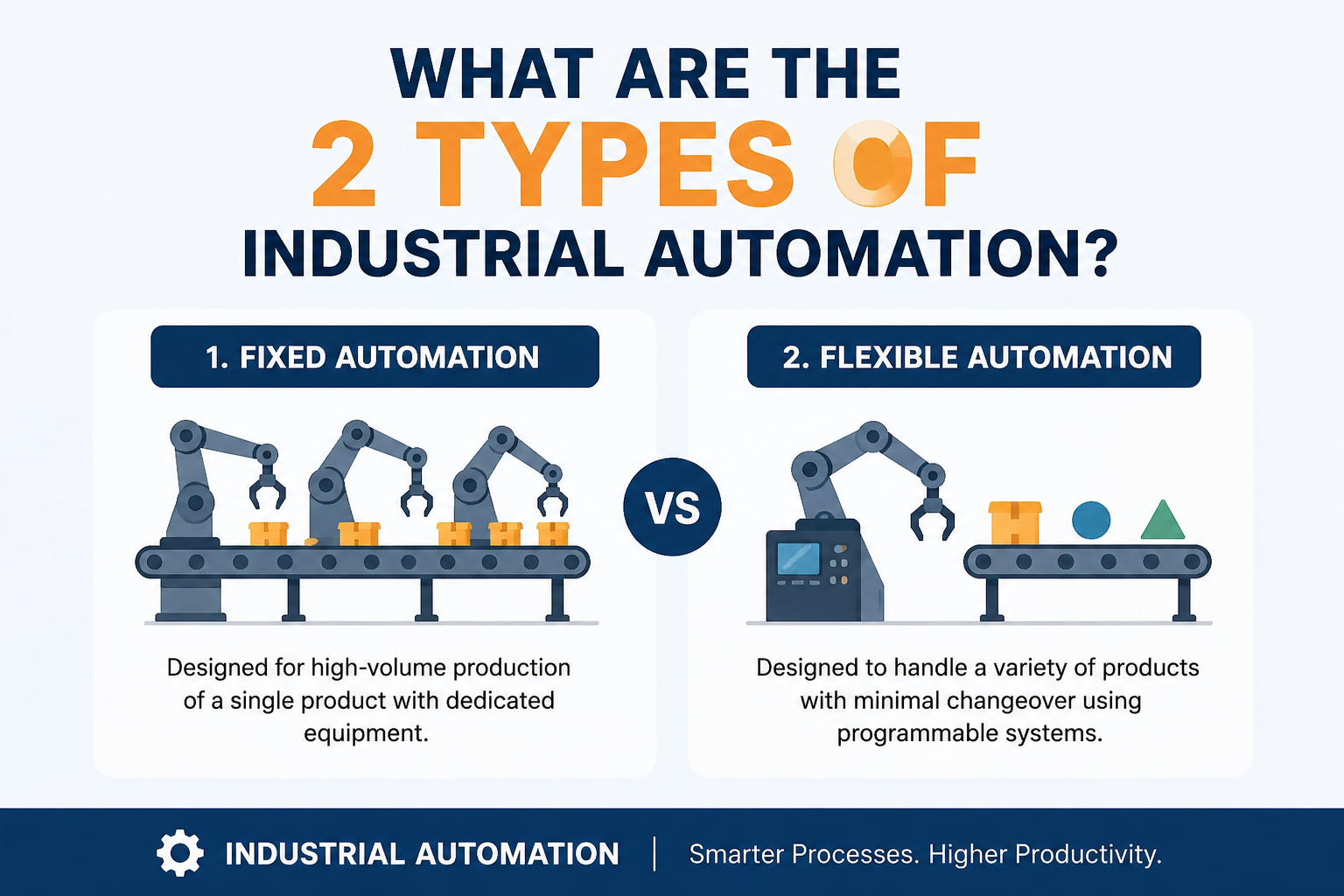
Fixed Automation is dedicated equipment built to perform the same task repeatedly, at high speed, with little to no variation. The machinery is engineered around one specific product or process, and it stays that way for the life of the equipment.
Flexible Automation uses programmable systems that can be reconfigured to handle different products, part variants, or process steps without major equipment changes. Instead of being built around one task, it’s built around adaptability.
The classification comes down to a single question: how easily can the system adapt to a new product or a changing manufacturing requirement? Fixed automation answers “not easily.” Flexible automation answers “quickly, through programming.”
Some engineers also refer to a middle category called programmable automation, which sits between the two. Programmable automation can be reconfigured, but changeovers take longer than they do with flexible automation, often requiring new tooling or a batch-level setup change rather than a simple program switch. For the purposes of this guide, the focus stays on the two dominant types most manufacturers plan around: fixed and flexible.
Why Is Industrial Automation Classified Into Two Types?
The split exists because no single automation approach works for every factory. A plant bottling the same beverage twenty-four hours a day has completely different needs than a contract electronics manufacturer building small batches of different circuit boards every week. A few factors decide which type makes sense for a given operation.
Production volume is usually the first consideration. High-volume, single-product lines favor fixed automation because the cost of dedicated equipment gets spread across millions of identical units. Lower-volume, multi-product lines favor flexible automation because dedicated tooling for every variant would be prohibitively expensive.
Product variety matters just as much as volume. Plants making one product for years at a time benefit from dedicated tooling built specifically for that product’s dimensions, materials, and tolerances. Plants that need to switch between many product variants need programmable systems that can adjust without a full mechanical rebuild.
Equipment flexibility describes how locked-in the machinery is. Fixed systems are mechanically built around one process, so changing what they do usually means replacing or re-engineering hardware. Flexible systems use software and reprogrammable hardware, such as robotic arms with interchangeable end effectors or CNC machines running different programs, to change what they do without new equipment.
Manufacturing cost behaves differently across the two types. Fixed automation usually has a lower cost per unit at scale because the equipment runs continuously without reprogramming overhead. Flexible automation costs more per unit on average, but it avoids the sunk cost of building new dedicated lines every time a product changes.
Changeover requirements are often the deciding factor in fast-moving industries. Switching a fixed line to a new product can take weeks of retooling, recalibration, and testing. Switching a flexible line can take minutes or hours, since much of the change happens through software rather than physical rebuilds.
Manufacturers weigh all five factors together, not in isolation. A plant with high volume but frequent minor product updates, like an automotive body shop that produces several vehicle trims on one platform, often ends up using a hybrid of both types rather than choosing one exclusively.
Type 1: Fixed Automation
Fixed automation is designed for mass production, where the same product moves through the same sequence of operations continuously, using dedicated machinery built for that exact task. It is sometimes called hard automation, because the process is mechanically hard-wired into the equipment rather than controlled through flexible software logic.
The defining traits of fixed automation are dedicated equipment, a predefined operating sequence, and minimal human intervention once the line is running. Machines are built to perform one operation, or a fixed set of operations, over and over without variation. Because the mechanical design is optimized for a single task, fixed automation systems typically achieve very high production speed, often far outpacing what a flexible system could match for the same product.
That performance comes at a price. Fixed automation requires a high initial investment, since every station on the line is custom engineered rather than pulled from a general-purpose catalog. The payoff comes from volume. Once the capital cost is spread across millions of units, the cost per unit drops well below what flexible automation could achieve for the same product.
Best used for:
- Automotive assembly, particularly body-in-white welding and stamping operations where the same panel geometry repeats on every unit
- Beverage bottling, where fill volume, cap torque, and label placement never change
- Cement plants, where the production process is continuous and largely unchanging
- Paper mills, where pulping, pressing, and rolling follow the same sequence around the clock
- Steel production, where casting and rolling operations are standardized around a narrow set of product specifications
Advantages of Fixed Automation
Fixed automation delivers a high production rate because the mechanical process never pauses for reconfiguration. Every cycle repeats the same motion at the same speed, which keeps output predictable and easy to forecast.
Consistent quality follows naturally from that repetition. Because the same mechanical process executes every cycle, part-to-part variation stays extremely low, often lower than what a human operator or a flexible system could achieve on a comparable task.
Labor cost stays low, since the system needs few operators to run once it’s commissioned. Most of the labor investment happens upfront, during installation and calibration, rather than during ongoing operation.
Reliability is strong in fixed automation because the mechanical systems are purpose-built and well understood. Maintenance teams know exactly what to expect from the equipment, which shortens troubleshooting time when something does go wrong.
Repeatability is high, which matters enormously in industries like automotive and pharmaceuticals, where regulatory bodies expect tight tolerances on every unit produced. And because volume amortizes the initial investment, the cost per unit drops significantly at scale, often becoming the cheapest production method available for that specific product.
Limitations of Fixed Automation
The upfront investment is expensive. Every station, conveyor, and fixture on a fixed automation line is engineered for one product, which means none of that capital cost can be recovered by repurposing equipment for something else.
The equipment is also difficult to modify once installed. A minor design change to the product, such as a new bottle shape or a revised panel dimension, can require re-engineering entire sections of the line rather than a simple software update.
Fixed automation isn’t suited to customized or low-volume products. If a manufacturer needs to produce even small variations of a product, the fixed line either can’t accommodate the change or requires a costly retrofit to do so.
Implementation timelines tend to be long. Designing, building, installing, and commissioning a fixed automation line often takes months, sometimes longer for complex processes like automotive body shops, before the line reaches full production speed.
Real-World Examples of Fixed Automation
A car assembly line welds and joins the same body panels on every unit that passes through, using robotic welders positioned in a fixed sequence that never changes for that model.
A bottle filling plant runs the same fill, cap, and label sequence thousands of times a day, with each station tuned to one bottle size and one fill volume.
PCB assembly lines place identical components on identical boards at high speed, using pick-and-place machines calibrated to one board layout.
Food packaging conveyors move product through the same weighing, sealing, and labeling sequence continuously, day after day, without any change to the process.
High-speed pharmaceutical packaging lines follow the same logic. One product, one blister pack design, one process, repeated continuously under tightly controlled conditions to meet regulatory requirements.
Type 2: Flexible Automation
Flexible automation uses programmable machines and control systems that can switch between different products with minimal downtime. Instead of being mechanically locked to one task, the system is reconfigured through software, tooling changes, or programmed instructions. It’s sometimes called soft automation, since the logic that governs the process lives in software rather than in the physical layout of the machine.
This type of automation typically relies on PLC-controlled systems for logic and sequencing, robotics for handling and assembly, CNC machines for machining operations, machine vision for inspection and part identification, servo systems for precise motion control, and industrial IoT integration for real-time monitoring and data collection. Together, these technologies let a single line handle multiple product variants without a full mechanical rebuild between runs.
Advantages of Flexible Automation
Flexible automation supports a high product variety, since the same equipment can be reprogrammed to handle different part geometries, materials, or assembly sequences. A manufacturer can run one product in the morning and switch to a different one in the afternoon without installing new machinery.
Faster changeovers between runs are one of the biggest draws of flexible automation. Where a fixed line might need weeks to retool, a flexible line can often switch products in minutes or hours through a program change and a tooling adjustment.
Less downtime follows directly from those fast changeovers. Manufacturers running multiple product lines on shared equipment lose far less production time to reconfiguration than they would with dedicated fixed lines for each product.
Flexible automation supports customization at scale, which has become increasingly important as customers expect more product variety and shorter lead times. Automotive manufacturers building multiple trim levels on one platform, or electronics manufacturers producing several board revisions, depend on this kind of adaptability.
Better resource utilization rounds out the advantages. Since the same equipment serves multiple product lines, capital investment gets spread across a wider range of output rather than sitting idle between runs of a single product.
Limitations of Flexible Automation
Programming these systems is more complex than setting up fixed equipment. Every product variant needs its own program, and engineers have to account for tolerances, tooling changes, and sequencing differences across all of them.
Maintenance tends to cost more, since flexible systems rely on a broader mix of sensors, servo drives, vision systems, and control software, all of which need ongoing calibration and updates.
Skilled operators are needed to manage changeovers and troubleshoot issues. Unlike fixed automation, where operators mostly monitor a stable process, flexible automation requires staff who understand programming, tooling changes, and system diagnostics.
The systems also carry a higher dependency on software that has to be maintained and updated. A bug in a control program or an outdated PLC firmware version can bring an entire flexible line to a stop across every product it runs, not just one.
Real-World Examples of Flexible Automation
CNC machining centers can be reprogrammed to cut entirely different part geometries, switching from one machined component to another with a new program and a tooling change rather than a new machine.
Robot welding cells adjust weld paths for different vehicle models on the same line, using programmed motion sequences that shift based on which model is currently moving through the station.
Flexible packaging lines switch between package sizes and formats without retooling from scratch, adjusting servo-driven forming and sealing stations through software rather than mechanical replacement.
Electronics manufacturing depends heavily on this adaptability, since board designs change frequently and production runs are often smaller than in industries like automotive.
Pharmaceutical batch production also relies on flexible automation, since different drug formulations and packaging formats need to run on shared equipment while maintaining strict regulatory compliance for each batch.
Fixed Automation vs Flexible Automation
| Feature | Fixed Automation | Flexible Automation |
|---|---|---|
| Production Volume | Very High | Medium to High |
| Product Variety | Low | High |
| Initial Cost | High | High |
| Changeover Time | Long | Very Short |
| Programming | Minimal | Extensive |
| Flexibility | Low | High |
| Best For | Mass Production | Custom Manufacturing |
Both types require significant capital investment, which surprises manufacturers new to automation planning. The difference isn’t that one is cheap and the other expensive, it’s where the money goes. Fixed automation spends heavily on dedicated mechanical engineering. Flexible automation spends on programmable hardware and the software layer that controls it.
Which Type of Industrial Automation Should You Choose?
The right choice depends on a few practical factors that every plant manager should evaluate before committing capital to either approach.
Production volume is the starting point. High, steady volume of one product points toward fixed automation, since the mechanical investment pays off through sheer unit count. Variable volume across multiple products points toward flexible automation, since dedicated tooling for each product wouldn’t be cost effective.
Product variety matters just as much. If the product line will stay the same for years, fixed automation pays off through low per-unit cost and high reliability. If products change seasonally, by customer order, or through frequent design revisions, flexible automation is the safer long-term bet.
Future expansion plans should factor into the decision as well. Flexible systems are easier to scale into new product lines without a full equipment overhaul, which matters for manufacturers expecting to grow their product catalog over the next several years.
Budget considerations go beyond the sticker price. Fixed automation often has a lower cost per unit long-term but requires more capital upfront for a single purpose, with limited resale or repurposing value if the product gets discontinued. Flexible automation spreads cost differently, with hardware costs paired against ongoing software licensing, programming labor, and system updates.
Downtime tolerance should also weigh into the decision. Fixed lines have long changeover windows if a product needs to change, which can shut down production for weeks. Flexible lines are built specifically to minimize that downtime, often switching products within a single shift.
ROI expectations differ meaningfully between the two. Fixed automation reaches ROI faster at high, stable volumes, since the equipment runs at maximum output with minimal interruption. Flexible automation reaches ROI more gradually, through adaptability and reduced retooling costs that add up over multiple product cycles rather than a single high-volume run.
Many manufacturers find that neither type alone covers every need, which is why hybrid lines combining both approaches have become increasingly common across industries like automotive, food processing, and packaging.
Common Industries Using These Automation Types
| Industry | Fixed | Flexible |
|---|---|---|
| Automotive | Yes | Yes |
| Food Processing | Yes | Yes |
| Pharmaceuticals | Yes | |
| Electronics | Yes | |
| Packaging | Yes | Yes |
| Steel | Yes | |
| Textile | Yes |
Automotive, food processing, and packaging show up in both columns because these industries often combine fixed and flexible stations on the same production line. A car body shop might use fixed automation for welding a common chassis platform, then switch to flexible automation for final assembly, where trim-specific components vary between vehicle configurations.
Pharmaceuticals, electronics, and textiles lean almost entirely toward flexible automation, since product specifications in these industries change frequently and batch sizes tend to be smaller than in heavy industries like steel.
Steel production sits firmly on the fixed automation side, since the casting and rolling processes involved are highly standardized and rarely change once a plant is built around a particular product specification.
Technologies Used in Both Types
Both fixed and flexible automation systems draw from the same core toolkit of industrial technologies. What differs is how these technologies are configured and controlled.
PLCs, or programmable logic controllers, handle the core logic and sequencing in both types, though flexible systems rely on them more heavily for multi-product program switching.
HMIs, or human-machine interfaces, give operators visibility into the process and allow adjustments, with flexible systems typically offering more configurable HMI screens to manage multiple product programs.
SCADA systems collect and display data across the plant floor, monitoring everything from cycle times to fault conditions, regardless of which automation type is running underneath.
Industrial robots appear in both types, but fixed automation uses them for single, repeated tasks, while flexible automation uses them with interchangeable end effectors and reprogrammable motion paths.
Servo motors provide precise motion control, and flexible automation depends on them more heavily since motion parameters often need to change between product variants.
Sensors monitor process conditions, part presence, and quality metrics across both types, feeding data back into the control system in real time.
VFDs, or variable frequency drives, control motor speed and are used in both types, though flexible systems often adjust VFD parameters dynamically based on which product is running.
Industrial Ethernet networks tie all of these components together, enabling the real-time communication that both fixed and flexible systems need to operate reliably.
Vision systems handle inspection and quality control, and they play a larger role in flexible automation, where part identification and defect detection need to adapt across multiple product types.
Industrial IoT ties the whole system together with real-time monitoring and data collection, feeding information that helps manufacturers optimize both fixed and flexible processes over time.
Benefits of Industrial Automation Regardless of Type
Whether a plant runs fixed or flexible automation, the core benefits carry over across both approaches.
Higher productivity comes standard with any well-implemented automation system, since machines can run continuously without the fatigue or variability that comes with manual labor.
Improved product quality results from the consistency automated systems provide, reducing the defect rates that come with manual variation.
Better worker safety follows naturally when automated systems take over repetitive, physically demanding, or hazardous tasks that previously required direct human involvement.
Reduced downtime applies differently to each type, but both benefit from predictive maintenance capabilities that modern automation systems increasingly include.
Lower operational costs emerge over time as labor requirements shrink and production efficiency improves, regardless of which automation approach a plant uses.
Improved data collection has become a defining feature of modern automation, with both fixed and flexible systems now commonly integrated with SCADA and IoT platforms that track performance in real time.
Faster production cycles result from the elimination of manual bottlenecks, whether that comes from a fixed line running at maximum mechanical speed or a flexible line minimizing changeover time between products.
Better energy efficiency rounds out the list, as modern automated systems increasingly incorporate energy monitoring and optimization features that reduce waste across the production process.
Key Takeaways
Industrial automation is broadly categorized into fixed automation and flexible automation. Fixed automation is ideal for high-volume, standardized production, where the same product moves through the same process indefinitely. Flexible automation supports multiple product variants with minimal changeover, using programmable systems that adapt through software rather than mechanical rebuilds.
The right choice depends on production volume, product variety, budget, and long-term manufacturing goals, and there’s no universal answer that fits every plant. Most modern factories end up combining both approaches, using fixed automation where volume and consistency matter most, and flexible automation where product variety and adaptability drive the business. Understanding both types, and the tradeoffs between them, is the foundation for building an automation strategy that actually fits a plant’s production reality rather than a generic template.
Ready to Automate Your Industrial Processes?
Whether you’re upgrading an existing production line or building a new automation system, AutomateXLab helps manufacturers improve productivity, reduce downtime, and optimize operations with reliable industrial automation solutions.
Our engineers specialize in PLC programming, HMI development, SCADA integration, industrial IoT, machine automation, and control system modernization for a wide range of industries.
Why Partner with AutomateXLab?
- Custom automation solutions tailored to your production requirements
- Experienced PLC, HMI, and SCADA engineers
- Support for new installations, upgrades, and troubleshooting
- Industry-standard programming and documentation
- Remote and on-site engineering support
- Scalable solutions designed for long-term reliability
Let’s discuss your automation project. Whether you need a complete control system, process optimization, or expert technical guidance, our team is ready to help.