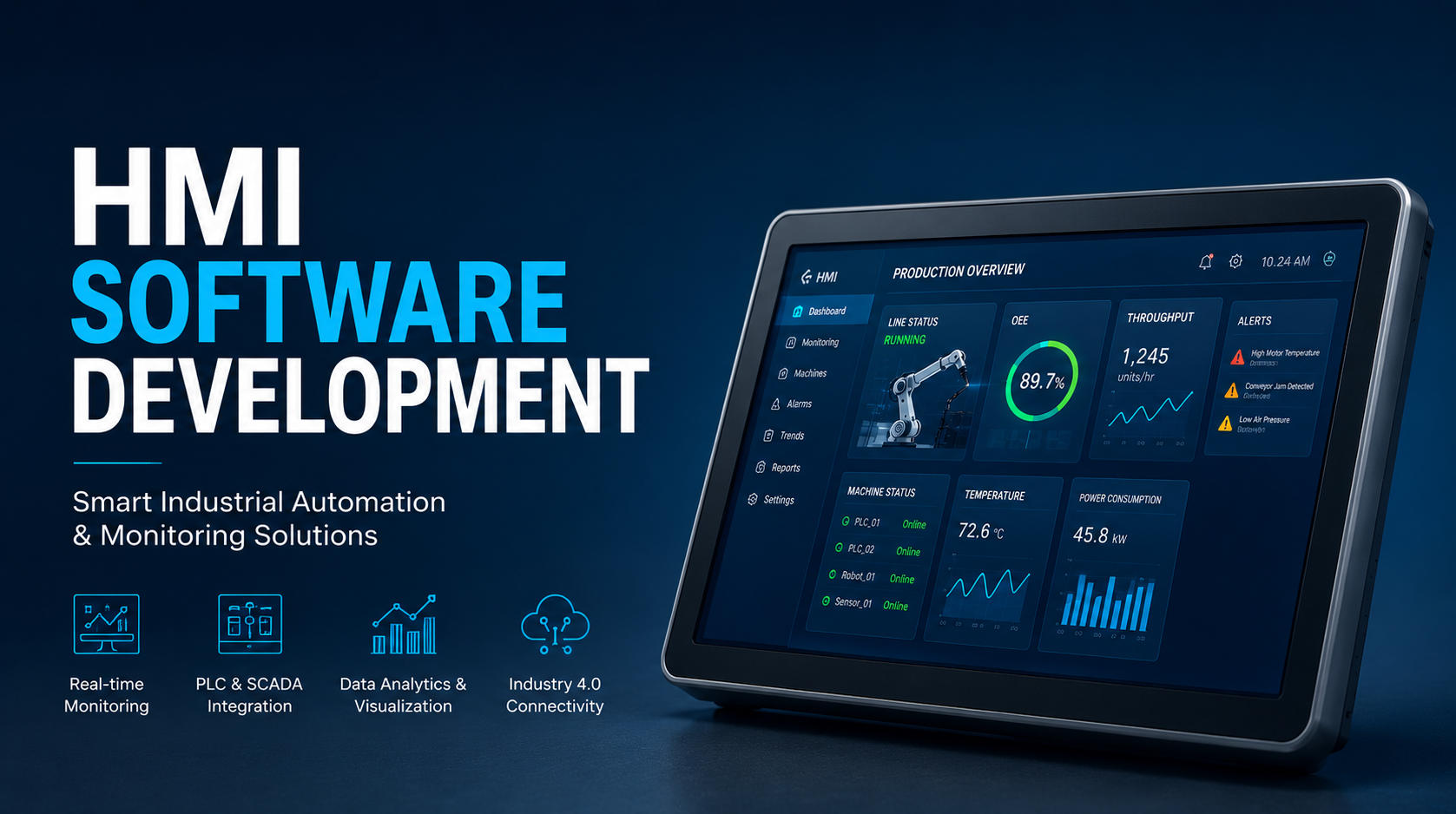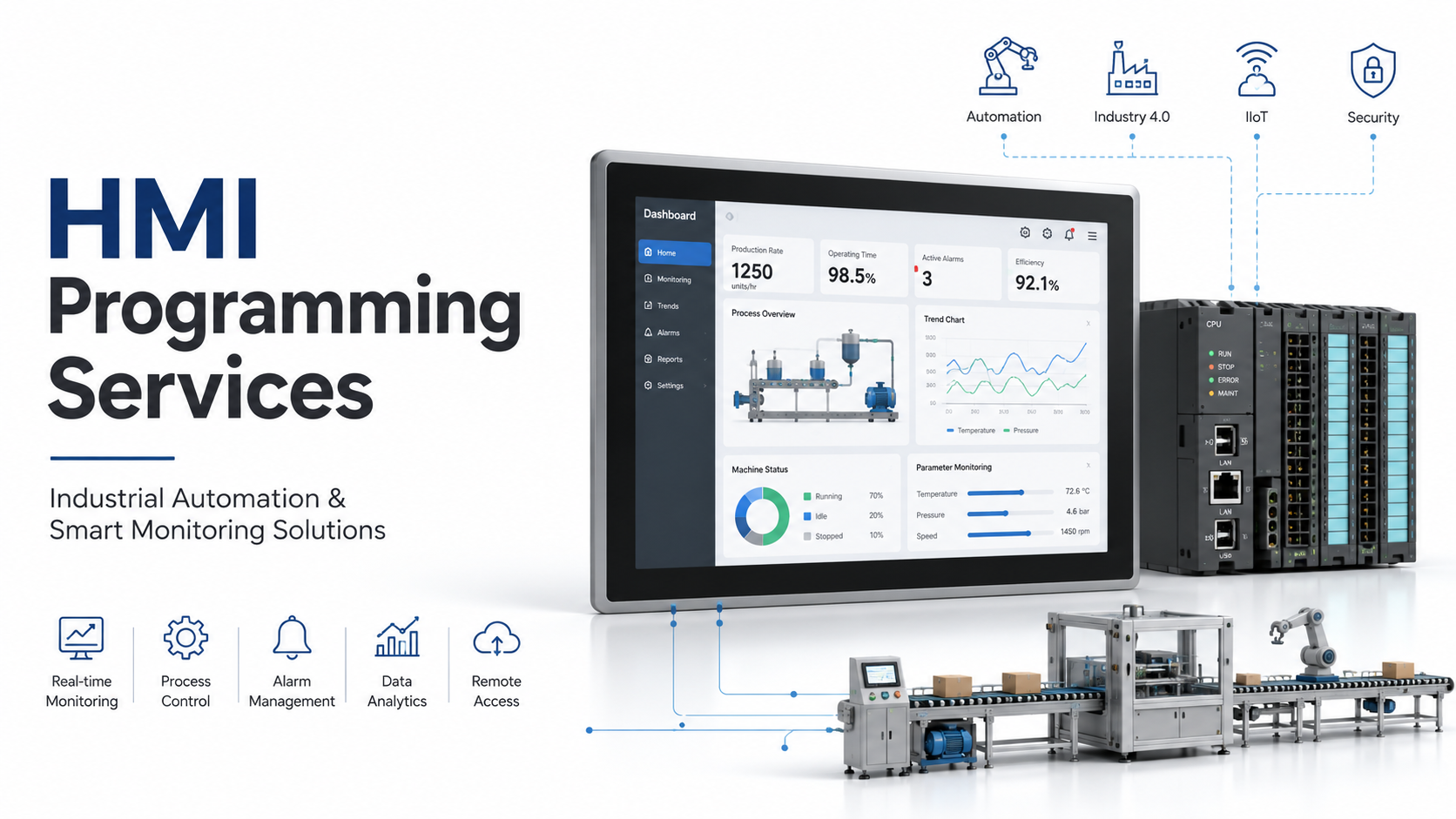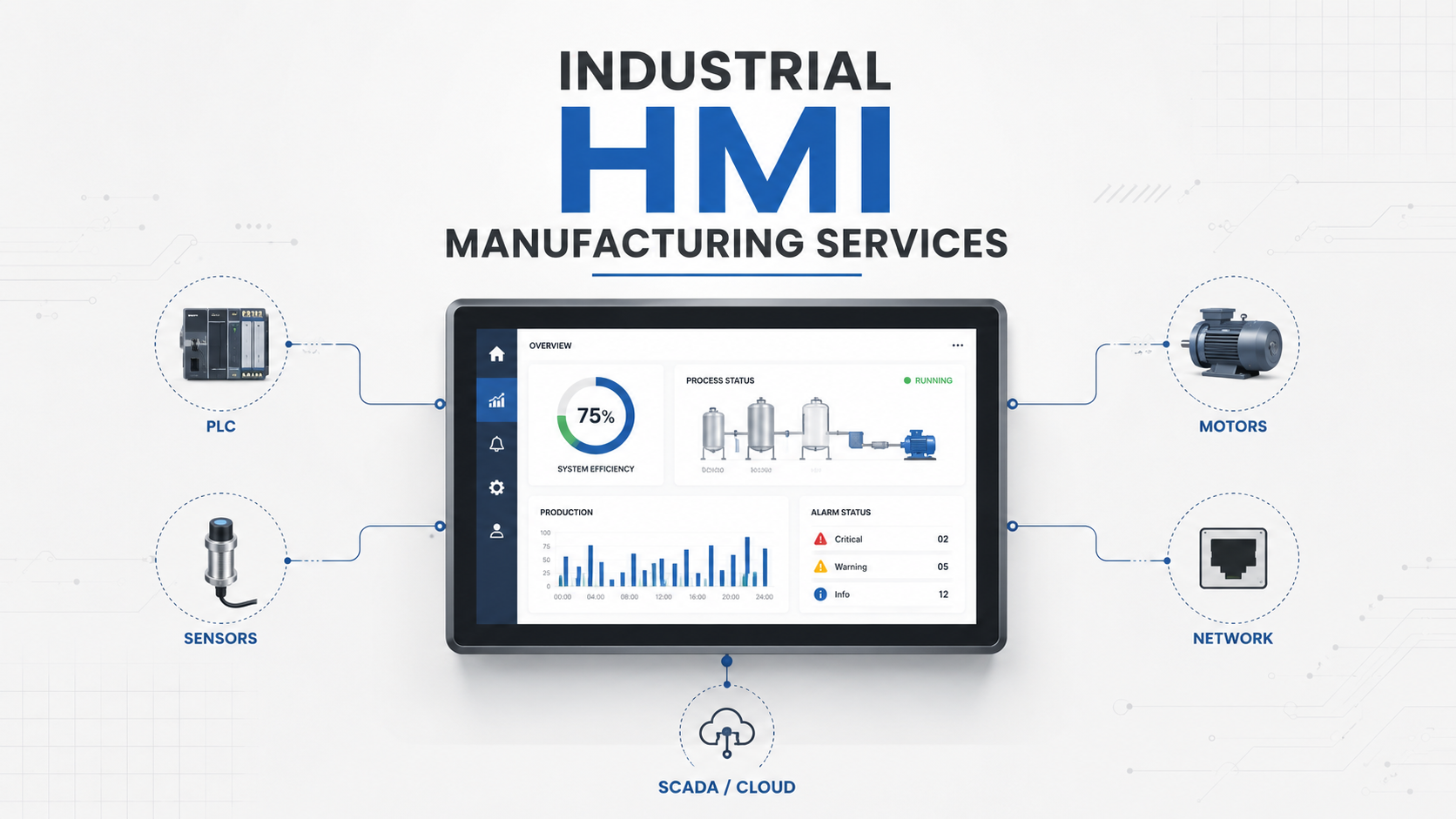
Industrial HMI manufacturing services form the backbone of modern automation environments. At their core, these services cover the full lifecycle of building Human Machine Interface systems, from initial concept and screen design to hardware selection, software configuration, system testing, and live deployment. An HMI is the visual and interactive layer that sits between an operator and the machinery or process they are responsible for running. Without a well-engineered interface, even the most sophisticated automation system becomes difficult to monitor, troubleshoot, or control effectively.
Modern HMI manufacturing goes well beyond simply placing buttons and indicators on a screen. It involves deep process understanding, communication architecture planning, alarm strategy design, and rigorous testing before any system goes live. Engineers must account for environmental conditions, operator skill levels, safety regulations, and the specific requirements of the underlying automation hardware. The result is a purpose-built interface that makes complex industrial processes readable and actionable in real time.
As industrial environments evolve toward greater connectivity and data visibility, the demand for well-designed HMI systems has grown significantly. Organizations running food processing lines, water treatment facilities, pharmaceutical production, or discrete manufacturing operations all depend on reliable interfaces to keep operations running safely and efficiently. This guide covers what industrial HMI manufacturing services involve, how these systems are built, what makes them effective, and what to look for when selecting a development partner.
What Are Industrial HMI Manufacturing Services?
Industrial HMI manufacturing services refer to the end-to-end process of designing, developing, and deploying Human Machine Interface systems for use in industrial and process automation environments. Unlike consumer-facing interfaces designed for general audiences, industrial HMIs are engineered for specific operational contexts where reliability, clarity, and speed of decision-making directly affect safety and output.
A consumer interface on a smartphone or web application can tolerate occasional lag, ambiguous navigation, or visual inconsistency. An industrial HMI cannot. When an operator on a production floor needs to identify a fault condition, isolate the affected zone, and respond appropriately, every second matters. The interface must communicate the right information clearly, without cognitive overload, and without technical failures.
The relevance of HMI systems has grown considerably in the context of Industry 4.0. As factories adopt IIoT sensors, edge computing devices, and cloud-connected data platforms, the HMI becomes the primary point where a human operator interacts with an increasingly complex and data-rich automation layer. A well-engineered HMI does not just display data. It contextualizes it, filters noise, surfaces priority information, and supports better decision-making at the operator level.
How Industrial HMI Systems Work
An industrial HMI functions as the communication layer between an operator and the automation systems running a process. Those underlying systems typically include PLCs, SCADA platforms, variable frequency drives, sensors, and industrial network infrastructure. The HMI reads live data from these devices, displays it in a meaningful visual format, and allows the operator to issue commands that feed back into the control system.
The core functions of an industrial HMI break down into five areas:
Data Acquisition involves continuously reading tag values from connected devices. These tags represent physical measurements like temperature, pressure, flow rate, motor speed, or valve position.
Visualization translates raw tag data into graphical representations. This includes animated process diagrams, trend charts, status indicators, numerical displays, and dashboards.
Command Execution allows operators to interact with the process. Starting and stopping equipment, adjusting setpoints, switching operating modes, and acknowledging alarms are all executed through the HMI interface.
Alarm Management monitors process values and system states against defined limits. When a value crosses a threshold or a fault condition occurs, the HMI generates an alarm that requires operator attention.
Reporting Functions log historical data, generate shift reports, track downtime events, and provide trend analysis for process improvement purposes.
Key Components of an Industrial HMI System
HMI Hardware
The physical hardware in an industrial HMI system must be selected with the operating environment in mind. Options range from dedicated industrial touch panels and operator terminals to panel PCs and ruggedized displays. Hardware ratings matter significantly. Environments with high dust levels, moisture, vibration, or extreme temperatures require hardware that meets appropriate IP and NEMA protection standards. Screen size decisions depend on the volume of information being displayed and the distance from which operators will typically read the interface.
HMI Software
The software layer includes the runtime application that communicates with field devices, the visualization environment where screens are built and maintained, the alarm management system, and historical data logging tools. Most industrial HMI software platforms provide tag databases, scripting environments, built-in communication drivers, and libraries of standard industrial graphics. Configuration decisions at the software level affect performance, scalability, and long-term maintainability of the system.
Communication Infrastructure
HMI systems connect to field devices and control systems through a range of industrial protocols. Ethernet/IP is widely used in Rockwell Automation environments. Modbus TCP and RTU remain common across a broad range of legacy and modern devices. PROFINET serves Siemens-centric architectures. OPC UA is increasingly used as a vendor-neutral standard that allows HMIs to communicate with multiple device types and connect upward to SCADA and cloud platforms without proprietary integration layers.
The Industrial HMI Manufacturing Process
HMI manufacturing follows a structured engineering process. Skipping or compressing any phase tends to create problems that are more expensive to resolve after deployment.
Requirement Analysis
Every project begins with understanding the process being automated and the operational requirements of the people who will use the interface. This phase covers what data needs to be displayed, what commands operators need to execute, what safety interlocks must be visible, and what alarm conditions are most critical. Getting this analysis right prevents expensive redesigns later.
Interface Design
Screen layouts, navigation structure, and alarm strategy are defined before any development begins. Good HMI design at this stage considers how operators move through information during normal operation, how they navigate during fault conditions, and how the interface communicates priority without causing confusion. Many projects involve operators in this phase to validate that the proposed design reflects how work actually happens on the floor.
Hardware Selection
Based on the requirements gathered, appropriate hardware is specified. This includes display size and type, enclosure rating, processor performance requirements, and connectivity options. Hardware choices at this stage affect the budget, the installation timeline, and the long-term serviceability of the system.
Development and Configuration
This is the primary build phase. Engineers create process graphics, configure communication tags, set up alarm limits, build navigation logic, and write any custom scripts required by the application. Communication is established with PLCs and other field devices. Tag mapping is verified against the control system configuration to ensure data accuracy.
Testing and Validation
Before any HMI goes live, it must be tested against defined acceptance criteria. Factory Acceptance Testing verifies that the system meets specifications in a controlled environment. Communication testing confirms that every tag reads and writes correctly. User acceptance testing involves operators working through typical operational scenarios to identify any usability gaps. This phase is essential and should not be treated as optional.
Deployment and Commissioning
Final installation and commissioning involve physical mounting of hardware, final network connections, live communication verification, and operator training. Post-commissioning support in the early days of operation is important because real-world operation often surfaces minor issues that were not apparent during testing.
Essential Features of Modern Industrial HMIs
Modern industrial HMI systems are expected to deliver more than basic process visualization. The following capabilities define a mature, well-engineered system:
Real-time monitoring provides continuously updated process data without perceptible lag. Operators must trust that what they see reflects what is happening in the plant at that moment.
Alarm management in a modern HMI goes beyond simply generating alerts. Effective alarm systems prioritize by severity, suppress nuisance alarms during known transient conditions, log alarm history, and support root cause analysis.
Historical trends allow operators and engineers to review how process variables have behaved over time. This is valuable for process optimization, troubleshooting recurring issues, and meeting regulatory documentation requirements.
Dashboard visualization consolidates key performance indicators from multiple areas of a plant into a single high-level view, giving supervisors and managers visibility without requiring them to navigate through detailed process screens.
Multi-language support is increasingly important in global manufacturing operations where operators may work in different languages across shifts or facilities.
User authentication controls access to different levels of the interface. Operators may be limited to viewing and basic commands, while engineers have access to configuration and calibration functions.
Remote access capabilities allow engineers and support personnel to monitor and troubleshoot systems without requiring physical presence at the machine. This reduces response times and support costs significantly.
Mobile accessibility is growing in industrial environments, allowing supervisors to view process status and receive alarm notifications on tablets or smartphones while moving through a facility.
Benefits of Industrial HMI Solutions
The business case for investing in well-engineered HMI systems rests on several measurable operational improvements.
Improved Operator Efficiency comes from presenting information in a format that reduces cognitive load and speeds up decision-making. When operators can quickly assess system status and understand what action is required, they work faster and with greater confidence.
Reduced Downtime results from better alarm management, faster fault identification, and clearer guidance during recovery procedures. When the interface makes it obvious where a problem is and what the operator needs to do about it, time to resolution decreases.
Better Process Visibility across an entire facility allows management and engineering teams to see performance data that was previously trapped in individual machines or control systems.
Faster Troubleshooting is supported by historical trend data, alarm logs, and clear process visualization. Engineers diagnosing a recurring issue can review exactly what happened leading up to a fault event rather than relying on operator recollections.
Enhanced Safety is one of the most important benefits. Well-designed interfaces reduce operator error by making safety-critical information prominent and by structuring command sequences in ways that prevent accidental activation of hazardous functions.
Data-Driven Decision Making becomes possible when HMI systems feed historical data into reporting tools or enterprise systems, giving operations managers the information they need to optimize production schedules, maintenance intervals, and resource allocation.
Industries That Use Industrial HMI Systems
Industrial HMI systems are used across virtually every sector where automated equipment is operating.
Manufacturing plants use HMIs to manage assembly lines, conveyors, robotic cells, and quality inspection systems. Food and beverage facilities rely on HMIs to control mixing, cooking, filling, and packaging operations while maintaining compliance with food safety documentation requirements. Water and wastewater treatment plants use HMIs to monitor and control pumping stations, chemical dosing systems, filtration processes, and discharge monitoring. Oil and gas operations depend on HMIs in upstream drilling, midstream pipeline management, and downstream refinery operations where process visibility is both an operational and a safety priority. Pharmaceutical production environments use HMIs alongside electronic batch records and process analytical technology to maintain the tight process control required by regulatory standards. Automotive manufacturing relies on HMIs to coordinate high-speed assembly operations, robotic welding, and paint line control. Energy and utilities facilities, including power generation plants and electrical substations, use HMIs to manage generation, distribution, and grid-connected equipment.
HMI Design Best Practices for Industrial Applications
High-performance HMI design has become an established discipline in industrial automation, driven largely by research into how operators respond to visual information under stress. The key principles include:
Situational awareness should be the primary design objective. Every screen element should help the operator understand what is happening right now, what is abnormal, and what requires immediate attention.
Consistent navigation reduces operator training time and prevents errors during high-pressure situations. Operators should be able to find any screen in a predictable number of steps using a consistent menu structure.
Alarm prioritization requires that high-priority alarms are immediately visible and clearly distinguished from low-priority notifications. Flooding operators with alarms of equal visual weight creates alarm fatigue and increases the likelihood of critical events being missed.
Minimal clutter is achieved by removing decorative elements and reducing the use of color to draw attention to information rather than to make screens visually complex. Overly detailed background graphics compete with the dynamic data elements that operators need to read quickly.
Color usage guidelines in high-performance HMI design typically reserve red for abnormal or alarm conditions, use gray as the primary background and equipment color, and apply color sparingly to indicate deviation from normal states rather than to differentiate equipment types.
Operator-centered design means validating screens with the people who will use them. Engineers who design HMI systems do not always have the same operational context as the operators who work with those systems daily. Iterative feedback during the design phase improves the final product significantly.
Common Challenges in Industrial HMI Projects
Communication Issues are among the most frequently encountered technical challenges. Timing mismatches between communication cycles, incorrect tag addressing, and protocol incompatibilities can cause data errors that are difficult to trace.
Legacy System Integration presents a common problem in facilities that have been operating for many years. Older PLCs and control systems may use communication protocols or hardware interfaces that require additional gateways or custom drivers to connect with modern HMI platforms.
Operator Adoption can slow down the intended benefits of a new HMI system. When operators are accustomed to an older interface, even a technically superior replacement may be resisted if it changes established workflows without sufficient training and change management.
Cybersecurity Concerns have become significant as industrial networks become more connected. HMI systems that were historically isolated from corporate networks and the internet are now often connected to both, creating attack surfaces that must be managed through network segmentation, access control, and regular patching.
Scalability Limitations emerge when a system designed for a specific application needs to expand. Systems built without scalability in mind may require expensive redesigns when additional equipment or new process areas need to be integrated.
Maintenance Complexity over the long term is a real operational cost. Systems built on obsolete software platforms, undocumented configurations, or unsupported hardware create ongoing support challenges that affect operational reliability.
Industrial HMI and PLC Integration
The relationship between an HMI and the PLC it is connected to defines the quality of the control system as a whole. The architecture typically places the PLC as the decision-making layer, executing control logic and managing safety functions, while the HMI provides the visualization and command interface for the operator.
Data exchange between the HMI and PLC happens through a shared tag database. Each tag in the HMI maps to a memory address in the PLC. The HMI reads these addresses at a defined scan rate to update the displayed values, and it writes to specific addresses when an operator issues a command. Tag management, which involves maintaining an accurate and consistent mapping between HMI tags and PLC addresses, is one of the more detail-intensive aspects of integration work.
Communication protocols govern how the HMI and PLC exchange data. The choice of protocol is usually determined by the PLC manufacturer, the network infrastructure, and the performance requirements of the application. Synchronization between communication cycles and HMI refresh rates must be managed carefully to avoid displaying stale data or creating command latency.
Future Trends in Industrial HMI Manufacturing
Web-Based HMIs are gaining ground as browser-based visualization platforms mature. Web HMIs allow process data to be accessed from any device with a browser without requiring dedicated client software installation, reducing IT overhead and improving accessibility.
Edge Computing Integration is enabling HMI systems to perform local data processing, analytics, and buffering at the machine level, reducing dependence on central servers and improving response times.
AI-Assisted Visualization is beginning to appear in advanced HMI platforms, where machine learning models analyze process data and surface anomaly detection results, predicted failure conditions, and optimization recommendations directly within the operator interface.
Augmented Reality Interfaces represent an emerging direction where operators use AR headsets or mobile devices to overlay process data onto physical equipment, enabling hands-free access to live readings and maintenance guidance at the machine.
Industrial IoT Connectivity is making it possible for HMI systems to serve as aggregation points for a much broader range of data sources than traditional PLC-based systems provided. Sensors, edge devices, and cloud platforms can all feed data into a modern HMI architecture.
Predictive Maintenance Dashboards within HMI platforms allow maintenance teams to monitor equipment health indicators alongside process data, enabling maintenance scheduling based on actual condition rather than fixed time intervals.
How AutomatexLab Approaches Industrial HMI Development
HMI development projects in industrial automation require a combination of process understanding, communication expertise, and user-centered design discipline. The engineering approach used in professional HMI development typically starts with thorough requirement gathering that captures not just what data needs to be displayed but how operators actually work during normal and abnormal conditions.
Screen development follows high-performance HMI principles, prioritizing situational awareness over visual complexity. Communication configuration between the HMI and PLC is treated as a critical engineering task rather than a configuration exercise, with tag mapping verified against actual PLC documentation and communication performance validated before deployment.
AutomatexLab applies this approach across HMI design, PLC integration, and system commissioning work for industrial clients. Projects typically involve close coordination between HMI development and the broader control system engineering work, ensuring that the interface accurately reflects the logic running in the underlying automation layer. Testing and validation are structured phases in every project rather than informal checkpoints, and documentation covering screen navigation, tag structures, and communication architecture is provided as a standard deliverable.
Key Takeaways
Industrial HMI manufacturing services cover the complete process of designing, building, and deploying operator interfaces for industrial automation environments. The quality of an HMI system directly affects operator efficiency, process safety, downtime frequency, and the ability of an organization to make data-driven operational decisions.
Effective HMI development requires process expertise, communication engineering knowledge, and a genuine commitment to user-centered design. Systems built without these foundations may function technically while still failing operators in the moments that matter most.
Integration with PLC and broader automation infrastructure is a critical engineering challenge that requires careful tag management, protocol selection, and communication performance validation. As industrial environments continue to adopt IIoT connectivity, edge computing, and AI-assisted analytics, HMI systems will play an increasingly central role in how organizations interact with and extract value from their automation investments.
Selecting the right development partner for an HMI project means looking beyond software familiarity to evaluate process understanding, integration experience, testing rigor, and the ability to support the system through its operational life. A well-engineered HMI is not a one-time deliverable. It is a long-term asset that evolves alongside the operation it supports.
FAQs
An industrial HMI is a hardware and software system that provides operators with a visual interface to monitor and control automated industrial equipment. It displays real-time process data, manages alarms, and allows operators to issue commands to the underlying control system.
An HMI typically operates at the machine or process unit level, providing local visualization and control. A SCADA system aggregates data from multiple HMIs and control systems across a facility or geographic area, providing plant-wide or enterprise-wide visibility and data logging.
Yes. Most industrial HMI systems are specifically designed to communicate with PLCs using protocols such as Ethernet/IP, Modbus, PROFINET, or OPC UA. The HMI reads and writes to PLC memory addresses through a configured tag database.
Industrial HMIs are used in manufacturing, food and beverage, water treatment, oil and gas, pharmaceuticals, automotive production, energy generation, and virtually any other sector operating automated equipment.
Project timelines vary based on complexity. A straightforward single-machine HMI can be developed and commissioned in a few weeks. Large multi-area facility systems with hundreds of screens and multiple communication layers may take several months from requirement analysis through final commissioning.
Common protocols include Ethernet/IP, Modbus TCP and RTU, PROFINET, OPC UA, BACnet, DNP3, and various vendor-specific protocols. The appropriate protocol depends on the PLC or field device being connected.
Yes. Modern HMI platforms typically support OPC UA and MQTT, which are the primary protocols used for IIoT data exchange. This allows HMI systems to publish data to edge platforms, cloud data historians, and analytics tools without requiring custom integration work.