Automation is reshaping how service businesses operate. From healthcare clinics to retail stores, companies are replacing slow, manual processes with smart systems that work faster and more accurately.
The demand for instant, error-free service has never been higher. Customers expect quick responses, accurate billing, and round-the-clock availability. Businesses that cannot keep up lose customers to competitors who can.
Automation addresses these pain points directly. It eliminates repetitive bottlenecks, reduces costly mistakes, and frees employees to focus on work that actually requires human judgment.
Industries like banking, hospitality, logistics, healthcare, and customer support are already seeing measurable results. Faster workflows, lower overhead, and better customer satisfaction scores are showing up on balance sheets across the board.
Businesses that automate repetitive service operations can significantly improve productivity while reducing operational bottlenecks.
This blog breaks down exactly how automation improves service industry productivity, with real-world examples, key benefits, and a clear roadmap for implementation.
What Is Service Industry Automation?
Definition of Service Automation
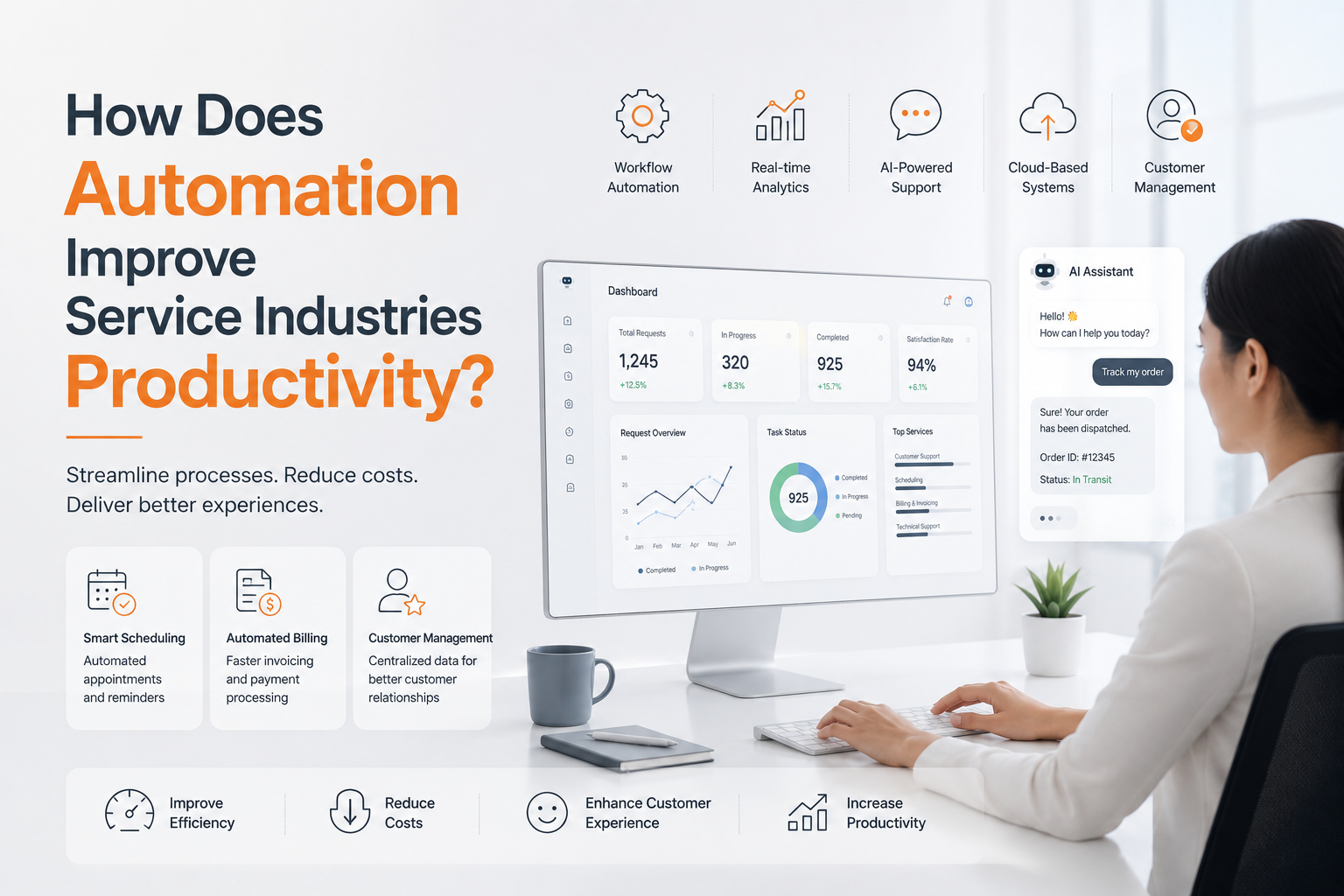
Service automation refers to using technology to perform tasks that humans previously handled manually. In service industries, this means software, AI, and digital tools take over routine processes like scheduling, billing, data entry, and customer communication.
Unlike industrial automation, which focuses on physical manufacturing tasks, service automation targets information-based work. It is about managing workflows, customer interactions, and data-driven decisions more efficiently.
The goal is not to replace humans entirely. It is to remove low-value, repetitive work so that skilled employees can focus on tasks that require empathy, creativity, and critical thinking.
Common Automation Technologies Used
Several technologies power service automation today:
AI Chatbots handle customer inquiries, answer FAQs, and route complex issues to human agents without any wait time.
CRM Automation manages customer data, sends follow-up emails, tracks sales pipelines, and logs interactions automatically.
Workflow Automation Tools like Zapier or Microsoft Power Automate connect apps and trigger actions based on pre-set rules, eliminating manual hand-offs between teams.
Robotic Process Automation (RPA) uses software bots to mimic human actions in digital systems, handling tasks like data extraction, form filling, and report generation.
Self-Service Kiosks allow customers to complete transactions, check in, or place orders without staff involvement.
Automated Billing and Scheduling Systems generate invoices, send reminders, and manage appointment books without human input.
Cloud-Based Management Platforms centralize operations and give managers real-time visibility into performance metrics across departments.
Industries Using Automation
Automation is no longer limited to tech companies. These industries are actively deploying it at scale:
- Healthcare for patient scheduling, records management, and diagnostic support
- Banking and Finance for fraud detection, loan processing, and customer account management
- Hospitality for self-check-in, room service requests, and guest communication
- Retail for inventory tracking, self-checkout, and personalized recommendations
- Logistics for shipment tracking, route optimization, and warehouse management
- Customer Support Centers for ticket routing, chatbot resolution, and performance analytics
- Education Services for enrollment management, grading assistance, and student communication
Why Productivity Matters in Service Industries
Challenges Faced Without Automation
Service businesses without automation face a consistent set of operational problems.
Human errors creep into billing, scheduling, data entry, and customer records. Even small mistakes create expensive corrections and damage customer trust.
Slow response times frustrate customers. When agents are buried in manual tasks, response delays increase and satisfaction drops.
Manual paperwork slows everything down. Processing forms, filing records, and generating reports by hand consumes hours that could be spent serving customers.
Employee burnout is a direct result of repetitive, low-stimulation work. High turnover in service roles often ties back to tasks that automation could easily handle.
High operational costs accumulate when businesses staff up to handle volume that software could manage at a fraction of the price.
Inconsistent customer experience happens when outcomes depend entirely on which employee handles a request. Without standardized, automated workflows, service quality varies widely.
Impact of Low Productivity on Businesses
Low productivity does not just slow things down. It has measurable financial and reputational consequences.
Customer dissatisfaction leads to churn. Customers who experience slow or error-prone service do not return, and they leave negative reviews that affect new customer acquisition.
Reduced profitability follows when businesses spend more resources than necessary to deliver the same output. Labor costs stay high while revenue growth stalls.
Poor employee efficiency compounds the problem. When staff are stuck on manual tasks, they cannot contribute to higher-value work that drives growth.
Delayed service delivery creates backlogs. One bottleneck in a manual workflow can cascade into delays that affect every downstream process.
How Automation Improves Productivity in Service Industries
Reduces Repetitive Manual Tasks
Automation handles the routine operations that eat up employee time every single day.
Tasks like appointment booking, invoice generation, data entry, report creation, and email follow-ups can all run automatically based on triggers and pre-set rules. Employees no longer spend hours on tasks that software completes in seconds.
This shift has a direct impact on output. When staff are freed from repetitive work, they redirect their time to customer-facing interactions, problem-solving, and strategic projects.
Automated appointment booking systems allow customers to schedule, reschedule, and receive reminders without any staff involvement. Healthcare clinics, salons, and service centers are reducing no-shows and administrative workload simultaneously.
Invoice generation tied to completed services or orders eliminates manual billing steps and reduces payment delays. Finance teams can focus on analysis instead of data entry.
Data entry systems integrated with CRMs and ERPs capture information automatically from forms, emails, and customer interactions, keeping records accurate and up to date without human effort.
Speeds Up Customer Service Response Time
Response time is one of the most important metrics in service industries. Customers expect fast answers. Automation delivers them.
Instant chatbot responses handle common questions in real time, 24 hours a day. Customers do not wait for business hours or an available agent to get answers about account balances, order status, or appointment times.
Automated ticket routing ensures every customer inquiry reaches the right team or agent immediately. Instead of manually assigning tickets, systems analyze request content and route it based on topic, urgency, and team availability.
Faster query handling reduces average resolution time significantly. When automation handles tier-one inquiries, human agents focus on complex issues that actually need their attention.
Real Examples
Banking chatbots resolve account queries, reset PINs, and explain transaction details instantly, without putting customers on hold.
Hotel self-check-in systems allow guests to bypass the front desk entirely, using a kiosk or mobile app to get their room key in under two minutes.
Minimizes Human Errors
Manual processes introduce mistakes. Automation removes most of them.
Billing errors, incorrect data entries, missed appointments, and miscommunication between teams are all common problems in manual workflows. Automation standardizes each step, ensuring the same process runs correctly every time.
Reduced billing mistakes protect revenue and customer relationships. Automated billing systems pull data directly from service records, eliminating transcription errors and ensuring accurate invoices.
Better data management comes from systems that log, store, and retrieve information automatically. Customer records, transaction histories, and interaction logs stay accurate without depending on manual updates.
Standardized workflows mean every customer interaction follows the same process, regardless of which employee or system handles it. Consistency improves outcomes and makes auditing and compliance much simpler.
Industries Benefiting Most
Healthcare records management relies on accuracy. Automated systems reduce documentation errors, ensure proper coding for insurance claims, and keep patient records up to date.
Financial transactions processed through automated systems have error rates far below those of manual processing. Reconciliation, compliance checks, and reporting all improve.
Insurance claim processing benefits from automation at every stage, from initial submission and document verification to approval routing and payment release.
Improves Employee Productivity
When employees are not bogged down by repetitive work, their productivity on meaningful tasks increases substantially.
Automation takes over the time-consuming, low-skill portions of a job. This leaves employees free to handle relationship-building, complex problem-solving, creative strategy, and direct customer care. These are the areas where human contribution genuinely adds value.
Reduced stress and workload improve employee mental health and performance. Burnout in service roles is often tied to high-volume, repetitive tasks with little cognitive engagement. Automation reduces that burden.
Faster task completion becomes possible when employees use tools that auto-fill information, generate draft responses, and handle follow-ups automatically. They accomplish more in less time.
Better team collaboration results from shared, automated workflows that keep everyone aligned. When data flows automatically between systems, teams spend less time chasing updates and more time acting on them.
Employee Benefits
- Higher job satisfaction from more meaningful, engaging work
- Faster onboarding when new hires use guided, automated workflows
- Less cognitive overload from managing repetitive tasks manually
- More time for professional development and skill-building
Enhances Customer Experience
Productivity gains are not just internal. Customers feel the difference when service operations run on automation.
Personalized recommendations powered by AI analyze customer behavior and purchase history to suggest relevant products, services, or support options. This level of personalization was previously only possible with dedicated account managers. Automation makes it scalable.
Faster service delivery results directly from automated workflows that eliminate waiting periods and manual processing steps. Orders are confirmed, appointments are scheduled, and queries are resolved faster than ever.
Consistent support experience is possible when automation standardizes how customers are handled across every channel, every time. Whether a customer contacts support via chat, email, or phone, they receive the same quality of response.
Examples
Retail recommendation engines on platforms like Amazon or Target analyze browsing and purchase data to surface products customers are likely to want. This drives both satisfaction and revenue.
Automated order tracking sends real-time updates to customers at every stage of fulfillment, reducing inbound status inquiries and improving transparency.
AI-powered customer support triages issues, resolves common problems automatically, and escalates complex cases to human agents with full context already attached.
Enables Operations Around the Clock
Human employees need breaks, weekends, and holidays. Automated systems do not.
This is one of the most straightforward productivity gains automation delivers. Services that once ran only during business hours can now operate continuously.
Global customer support becomes manageable when automation handles inquiries across time zones without staffing overnight shifts. Customers in different regions receive the same quality of service regardless of the hour.
Improved service availability means customers can complete transactions, get answers, and access support whenever they need it. This directly reduces abandonment rates and increases customer satisfaction.
Examples
Online banking systems allow customers to check balances, transfer funds, and dispute transactions at any hour without branch access.
E-commerce support automation handles order questions, return requests, and tracking updates outside of business hours, keeping customers informed without delay.
Automated scheduling platforms let customers book appointments at midnight or on Sunday if that is when they happen to be available. Businesses fill their calendars without any staff involvement.
Reduces Operational Costs
Automation has a measurable impact on the bottom line. When processes run automatically, businesses need fewer labor hours to produce the same or better output.
Lower labor costs come from reducing the headcount required to handle high-volume, repetitive work. Staff are redirected to roles that drive growth rather than maintain operations.
Reduced paperwork eliminates printing, filing, and physical storage costs. Digital workflows replace paper-based processes entirely, saving both time and money.
Better resource utilization means every dollar spent on staff, tools, and systems produces more output. Automation removes waste from workflows and ensures capacity is used efficiently.
Fewer costly errors reduce the expense of corrections, refunds, complaints, and compliance violations. Accuracy improvements from automation directly protect margin.
Return on Investment
Automation tools often pay for themselves quickly. Savings from reduced labor hours, error correction, and faster throughput compound over time.
Businesses that scale with automation do not need to hire proportionally as volume increases. A company handling twice the customer volume does not necessarily need twice the staff if its core processes are automated.
Real-World Examples of Automation in Service Industries
Healthcare Industry
Healthcare is one of the most data-intensive service sectors, and automation is transforming how it operates.
Automated patient scheduling systems let patients book appointments online, receive reminders, and reschedule without calling the office. This reduces no-shows and administrative workload for clinic staff.
AI-assisted diagnostics support physicians by analyzing imaging, flagging anomalies, and cross-referencing patient history against clinical guidelines. Doctors make faster, better-informed decisions.
Digital medical records managed through Electronic Health Record (EHR) systems eliminate paper files and make patient information instantly accessible to authorized providers across locations.
Banking and Financial Services
Banking was an early adopter of automation, and the results are visible in both efficiency and customer satisfaction.
Fraud detection systems analyze transaction patterns in real time and flag suspicious activity instantly. What previously required manual review now happens in milliseconds.
Automated loan processing reduces the time from application to approval from weeks to hours in some cases. Verification, credit checks, and documentation review run through automated workflows.
AI banking assistants handle a large portion of customer inquiries without human involvement. They answer balance questions, explain fees, process simple requests, and escalate complex issues when necessary.
Hospitality Industry
Hotels and travel companies are using automation to deliver better guest experiences at scale.
Smart hotel check-ins allow guests to complete the entire check-in process on their phone or at a kiosk. Room keys are issued digitally, wait times drop to zero, and front desk staff can focus on higher-value guest interactions.
Automated room service requests handled through in-room tablets or apps streamline communication between guests and staff. Orders go directly to the right department without phone calls or manual relaying.
Digital concierge systems provide guests with restaurant recommendations, local activity information, transportation booking, and service requests through a single automated interface.
Retail Industry
Retail automation is improving both back-end operations and front-end customer experience.
Self-checkout systems reduce the need for cashier staffing at peak hours and give customers the option to complete purchases faster on their own terms.
Inventory automation tracks stock levels in real time, triggers reorders when items fall below threshold, and alerts managers to discrepancies. Stockouts and overstock situations both decrease.
Personalized shopping experiences powered by recommendation algorithms increase average order value and improve customer satisfaction by surfacing products that are genuinely relevant to each shopper.
Key Benefits of Automation for Service Businesses
Increased Efficiency
Automated workflows complete tasks faster than manual processes and do not slow down under high volume. Efficiency gains compound across departments when automation is implemented systematically.
Better Accuracy
Software does not make transcription errors, forget steps, or rush through tasks. Accuracy improves across billing, data management, customer records, and compliance documentation.
Faster Decision-Making
When data is collected and processed automatically, managers have access to real-time performance metrics. Decisions are based on current, accurate information rather than outdated reports.
Improved Customer Retention
Faster response times, consistent service quality, and personalized experiences drive customer loyalty. Automation makes all three scalable without proportionally increasing costs.
Higher Scalability
Businesses can handle increased volume without linear headcount increases. Automation scales with demand, allowing growth without operational constraints.
Better Business Insights Through Data Analytics
Automated systems collect detailed data on every interaction, transaction, and workflow step. This data feeds analytics dashboards that reveal performance trends, customer behavior, and operational inefficiencies. Leaders make smarter strategic decisions based on solid evidence.
Challenges of Implementing Automation
Initial Investment Costs
Automation tools, platform subscriptions, and implementation services require upfront spending. For small businesses, this can be a significant barrier. However, the ROI typically justifies the investment within the first year for most service businesses.
Employee Training Requirements
Introducing new systems requires training. Employees need time to learn tools, adjust workflows, and build confidence with automated processes. Proper change management reduces friction and accelerates adoption.
Integration with Existing Systems
Many service businesses run on legacy software that does not easily connect with modern automation tools. Integration challenges can require custom development or middleware solutions to bridge the gap.
Data Security Concerns
Automation systems handle sensitive customer and business data. Proper security protocols, access controls, encryption, and compliance with regulations like HIPAA or GDPR are essential requirements, not optional add-ons.
Resistance to Change
Employees often worry that automation threatens their jobs. Transparent communication about how automation will affect roles, combined with upskilling opportunities, reduces resistance and improves adoption outcomes.
Future Trends in Service Industry Automation
AI-Powered Service Operations
AI is moving beyond task automation into reasoning and decision-making. Systems that once only followed rules are now learning from data and adapting to new situations. This will expand automation into more complex, judgment-based service tasks.
Hyperautomation
Hyperautomation combines RPA, AI, machine learning, and process mining to automate entire end-to-end workflows rather than individual tasks. Gartner identifies it as one of the top technology trends for enterprise operations.
Predictive Analytics
Service businesses are using historical data to predict future demand, customer behavior, and operational needs. Predictive models allow proactive service delivery rather than reactive problem-solving.
Voice Automation
Voice-activated interfaces are becoming mainstream in customer service. Automated phone systems, smart speakers, and voice-enabled apps are handling service interactions that previously required typed input or live agents.
Robotic Customer Service
Physical robotics are entering customer-facing roles in hospitality, retail, and logistics. From delivery robots in hotels to automated checkout systems in stores, robotic service is expanding steadily.
Smart Data-Driven Decision Making
Integrated data platforms are giving service businesses a unified view of operations, customers, and performance. Real-time dashboards, AI-generated recommendations, and automated reporting are replacing slow, manual analysis processes.
How Businesses Can Successfully Implement Automation
Identify Repetitive Processes
Start by auditing current workflows to identify tasks that are high-volume, rule-based, and time-consuming. These are the best candidates for automation. Look for processes that run the same way every time and do not require creative judgment.
Start with Small Automation Projects
Avoid trying to automate everything at once. Start with one or two high-impact, low-risk processes. Build confidence, measure results, and use early wins to build internal support for broader implementation.
Choose Scalable Automation Tools
Select platforms that can grow with your business. Avoid tools that work only for your current size or that cannot integrate with other systems. Look for flexibility, strong vendor support, and a proven track record in your industry.
Train Employees Properly
Automation is most effective when employees understand how to work alongside it. Invest in structured training programs and create clear documentation. Designate internal champions who can support colleagues through the transition.
Continuously Monitor Performance
Set clear metrics before implementation and track them consistently after launch. Monitor error rates, processing times, customer satisfaction scores, and employee feedback. Use this data to identify gaps and optimize automated workflows over time.
Conclusion
Automation is one of the most effective tools available to service businesses looking to grow without proportionally growing their costs.
It speeds up operations, reduces errors, cuts overhead, and delivers better customer experiences at scale. It also gives employees more time to focus on work that genuinely requires their skills and judgment.
The businesses seeing the biggest gains are not waiting for automation to become the industry standard. They are implementing it now and pulling ahead of competitors who are still managing repetitive processes manually.
Automation is no longer optional for modern service businesses aiming to stay competitive and scalable.
The question is not whether to automate. It is which processes to start with and how quickly you can get them running.
Ready to Improve Productivity Through Automation?
Modern service industries cannot rely on slow manual processes if they want to stay competitive. From customer support and scheduling to data management and workflow optimization, automation helps businesses operate faster, reduce errors, and deliver a better customer experience.
At AutomateXLab, we help businesses streamline operations with smart automation solutions tailored to their industry needs. Whether you’re looking to automate customer service workflows, improve operational efficiency, or scale your business processes, our team can help you build reliable and future-ready automation systems.
Our Automation Solutions Include:
- Workflow Automation
- PLC & SCADA Integration
- Industrial & Service Process Automation
- Smart Monitoring Systems
- Custom Automation Solutions
- Real-Time Operational Optimization
Get in touch with AutomateXLab today and discover how automation can transform your business productivity.
FAQs
Automation removes time-consuming manual tasks from employee workloads, reduces errors that require correction, and enables processes to run continuously without human involvement. The result is faster throughput, lower costs, and better output quality across every service function.
Healthcare, banking, retail, logistics, hospitality, and customer support centers see the largest productivity gains. These industries handle high volumes of repetitive, data-intensive work that is well-suited to automated processing.
Initial costs vary depending on the tools and scope of implementation. Many automation platforms offer tiered pricing that makes them accessible to small businesses. Starting with one focused automation project keeps costs manageable while demonstrating clear ROI before scaling further.
No. Automation handles repetitive, rule-based tasks effectively, but it cannot replace human empathy, creative problem-solving, complex judgment, or relationship management. The most productive service businesses use automation to enhance human roles, not eliminate them.
The top benefits are increased operational efficiency, reduced error rates, lower labor costs, faster customer service response times, improved scalability, and better data-driven decision-making. These combine to improve both profitability and customer satisfaction.
AI-powered tools like chatbots, recommendation engines, and predictive analytics handle high volumes of customer interactions automatically. They route inquiries to the right agents, personalize service at scale, and give managers real-time insight into performance, all without proportionally increasing staff requirements.