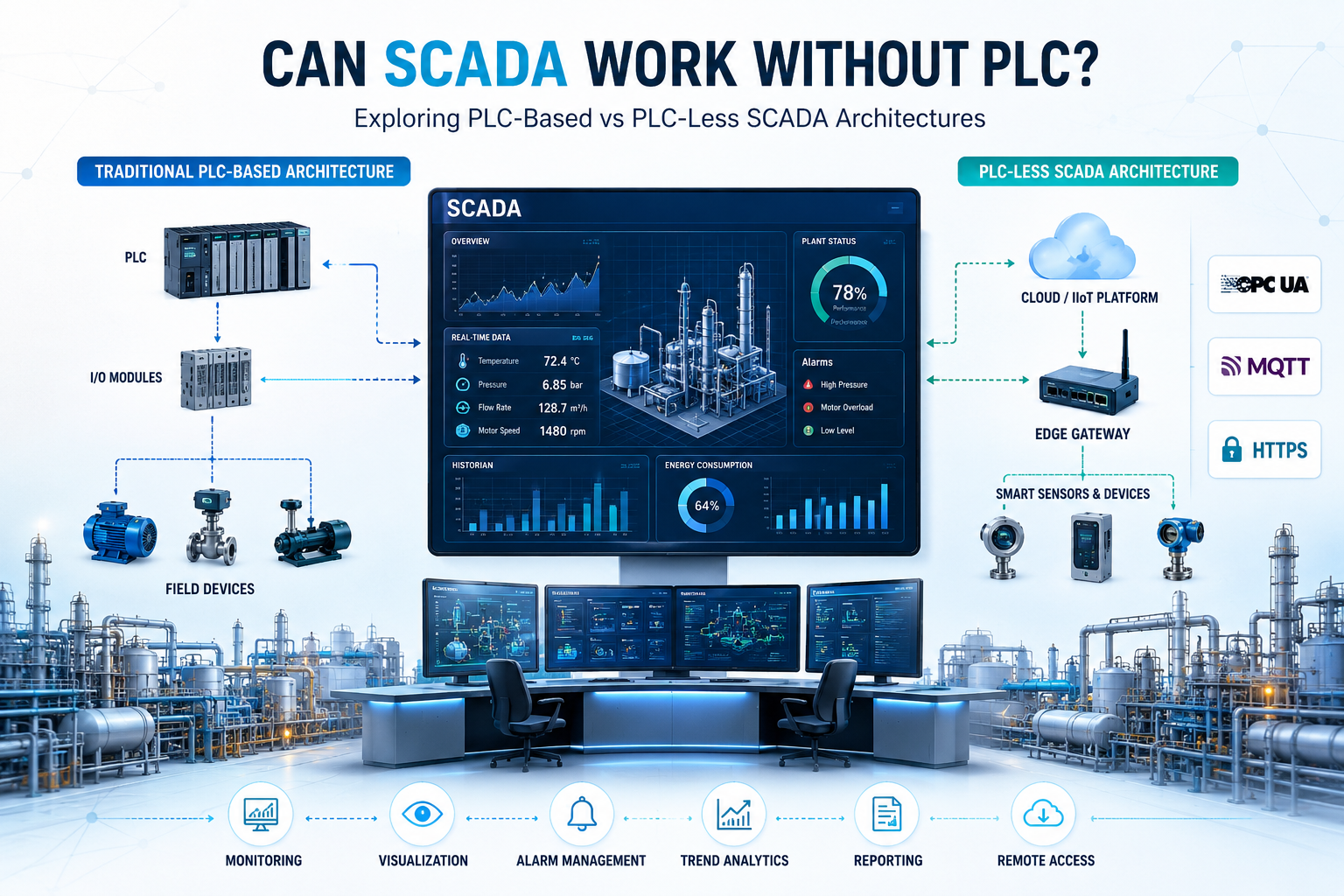
SCADA can technically work without a PLC. But that does not mean it should in most industrial environments.
SCADA handles visualization, monitoring, alarms, data collection, and supervisory control. It is not built to be a real-time control engine. PLCs handle that job. In specific scenarios like remote monitoring, IoT dashboards, or telemetry systems, SCADA runs independently without any PLC in the loop.
This guide breaks down exactly when SCADA can operate without a PLC, where it falls short, and what alternatives exist for modern industrial systems.
What Is SCADA?
SCADA stands for Supervisory Control and Data Acquisition. It is an industrial software system designed to monitor, visualize, and supervise large-scale operations across multiple sites or machines.
SCADA does not directly control physical hardware in most setups. Instead, it collects data from field devices, displays that data to operators, triggers alarms, and logs historical records for analysis.
Core components of a SCADA system:
- HMI (Human Machine Interface): The screen-based interface operators use to view system status and issue commands
- SCADA Software: The central platform managing data, alarms, and communication
- Communication Network: Ethernet, fiber, cellular, or radio links connecting all components
- Field Devices: PLCs, RTUs, smart sensors, or IoT gateways that gather real-world data
- Historian Database: Stores long-term operational data for reporting and analytics
Industries that rely on SCADA:
- Water and wastewater treatment plants
- Oil and gas pipelines
- Electric power grids
- Manufacturing and automotive plants
- Smart buildings and campuses
What Is a PLC?
A PLC, or Programmable Logic Controller, is a ruggedized industrial computer designed to control machines and automate processes in real time.
Unlike a standard PC, a PLC runs on a deterministic operating system. That means it executes control logic at precise, repeatable time intervals without delays or crashes caused by background processes.
Why industries use PLCs:
- Real-time input and output handling
- Reliable operation in extreme temperatures and electrical noise
- Deterministic scan cycles measured in milliseconds
- Long hardware lifespan with minimal downtime
PLCs are programmed using languages like Ladder Logic, Function Block Diagram, or Structured Text. They connect directly to sensors, motors, valves, conveyors, and actuators.
Simple PLC logic examples:
- Motor starts when a start button is pressed and a safety interlock is clear
- Conveyor belt stops automatically when a jam sensor activates
- Packaging machine counts products and triggers ejection at a set quantity
PLCs are the muscle of industrial automation. SCADA is the brain that watches and reports. Both serve very different functions.
Can SCADA Work Without PLC?
Yes, SCADA can work without a PLC in systems where monitoring, visualization, and data collection are the primary goals.
SCADA can connect directly to:
- Smart sensors with digital communication outputs
- IoT gateways using MQTT or HTTP protocols
- Remote Terminal Units (RTUs)
- Industrial PCs running soft control applications
- OPC UA-enabled field devices
- Cloud platforms and edge computing nodes
- Historian databases for analytics dashboards
In these configurations, SCADA reads data from devices and displays it to operators without any PLC in the architecture.
The limitation becomes clear the moment real-time machine control is needed. SCADA software runs on standard operating systems like Windows or Linux. These systems are not designed for deterministic control. A software update, a background task, or a network hiccup can introduce delays that make reliable machine control impossible.
Key distinction:
| Function | SCADA | PLC |
|---|---|---|
| Data visualization | Yes | No |
| Real-time machine control | No | Yes |
| Alarm management | Yes | Limited |
| Deterministic processing | No | Yes |
| Long-term data storage | Yes | No |
| Direct I/O handling | Limited | Yes |
SCADA supervises. PLC controls. Both roles are necessary in most industrial plants, but certain applications can get by with SCADA alone.
When SCADA Can Work Without PLC
IoT-Based Monitoring Systems
In IoT-heavy deployments, smart sensors transmit data directly to cloud or on-premise SCADA platforms using MQTT, CoAP, or REST APIs. No PLC sits in the middle.
Common use cases:
- Temperature and humidity monitoring in cold storage warehouses
- Air quality tracking in commercial buildings
- Asset condition monitoring in remote locations
These systems focus entirely on visibility, not control. Operators see data trends, receive alerts, and make decisions. No machine action is triggered automatically, so PLC-level determinism is not required.
Energy Monitoring Systems
Power meters, smart inverters, and energy management devices communicate directly with SCADA using Modbus TCP, DNP3, or BACnet protocols.
Examples:
- Solar farm dashboards displaying inverter output, grid export, and fault logs
- Building energy monitoring tracking floor-by-floor consumption
- Demand response systems alerting operators when thresholds are exceeded
These systems read electrical data and present it visually. Physical control actions like switching breakers are usually handled manually by operators, not by automated PLC logic.
Remote Telemetry Systems
RTUs are purpose-built field devices for remote data acquisition. They connect to sensors, log data, and transmit it back to a central SCADA system over cellular, radio, or satellite links.
SCADA plus RTU architectures are common in:
- Oil and gas pipeline monitoring across hundreds of miles
- Water distribution networks in municipal systems
- Remote environmental monitoring stations
RTUs handle some local decision-making, but they are not PLCs. The SCADA system centralizes all data without needing PLC-based automation at every site.
Data Visualization and KPI Dashboards
Many industrial organizations use SCADA as a reporting and analytics layer sitting on top of existing historian databases or MES systems.
In these deployments, SCADA pulls data from SQL databases, cloud data lakes, or OPC servers and presents it in custom dashboards. No real-time field device communication is required, and no PLC is involved.
Typical applications:
- Production OEE tracking on manufacturing floor displays
- Shift performance reports for plant managers
- Predictive maintenance KPI dashboards
Small and Prototype Automation Projects
Educational labs, research setups, and small pilot systems sometimes use SCADA connected directly to low-cost data acquisition hardware or Arduino-based I/O systems.
These are low-criticality environments where reliability requirements are minimal and the goal is learning or proof-of-concept rather than production-grade automation.
Limitations of Using SCADA Without PLC
No Deterministic Control
SCADA software runs on general-purpose operating systems. Windows and Linux are not real-time operating systems. They manage hundreds of background tasks, memory allocation, and driver operations simultaneously.
This creates non-deterministic behavior. The system cannot guarantee that a control command will execute within a specific time window. For processes where timing accuracy matters even slightly, this is a serious problem.
In high-speed packaging lines, for example, a 10-millisecond delay in a control signal can cause product misalignment, damaged equipment, or failed quality checks.
Reduced System Reliability
PLCs are designed to run continuously for years without interruption. They have no fans, no hard drives, and no operating system overhead. They boot in seconds and resume normal operation after a power failure.
SCADA systems run on industrial PCs or servers. These devices are susceptible to:
- Software crashes requiring restarts
- Hard drive failures
- Operating system updates forcing reboots
- Network communication drops
In a plant that runs three shifts, seven days a week, this level of potential downtime is not acceptable for critical control functions.
Weak Real-Time Response
Real industrial machines operate fast. Conveyor systems, robotic arms, and press machines execute hundreds of actions per minute. PLCs scan their I/O and execute logic in scan cycles that range from one to ten milliseconds.
SCADA polling cycles are typically measured in seconds, not milliseconds. By the time SCADA detects a condition and responds, the machine may have already moved to the next state. This makes SCADA inadequate for direct real-time machine control.
Examples where slow response causes problems:
- Emergency stop systems that must respond in under 100 milliseconds
- High-speed sorting machines that require precise timing
- Synchronization between multiple conveyor belts
Safety Risks
Industrial safety standards like IEC 61511 for process safety and IEC 62061 for machinery safety require deterministic, reliable control systems for safety-critical functions. SCADA software running on standard PCs does not meet these requirements without significant additional engineering.
Safety-rated PLCs and safety relay modules are specifically designed and certified for these environments. Replacing them with SCADA-based PC control introduces unacceptable risk in applications involving high voltage, high pressure, hazardous materials, or personnel safety.
Limited Industrial I/O Handling
PLCs connect directly to field wiring using industrial I/O modules. These handle:
- Digital inputs from pushbuttons, limit switches, and proximity sensors
- Digital outputs to solenoid valves, contactors, and indicator lights
- Analog inputs from pressure transmitters, flow meters, and thermocouples
- Analog outputs for variable speed drives and control valves
SCADA software does not have native physical I/O capabilities. Without a PLC, RTU, or data acquisition device acting as an intermediary, SCADA cannot interface with most field wiring directly.
SCADA vs PLC: Main Differences
| Feature | SCADA | PLC |
|---|---|---|
| Main role | Monitoring and supervision | Real-time machine control |
| Real-time capability | Limited | Excellent |
| Hardware type | Software platform on PC | Dedicated industrial controller |
| Visualization | Full graphical HMI | Minimal or none |
| Automation logic | Basic supervisory | Advanced, deterministic |
| Reliability | Moderate | Very high |
| Industrial I/O | Via intermediary devices | Direct field wiring |
| Safety certifications | Not standard | Available for SIL-rated PLCs |
| Use layer | Supervisory layer | Machine layer |
These two systems are complementary, not competitive. A well-designed industrial automation architecture uses both together, each doing what it does best.
SCADA Architectures Without PLC
SCADA With IoT Sensors
In this architecture, smart sensors transmit data using wireless or wired IoT protocols directly to a SCADA or cloud dashboard platform. An edge gateway often sits in between to handle protocol translation and local buffering.
Protocols commonly used:
- MQTT for lightweight publish/subscribe messaging
- HTTP/REST for cloud API integration
- OPC UA for standardized industrial communication
This setup works well for monitoring applications where no automated control action is needed. The operator sees the data and manually decides what to do.
SCADA With RTU
RTUs are designed specifically for remote data acquisition over long-distance communication links. They connect to analog and digital sensors, perform basic local processing, and forward data to a central SCADA host.
Best applications:
- Pipeline pressure and flow monitoring
- Pump station status tracking
- Remote environmental sensors
RTUs offer more field-level reliability than PC-based alternatives, making them a solid PLC alternative for telemetry-focused systems.
SCADA With Industrial PC
An industrial PC (IPC) running soft PLC software or custom control applications can handle automation logic without a traditional PLC. This is common in flexible manufacturing and advanced robotics environments.
IPCs offer more processing power than PLCs and support complex algorithms, vision processing, and data analysis. The trade-off is that software-based control is less deterministic than hardware-based PLC logic unless a real-time operating system is used.
SCADA With OPC UA Smart Devices
Modern industrial devices, including variable frequency drives, smart transmitters, and intelligent motor starters, now include built-in OPC UA servers. SCADA can connect directly to these devices and read or write data without a PLC acting as an intermediary.
This is a growing trend in Industry and smart factory environments where device-level intelligence reduces the dependency on centralized PLC-based control.
Real Industrial Examples
Solar Plant Monitoring
Large solar farms often run SCADA without PLCs for monitoring purposes. SCADA connects directly to string inverters using Modbus TCP or SunSpec protocols. It reads generation data, fault codes, and grid parameters in real time.
No PLC is needed because the inverters manage their own control logic internally. SCADA only reads and reports.
Smart Building Systems
Building management systems (BMS) use SCADA-like platforms connected directly to HVAC controllers, energy meters, and lighting systems via BACnet or Modbus. These systems monitor energy consumption, control setpoints, and generate reports without traditional PLCs.
The controllers in these systems are application-specific and handle their own control logic independently.
Pipeline Telemetry
Gas and water utility companies monitor thousands of miles of pipeline using RTU-based SCADA systems. RTUs at each pump station or valve site collect local sensor data and report back to a central SCADA host over cellular or radio links.
PLCs are not used at most remote sites because the control requirements are simple and RTUs are sufficient.
Factory Production Line
In a high-speed automotive stamping plant, SCADA absolutely depends on PLCs. The PLCs control press timing, part ejection, conveyor indexing, and safety interlocks at millisecond precision. SCADA reads status from all PLCs, displays production counts, and alerts supervisors to faults.
Removing PLCs from this environment and trying to run control through SCADA would immediately cause production failures and safety hazards.
Can SCADA Replace PLC Completely?
In most industrial automation environments, SCADA cannot fully replace PLCs. The real-time control requirements of manufacturing, process, and motion control applications demand dedicated hardware-based controllers.
That said, the concept of soft PLCs is gaining ground. Soft PLCs are software programs that run PLC logic on industrial PCs or embedded computers using real-time operating systems. Platforms like CODESYS and Beckhoff TwinCAT enable this approach.
Industries still requiring dedicated PLCs:
- Automotive manufacturing and robotics
- Chemical and refining process plants
- Food and beverage packaging lines
- Pharmaceutical batch control systems
- Motion control and CNC machining
Where PLC-less systems are growing:
- Building automation
- Renewable energy monitoring
- Smart city infrastructure
- Predictive maintenance platforms
- Non-critical data acquisition systems
The future of industrial automation is not PLC versus SCADA. It is a layered architecture where PLCs handle machine control, edge devices handle local intelligence, and SCADA handles supervisory visibility, all connected through standardized communication protocols.
Best Alternatives to PLC in SCADA Systems
| Alternative | Best Use Case | Key Strength |
|---|---|---|
| RTU | Remote infrastructure, pipelines | Long-distance telemetry |
| Soft PLC | Flexible manufacturing, lab systems | Software-based control flexibility |
| Industrial PC | Advanced processing, vision systems | High computing power |
| IoT Gateway | Cloud monitoring, smart sensors | Protocol bridging, cloud connectivity |
| Edge Controller | Smart factories, Industry systems | Local intelligence with cloud sync |
| BMS Controller | Building automation | Domain-specific control logic |
Each of these alternatives trades off some capability that a traditional PLC provides. Choosing the right one depends on the application’s control requirements, reliability standards, and environmental conditions.
Is SCADA Alone Good for Small Businesses?
For small monitoring projects with limited budgets, SCADA without PLC can be a practical choice.
Advantages for small operations:
- Lower upfront hardware costs since no PLC or I/O modules are required
- Simpler architecture with fewer components to configure and maintain
- Faster deployment using off-the-shelf smart sensors and IoT devices
- Cloud-based SCADA platforms reduce IT infrastructure requirements
Challenges to plan for:
- Scaling the system later will likely require adding PLCs as automation complexity grows
- Reliability limitations become visible as production requirements increase
- Real-time control needs will eventually outgrow what SCADA alone can handle
Small businesses doing warehouse monitoring, energy tracking, or basic environmental sensing can absolutely get started with SCADA and IoT sensors. The important thing is to design the architecture with future expansion in mind so adding PLCs later does not require rebuilding the entire system.
Future of PLC-Less SCADA Systems
The trend toward PLC-less or PLC-light SCADA architectures is accelerating because of several major shifts in industrial technology.
Driving forces:
- Edge computing pushes processing intelligence to field devices, reducing the need for centralized PLC control at every site
- AI-powered analytics enable predictive decision-making at the SCADA level, reducing reliance on hardcoded PLC logic for some functions
- Smart sensors now include onboard processing capable of running basic control routines independently
- Cloud SCADA platforms like Ignition, Inductive Automation, and AWS IoT SiteWise support direct device connections without PLCs
- OPC UA and MQTT Sparkplug provide standardized communication layers that allow diverse devices to speak directly to SCADA without protocol conversion through PLCs
Despite these advances, PLCs are not disappearing. The ISA-99 and IEC 62443 cybersecurity standards for industrial control systems, combined with long equipment lifecycle expectations in heavy industry, mean PLCs will remain dominant in manufacturing and process control for at least the next decade.
The most likely outcome is a hybrid architecture: PLCs where real-time deterministic control is needed, edge controllers and IoT devices for distributed sensing, and SCADA as the unified supervisory and analytics platform tying everything together.
Conclusion
SCADA can work without PLC, but the right context matters.
For monitoring-focused applications like solar dashboards, pipeline telemetry, building energy management, and IoT sensor networks, SCADA operates effectively without any PLC in the architecture. These systems prioritize data collection, visualization, and alerting over real-time machine control.
For industrial automation applications involving machines, conveyors, robots, process control, and safety systems, PLCs remain essential. SCADA alone cannot deliver the deterministic, reliable, and certified control performance these environments demand.
Modern industrial automation is moving toward hybrid systems that combine PLCs for machine-level control, edge devices for local intelligence, IoT sensors for distributed data, and SCADA for supervisory oversight. The goal is not to eliminate one technology in favor of another but to use each one where it delivers the most value.
Understanding where SCADA ends and PLC begins is what separates a system that monitors well from one that also runs reliably.
Ready to Upgrade Your Industrial Automation?
AutomatexLab helps businesses build smarter industrial systems with PLC programming, SCADA development, HMI design, Industrial IoT integration, and factory automation solutions.
From monitoring to full smart factory automation, we create reliable, scalable, and practical industrial systems tailored to your operations.
Start Your Automation Project With AutomatexLab Today.
FAQs
Yes, but only for limited and low-criticality applications. SCADA can write setpoints to smart devices using protocols like OPC UA or Modbus, but it lacks the deterministic timing needed for reliable machine control.
No. SCADA can operate with RTUs, IoT gateways, smart sensors, or IPCs. PLCs are not mandatory but are highly recommended for any application requiring real-time machine control.
Yes. SCADA supports direct sensor communication through IoT protocols like MQTT, industrial protocols like Modbus and DNP3, and OPC UA-enabled smart devices.
Neither is inherently more important. They serve different purposes. PLCs control machines. SCADA supervises and reports on operations. In most industrial environments, both are needed together.
SCADA typically includes HMI functionality as a built-in component. The difference is scope. An HMI is local to one machine or panel. SCADA operates at a system-wide supervisory level across multiple machines and sites.