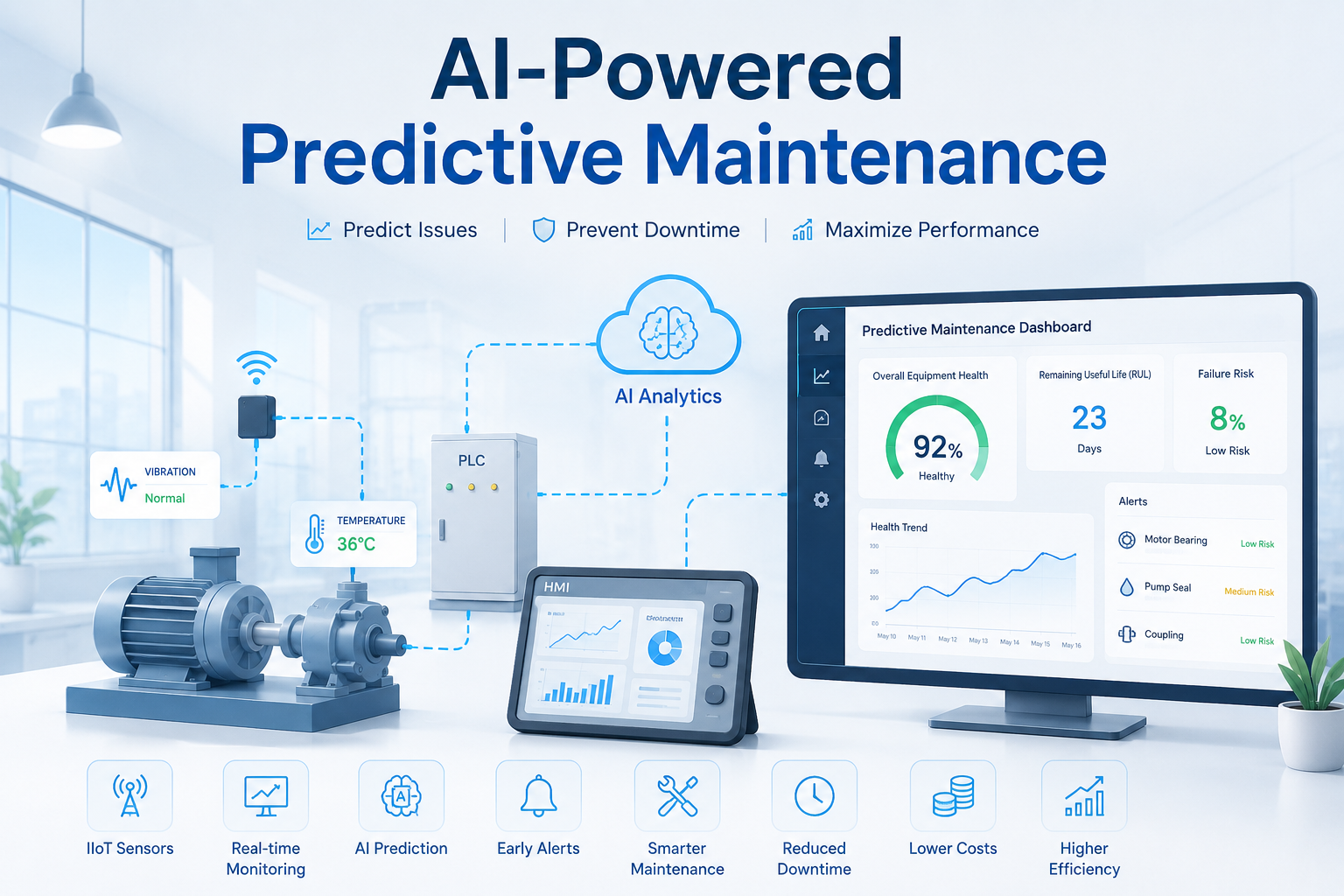
AI-powered predictive maintenance uses machine learning and real-time sensor data to detect early signs of equipment failure before a breakdown occurs. Instead of waiting for machines to fail or servicing them on a fixed schedule, manufacturers get precise, data-driven alerts that trigger maintenance only when it is actually needed reducing downtime, cutting costs, and extending equipment life.
What Is AI-Powered Predictive Maintenance?
Predictive maintenance is not new. Engineers have long used vibration analysis and thermal imaging to catch developing faults. What AI adds is scale and accuracy.
Traditional predictive maintenance relies on threshold rules: if a temperature reading exceeds a set limit, trigger an alert. These rules are static, manually defined, and blind to the complex interaction between multiple variables happening simultaneously inside industrial equipment.
AI-powered predictive maintenance replaces rigid thresholds with models that learn from historical data. The system observes thousands of sensor readings across months or years of operation, identifies patterns that preceded past failures, and applies those patterns to live data. The result is a prediction not just a warning that tells maintenance teams what is likely to fail, how soon, and how confident the model is.
This shift from rule-based alerting to learned pattern recognition is what separates AI-driven systems from earlier approaches. The accuracy improves over time as the model ingests more data, making the system smarter the longer it runs.
How AI-Powered Predictive Maintenance Works
Step One: Data Collection
Every prediction begins with data. AI predictive maintenance draws from multiple industrial sources operating in parallel.
PLCs continuously log machine states, output values, and fault codes during normal operation. Industrial sensors capture physical conditions including temperature, vibration, pressure, current draw, and acoustic emissions. SCADA systems aggregate this data across equipment and production lines, providing a plant-wide operational picture. IIoT devices extend connectivity to assets not previously linked to control systems, streaming data to centralized platforms. Machine logs record runtime hours, cycle counts, speed changes, and operator interventions.
The volume and variety of data from these sources is what gives AI models enough signal to detect subtle degradation patterns invisible to human observation.
Step Two: Data Processing
Raw industrial data arrives noisy, incomplete, and inconsistently timed. Before any model can learn from it, the data must be cleaned and organized.
This means removing sensor spikes caused by electrical interference, filling gaps where readings dropped out, synchronizing timestamps across different systems, and normalizing values that arrive in different units or scales. Historical maintenance records are also incorporated — linking past fault events to the sensor readings that preceded them creates the labeled dataset the AI model needs to learn from.
Data quality directly determines prediction quality. Poorly cleaned data produces unreliable models regardless of how sophisticated the AI is.
Step Three: AI Model Analysis
With clean, organized data, the AI model performs three core functions.
Pattern recognition maps correlations between sensor readings and historical failure events. The model learns that a particular combination of rising vibration amplitude, slight temperature increase, and shifting motor current preceded bearing failures in 87 of the last 90 cases recorded.
Failure prediction applies these learned patterns to live sensor data, calculating the probability that a specific failure mode is developing right now.
Anomaly detection flags readings that fall outside the model’s learned understanding of normal operation — even when no historical failure pattern matches exactly. This catches new fault types the model has not seen before.
Step Four: Maintenance Recommendations
The output of AI analysis is not just an alert. Production-grade predictive maintenance systems deliver three actionable outputs.
Remaining Useful Life estimates how much operating time remains before the component is likely to fail, expressed as hours, days, or machine cycles. Failure probability gives maintenance planners a confidence score so they can prioritize interventions. Maintenance scheduling integrates these predictions with production calendars, spare parts availability, and technician schedules to recommend the optimal intervention window.
Why Traditional Maintenance Is No Longer Enough
Reactive Maintenance Problems
Reactive maintenance — fixing machines after they break — is the most expensive approach available. Unplanned downtime stops production lines without warning, cascading delays into downstream operations. Emergency repairs require technicians to work under pressure with whatever parts are available, often producing lower-quality repairs at inflated costs. Secondary damage is common: a bearing that runs to failure frequently destroys the shaft, housing, and adjacent components it contacts, multiplying the repair bill.
In automotive manufacturing, a single hour of unplanned downtime can cost hundreds of thousands of dollars. Reactive maintenance makes that cost unpredictable and impossible to budget for.
Preventive Maintenance Problems
Time-based preventive maintenance solves the unplanned downtime problem but introduces a different inefficiency. Replacing components on a fixed schedule means replacing them when the calendar says to, not when the equipment actually needs it.
In practice, this results in unnecessary servicing of machines that are running perfectly well and early replacement of components with substantial life remaining. Maintenance budgets are consumed by work that did not need to happen yet, and technicians spend hours on equipment that posed no risk of failure.
Preventive maintenance also cannot adapt to changes in operating conditions. A machine running heavier loads, longer shifts, or in higher ambient temperatures degrades faster than the maintenance schedule assumes. The schedule does not know this. The AI does.
How AI Solves These Challenges
AI predictive maintenance replaces both approaches with condition-based intervention. Maintenance happens when sensor data indicates the equipment needs attention — not according to a calendar and not after a breakdown. The result is fewer unnecessary service events than preventive maintenance and dramatically lower unplanned downtime than reactive maintenance. Most manufacturers implementing AI predictive maintenance report downtime reductions of 30 to 50 percent alongside maintenance cost reductions in the same range.
Core Technologies Behind AI Predictive Maintenance
Artificial intelligence is the overarching capability that enables machines to perform tasks that previously required human expertise — recognizing patterns, drawing inferences, and making recommendations from complex data.
Machine learning is the specific AI discipline most widely used in predictive maintenance. ML models train on historical sensor and failure data, then generalize that learning to make predictions on new data. Algorithms including Random Forest, Support Vector Machines, and gradient boosting methods are common in industrial applications for their interpretability and reliability with structured sensor data.
Deep learning handles more complex inputs. Recurrent neural networks and Long Short-Term Memory (LSTM) models are particularly effective for time-series sensor data, learning dependencies across long time windows that simpler models miss. Convolutional neural networks process vibration waveforms and acoustic signals to identify fault signatures.
Industrial IoT connects previously isolated machines and sensors to networks that stream data to AI platforms. IIoT gateways aggregate readings from PLCs, sensors, and SCADA systems and transmit them — either to edge systems or cloud platforms — where AI processing occurs.
Edge computing moves AI inference closer to the machine itself. Rather than sending all sensor data to a central cloud, edge devices process data locally and generate predictions in milliseconds. This enables real-time response for high-speed machinery where cloud latency would arrive too late to prevent damage.
Cloud computing provides the storage and computational power required to train AI models on years of historical data from hundreds of machines simultaneously. Cloud platforms also enable cross-facility learning, where failure patterns discovered at one plant improve predictions across an entire manufacturing network.
Digital twins are virtual replicas of physical assets that simulate machine behavior under varying operating conditions. In predictive maintenance, digital twins allow engineers to test failure scenarios virtually, validate AI predictions, and understand root causes without interrupting production.
Computer vision extends predictive maintenance beyond sensor data. High-resolution cameras combined with image recognition models detect surface cracks, corrosion, seal degradation, and misalignment visible only to optical inspection.
Big data analytics provides the infrastructure to process the volumes of data industrial equipment generates. A single large manufacturing facility can produce terabytes of sensor data daily. Big data platforms handle ingestion, storage, querying, and pipeline management at that scale.
What Data Does AI Use to Predict Machine Failures?
Vibration Data
Vibration is the most widely used signal in predictive maintenance. Accelerometers mounted on rotating equipment capture frequency spectra that encode the mechanical health of bearings, shafts, gears, and couplings. Characteristic fault frequencies — calculated from geometry of the component — appear in the spectrum as the component degrades, enabling early detection weeks or months before failure.
Temperature Monitoring
Thermal sensors and infrared cameras track operating temperatures across motors, gearboxes, electrical panels, and hydraulic systems. Abnormal heat generation indicates friction, overloading, cooling system failure, or electrical resistance issues. Temperature trends often provide early warning when vibration signals are still within normal range.
Pressure Data
Pressure transducers monitor hydraulic systems, pneumatic circuits, and process lines. Gradual pressure drops indicate developing leaks or pump wear. Pressure spikes signal blockages or valve failures. AI models distinguish normal pressure fluctuations from developing fault signatures by analyzing pressure patterns over time rather than single-point readings.
Motor Current Analysis
Current drawn by electric motors encodes mechanical load, winding health, rotor condition, and bearing state. Motor Current Signature Analysis (MCSA) applies AI to current waveforms to detect developing faults in motors and the mechanical loads they drive — without requiring additional sensors beyond the current transducers already present in most motor control panels.
Energy Consumption
A machine consuming more energy than its baseline for a given production rate is working harder than it should. AI models trained on energy-per-unit-output ratios detect efficiency losses that indicate mechanical degradation before the degradation becomes severe enough to trigger other sensor alerts.
Oil Quality Analysis
In-line oil sensors measure viscosity, contamination, particle count, and acidity in gearboxes, compressors, and hydraulic systems. Metallic particles in oil indicate wear. Rising acidity indicates thermal breakdown or water contamination. AI combines oil quality trends with other sensor data to assess lubrication system health.
Acoustic Monitoring
Ultrasonic and acoustic sensors detect high-frequency sound emissions from developing cracks, electrical discharge, steam leaks, and bearing cage defects. Acoustic data processed by AI models identifies fault signatures inaudible to human technicians and distinguishable from normal operational noise.
Production Performance Data
Cycle times, throughput rates, scrap rates, and reject counts reflect machine health indirectly. A CNC machine producing parts with increasing dimensional variation may have developing spindle bearing wear. AI models correlating production quality data with maintenance history identify these indirect signals.
Historical Maintenance Records
Work orders, repair logs, and component replacement histories provide the ground truth labels AI models require. Linking sensor readings from the period preceding a recorded failure to the failure event itself is how models learn what developing failure actually looks like in the data.
Types of Machine Failures AI Can Predict
AI predictive maintenance is not limited to a narrow class of failure modes. Across industrial environments, the technology has demonstrated reliable prediction of bearing failures, motor winding degradation, pump cavitation and impeller wear, conveyor belt misalignment and roller failures, gearbox tooth wear and lubrication breakdown, compressor valve and piston ring failures, hydraulic seal leaks and pump wear, fan blade imbalance and bearing deterioration, control valve sticking and seat erosion, and electrical insulation degradation and connection failures.
The common thread across all these failure types is that they develop gradually, producing measurable changes in sensor data before catastrophic breakdown — which is precisely what AI is designed to detect.
AI Predictive Maintenance Workflow
The end-to-end process from machine operation to scheduled maintenance follows a consistent sequence in industrial deployments.
Machines generate operating data continuously during production. Sensors mounted on critical components capture vibration, temperature, current, pressure, and acoustic readings at sampling rates matched to the failure dynamics of each asset. PLCs and SCADA systems collect and timestamp this data alongside control system states, providing operational context for every sensor reading. IIoT gateways aggregate sensor streams and transmit them to processing platforms — either on-premises edge systems or cloud infrastructure depending on latency requirements and data volume.
AI models analyze incoming data against learned failure patterns, calculating failure probabilities and Remaining Useful Life estimates for each monitored asset. When predictions cross defined confidence thresholds, the system notifies the maintenance team through CMMS integration, mobile alerts, or SCADA dashboards, providing the predicted failure mode, timeline, and recommended action. Maintenance planners schedule the repair within the available window — before predicted failure but timed to minimize production impact.
After maintenance is completed, technicians log the intervention outcome. This feedback re-enters the AI training pipeline, improving model accuracy with every maintenance event. The system continuously learns from the difference between its predictions and actual outcomes.
Benefits of AI-Powered Predictive Maintenance
Reduced Unplanned Downtime
The primary benefit is eliminating the production losses, emergency labor costs, and secondary damage that accompany unexpected breakdowns. Manufacturers with mature predictive maintenance programs consistently report unplanned downtime reductions between 30 and 50 percent within the first two years of implementation.
Lower Maintenance Costs
Condition-based intervention eliminates the unnecessary component replacements and scheduled teardowns that make preventive maintenance expensive. Parts are replaced when they need to be, not when the calendar indicates. Maintenance labor is concentrated where equipment actually requires attention.
Increased Equipment Lifespan
Equipment operated within healthy parameters and serviced before damage compounds lives significantly longer than equipment run to failure or maintained according to conservative fixed schedules that do not account for actual operating conditions.
Better Spare Parts Planning
AI predictions with 30-to-90-day advance notice give procurement teams time to source components at normal prices rather than emergency procurement rates. Inventory can be optimized around predicted demand rather than worst-case stocking assumptions.
Improved Worker Safety
Unexpected mechanical failures create hazardous conditions — pressure releases, structural collapses, electrical faults, and high-speed component ejections. Preventing failures prevents the safety incidents that accompany them. Predictive maintenance reduces the frequency of emergency maintenance situations where technicians work under time pressure in potentially unsafe conditions.
Higher Production Efficiency
Machines in good health produce at rated capacity with consistent quality. Degraded equipment runs slower, produces more scrap, and requires more operator intervention. Keeping equipment in optimal condition sustains production throughput and product quality simultaneously.
Better Asset Utilization
When equipment reliability is predictable, production scheduling can maximize asset utilization without carrying large time buffers for potential breakdowns. Planned maintenance windows replace unscheduled stoppages, making production capacity more predictable and easier to commit to customers.
Lower Energy Consumption
Degraded equipment consumes more energy to produce the same output. Bearings with increased friction, motors with winding faults, and pumps with worn impellers all draw excess current. Catching and correcting these conditions reduces energy consumption alongside the maintenance cost savings.
Improved Product Quality
Many quality defects trace back to equipment condition. CNC spindle wear causes dimensional variation. Conveyor misalignment causes packaging defects. Maintaining equipment in optimal condition reduces the root cause of process variation.
Data-Driven Maintenance Decisions
Predictive maintenance replaces intuition, calendar rules, and reactive firefighting with quantified predictions and confidence scores. Maintenance managers can prioritize resources, justify capital investments, and communicate equipment health status to operations leadership with data rather than estimates.
Industries Using AI Predictive Maintenance
Automotive manufacturing was among the earliest adopters. Body weld lines, stamping presses, and robotic assembly cells run at rates where a single unplanned stoppage disrupts entire production schedules. AI monitoring of robotic joint actuators, press bearings, and conveyor systems is now standard practice at major OEMs and tier-one suppliers.
Food processing combines demanding hygienic requirements with continuous multi-shift operation. Pump failures in filling lines, mixer gearbox failures, and conveyor drive failures all cause production losses and potential contamination events. AI monitoring protects both uptime and food safety.
Pharmaceutical manufacturing operates under regulatory frameworks that require documented equipment qualification and deviation reporting. AI predictive maintenance integrates with quality management systems, providing evidence of equipment health status and reducing the frequency of unscheduled deviations that require regulatory disclosure.
Oil and gas deploys predictive maintenance on compressors, pumps, heat exchangers, and rotating equipment across upstream, midstream, and downstream operations. The cost of unplanned downtime in these environments — including production loss, safety risk, and environmental liability — makes predictive maintenance investment highly attractive.
Chemical plants operate continuous processes where equipment failures can cascade into safety incidents and environmental releases. AI monitoring of pumps, agitators, heat exchangers, and pressure systems provides early warning that allows controlled shutdowns rather than emergency responses.
Water treatment relies on pump stations, blowers, and filtration systems that must operate continuously. AI monitoring of pump health and motor conditions enables municipalities to maintain service reliability with reduced maintenance staffing.
Power generation monitors turbines, generators, cooling systems, and fuel handling equipment. In both thermal and renewable power facilities, AI predictive maintenance protects assets worth hundreds of millions of dollars and prevents outages that affect grid stability.
Mining subjects equipment to extreme loads, abrasive environments, and remote operating conditions. Haul truck drivetrains, conveyor systems, crushers, and grinding mills are monitored with AI to prevent failures in locations where emergency repairs are logistically difficult and expensive.
Cement and packaging industries round out the widespread adoption across process manufacturing, where continuous-operation equipment and high-volume production runs make unplanned downtime disproportionately costly.
Real-World Examples of AI Predictive Maintenance
Example One: Conveyor Bearing Failure Prediction
A food processing plant operating a multi-line conveyor system installed accelerometers on idler roller bearings and motor drive bearings across 12 conveyors. The AI model trained on six months of vibration data identified characteristic bearing defect frequencies emerging on three motors over four weeks. Maintenance teams replaced the bearings during a scheduled weekend stoppage. Post-replacement analysis confirmed the bearings were showing significant fatigue damage that would have progressed to failure within two to three weeks of additional operation.
Example Two: CNC Machine Monitoring
An automotive parts manufacturer monitoring a CNC machining center used spindle current signatures and vibration data from the spindle bearing to detect developing tool holder runout and spindle bearing wear. The AI system flagged the developing condition 18 days before the machine was scheduled for its next preventive maintenance interval, allowing advance parts procurement and earlier intervention that avoided a spindle crash that would have required a six-week spindle rebuild.
Example Three: Industrial Pump Health Monitoring
A chemical plant monitoring transfer pumps with vibration, temperature, and differential pressure sensors used AI to detect the development of cavitation in a high-value process pump. The model identified the distinctive acoustic and vibration signature of cavitation developing 11 days before it would have caused impeller erosion significant enough to require replacement. Operators adjusted inlet conditions to eliminate the cavitation source, avoiding an unplanned shutdown.
Example Four: Compressor Failure Prediction
A natural gas processing facility monitored reciprocating compressor valve temperatures alongside vibration and discharge pressure data. The AI model detected a developing valve leak indicated by abnormal temperature differential between cylinder banks — a subtle signature that the existing alarm system was not configured to detect. Valve replacement was scheduled during the next maintenance window, preventing a compressor trip that would have required emergency shutdown of a processing train.
Example Five: Robot Maintenance in Automotive Plants
A major automotive assembly plant monitoring collaborative robot joint actuators with current and position data used AI to detect increasing torque requirements on specific joints indicating lubrication degradation and wear. The system predicted joint actuator maintenance requirements with 30-day advance notice, allowing replacement during model changeover periods rather than disrupting production runs.
AI Predictive Maintenance vs Preventive Maintenance
| Feature | AI Predictive Maintenance | Preventive Maintenance |
|---|---|---|
| Maintenance timing | Condition-based | Schedule-based |
| Downtime | Very low | Moderate |
| Maintenance cost | Lower | Higher |
| AI required | Yes | No |
| Sensor data | Continuous | Limited |
| Failure prediction | Accurate | Not predictive |
| Resource utilization | High | Moderate |
Preventive maintenance remains appropriate for low-cost components where the cost of monitoring exceeds the value of prediction, and for regulatory requirements mandating specific service intervals regardless of condition. For high-value assets with meaningful failure consequences, AI predictive maintenance delivers superior economics in virtually every industrial application studied.
AI Predictive Maintenance vs Reactive Maintenance
| Feature | AI Predictive | Reactive |
|---|---|---|
| Repair approach | Before failure | After failure |
| Downtime | Low | High |
| Repair cost | Lower | Highest |
| Production impact | Minimal | Severe |
| Equipment life | Longer | Shorter |
The cost comparison between predictive and reactive maintenance consistently favors predictive maintenance by a significant margin once implementation costs are amortized. Industry analyses typically cite a return of three to ten dollars in avoided costs for every dollar invested in predictive maintenance infrastructure.
Challenges of AI Predictive Maintenance
High Initial Investment
Sensor hardware, IIoT connectivity infrastructure, AI software platforms, and system integration require upfront capital expenditure. For small and mid-size manufacturers, this investment threshold has historically been a barrier, though decreasing sensor costs and cloud-based AI platforms delivered on subscription terms have substantially reduced entry costs since 2020.
Data Quality Issues
AI models perform only as well as the data they train on. Facilities with inconsistent sensor calibration, incomplete maintenance records, or poorly documented failure histories face longer model maturation periods before predictions reach acceptable accuracy. Data governance programs are a prerequisite for predictive maintenance success.
Sensor Installation Costs
Retrofitting sensors onto existing equipment requires mechanical and electrical work that can be disruptive and costly on legacy machines. Equipment with limited physical access or intrinsically safe area requirements adds further complexity and cost to sensor installation programs.
AI Model Training
Models require sufficient historical data covering a range of operating conditions and failure events to generalize accurately. New facilities or recently installed equipment lack the historical record needed for immediate high-accuracy prediction. Initial model performance improves over months as failure events accumulate and are incorporated into training datasets.
Legacy Equipment Integration
Older equipment without digital outputs or communication interfaces requires additional hardware to extract operating data. Protocol converters, retrofit sensors, and custom integration work add cost and complexity to predictive maintenance programs targeting legacy assets alongside modern equipment.
Cybersecurity Risks
Connecting industrial equipment to networks that feed AI platforms expands the attack surface of operational technology environments. Network segmentation, authentication controls, encrypted communications, and OT-specific cybersecurity monitoring are essential components of any IIoT-connected predictive maintenance deployment.
Skilled Workforce Requirements
Implementing and operating AI predictive maintenance requires expertise spanning data engineering, machine learning, industrial controls, and maintenance engineering. This combination of skills is scarce. Training existing maintenance staff in data interpretation and building AI engineering capability are ongoing challenges for most manufacturing organizations.
Best Practices for Successful Implementation
Starting with critical machines — the highest-value assets where failure consequences are most severe — concentrates initial investment where returns are largest and builds organizational confidence in the technology before broader rollout.
Reliable sensors are foundational. Industrial-grade sensors with appropriate IP ratings, vibration tolerance, and operating temperature ranges for the target environment produce consistent data. Consumer-grade alternatives introduce noise and failure rates that undermine model accuracy.
Collecting quality historical data before model deployment gives the AI the labeled failure examples it needs. If historical records are incomplete, an initial monitoring phase focused on data collection before prediction deployment produces better long-term outcomes than rushing to predictive output on insufficient data.
Integrating PLC, SCADA, and IIoT data streams gives AI models operational context that pure sensor data lacks. Knowing that a machine was running at elevated speed during a period of anomalous vibration changes the interpretation of that data.
Continuous model training — retraining on new failure events and incorporating maintenance feedback — is what allows AI predictive maintenance to improve over time rather than stagnate at initial deployment accuracy.
Monitoring prediction accuracy against actual outcomes, reviewing maintenance results, and adjusting confidence thresholds as model performance evolves are ongoing operational requirements, not one-time setup tasks.
Future of AI Predictive Maintenance
Generative AI for Maintenance
Large language models integrated with predictive maintenance platforms are beginning to provide natural language explanation of fault diagnoses, maintenance procedure generation from technical documentation, and conversational interfaces that allow maintenance technicians to query equipment health status without specialized training.
Autonomous Maintenance Systems
Advances in robotics and AI reasoning are moving toward systems that not only predict failures but autonomously execute routine maintenance interventions — lubrication, minor adjustments, and component swaps — on equipment designed to accommodate autonomous access.
Digital Twin Integration
Digital twins updated with real-time sensor data will increasingly serve as the simulation environment where AI failure predictions are validated and root causes are explored before physical intervention. The combination of physics-based simulation and data-driven AI addresses the limitation of pure machine learning models that struggle with failure modes underrepresented in historical data.
Self-Healing Machines
Equipment designed with adaptive control systems that adjust operating parameters in response to developing faults — reducing speed, load, or duty cycle to extend remaining life while maintenance is scheduled — represents the next evolution beyond predictive alerting.
Edge AI
Continued improvement in edge computing hardware is bringing high-accuracy AI inference directly to machine-mounted devices, enabling real-time prediction without cloud latency and reducing bandwidth requirements for facilities monitoring hundreds of assets simultaneously.
Explainable AI
As regulatory and operational requirements demand accountability for AI decisions, explainable AI methods that surface the specific sensor patterns driving each prediction are becoming a standard requirement for industrial deployment rather than an optional feature.
Hyperautomation in Manufacturing
Predictive maintenance is increasingly one component of broader hyperautomation programs that connect equipment health management to production scheduling, supply chain procurement, quality management, and financial planning systems — treating equipment reliability as an input to factory-wide optimization rather than a standalone maintenance function.
Key Takeaways
AI predicts failures before breakdowns occur by learning the sensor signatures of developing faults from historical data and applying those patterns to live equipment monitoring.
Predictive maintenance reduces both unplanned downtime and maintenance costs simultaneously — addressing the principal economic drivers of maintenance program investment.
High-quality sensor data is the foundation of accurate AI predictions. Technology cannot compensate for poor data collection practices, inconsistent sensor calibration, or incomplete failure records.
Combining PLCs, SCADA, IIoT, and AI creates a layered maintenance intelligence system where control system context, operational data, and machine learning analysis reinforce each other to produce more accurate and actionable predictions than any single layer could provide alone.
Adoption is accelerating with Industry 4.0 and smart manufacturing investment. Organizations implementing AI predictive maintenance today are building operational capabilities and data assets that compound in value as models mature — creating a growing competitive advantage over facilities relying on reactive and time-based maintenance approaches.
Conclusion
AI-powered predictive maintenance represents the most significant shift in industrial maintenance practice since the introduction of condition monitoring technology decades ago. What condition monitoring began — using physical measurements to assess equipment health — AI completes by transforming measurements into predictions with the accuracy, scale, and speed that industrial operations require.
The shift from reactive to predictive is not merely a technology upgrade. It changes how manufacturing organizations relate to their equipment: from managing failures to preventing them, from responding to data to acting on intelligence, from accepting downtime as inevitable to treating reliability as something that can be engineered and continuously improved.
Manufacturers who adopt AI predictive maintenance gain higher equipment reliability, dramatically reduced unplanned downtime, lower maintenance operating costs, and improved production consistency. These are not marginal improvements. In competitive manufacturing environments where uptime, cost, and quality determine who wins customer relationships and who loses them, predictive maintenance has become a cornerstone capability of modern smart factory operations — and the gap between facilities that have built this capability and those that have not continues to widen.
Need to implement AI-driven predictive maintenance in your factory? AutomatexLab helps manufacturers integrate PLCs, SCADA, IIoT, and AI-powered monitoring solutions to reduce downtime and improve operational efficiency. Contact AutomatexLab Now
FAQs
AI-powered predictive maintenance is a maintenance strategy that uses machine learning models trained on sensor and operational data to identify developing equipment faults before they cause failures. The system continuously analyzes real-time data against learned failure patterns and provides advance warning with estimated time to failure and recommended maintenance actions.
AI models train on historical sensor data from periods preceding recorded failures. They learn the patterns — in vibration spectra, temperature trends, current signatures, and other signals — that consistently appeared before specific failure modes. Applied to live sensor data, the model compares current readings against these learned patterns and calculates the probability that a failure is developing.
The most widely used sensors are accelerometers for vibration, thermocouples and infrared sensors for temperature, current transducers for motor current analysis, pressure transducers for hydraulic and pneumatic systems, and ultrasonic sensors for acoustic monitoring and leak detection. The specific sensor mix depends on the asset type and the failure modes being monitored.
Initial implementation costs — sensors, connectivity, software, and integration — represent a meaningful investment. However, most industrial deployments achieve payback within 12 to 24 months through reduced downtime, lower maintenance costs, and extended equipment life. Cloud-based AI platforms delivered on subscription terms have substantially reduced the upfront capital requirements compared to on-premises systems.
Industries with high-value rotating equipment, continuous production processes, and significant consequences of unplanned downtime receive the greatest returns. Automotive manufacturing, oil and gas, chemical processing, power generation, pharmaceuticals, and food processing consistently report strong ROI from predictive maintenance programs.
Yes, though integration requires additional work. Retrofit sensor kits, protocol converters, and IIoT gateways can connect legacy equipment to AI monitoring platforms without modifying the original control systems. The additional hardware cost is typically justified for high-value legacy assets where failure consequences are significant.
Preventive maintenance services equipment on a fixed time or usage schedule regardless of actual condition. Predictive maintenance services equipment based on condition data indicating actual need. Predictive maintenance avoids unnecessary servicing while also preventing failures that time-based schedules miss when equipment degrades faster than expected.
Accuracy varies with data quality, model maturity, and failure mode complexity. Mature industrial deployments with high-quality sensor data and substantial failure history typically achieve prediction accuracy in the range of 85 to 95 percent for well-characterized failure modes. Accuracy improves over time as models incorporate additional failure events into training.
Industrial AI platforms from vendors including IBM Maximo, SAP Predictive Asset Insights, Uptake, SparkCognition, C3.ai, and Aspentech are widely deployed. These integrate with existing CMMS, SCADA, and ERP systems. For organizations with in-house data science capability, open-source tools including TensorFlow, PyTorch, and scikit-learn are used to build custom models.
No. AI predictive maintenance shifts the role of maintenance engineers from reactive problem-solving to proactive health management and data interpretation. Engineers work alongside AI systems, validating predictions, investigating fault causes, and improving model performance. The technology expands what maintenance teams can accomplish rather than replacing the expertise they bring.