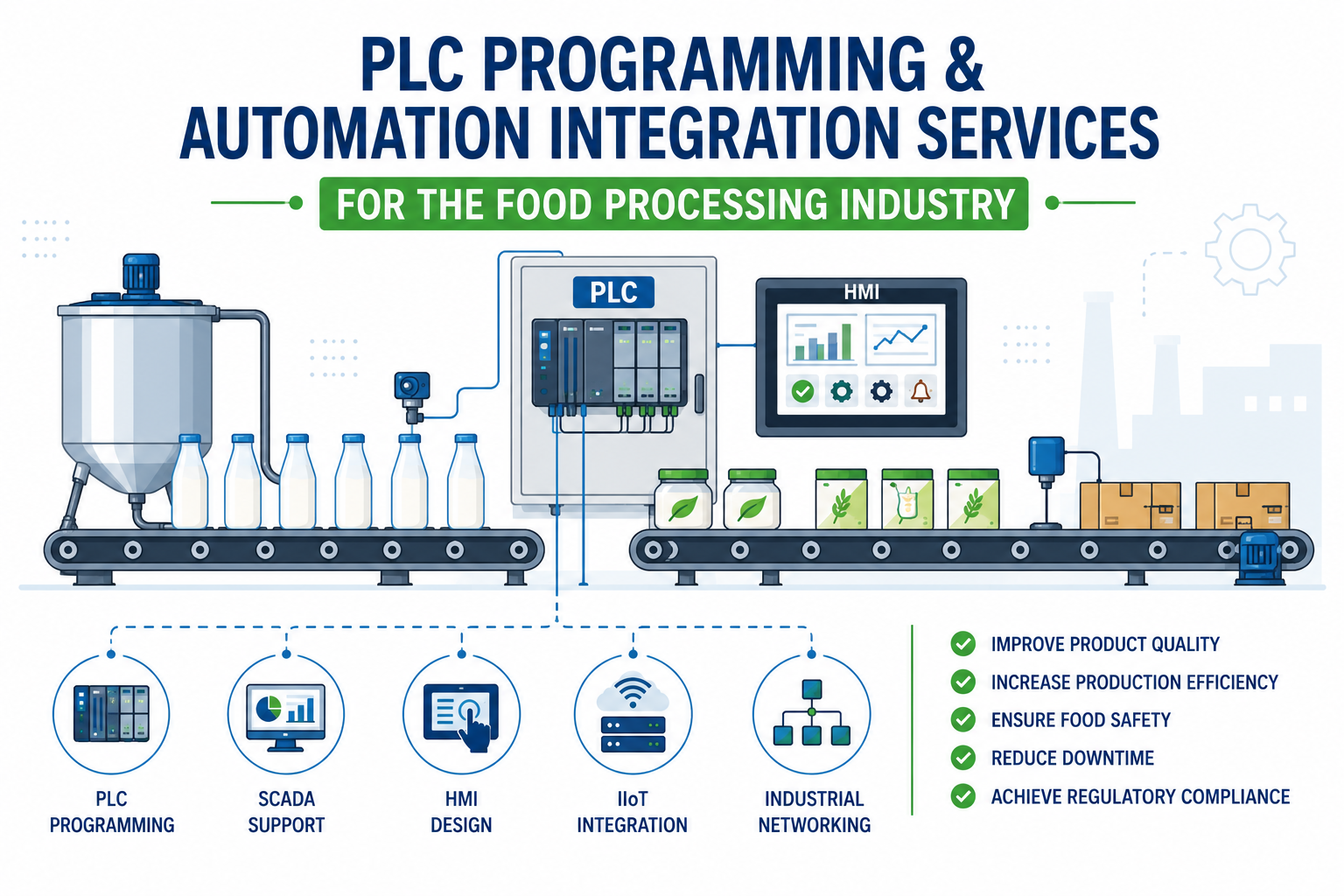
PLC programming and automation integration services help food processing companies automate production lines, improve food safety, reduce downtime, ensure regulatory compliance, and increase overall manufacturing efficiency. Custom PLC solutions enable reliable control of mixing, cooking, packaging, filling, labeling, cleaning, and material handling processes.
Food manufacturers across the country are under constant pressure to produce more, waste less, and meet stricter safety standards, all while keeping labor costs under control. AutomatexLab helps food processing plants modernize their production facilities with custom PLC programming, SCADA systems, HMI design, and full automation integration built around the realities of a working plant floor, not a generic template.
Why Do Food Processing Plants Need Industrial Automation?
Food manufacturers face a specific set of operational pressures that most other industries do not deal with at the same scale.
| Challenge | Impact on Production |
|---|---|
| Rising labor costs | Higher cost per unit, harder to scale shifts |
| Human errors | Inconsistent batches, safety risks, rework |
| Product inconsistency | Customer complaints, brand damage |
| Strict food safety regulations | Constant audit and compliance pressure |
| Increasing customer demand | Lines can’t keep pace without automation |
| Production downtime | Direct revenue loss, missed shipments |
| High utility consumption | Shrinking margins |
| Traceability requirements | Manual record keeping becomes unmanageable |
Each of these problems points to the same root cause: manual and semi-manual processes cannot keep up with modern food production demands. PLC-controlled automation directly addresses this by removing variability, enforcing consistent process steps, and generating the digital records that regulators and customers now expect.
What Are PLC Programming and Automation Integration Services?
PLC programming and automation integration cover the full set of technologies that control, monitor, and connect a food processing plant.
This includes:
- PLC programming for machine and line control
- Machine automation for individual equipment
- Production line automation across multiple machines
- SCADA integration for plant-wide visibility
- HMI development for operator interaction
- Sensor integration for real-time process data
- Industrial networking to connect devices and systems
- Recipe automation for repeatable product formulas
- Data logging for compliance and quality records
- Remote monitoring for off-site visibility
No two production lines are identical, even within the same facility. A dairy bottling line and a bakery packaging line need entirely different control logic, timing sequences, and safety interlocks. Every automation project starts with custom logic built for that specific line.
Our PLC Programming Services for Food Processing
Custom PLC Programming
New machines need control logic built from scratch, and existing machines often need their programs modified as production needs change. AutomatexLab handles new machine programming, existing PLC modifications, logic optimization, and production sequence development for equipment across the plant.
PLC Migration and Upgrade
Legacy controllers eventually become a liability. Parts stop being available, support ends, and the risk of a full line stoppage increases every year the system stays in place. AutomatexLab manages legacy PLC replacement, program conversion between platforms, and controller upgrades, all planned to keep production interruption to a minimum or eliminate it entirely.
PLC Troubleshooting
Unexpected machine stoppages cost food manufacturers real money in lost production and spoiled product. AutomatexLab provides fault diagnosis, online debugging, emergency support, and performance optimization to get lines back up quickly and prevent repeat failures.
PLC Program Optimization
An existing PLC program that technically works is not the same as one that works efficiently. Optimization work focuses on faster cycle time, reduced machine idle time, energy optimization, and stable machine operation across shifts.
Automation Integration Services We Offer
SCADA Development
SCADA systems give plant managers a real-time view of the entire operation. AutomatexLab builds production dashboards, alarm management systems, historical trend tracking, batch monitoring, and remote monitoring capability into every SCADA deployment.
HMI Design
Operators interact with the process through the HMI, so screen design directly affects speed and error rate on the floor. AutomatexLab designs operator-friendly screens, recipe selection interfaces, production monitoring views, alarm visualization, and maintenance screens tailored to how the line actually runs.
Industrial IoT Integration
Connecting machines to the cloud opens up data that was previously invisible. This includes machine data collection, cloud dashboards, predictive maintenance alerts, OEE monitoring, and remote analytics accessible from anywhere.
MES Integration
Manufacturing execution systems tie the plant floor to the business side of the operation. AutomatexLab integrates production tracking, batch management, quality records, traceability data, and ERP connectivity so information flows both ways without manual entry.
Industrial Communication Integration
Modern food plants run on a mix of equipment from different eras and different vendors, which makes communication protocol support essential.
Supported protocols include:
- Modbus
- OPC UA
- PROFINET
- EtherNet/IP
- Ethernet TCP/IP
- MQTT
- CANopen
What Food Processing Equipment Do We Automate?
AutomatexLab automates equipment across every stage of food production.
| Equipment Category | Examples |
|---|---|
| Mixing and blending | Mixing systems |
| Product movement | Conveyors, material handling systems, palletizers |
| Filling and packaging | Filling machines, packaging machines, labeling systems |
| Bottling | Bottling plants |
| Cleaning | CIP systems |
| Thermal processing | Pasteurization systems, ovens, baking equipment |
| Cold chain | Refrigeration systems, freezing plants |
| Robotics | Robotic packaging cells |
Which PLC Brands Do We Support?
AutomatexLab works across all major PLC platforms, so plants are never locked into a single vendor.
Supported brands include:
- Siemens
- Allen-Bradley
- Mitsubishi
- Omron
- Schneider Electric
- Delta
- ABB
- Beckhoff
- WAGO
- Phoenix Contact
Every project is approached as vendor-independent, which means recommendations are based on what fits the plant’s process and existing infrastructure rather than a preferred brand.
Which Food Processing Industries Do We Serve?
AutomatexLab has experience automating production across a wide range of food processing segments, including:
- Dairy
- Beverage
- Bakery
- Snack manufacturing
- Frozen foods
- Meat processing
- Seafood
- Edible oil
- Confectionery
- Spice manufacturing
- Grain processing
- Ready-to-eat foods
What Does Our Automation Integration Process Look Like?
Requirement analysis
The process starts with understanding the current production process, its bottlenecks, and its goals.
Site assessment
The team reviews existing machines and control systems on site to understand what can be reused and what needs replacement.
Automation design
This stage covers electrical architecture, control philosophy, and network design for the full system.
PLC software development
Custom programming is written, simulated, and tested before it ever touches the production floor.
System integration
Sensors, drives, HMIs, robots, SCADA, and existing equipment are brought together into a single working system.
Factory acceptance testing
The system is tested and validated before shipment or installation.
Site commissioning
The system is installed and commissioned on the actual production line.
Operator training
Plant staff are trained to run and troubleshoot the new system confidently.
Long-term support
Ongoing support is available after commissioning to handle updates, troubleshooting, and future expansion.
What Are the Benefits of PLC Automation in Food Manufacturing?
| Benefit | Why It Matters |
|---|---|
| Improved product consistency | Fewer customer complaints and rejected batches |
| Higher production output | More product with the same footprint |
| Reduced waste | Direct impact on margins |
| Better food safety | Fewer manual handling risks |
| Easier compliance | Automated records simplify audits |
| Faster production cycles | More throughput per shift |
| Lower labor dependency | Less exposure to staffing shortages |
| Predictive maintenance | Fewer surprise breakdowns |
| Reduced downtime | More consistent revenue |
| Better energy efficiency | Lower utility costs |
| Digital production records | Faster traceability during recalls |
| Easier expansion | Scalable architecture supports growth |
What Common Automation Challenges Do We Solve?
Food processing plants often reach out to AutomatexLab because of specific, recurring problems:
- Frequent production stoppages
- Slow packaging lines
- Manual batch recording
- Inconsistent filling
- Conveyor synchronization issues
- Legacy PLC failures
- No production visibility
- Excessive product wastage
- Poor machine communication
Each of these issues traces back to a control system that either wasn’t designed for current production demands or has aged past its useful life. Custom PLC and automation work resolves them at the source rather than patching symptoms.
Why Choose AutomatexLab?
- Experienced PLC programmers who understand food industry constraints
- Industry-standard programming practices
- Vendor-neutral automation solutions
- Custom-built control logic for each line
- Scalable architectures that support future expansion
- Fast commissioning support to minimize downtime
- Remote troubleshooting for quick issue resolution
- Documentation and training included with every project
- Long-term maintenance support after commissioning
- A focus on production efficiency and reliability, not just installation
Conclusion
Reliable PLC programming and automation integration give food processing manufacturers the efficiency, product quality, traceability, and operational reliability needed to compete in a demanding market. Whether the goal is replacing an aging legacy system, building a new production line from scratch, or connecting the plant floor to modern IoT and MES platforms, the right automation partner makes the difference between a system that just runs and one that runs well.
Contact AutomatexLab today for custom PLC programming, automation integration, SCADA, HMI, and Industry 4.0 solutions built around your food processing operation.
FAQs
AutomatexLab programs across all major platforms, including Siemens, Allen-Bradley, Mitsubishi, Omron, Schneider Electric, Delta, ABB, Beckhoff, WAGO, and Phoenix Contact.
Yes. AutomatexLab handles legacy PLC replacement, program conversion, and controller upgrades with minimal production interruption.
Yes. This includes production dashboards, alarm management, historical trends, batch monitoring, and remote monitoring.
Yes. Existing equipment is integrated alongside new sensors, drives, HMIs, robots, and SCADA systems during the automation design process.
AutomatexLab serves dairy, beverage, bakery, snack, frozen food, meat, seafood, edible oil, confectionery, spice, grain, and ready-to-eat food processing plants.
Yes. Remote troubleshooting is available for fault diagnosis and online debugging without always requiring an on-site visit.
Yes. Site commissioning is part of the standard automation integration process, along with factory acceptance testing beforehand.
Yes. MES integration includes production tracking, batch management, quality records, traceability, and ERP connectivity.
Yes. This includes industrial IoT integration, cloud dashboards, predictive maintenance, and OEE monitoring.
Timelines vary based on the complexity of the line and the scope of integration required. Simpler upgrades can move quickly, while full line automation projects take longer due to design, testing, and commissioning phases.