Every automation engineer eventually gets asked the same question by a client who read one blog post too many: “Should we just use MQTT for everything?”
The honest answer is no, and anyone telling you otherwise probably hasn’t had to debug a missing tag on a live SCADA system at two in the morning. MQTT and OPC UA aren’t rivals. They’re tools built for different jobs, and most factories running real Industry 4.0 systems today use both.
Here’s the breakdown, based on what actually happens when these protocols hit a real production floor.
Why this comparison keeps coming up
Anyone building a modern industrial network eventually has to decide how machines talk to software, and how that data reaches the cloud. Get this wrong and you end up with either a fragile, overloaded broker or a factory floor that can’t talk to its own SCADA system without three layers of translation.
MQTT and OPC UA sit at the center of that decision because they solve opposite halves of the same problem. One moves data fast and cheap. The other describes what that data actually means.
MQTT in plain terms
MQTT was built in 1999 for oil pipeline monitoring over unreliable satellite links. That origin matters. It explains why the protocol is so stripped down: bandwidth was expensive and connections dropped constantly, so the whole design optimizes for small messages and tolerance for flaky networks.
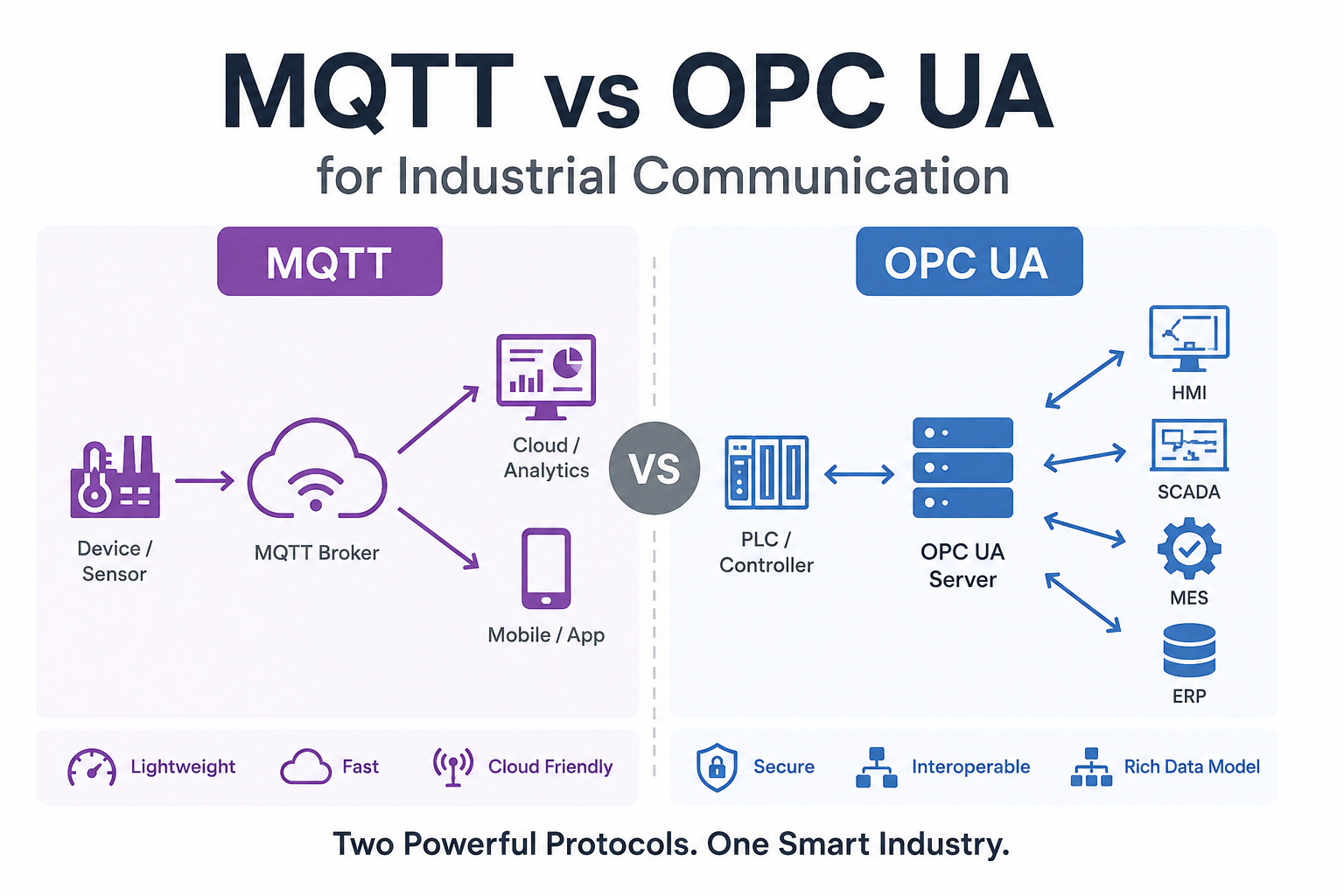
The architecture is simple. A device (the publisher) sends data to a central broker. Anything subscribed to that topic receives it. Publishers and subscribers never talk directly, which keeps the system loosely coupled and easy to scale.
A sensor on a pump publishes vibration data to a topic like plant1/pump3/vibration. The broker forwards it to whatever is listening, whether that’s a cloud dashboard, a historian, or an alert system. Add a hundred more sensors and the architecture doesn’t change, just the load on the broker.
What MQTT does not give you out of the box is meaning. A payload is just bytes. Whether that number is in millimeters per second or inches per second is something you have to agree on separately, usually by convention or documentation that lives outside the protocol entirely.
OPC UA in plain terms
OPC UA came out of the automation world, not the IoT world, and it shows. It was built to replace the old Windows-only OPC Classic standard with something secure, cross-platform, and rich enough to describe an entire factory’s worth of machine data.
Instead of a broker, OPC UA uses a client-server model. A PLC or gateway runs a server that exposes an address space, essentially a structured map of everything that device knows about itself: tag values, alarms, historical data, even executable methods. A SCADA system, HMI, or MES connects as a client and browses that structure directly.
This is the part that trips people up coming from the IoT world. OPC UA data isn’t just a number. It’s a number with a name, a type, a unit, a timestamp, and a place in a hierarchy that describes what machine it belongs to and what that machine does. That’s what people mean when they say OPC UA has semantics and MQTT doesn’t.
The comparison that actually matters
| Question | MQTT answer | OPC UA answer |
|---|---|---|
| What is it built for | Fast, cheap data transport | Structured, secure machine communication |
| How does data move | Broker relays messages between publishers and subscribers | Clients connect directly to servers |
| Does the data describe itself | No, payload is raw | Yes, every value has type, unit, and context |
| How’s security handled | TLS at the transport layer | Built into the protocol, with certificates and roles |
| Native PLC support | Weak, usually needs a gateway | Strong, most major PLC brands support it directly |
| Where it shines | Cloud, remote sites, constrained devices | Factory floor, SCADA, MES integration |
If you’re choosing based on a single word, MQTT is about movement and OPC UA is about meaning.
Where each one actually earns its place on the floor
I’ve walked into plants where someone tried to run OPC UA all the way out to a hundred remote wellheads on cellular modems, and watched it choke under the overhead. I’ve also seen someone try to pull rich asset data for a digital twin project through MQTT topics with no schema, and watched the integration team spend three weeks just agreeing on what each field meant.
Both mistakes come from treating these as interchangeable. They aren’t.
MQTT does its best work when:
- Devices are remote, battery powered, or on unreliable connections
- You’re streaming high-volume sensor data to the cloud
- You need to onboard thousands of devices without custom integration work
- The receiving system already knows what the data means, so you don’t need OPC UA’s self-describing structure
OPC UA does its best work when:
- You’re pulling data directly off PLCs, robots, or CNC machines
- SCADA, MES, or ERP systems need structured, browsable access to machine state
- Vendor interoperability matters, since Siemens, Rockwell, Schneider, Mitsubishi, Beckhoff, and Omron all support it natively
- You need alarms, historical data, and diagnostics without building that logic yourself
How the architectures actually differ
MQTT’s centralized broker model is its biggest strength and its biggest weakness at the same time. It scales beautifully because adding a new device just means adding a new publisher. But the broker becomes a single point of failure, and there’s no built-in way for a new device to announce itself. Someone has to configure that topic subscription manually or through automation you build yourself.
OPC UA’s distributed server model solves the discovery problem natively. A client can browse a server’s address space and find out what’s available without prior configuration. That’s genuinely useful on a factory floor where equipment gets added, replaced, or reconfigured constantly. The tradeoff is more overhead per connection and more complexity to stand up in the first place.
Security is not an afterthought in either protocol, but the starting point differs
MQTT security depends entirely on what you build around it. TLS encrypts the connection, and the broker can enforce authentication, but the protocol itself doesn’t dictate how granular that access control gets. A lot of MQTT deployments I’ve reviewed have flat topic structures with weak access segmentation, mostly because nobody thought about it until an audit forced the question.
OPC UA bakes security into the protocol itself. Message signing, encryption, and certificate-based authentication are part of the spec, not an add-on. User roles can restrict access down to individual nodes. This is a big reason why industries with strict compliance requirements, like pharmaceuticals, energy, and critical infrastructure, default to OPC UA for anything touching operational technology.
Neither protocol is unsafe by design. But OPC UA forces good security habits, and MQTT trusts you to build them yourself.
The setup almost every modern factory actually runs
If you’re building a real Industry 4.0 stack in 2026, the architecture that keeps showing up looks like this:
PLC runs an OPC UA server. A gateway or edge device acts as an OPC UA client, pulling structured, contextualized data off the floor. That gateway republishes a filtered version of that data as MQTT, often using Sparkplug B for added structure. The MQTT broker forwards it to the cloud, where it feeds dashboards, analytics, or AI models.
This gives you OPC UA’s rich semantics inside the factory and MQTT’s lightweight efficiency getting data out to the cloud. Neither protocol is doing the other’s job. They’re each doing what they were built for.
What Sparkplug B actually fixes
Sparkplug B is a specification layered on top of MQTT that adds the structure MQTT lacks natively: standardized payload formats, birth and death certificates for devices, and support for the Unified Namespace concept that’s become a buzzword in manufacturing circles over the last couple of years.
It closes some of the gap with OPC UA, but not all of it. You still don’t get OPC UA’s full information modeling or its native discovery. Think of Sparkplug B as MQTT growing up for industrial use, not MQTT becoming OPC UA.
A decision framework that skips the theory
Ask yourself three questions.
Is the data coming directly off a PLC, robot, or industrial controller? If yes, start with OPC UA.
Is the data going to the cloud, or coming from something remote, battery powered, or high volume? If yes, MQTT is the better transport.
Are you building a full Industry 4.0 stack with SCADA, MES, and cloud analytics all in play? Then you’re not choosing one, you’re architecting how both fit together, and that’s the normal outcome for anyone doing this at scale.
Mistakes I see repeated across projects
The most common one is treating MQTT as a full replacement for OPC UA because it’s easier to set up. It works right up until someone needs semantic context on that data and realizes none exists.
The second is exposing OPC UA servers directly to the internet without a gateway. OPC UA’s security features don’t fix bad network architecture.
The third is skipping certificate management on OPC UA because it feels like friction during a pilot project. That friction is the security model working as intended, and skipping it early creates real problems at scale later.
Where this is heading
Unified Namespace architectures are pushing MQTT and OPC UA closer together rather than further apart. OPC UA over TSN is improving real-time performance for motion control applications that used to require dedicated fieldbus protocols. Sparkplug B adoption keeps growing as more vendors bake it into their gateways by default.
None of this points toward one protocol winning. It points toward both becoming more tightly integrated as the standard way modern factories are built.
The bottom line
MQTT and OPC UA were built to solve different problems, and trying to make one do the other’s job is where most integration headaches start. OPC UA belongs on the factory floor, where structure and semantics matter. MQTT belongs on the path to the cloud, where speed and efficiency matter more than context. Get that division right, and the rest of your architecture tends to fall into place.
Need Help Designing Your MQTT and OPC UA Architecture?
Choosing between these protocols on paper is one thing. Implementing them correctly on a live production floor is another.
AutomatexLab designs and builds industrial communication architectures for manufacturers who need their PLCs, SCADA systems, and cloud platforms to actually talk to each other without constant firefighting.
What we handle:
- OPC UA server configuration across Siemens, Rockwell, Schneider, Mitsubishi, Beckhoff, and Omron platforms
- MQTT and Sparkplug B integration for cloud connectivity and remote monitoring
- Edge gateway architecture that bridges OT and IT networks securely
- SCADA and HMI integration built on top of your existing PLC infrastructure
- Predictive maintenance pipelines combining OPC UA context with MQTT telemetry
Whether you’re modernizing a legacy plant or building a greenfield Industry 4.0 deployment, the protocol choice matters less than getting the architecture right the first time.
Talk to an automation engineer, not a sales rep.
FAQs
For simple data transport, yes, mainly because of lower protocol overhead. That speed advantage shrinks once you factor in the modeling and context OPC UA provides for free.
No. They’re increasingly deployed together, not in competition, and OPC UA’s native PLC support isn’t something MQTT is trying to replace.
Yes, but almost always through a gateway or middleware layer. OPC UA is the native language of most Siemens controllers.
MQTT if you’re coming from a software or IoT background, since it’s simpler to pick up. OPC UA if you’re going to work directly with PLCs or SCADA systems, since you’ll need it regardless.
If you’re running anything beyond a small pilot, almost certainly yes. The combination is what most production-grade Industry 4.0 systems actually use.