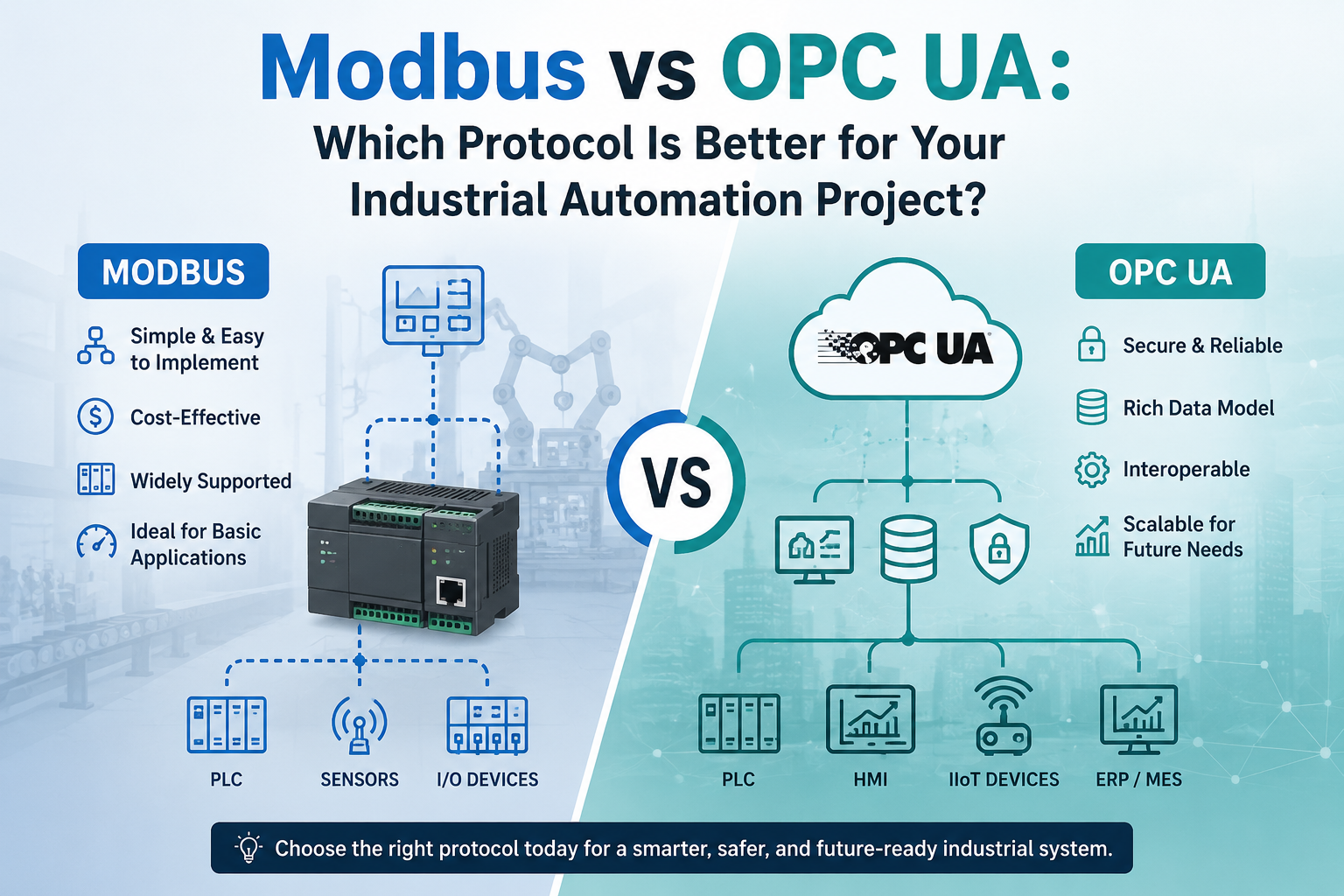
Choosing between Modbus and OPC UA is one of the most common decisions industrial automation engineers face during system design. Both protocols move data between PLCs, SCADA systems, and HMIs, but they were built decades apart to solve very different problems.
This guide breaks down the technical architecture, security models, performance tradeoffs, industry use cases, and migration considerations for both protocols, based on integration work across manufacturing, process control, and IIoT deployments.
What Is Modbus and Why Is It Still Used
Modbus is a serial and Ethernet based communication protocol developed in 1979 by Modicon for connecting industrial electronic devices. It uses a simple master-slave, now called client-server, model where one device requests data and another responds with raw register values.
Modbus was designed in an era when microprocessors had extremely limited memory and computing power. Every design decision in the protocol reflects that constraint. Messages are small, the function set is limited to reading and writing registers or coils, and there is no concept of data typing built into the wire format. A temperature value and a motor speed look identical on the wire. The engineer has to know what each register means ahead of time.
Despite being over four decades old, Modbus remains one of the most deployed protocols in industrial settings. It survives because it is lightweight, free to implement, and supported by nearly every PLC, VFD, sensor, and metering device manufacturer on the market. A single Modbus RTU message can be as small as eight bytes, which makes it ideal for low-bandwidth serial links, battery-powered field devices, and older equipment that was never designed with networking in mind.
Modbus variants in active use:
| Variant | Physical Layer | Typical Use Case |
|---|---|---|
| Modbus RTU | RS-232 or RS-485 serial | Legacy field devices, sensors, VFDs |
| Modbus ASCII | RS-232 or RS-485 serial | Rare, used where message readability matters |
| Modbus TCP | Ethernet | Modern PLC to SCADA communication |
| Modbus Plus | Proprietary token-passing network | Older Modicon-specific installations |
What Is OPC UA and Why Was It Built
OPC UA, short for Open Platform Communications Unified Architecture, is a platform-independent, service-oriented protocol released in 2006 by the OPC Foundation to replace the original OPC standard, which relied heavily on Windows-only COM and DCOM technology.
The original OPC standard worked well inside a single Windows-based control network but broke down as plants started connecting to broader IT infrastructure, other operating systems, and eventually the cloud. DCOM was notoriously difficult to configure across firewalls and was never designed with modern cybersecurity threats in mind.
OPC UA was built from the ground up to solve those problems. It carries structured, self-describing data instead of raw registers, meaning a connected system can query not just a value but also its data type, units, timestamp, and relationship to other data points. It supports built-in security at the protocol level and runs on Windows, Linux, and embedded systems alike. This is why OPC UA has become the primary data backbone recommended in Industry 4.0 and IIoT reference architectures, including the RAMI 4.0 model used across European manufacturing standards.
Core capabilities OPC UA adds over Modbus:
| Capability | Description |
|---|---|
| Information modeling | Data carries context, type, and relationships, not just raw values |
| Built-in security | Certificate-based authentication and encrypted transport |
| Platform independence | Runs on Windows, Linux, macOS, and embedded RTOS |
| Publish-subscribe support | Efficient one-to-many data distribution for large systems |
| Historical access | Standardized way to query historical process data |
| Alarms and conditions | Native support for alarm states, not just numeric values |
Modbus vs OPC UA: Direct Comparison Table
| Factor | Modbus | OPC UA |
|---|---|---|
| Year introduced | 1979 | 2006 |
| Data model | Raw registers, no context | Structured, self-describing objects |
| Security | None built in | Built-in encryption and authentication |
| Platform support | Any device with a serial or TCP stack | Windows, Linux, embedded, cloud |
| Bandwidth need | Very low | Moderate to high |
| Setup complexity | Low | Higher, needs address space modeling |
| Interoperability | Requires manual register mapping | Semantic interoperability across vendors |
| Communication model | Client-server only | Client-server and publish-subscribe |
| Historical data access | Not built in | Standardized historical access service |
| Alarm handling | Not built in | Native alarm and condition model |
| Best fit | Field level device communication | Plant-wide and cloud-connected architectures |
| Cost to implement | Low | Higher initial engineering cost |
Which Protocol Has Better Security
OPC UA is significantly more secure than Modbus, and this is not a close comparison.
Modbus was built before industrial cybersecurity was a serious design concern. It has no authentication, no encryption, and no message integrity checking anywhere in the specification. Any device with network access to a Modbus TCP line can read or write to a PLC’s registers without any credentials. On serial Modbus RTU networks, physical access to the wiring is effectively the only barrier.
This design was acceptable when industrial networks were physically isolated from corporate IT and the internet. That assumption no longer holds in most modern plants. Remote monitoring, cloud dashboards, and IT-OT convergence mean control networks are frequently bridged to broader infrastructure, which expands the attack surface considerably.
OPC UA includes certificate-based authentication, encrypted transport using standard TLS-based mechanisms, and user access control as part of the protocol specification itself, not as an add-on. A client must present valid credentials and a trusted certificate before it can read or write data. Message signing prevents tampering in transit, and different security policies can be applied depending on the sensitivity of the network segment.
Security comparison at a glance:
| Security Feature | Modbus | OPC UA |
|---|---|---|
| Authentication | None | Certificate-based, username, or both |
| Encryption | None | Yes, configurable security policies |
| Message integrity checking | None | Yes, cryptographic signing |
| Access control by user role | None | Yes |
| Audit logging support | None | Yes |
For any new deployment that touches a corporate network, cloud platform, or remote access point, OPC UA is the safer default. Modbus should be treated as a trusted, isolated field-level protocol only, ideally kept behind a secure gateway rather than exposed directly to broader networks.
Which Protocol Performs Better on the Plant Floor
Modbus wins on raw speed and simplicity at the device level, and this matters more than it might seem on paper.
Because Modbus messages carry no metadata, they transmit fast and consume very little processing power on constrained devices like VFDs, temperature controllers, and basic sensors. Many of these devices run on microcontrollers with only a few kilobytes of RAM. Implementing a full OPC UA stack on hardware like this is often impractical or impossible without a gateway device to translate.
This makes Modbus RTU a strong choice for tight, deterministic control loops where every millisecond of latency counts, such as motor control feedback loops or fast analog sensor polling.
OPC UA’s structured data model adds overhead by design. A single OPC UA read can carry far more information than a Modbus read, including data type, quality flags, and timestamps, but that extra context comes at the cost of bandwidth and processing time. On resource-limited legacy hardware, this overhead can become a real constraint, particularly on older serial links or heavily loaded Ethernet segments with many polling clients.
Quick rule of thumb: if the device sits close to the machine and only needs to exchange simple values at high speed, Modbus is usually sufficient. If the data needs to travel across systems with context intact, and slightly higher latency is acceptable, OPC UA is the better fit.
Can Modbus and OPC UA Work Together
Yes, and in most real plants they already do.
A common architecture uses Modbus at the field level to talk to sensors, drives, and legacy PLCs, then uses an OPC UA server as a gateway to expose that data to SCADA, MES, and cloud analytics platforms above it. This layered approach protects existing investment in Modbus-based equipment while still gaining OPC UA’s security and interoperability benefits at the higher levels of the automation pyramid.
This hybrid model generally follows a pattern:
- Field devices communicate over Modbus RTU or Modbus TCP to a local PLC or edge gateway.
- The gateway or PLC runs an embedded OPC UA server that exposes the same data using a structured information model.
- SCADA, MES, historians, and cloud platforms connect to the OPC UA server, never directly to the Modbus devices.
Most modern PLC platforms, including Siemens, Allen-Bradley, and Schneider Electric controllers, support this hybrid setup natively or through a lightweight OPC UA gateway module. This is by far the most common architecture seen in brownfield plants that are modernizing without replacing existing field-level hardware.
Industry Specific Considerations
Oil and gas and process industries
These environments often mix decades-old Modbus RTU instrumentation with newer digital control systems. Given the remote and sometimes hazardous nature of these sites, OPC UA gateways are increasingly used to securely centralize data for remote monitoring without exposing Modbus devices directly to wide area networks.
Pharmaceutical and food processing
Regulatory frameworks in these industries increasingly require documented cybersecurity controls and audit trails. OPC UA’s built-in authentication and logging capabilities make compliance significantly easier than trying to bolt security onto a Modbus network after the fact.
Discrete manufacturing and automotive
These plants tend to have a large number of PLCs from multiple vendors on the same floor. OPC UA’s vendor-neutral information modeling reduces the integration burden when connecting MES systems across mixed-vendor equipment, something Modbus cannot do natively since register maps vary by manufacturer.
Building automation and utilities
Field devices such as meters and sensors are frequently Modbus based due to low cost and low power requirements, while supervisory and reporting layers increasingly use OPC UA or BACnet for broader system integration.
Cost and Engineering Time Comparison
| Cost Factor | Modbus | OPC UA |
|---|---|---|
| Software licensing | Often free or low cost | Varies, some free open source servers exist |
| Engineering time to configure | Low, simple register mapping | Higher, requires information model design |
| Hardware requirements | Minimal | May require gateway for legacy devices |
| Long-term maintenance | Higher due to manual documentation needs | Lower due to self-describing data |
| Security add-on costs | Requires separate network security investment | Built in, lower additional cost |
Modbus has a lower upfront cost but can accumulate hidden costs over time through manual register documentation, lack of built-in security requiring separate network hardening, and integration friction when connecting multiple vendors’ equipment. OPC UA has a higher initial engineering investment but tends to reduce long-term integration and security costs, particularly as a plant scales or adds new systems.
Common Mistakes When Choosing Between the Two
Assuming newer always means better. OPC UA is not a universal upgrade. Forcing it onto simple, isolated field devices where Modbus already works well adds unnecessary complexity and cost.
Exposing Modbus TCP directly to corporate networks. This is one of the most common industrial security gaps found during audits. Modbus should sit behind a gateway or firewall, never directly accessible from IT networks.
Underestimating OPC UA address space design time. Teams new to OPC UA sometimes assume it is a drop-in replacement for Modbus. Building a proper information model takes real engineering time and should be planned for in project timelines.
Ignoring the hybrid approach. Some teams treat this as an either-or decision when the most practical answer for most brownfield plants is both protocols working together at different layers.
Modbus vs OPC UA: Which One Is Actually Better
Neither protocol is universally better. They solve different layers of the same problem, and the right answer depends entirely on where in the automation architecture the communication is happening.
Modbus is better for fast, low-cost, device-level communication where security is handled elsewhere, typically through network isolation. OPC UA is better for secure, structured, plant-wide data exchange, especially when that data needs to reach dashboards, historians, MES systems, or the cloud.
Most modern automation architectures do not choose one over the other. They use Modbus close to the machine, where speed and simplicity matter most, and OPC UA as the integration layer above it, giving plants the raw speed of a proven legacy protocol combined with the security and interoperability of a modern industrial standard.
Frequently Asked Questions
Is OPC UA replacing Modbus completely?
No. Modbus remains deeply embedded in existing field devices and is still specified in new low-cost sensors, drives, and meters. OPC UA is replacing the integration and supervisory layer, not the field layer.
Does OPC UA require more expensive hardware?
Not necessarily for software-based servers, but older PLCs may need an added gateway device or a firmware update to support OPC UA natively, which adds cost to a project.
Can Modbus TCP be made secure?
Modbus TCP itself has no native security, but it can be secured using network-level controls such as VPNs, firewalls, and VLAN segmentation. It cannot match OPC UA’s built-in protocol-level security, since those controls sit outside the protocol rather than inside it.
Which protocol is easier to learn for a new automation engineer?
Modbus has a shallower learning curve because it deals with simple register reads and writes. OPC UA takes more time to learn because it involves address space modeling and a deeper understanding of information architecture.
Do I need to choose one protocol for an entire plant?
No. Most plants use a layered approach, with Modbus at the device level and OPC UA at the supervisory and integration level, rather than standardizing on a single protocol plant-wide.
Is OPC UA overkill for a small automation project?
For a small, isolated system with a handful of devices and no need for external connectivity, Modbus is often sufficient and simpler to deploy. OPC UA becomes more valuable as system complexity, vendor diversity, or connectivity requirements grow.