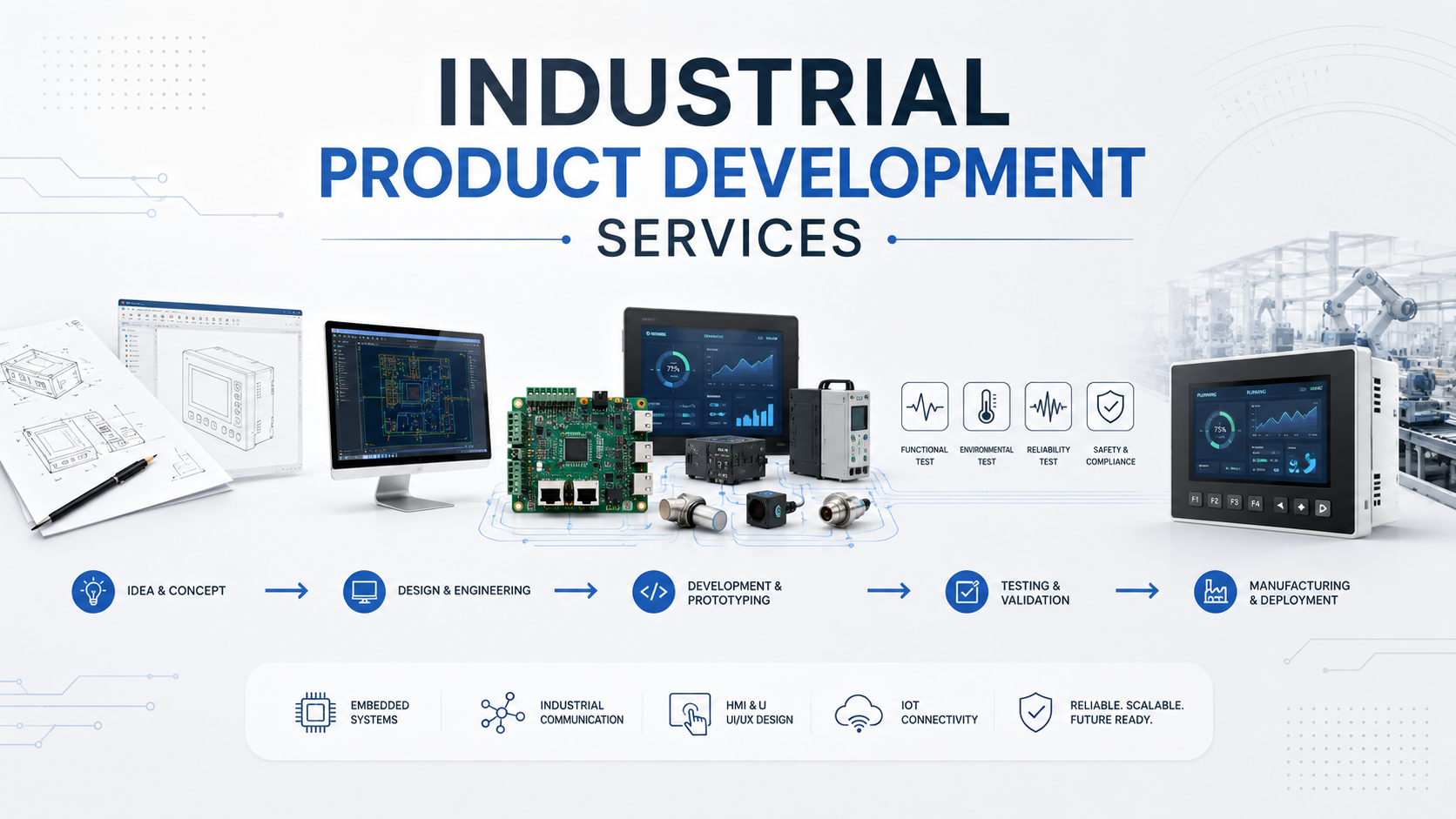
Industrial product development services help companies transform an idea into a functional, manufacturable, and scalable industrial product through stages such as requirement analysis, concept design, hardware development, embedded software development, mechanical design, prototyping, and testing and validation.
What Are Industrial Product Development Services?
Definition of industrial product development
Industrial product development is the structured process of taking a product concept and turning it into a working, reliable device that is ready for manufacturing. It covers everything from understanding the problem the product needs to solve, through electronics and firmware design, mechanical packaging, prototyping, and rigorous testing.
Unlike a simple proof of concept, industrial product development accounts for the realities of factory environments: continuous operation, vibration, dust, temperature swings, electrical noise, and long service life expectations.
Why product development matters in industrial automation
In industrial automation, equipment often runs for years without interruption inside demanding environments. A product that works on a lab bench can fail within weeks on a factory floor if environmental conditions, electrical interference, or mechanical stress were not properly accounted for during development.
Proper product development reduces the risk of field failures, simplifies maintenance, and ensures the final product can actually be manufactured at the volumes a business needs, at a cost that makes sense.
Difference between product development and manufacturing
| Industrial Product Development | Manufacturing |
|---|---|
| Focuses on design and engineering | Focuses on production |
| Involves prototyping and iteration | Involves repeatable, high-volume output |
| Iterative process with frequent design changes | Repetitive process with fixed processes |
| High engineering involvement | High operational involvement |
| Output: a validated, manufacturable design | Output: physical units at scale |
Product development answers the question “will this work, and can it be built?” Manufacturing answers the question “how do we build many of these, reliably and cost-effectively?”
Typical industries that require these services
- Factory automation and process industries
- OEM machinery builders
- Smart device and IoT hardware companies
- Embedded systems and electronics manufacturers
- Energy and utility equipment providers
Key Takeaway
Industrial product development focuses on creating reliable, tested products before they enter large-scale manufacturing, reducing the risk of costly redesigns and field failures later.
Why Industrial Product Development Is Important
A structured development process delivers several benefits that directly affect a company’s bottom line and reputation.
Faster innovation. A defined process with clear stages (requirements, design, prototyping, testing) helps teams move from concept to working product more predictably than an ad-hoc approach.
Reduced engineering risks. Identifying technical challenges early, during concept design or prototyping, is far cheaper than discovering them after tooling and production have started.
Lower development costs. Catching design flaws during prototyping avoids expensive rework during manufacturing, where changes to tooling, PCBs, or enclosures can be costly and slow.
Improved reliability. Environmental and reliability testing during development means the product is more likely to perform consistently once deployed in the field.
Better manufacturability. Designing with manufacturing in mind, known as design for manufacturing, ensures components are sourceable, assembly is straightforward, and production costs stay reasonable.
Easier compliance with standards. Building safety, EMC, and industry-specific compliance considerations into the design process from the start avoids late-stage surprises during certification.
Where this applies
- Factory automation: control panels, embedded controllers, and HMI systems that need to survive continuous operation on a production line.
- Process industries: sensors and data acquisition systems exposed to chemicals, heat, or moisture.
- OEM machinery: custom controllers and interfaces that need to integrate with a manufacturer’s existing equipment lineup.
- Smart devices: connected industrial products requiring both hardware reliability and IoT connectivity.
- Embedded systems: standalone devices running dedicated firmware for monitoring, control, or data logging.
Stages of Industrial Product Development
1. Requirement Analysis
Before any design work begins, the requirements that will shape the entire project need to be defined clearly.
Functional requirements describe what the product needs to do: what inputs it accepts, what outputs it produces, and what logic or control behavior it must support.
Environmental requirements describe the conditions the product will operate in, such as temperature range, humidity, vibration, dust exposure, and electrical noise.
Performance expectations cover response times, accuracy, processing capability, and communication speed needed for the application.
Safety considerations identify any hazards the product might create or be exposed to, and what protective measures or certifications are needed as a result.
Example: Developing an industrial HMI panel for harsh environments would involve defining the display size and touch sensitivity needed (functional), the IP rating and operating temperature range required for the factory floor (environmental), the screen refresh rate and communication protocol response times (performance), and any isolation or grounding requirements for operator safety (safety).
2. Concept Design
Once requirements are understood, the team moves into concept design, where the overall approach to the product is planned out.
Architecture planning defines how the major subsystems, such as processing, communication, power, and user interface, will work together.
Hardware selection involves choosing the processors, communication chips, sensors, and other key components that will form the foundation of the design.
Mechanical considerations at this stage are about rough sizing, mounting approach, and how the electronics will fit inside an enclosure.
User requirements ensure the product’s interface and operation match how the end user will actually interact with it on the factory floor.
Engineers typically evaluate multiple architectural approaches at this stage, weighing factors like cost, component availability, development time, and long-term maintainability before committing to a direction.
3. Hardware and Electronics Development
With a concept direction set, the team moves into detailed electronics development.
PCB design involves laying out the printed circuit board that will host all the components, with attention to signal integrity, thermal management, and manufacturability.
Component selection focuses on choosing parts that are reliable, available in the required volumes, and suited to the operating environment.
Sensor integration covers how sensors are wired, powered, and interfaced with the processing hardware to capture the data the product needs.
Power management ensures the device can operate reliably from its intended power source, whether that is mains power, battery, or industrial DC supplies, while handling fluctuations safely.
Communication interfaces define how the device will talk to other equipment, whether through industrial protocols, Ethernet, or wireless connections.
4. Embedded Software Development
Hardware alone does not make a functional product. Embedded software brings it to life.
Firmware development is the low-level code that runs directly on the device’s processor, controlling its hardware functions.
Device communication software handles sending and receiving data over the communication interfaces defined during hardware development.
Real-time operation is often critical in industrial applications, where the software must respond to inputs within strict time limits to keep processes running safely and correctly.
System control logic ties everything together, managing how the device behaves based on sensor inputs, communication, and user interaction.
Hardware and software must be developed in close coordination. A hardware design that does not account for the processing needs of the firmware, or firmware that does not account for hardware timing limitations, can lead to a product that does not perform as intended.
5. Mechanical Design
The mechanical design determines how the electronics are physically protected and presented.
Enclosures need to provide the right level of protection against dust, moisture, and impact, while allowing access for connectors, displays, or controls.
Heat management ensures components do not overheat, particularly important in sealed industrial enclosures where airflow may be limited.
Mounting systems determine how the product is installed, whether on a DIN rail, panel, wall, or machine frame.
Material selection affects durability, cost, and suitability for the operating environment, such as choosing materials resistant to chemicals or UV exposure.
Durability requirements ensure the enclosure and mechanical components can withstand the vibration, impacts, and wear expected over the product’s service life.
6. Prototype Development
Prototyping turns the design on paper into a physical, testable product.
Early validation allows the team to confirm that the chosen architecture actually works as intended before committing to production tooling.
Design verification checks that the prototype matches the specifications defined during requirement analysis.
Functional testing at the prototype stage confirms that the core features of the product operate correctly.
Iterative improvements are made based on what is learned from the prototype, refining the design before moving toward final validation and production.
7. Testing and Validation
Before a product is ready for manufacturing, it needs to go through thorough testing.
Functional testing ensures the intended operation works correctly across all the features and modes the product supports.
Environmental testing verifies performance under temperature extremes, vibration, and humidity, simulating the conditions the product will face in the field.
Reliability testing measures long-term stability, often through extended operation under load to identify any issues that only appear after sustained use.
Safety testing confirms that the product meets relevant safety requirements and any certifications needed for its intended market.
Technologies Used in Industrial Product Development
Embedded Systems
Embedded systems form the computing core of most industrial products, combining microcontrollers or processors with software to perform dedicated functions.
Microcontrollers are compact processing units suited for handling specific control tasks with low power consumption.
Processors with more computing power are used when a product needs to run more complex software, such as data processing or connectivity stacks.
Real-time control capability ensures that the embedded system can respond to inputs within predictable, often very short, time windows, which is essential for safe and accurate machine control.
Industrial Communication Protocols
Industrial products rarely operate in isolation. They need to communicate with other equipment using established protocols.
Modbus is a widely used protocol for connecting industrial devices, valued for its simplicity and broad support across equipment from different manufacturers.
CAN Bus is commonly used in applications requiring robust communication between multiple nodes, particularly where electrical noise is a concern.
RS-485 provides a reliable serial communication standard for connecting multiple devices over longer distances in industrial settings.
Ethernet based industrial protocols enable higher-speed communication and easier integration with factory networks and enterprise systems.
HMI Technologies
Human-machine interfaces are how operators interact with industrial equipment.
Touchscreens allow operators to interact directly with controls and data displays, often replacing banks of physical buttons and switches.
Displays need to be selected for visibility under factory lighting conditions and durability against dust and impact.
User interfaces for industrial HMIs are designed for clarity and quick recognition of status and alarms, since operators often need to act quickly.
IoT Connectivity
Many modern industrial products include connectivity features that extend their capabilities beyond the local installation.
Remote monitoring allows equipment status and performance to be viewed from outside the facility, supporting maintenance and operational decisions.
Data acquisition features collect operational data from sensors and processes for analysis and record-keeping.
Cloud communication enables data collected by the device to be sent to cloud platforms for storage, analysis, and integration with other systems.
Applications of Industrial Product Development
Industrial product development services are commonly applied to:
- Industrial HMI systems for operator interaction with machines and processes
- Smart sensors that combine sensing elements with onboard processing and communication
- Control panels that house the electronics for controlling machinery or processes
- Embedded controllers dedicated to specific automation tasks
- IoT devices that bring connectivity to industrial equipment
- Data acquisition systems for collecting and logging process data
- Machine monitoring equipment that tracks equipment health and performance
- Industrial gateways that bridge communication between different protocols and networks
Challenges in Industrial Product Development
Component Availability
Supply chain considerations play a significant role in industrial product development. Components selected during design need to remain available throughout the product’s production life, which can span many years. Designs that rely on parts with long lead times or limited sourcing can face production delays or costly redesigns later.
Reliability Requirements
Industrial products often operate continuously, sometimes around the clock, for years at a time. This places much higher demands on component selection, thermal design, and testing compared to consumer products that may only be used intermittently.
Environmental Conditions
Dust, vibration, moisture, and temperature extremes are common in industrial settings. Products need to be designed and tested to withstand these conditions without degrading performance or shortening service life.
Integration Complexity
Hardware and software coordination becomes more complex as products incorporate more features, communication protocols, and connectivity options. Ensuring all these elements work together reliably requires careful planning and thorough testing.
Compliance Requirements
Industry standards and certifications vary depending on the application and target market. Identifying which standards apply and designing to meet them from the start helps avoid delays during the certification process.
Factors That Influence Product Development Success
Several factors consistently influence whether an industrial product development project delivers a successful result:
- Clear requirements established at the start of the project, reducing the risk of scope changes later
- Cross-disciplinary engineering, since industrial products require coordination between electronics, software, and mechanical design
- Early testing, which surfaces issues while they are still inexpensive to fix
- Scalability, ensuring the design can move from prototype quantities to production volumes
- Design for manufacturing, so the product can be built efficiently and cost-effectively at scale
- Long-term maintainability, considering how the product will be serviced and supported over its operational life
Industrial Product Development vs Product Manufacturing
| Industrial Product Development | Manufacturing |
|---|---|
| Focuses on design and engineering | Focuses on production |
| Involves prototyping | Involves mass production |
| Iterative process | Repetitive process |
| High engineering involvement | High operational involvement |
Wrapping Up
Industrial product development is a multidisciplinary process that combines hardware, software, mechanical engineering, and testing to create reliable products suitable for industrial environments. Each stage, from requirement analysis through testing and validation, plays a role in reducing risk and ensuring the final product can be manufactured and operated reliably.
Need Technical Guidance?
If you are evaluating an industrial product idea or exploring technologies such as embedded systems, HMIs, control panels, or IoT devices, the engineering resources and technical insights available on AutomatexLab can help you understand the development process and make informed decisions.
FAQs
Industrial product development services involve designing, engineering, prototyping, and validating industrial products before production begins.
Industries including manufacturing, process automation, electronics, energy, and OEM machinery commonly use product development services.
Prototyping helps identify issues early and reduces risks before full-scale production. An industrial touchscreen HMI, for example, may undergo environmental and reliability testing as a prototype before deployment in factory automation systems.
Embedded systems, electronics, communication protocols, sensors, HMIs, and IoT technologies are widely used across industrial product development projects.
Timelines vary widely depending on product complexity, but projects generally move through requirement analysis, concept design, hardware and software development, mechanical design, prototyping, and testing before reaching production readiness.
An embedded system is a custom-built electronic device with dedicated hardware and firmware designed for a specific function, while a PLC (Programmable Logic Controller) is a general-purpose, off-the-shelf industrial controller that is programmed using standard logic programming methods. Embedded systems offer more design flexibility, while PLCs offer faster deployment using established platforms.