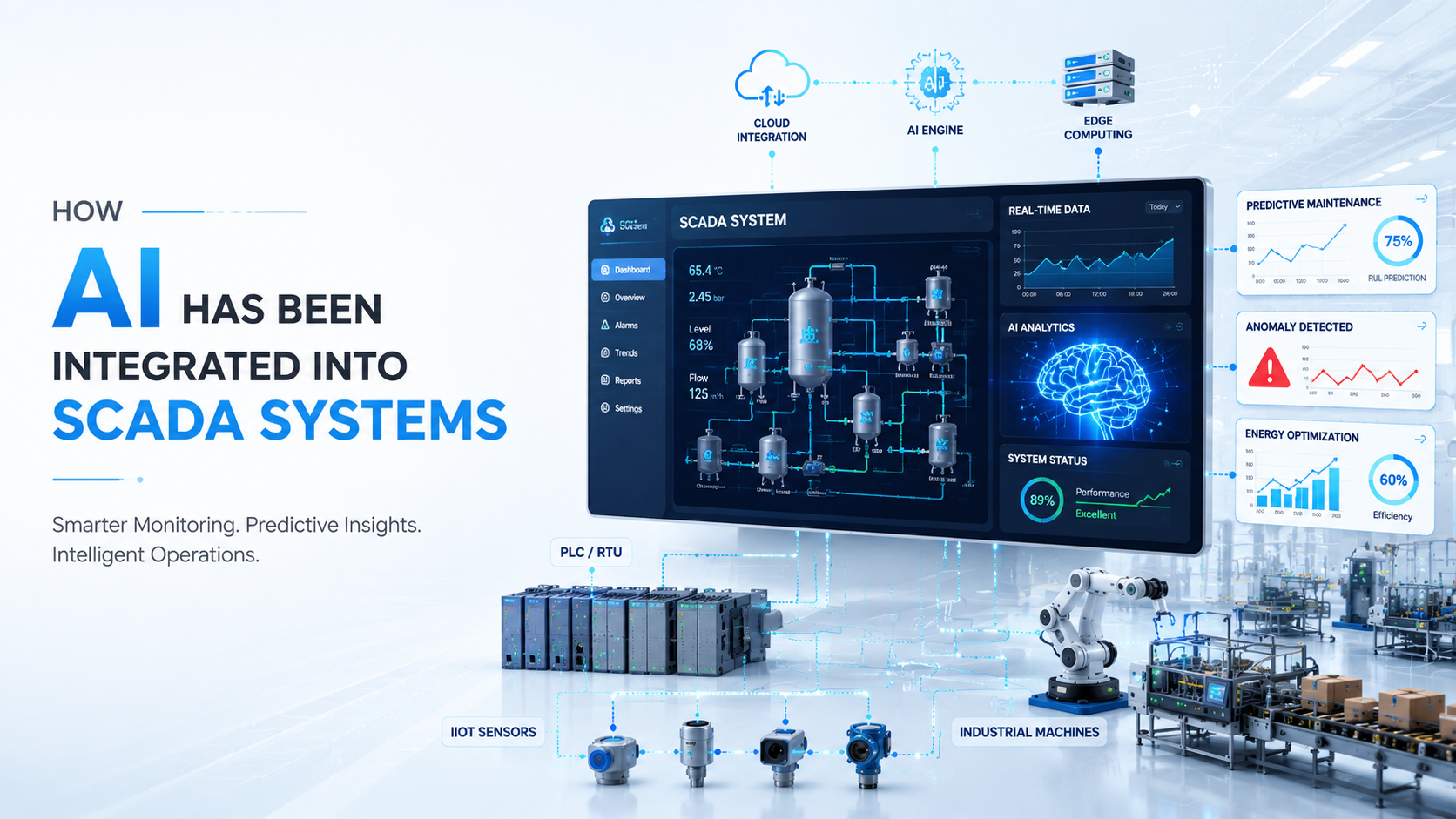
AI is transforming SCADA from a passive monitoring system into an intelligent decision-making platform capable of predictive maintenance, anomaly detection, energy optimization, and autonomous industrial insights.
Traditional SCADA systems were built to monitor and collect data. That was it. Engineers watched dashboards, responded to alarms, and made decisions manually. The problem? Industrial plants generate enormous volumes of real-time data that humans simply cannot analyze fast enough or accurately enough at scale.
That gap is exactly where AI stepped in.
What SCADA Actually Does in Industrial Automation
SCADA (Supervisory Control and Data Acquisition) is the backbone of industrial monitoring and control. It connects sensors, machines, PLCs, and operators into one centralized system that tracks what is happening across an entire industrial operation in real time.
Core components of a SCADA system include:
- PLCs (Programmable Logic Controllers) and RTUs (Remote Terminal Units)
- HMI dashboards for operator visibility
- Communication protocols like Modbus, OPC UA, and MQTT
- Historian databases for storing process data
- Alarm systems and central monitoring stations
For decades, this setup worked fine. But it had hard limits.
Traditional SCADA limitations:
- Only reactive alerts, no predictive capability
- Relied entirely on human judgment for decisions
- Produced massive data volumes with limited analysis tools
- Required manual troubleshooting when something went wrong
- Alarm flooding made it hard for operators to identify real issues
These limitations became costly as industrial operations scaled up and the margin for downtime got smaller.
Why Industries Started Integrating AI Into SCADA
Industrial plants needed a smarter layer on top of their existing SCADA infrastructure. AI provided exactly that by turning raw process data into actionable intelligence.
The industrial challenges AI directly addresses:
- Unexpected equipment downtime that halts production
- Alarm fatigue from thousands of low-priority alerts
- Inefficient maintenance schedules based on fixed intervals, not actual equipment condition
- Energy waste across large-scale operations
- Human error in monitoring complex multi-variable processes
- Production bottlenecks that were hard to identify manually
The growth of Industry 4.0 accelerated this shift. As IIoT sensors became cheaper and more widespread, plants started collecting more data than ever before. Edge computing made it possible to process that data closer to the source. Cloud-based SCADA platforms opened the door to scalable analytics. The infrastructure for AI was already being built, and the demand for intelligent automation was growing fast.
How AI Integration in SCADA Evolved Over Time
AI did not arrive in SCADA overnight. It developed in stages, each building on the last.
Stage One: Rule-Based Automation
The earliest form of automation used fixed thresholds and predefined logic. If a temperature exceeded a set value, an alarm triggered. Simple, but limited to scenarios engineers anticipated in advance.
Stage Two: Data Analytics Integration
Plants started layering trend analysis and historical data visualization onto their SCADA systems. KPI monitoring became standard. This helped operators understand what had happened, but still did not predict what would happen next.
Stage Three: Machine Learning Adoption
This is where SCADA started getting genuinely intelligent. Machine learning models were trained on historical process data to recognize failure patterns before they caused shutdowns. Predictive maintenance became a real capability, not just a marketing term.
Stage Four: Intelligent Autonomous SCADA
Modern AI-powered SCADA systems are self-learning. They adapt over time, generate operational recommendations, and in some cases make autonomous process adjustments without waiting for a human to intervene.
How AI Connects With SCADA Architecture
AI does not replace SCADA infrastructure. It adds an analytics and intelligence layer on top of existing data pipelines.
The layered architecture of AI-integrated SCADA:
| Layer | Components |
|---|---|
| Data Collection | Sensors, PLCs, RTUs, IIoT devices |
| Data Transmission | OPC UA, Modbus, MQTT, Industrial Ethernet |
| Data Processing | Edge computing, industrial gateways, cloud SCADA |
| AI Analytics | ML models, anomaly detection, neural networks |
| Visualization | Smart HMI dashboards, AI-generated alerts, predictive graphs |
Each layer feeds into the next. Sensors collect raw data. Communication protocols transmit it. Edge devices or cloud platforms process it. AI models analyze it. Operators see the results through smart dashboards that surface the most critical insights automatically.
Major AI Applications Running Inside SCADA Systems Today
Predictive Maintenance
Predictive maintenance is the most widely deployed AI application in industrial SCADA environments. Instead of following fixed maintenance intervals or waiting for equipment to fail, AI continuously monitors vibration, temperature, electrical current, and pressure data to detect early warning signs.
How it works:
- AI models analyze multivariate sensor data streams continuously
- The system identifies subtle patterns that precede equipment failure
- Alerts are generated days or weeks before a breakdown occurs
- Maintenance teams schedule repairs at optimal times, not emergency responses
Real-world impact:
- Reduced unplanned downtime
- Lower maintenance labor and parts costs
- Extended equipment lifespan
- Fewer production disruptions
A practical example: AI detects abnormal vibration signatures in a motor bearing weeks before it fails. The maintenance team replaces the bearing during a scheduled window rather than scrambling during an unplanned shutdown.
Anomaly Detection
Anomaly detection goes beyond preset alarm thresholds. AI learns what normal operation looks like across hundreds of variables simultaneously, then flags deviations that fall outside expected ranges, even when those deviations do not trigger traditional alarms.
What AI-based anomaly detection catches:
- Subtle pressure spikes that indicate developing leaks
- Abnormal energy consumption patterns
- Sensor irregularities that suggest calibration drift or hardware failure
- Unusual machine behavior during specific operating conditions
This capability matters because many industrial failures develop gradually. Traditional SCADA alarms are often configured to alert only at critical thresholds. By that point, significant damage may already be underway. AI catches problems earlier.
Intelligent Alarm Management
Alarm fatigue is a real and serious problem in industrial operations. Large SCADA systems can generate thousands of alarms per day, many of them repetitive, low-priority, or redundant. Operators become desensitized, and critical alarms get missed.
How traditional alarm management fails:
- Alarm flooding overwhelms operators
- No prioritization between critical and nuisance alarms
- Operators cannot quickly identify root causes
- Response times slow down across the board
What AI-based alarm management delivers:
- Automated prioritization based on criticality and context
- Filtering of false positives and nuisance alarms
- Root cause identification to explain why an alarm triggered
- Suggested corrective actions for operators to act on immediately
This shifts operators from reactive firefighting to focused, informed decision-making.
Energy Optimization
Energy is one of the largest operational costs in manufacturing, utilities, and process industries. AI identifies waste and inefficiency that humans cannot spot in real time across an entire facility.
AI energy monitoring capabilities:
- Identifies machines running at suboptimal efficiency
- Detects idle equipment consuming unnecessary power
- Balances industrial loads to reduce peak demand charges
- Optimizes startup and shutdown sequences for energy savings
Operational impact:
- Lower electricity costs without reducing output
- Reduced carbon footprint across operations
- Better alignment with sustainability reporting requirements
- Improved regulatory compliance in energy-regulated industries
Process Optimization
AI continuously analyzes process variables and makes recommendations, or in some systems, autonomous adjustments, to improve production efficiency, reduce cycle times, and maintain quality consistency.
What AI optimizes in industrial processes:
- Production throughput and cycle time reduction
- Raw material utilization and waste reduction
- Quality consistency by detecting parameter drift early
- Resource allocation across production lines
AI can dynamically adjust process parameters in real time based on incoming sensor data, something no human operator can do at the same speed or scale.
AI-Powered Vision Systems in SCADA
Computer vision is becoming a standard component of smart SCADA environments. Cameras connected to AI models provide a layer of visual intelligence that complements sensor-based monitoring.
Computer vision applications in industrial SCADA:
- Defect detection on production lines
- Safety monitoring for unauthorized access in restricted zones
- PPE compliance verification for worker safety
- Conveyor and assembly line inspection
Industries deploying AI vision systems:
- Automotive manufacturing
- Food and beverage processing
- Pharmaceutical production
- Electronics assembly
These systems operate continuously without fatigue, catching visual defects and safety violations at a speed and consistency that manual inspection cannot match.
AI, SCADA, and IIoT Working Together
AI becomes significantly more powerful when SCADA systems are connected to Industrial IoT sensor networks. IIoT devices generate continuous, high-frequency data streams from assets across an entire facility or across multiple sites.
What IIoT adds to AI-powered SCADA:
- Massive real-time sensor data volumes that fuel better AI models
- Remote monitoring of assets in geographically distributed locations
- Smart edge devices that preprocess data before it reaches central systems
- Connected factory environments where every asset is digitally visible
This combination creates the foundation for truly smart manufacturing.
Edge AI in Industrial Automation
Edge AI is one of the most important developments in industrial automation right now. Rather than sending all sensor data to a central cloud platform for analysis, edge AI processes data locally, at or near the machine itself.
Why edge AI matters for SCADA:
- Faster processing with near-zero latency
- Real-time decisions without waiting for cloud round-trips
- Reduced bandwidth costs from transmitting less raw data
- Continued operation even when cloud connectivity is interrupted
A direct example: an edge AI module detects that a motor is overheating and triggers an automatic shutdown in milliseconds, without waiting for that data to reach a cloud server and return a response. In high-speed industrial environments, that speed difference is the difference between a controlled shutdown and catastrophic equipment failure.
Machine Learning Models Used in SCADA Environments
Modern AI-powered SCADA platforms use multiple types of machine learning depending on the application.
| ML Type | SCADA Application |
|---|---|
| Supervised Learning | Failure prediction, quality forecasting |
| Unsupervised Learning | Anomaly detection, pattern discovery |
| Deep Learning | Visual inspection, complex process forecasting |
| Reinforcement Learning | Autonomous process optimization |
No single model type handles every use case. Production-grade AI SCADA platforms typically combine multiple techniques within a unified analytics architecture.
Industries Using AI-Integrated SCADA Systems
Manufacturing
Smart factories are the most visible deployment of AI-powered SCADA. Predictive maintenance, quality inspection using computer vision, and real-time process optimization are now standard capabilities at leading manufacturing facilities.
Oil and Gas
Pipeline monitoring, leak detection, and remote asset intelligence are critical applications in oil and gas operations where assets are spread across vast and often inaccessible geographic areas. AI reduces the need for manual inspection while improving detection accuracy.
Power and Utilities
Smart grid management, load forecasting, and fault prediction are AI applications that are reshaping how utilities operate. AI helps balance grid demand in real time and predicts equipment failures before they cause outages.
Water Treatment Plants
AI optimizes pump operations, monitors water quality parameters continuously, and detects distribution leaks earlier than traditional monitoring methods. For municipalities managing aging infrastructure, this is a significant operational advantage.
Mining
Equipment health monitoring and autonomous operations are driving AI adoption in mining environments where equipment downtime is extremely costly and safety risks are high.
Real-World Companies Leading AI-SCADA Integration
Siemens has built AI-powered predictive analytics directly into its industrial automation platforms, enabling manufacturers to monitor asset health and optimize production processes using integrated machine learning tools.
Schneider Electric developed the EcoStruxure platform, which layers AI-driven analytics and intelligent SCADA capabilities across energy management, building automation, and industrial operations.
ABB delivers AI-driven industrial monitoring solutions that connect field-level data with advanced analytics to give operators real-time visibility and predictive intelligence across their assets.
Honeywell integrates predictive intelligence into its industrial operations platforms, focusing on reducing unplanned downtime and improving operational performance in process industries.
Rockwell Automation provides smart manufacturing analytics that combine SCADA data with machine learning to improve production efficiency, quality, and equipment reliability for manufacturers across multiple sectors.
AI vs Traditional SCADA: A Direct Comparison
| Capability | Traditional SCADA | AI-Powered SCADA |
|---|---|---|
| Monitoring approach | Reactive monitoring | Predictive intelligence |
| Data analysis | Manual analysis by operators | Automated insights at scale |
| Alarm handling | Fixed threshold alarms | Intelligent, prioritized alarms |
| Decision making | Human-driven decisions | AI-assisted decision support |
| Reporting | Historical reporting after the fact | Real-time forecasting |
| System behavior | Static, rule-based systems | Adaptive, self-learning systems |
| Maintenance | Schedule-based or reactive | Condition-based predictive |
| Failure detection | Detects failure after it occurs | Identifies failure weeks in advance |
The difference is not incremental. AI-powered SCADA represents a fundamentally different operational model.
Key Benefits of AI Integration in SCADA
Operational benefits:
- Significant reduction in unplanned downtime through early failure detection
- Faster, more accurate decision making based on real-time data analysis
- Lower maintenance costs from condition-based scheduling
- Improved worker safety through automated monitoring and faster hazard detection
- Higher production throughput from continuous process optimization
Business benefits:
- Lower energy costs across large-scale operations
- Reduced capital expenditure from extending equipment lifespan
- Better regulatory compliance through automated data tracking
- Stronger competitive position through smarter, more efficient operations
Challenges of Integrating AI Into SCADA Systems
AI integration is not without obstacles. Organizations need to plan for these challenges upfront.
Legacy system compatibility is a significant barrier. Many industrial facilities run PLCs and control systems that are decades old and were never designed to support AI-ready data architectures. Retrofitting these systems requires investment and careful planning.
Data quality problems directly undermine AI performance. Machine learning models are only as good as the data they are trained on. Poor sensor calibration, missing data, and inconsistent labeling all reduce model accuracy.
Cybersecurity risks increase when SCADA systems connect to cloud platforms and AI analytics layers. Every new connection point is a potential attack surface. Industrial cybersecurity must be treated as a core design requirement, not an afterthought.
High initial investment can be a barrier for smaller operations. Infrastructure modernization, software licensing, and integration work require upfront capital that not every organization can absorb quickly.
The AI skill gap in industrial settings is real. Deploying and maintaining AI models in operational technology environments requires expertise that many engineering teams do not yet have internally.
Cybersecurity in AI-Connected SCADA Systems
Connected industrial systems face a different threat landscape than traditional isolated SCADA networks. AI integration increases both capability and exposure.
Common security risks in AI-based SCADA:
- Ransomware attacks targeting industrial control systems
- Unauthorized remote access to connected assets
- Data interception across industrial communication protocols
- Manipulation of AI models through adversarial inputs
Security best practices for AI-integrated SCADA:
- Network segmentation between IT and OT environments
- Zero-trust architecture applied to all remote access
- Industrial firewalls with deep packet inspection for OT protocols
- Encrypted communication across all data transmission layers
- AI-based threat detection monitoring the network itself for anomalies
Cybersecurity in AI-connected SCADA is not a one-time configuration. It requires continuous monitoring and regular review as the threat landscape evolves.
The Future of AI in SCADA Systems
Autonomous Industrial Operations
The direction industrial AI is heading is clear: more autonomy. Self-optimizing factories where AI adjusts production parameters, reroutes workflows, and schedules maintenance without human initiation are already emerging at leading industrial organizations.
Digital Twins
Digital twins are virtual models of physical industrial assets and processes. When integrated with AI and SCADA data, they allow operators to simulate changes, test scenarios, and predict outcomes before implementing anything in the real world. This capability is becoming a standard tool for large-scale industrial planning.
Generative AI in SCADA
Generative AI is beginning to appear in industrial operations as a tool for automated troubleshooting guidance and report generation. Operators can query AI systems in plain language and receive diagnostic explanations, maintenance recommendations, and operational summaries without needing to interpret raw data themselves.
Hyper-Predictive Maintenance
The next generation of predictive maintenance is moving beyond weeks-out failure prediction toward months-ahead forecasting. Combined with digital twins and advanced sensor networks, this will allow maintenance planning to operate on a strategic timeline rather than a reactive one.
Human-AI Collaboration
The near-term future of SCADA operations is not full automation. It is augmentation. Operators working alongside AI systems that surface insights, flag risks, and recommend actions, while humans retain final decision authority. AI handles the data volume. Humans handle judgment and accountability.
Bottom Line
AI integration is not a feature add-on for SCADA. It is a fundamental shift in how industrial operations are monitored, managed, and optimized.
Traditional SCADA told operators what was happening. AI-powered SCADA tells operators what is going to happen, why it is happening, and what they should do about it.
Plants that adopt AI-integrated SCADA gain measurable advantages in uptime, efficiency, safety, and cost. As edge computing, IIoT sensor networks, and machine learning tools continue to mature, the gap between AI-powered operations and traditional SCADA environments will only widen.
The transition is already underway. The question for most industrial organizations is not whether to integrate AI into their SCADA systems, but how fast they can do it responsibly.
Build Smarter Industrial Systems With AI-Powered Automation
AI-driven SCADA is no longer a future concept. Modern factories are already using predictive maintenance, intelligent monitoring, industrial IoT, and real-time analytics to reduce downtime and improve operational efficiency.
At AutomatexLab, we help industries integrate smarter automation systems using PLCs, SCADA, HMI, IIoT, industrial data analytics, and intelligent factory solutions tailored for modern manufacturing environments.
Whether you want to modernize legacy systems, improve industrial monitoring, or build Industry 4.0-ready infrastructure, our team helps turn complex automation challenges into scalable industrial solutions.
What We Help With
- SCADA system development
- PLC programming
- Industrial IoT integration
- Smart factory solutions
- HMI design and optimization
- Industrial data monitoring
- Predictive maintenance systems
- Factory automation consulting
Ready to Modernize Your Industrial Operations?
Connect with AutomatexLab to discuss intelligent automation solutions for your factory, plant, or industrial process.
FAQs
AI is used in SCADA for predictive maintenance, anomaly detection, intelligent alarm management, energy optimization, and real-time process automation. It analyzes sensor data at scale to surface insights that human operators cannot produce manually.
No. AI enhances SCADA rather than replacing it. SCADA remains the core industrial monitoring and control infrastructure. AI adds an intelligence layer on top of that infrastructure.
Manufacturing, oil and gas, power and utilities, water treatment, pharmaceuticals, mining, food processing, and smart infrastructure industries all actively deploy AI-based SCADA solutions.
Reduced unplanned downtime, condition-based predictive maintenance, intelligent alarm management, energy cost reduction, and faster, more accurate operational decision making.
Autonomous factories, digital twins, edge AI processing, generative AI diagnostics, and self-optimizing industrial systems represent the near and medium-term future of AI in SCADA environments.