In today’s manufacturing market, the ability to monitor, control, and optimize machines in real time is no longer optional. It is a competitive necessity. Industrial HMI (Human Machine Interface) systems are at the heart of this transformation, connecting operators to complex machinery through intuitive visual interfaces that drive efficiency, reduce downtime, and enable smarter decision-making on the factory floor.
As factories across the globe embrace Industry 4.0 principles, the demand for reliable, high-performance HMI systems is growing at an unprecedented rate. From automotive assembly lines to pharmaceutical production units, every modern industrial facility depends on intelligent control interfaces to maintain operational excellence.
AutomateXLab is a specialized industrial HMI manufacturing company delivering custom HMI solutions designed for the real-world demands of industrial automation. Our engineering-first approach combines rugged hardware design, advanced software integration, and deep domain expertise to produce HMI systems that perform reliably in the harshest environments.
What Are Industrial HMI Systems?
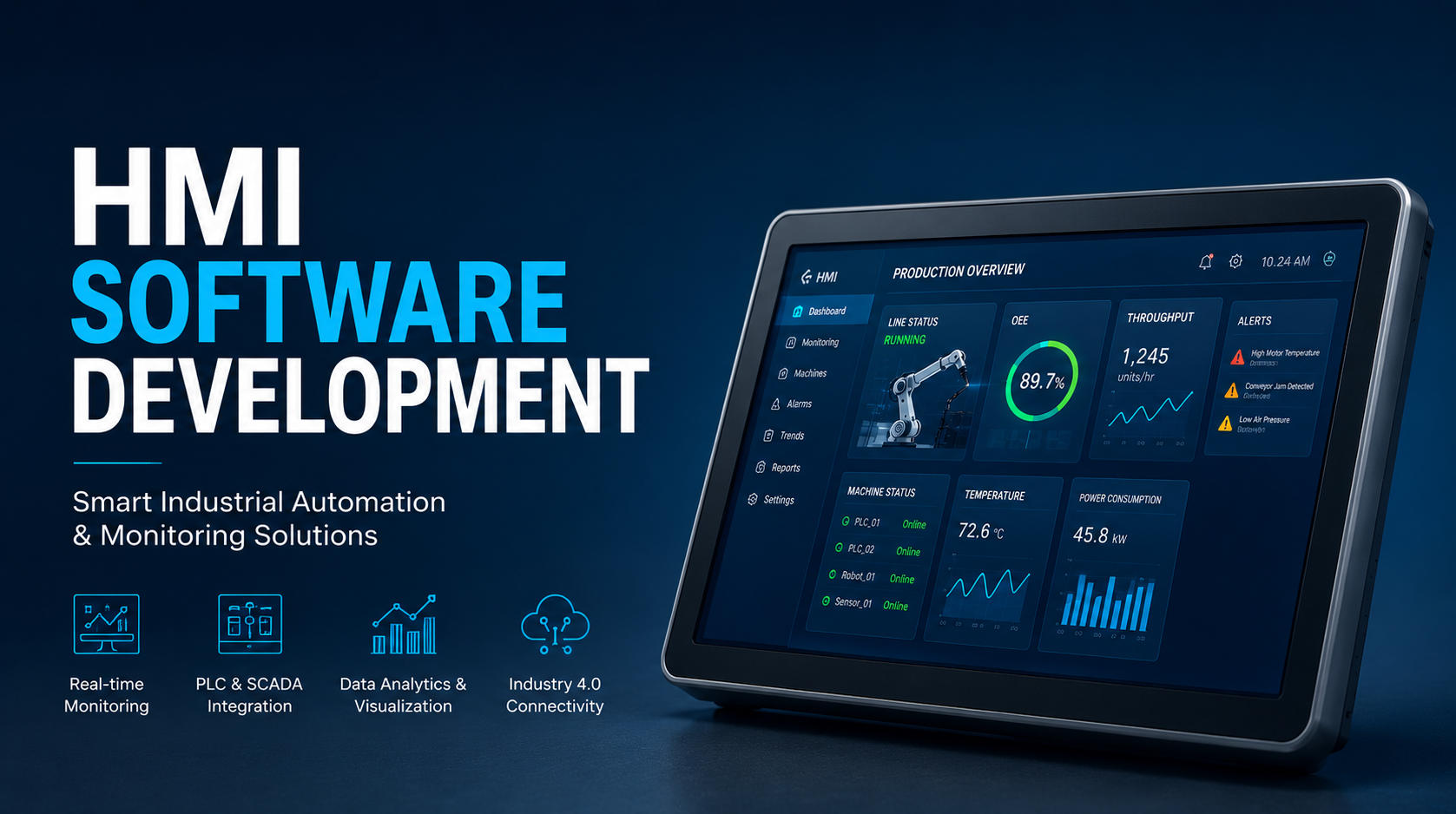
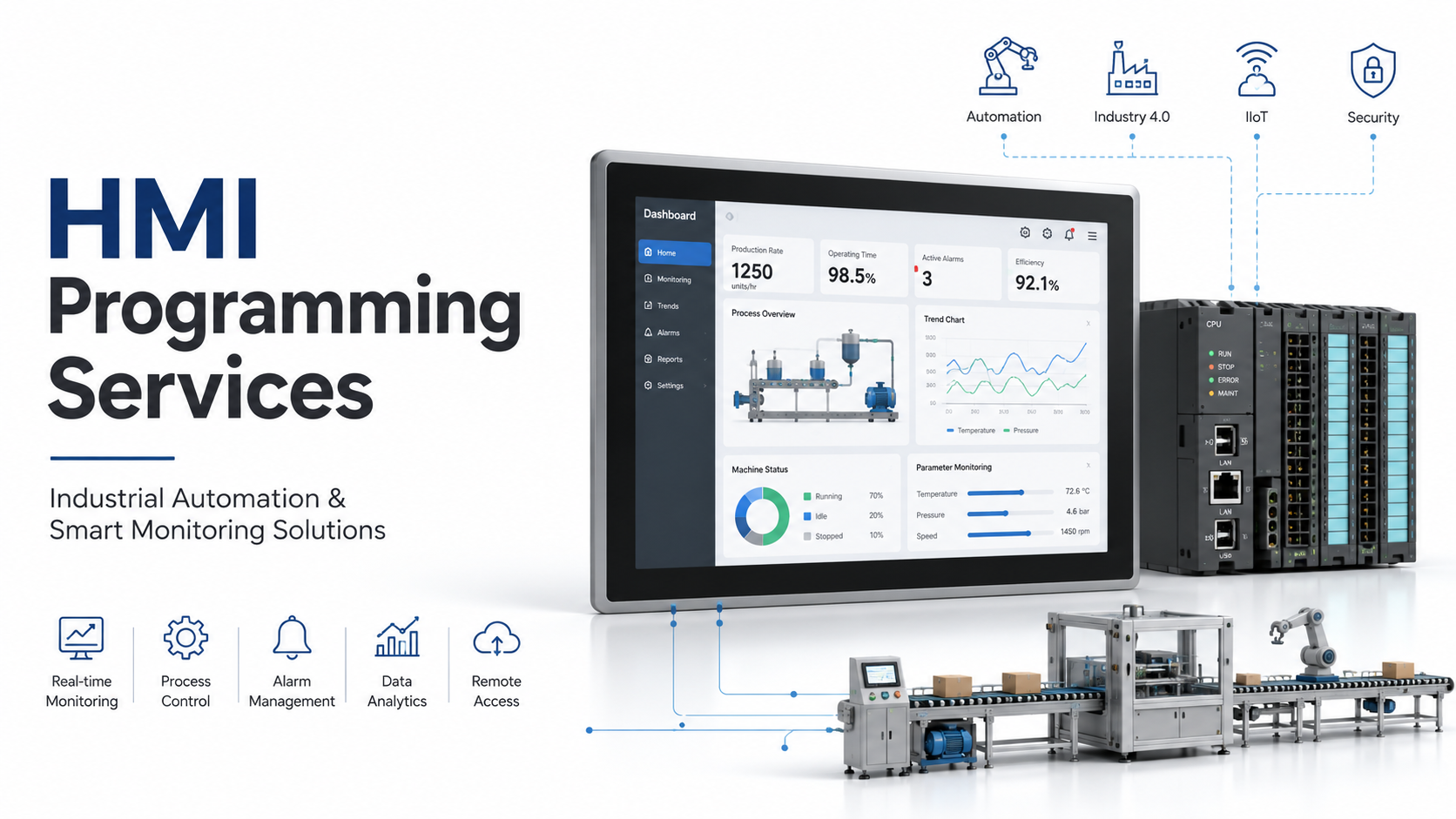
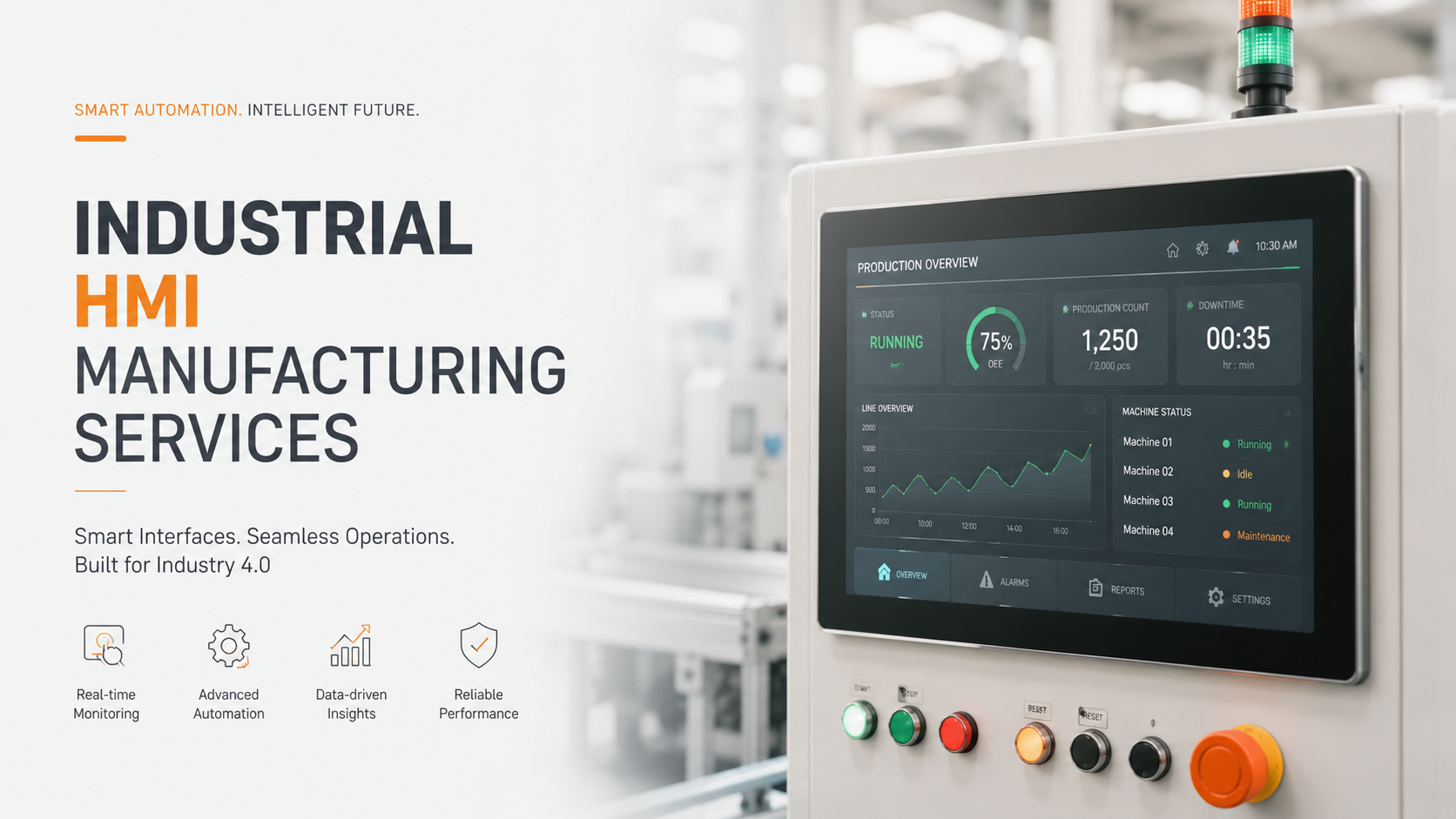
A Human Machine Interface (HMI) is a software and hardware-based system that enables operators to interact with industrial machinery, production lines, and automated systems through a visual interface. Think of it as the control panel and information dashboard of a modern factory, combining real-time data visualization, machine controls, alarms, and process monitoring into a single, operator-friendly screen.
HMI systems serve as the bridge between human operators and the machines they manage. Rather than relying on manual gauges, switches, and paper logs, operators can monitor critical parameters, adjust machine settings, respond to alerts, and track production performance all from a centralized display.
Common industries that rely on industrial HMI systems include:
- Automotive manufacturing and assembly
- Food processing and beverage production
- Pharmaceutical and life sciences
- Packaging and material handling
- Chemical processing plants
- CNC machining and precision manufacturing
- Power generation and energy distribution
These systems are closely linked with broader industrial control technologies including SCADA platforms, PLC networks, automation dashboards, and machine monitoring interfaces, forming the digital backbone of modern smart factories.
Why Industrial HMI Manufacturing Is Essential in Modern Factories
How Do HMIs Improve Industrial Productivity?
Industrial HMI systems give operators complete visibility into production processes in real time. Instead of walking across a factory floor to check machine status manually, operators can view all critical data from a single interface. This dramatically reduces response times, minimizes operational errors, and enables faster decision-making.
Key productivity benefits include:
- Real-time process visibility across multiple machines and production lines
- Faster fault detection through live alarm monitoring and diagnostic screens
- Reduced operator errors with guided workflows and visual confirmation steps
- Centralized machine control from a single operator station
- Production monitoring with live throughput, cycle time, and quality data
- Improved coordination between different sections of the production line
Why Are HMI Systems Important in Automation?
Manual control systems simply cannot keep pace with the speed and complexity of modern automated production. Industrial HMI systems enable factories to move from reactive operations to proactive management. When a machine deviation occurs, an HMI system captures it instantly, notifies the operator, and provides diagnostic information to speed up resolution.
Studies in industrial automation consistently show that facilities using advanced HMI systems report measurable reductions in unplanned downtime, faster troubleshooting cycles, and significantly improved overall equipment effectiveness (OEE). In high-volume production environments, even small efficiency gains translate into major cost savings.
Types of Industrial HMI Solutions Offered by AutomateXLab
Touchscreen HMI Panels
Our touchscreen HMI panels are built for demanding industrial environments where durability and responsiveness are non-negotiable. We manufacture panels with:
- Capacitive touchscreen displays for precise, glove-friendly operation
- Rugged industrial-grade screens resistant to vibration, dust, and moisture
- Multi-touch support for intuitive gesture-based controls
- Various screen sizes from compact operator terminals to large format control displays
PLC Integrated HMI Systems
AutomateXLab engineers have deep experience integrating HMI systems with leading PLC platforms, including:
- Siemens (S7-300, S7-1200, S7-1500 series)
- Mitsubishi (MELSEC series)
- Allen-Bradley (Rockwell Automation platforms)
- Delta (DVP and AS series PLCs)
- Schneider Electric (Modicon series)
Seamless PLC-HMI integration ensures accurate data exchange, synchronized control logic, and reliable automation performance across the entire production system.
SCADA and HMI Integration
For larger facilities requiring enterprise-level process visibility, AutomateXLab provides SCADA-integrated HMI solutions that enable:
- Centralized monitoring across multiple machines, lines, and facilities
- Advanced data visualization with trend charts, reports, and dashboards
- Remote operations via secure network connectivity
- Historical data logging for compliance and performance analysis
Custom HMI Control Panels
Every factory has unique operational requirements. AutomateXLab specializes in fully custom HMI control panel manufacturing that includes:
- Tailored screen layouts designed around your specific workflow
- Custom enclosure fabrication in stainless steel, mild steel, or GRP
- Branding and labeling options for OEM and white-label applications
- Multi-station configurations for complex production environments
Features of High-Performance Industrial HMI Systems
Key Features of Industrial HMI Systems:
- Rugged industrial enclosure design rated for harsh environments
- IP65/IP66/IP67 protection against dust and water ingress
- High-temperature and humidity resistance for demanding conditions
- Real-time alarm management with escalation workflows
- Multi-language interface support for global manufacturing operations
- Onboard data logging and production reporting
- Cloud connectivity for remote monitoring and analytics
- IoT and IIoT integration for smart factory applications
- Energy monitoring and consumption tracking
- Redundant communication protocols for high-availability systems
These features make modern industrial HMI systems far more than simple operator panels. They are intelligent control hubs that support data-driven manufacturing strategies and continuous process improvement.
Industrial HMI Manufacturing Process at AutomateXLab
Requirement Analysis
Every project begins with a thorough understanding of your factory environment. Our engineering team works closely with your operations and automation teams to map out machine communication requirements, operator workflows, safety considerations, and production goals. This stage ensures that the HMI solution we design is precisely aligned with how your facility actually operates.
Electrical and UI Design
Once requirements are confirmed, our designers create detailed HMI screen layouts focused on operator usability and process clarity. Every interface element, from alarm displays to trend graphs to control buttons, is positioned for intuitive operation. Simultaneously, our electrical engineers develop full panel schematics covering power distribution, I/O wiring, and communication networks.
Hardware Manufacturing
Our in-house manufacturing facility handles complete panel fabrication including enclosure cutting, component mounting, cable routing, and termination. We source industrial-grade components from trusted global suppliers and manufacture panels to strict quality and safety standards.
PLC and Software Integration
With hardware complete, our automation engineers configure communication protocols, load and test PLC programs, and synchronize automation logic with the HMI software. We work with standard industrial protocols including Modbus, Profibus, Profinet, EtherNet/IP, and OPC-UA to ensure compatibility with your existing systems.
Quality Testing
Before any system leaves our facility, it undergoes comprehensive testing including functional validation, stress testing under simulated load conditions, industrial environment simulation, communication fault testing, and alarm response verification. Only systems that pass our full quality checklist proceed to installation.
Installation and Support
Our field engineers manage complete on-site commissioning including panel installation, network integration, operator training, and system handover. We also provide ongoing technical support, remote diagnostics, and preventive maintenance services to protect your investment long term.
Industries We Serve
Automotive Manufacturing
Automotive plants operate some of the most complex and high-speed production environments in the world. Our HMI systems provide precise control and real-time visibility across robotic welding, paint lines, assembly conveyors, and quality inspection stations, helping automotive manufacturers maintain the throughput and precision their operations demand.
Pharmaceutical Automation
Pharmaceutical manufacturing requires strict process control, regulatory compliance, and complete data traceability. Our HMI systems support 21 CFR Part 11 compliant data logging, batch record management, and cleanroom-compatible designs that meet the hygiene and documentation standards of pharma production.
Packaging Industries
Packaging lines run at high speeds with frequent product changeovers. Our HMI solutions provide quick-change recipe management, real-time speed and count monitoring, and fault detection systems that minimize line stoppages and keep packaging operations running at peak efficiency.
Food and Beverage Plants
Food manufacturing plants require hygienic and waterproof HMI systems designed for washdown environments. AutomateXLab manufactures stainless steel HMI enclosures with IP69K-rated protection that withstand daily high-pressure cleaning while maintaining full operational integrity.
Oil and Gas Operations
Hazardous area classifications, extreme temperatures, and remote site locations make oil and gas one of the most demanding HMI application environments. We manufacture ATEX and IECEx compliant HMI systems built for upstream, midstream, and downstream operations.
Chemical Processing Units
Chemical plants demand HMI systems that can handle continuous 24/7 operations, aggressive environmental conditions, and complex process control requirements. Our systems integrate with distributed control systems (DCS) and safety instrumented systems (SIS) to provide reliable chemical process management.
Textile Manufacturing
Modern textile manufacturing relies on precise speed control, tension monitoring, and quality tracking across spinning, weaving, and dyeing processes. Our HMI solutions give textile operators real-time visibility and control over every stage of the production process.
Benefits of Choosing AutomateXLab for Industrial HMI Manufacturing
When selecting an industrial HMI manufacturing partner, the quality of engineering, depth of integration experience, and reliability of post-project support matter as much as the product itself.
Here is what sets AutomateXLab apart:
- Custom engineering expertise tailored to your specific industry and application
- ISO-aligned quality processes at every stage of design and manufacturing
- End-to-end automation support from concept through commissioning and beyond
- Fast project turnaround without compromising on engineering quality
- Industrial-grade reliability built into every component and connection
- Scalable solutions that grow with your automation requirements
- Long-term maintenance support with local and remote service options
With extensive experience across automation projects in diverse industries, AutomateXLab brings both the technical capability and practical knowledge to deliver HMI systems that perform reliably from day one and for years into the future.
Industrial HMI vs Traditional Control Systems
| Feature | Traditional Control Systems | Industrial HMI Systems |
|---|---|---|
| Process Monitoring | Manual gauges and indicators | Real-time digital dashboards |
| Fault Troubleshooting | Slow and labor-intensive | Fast with live diagnostics |
| Data Analytics | Limited or nonexistent | Advanced with trend analysis |
| Operator Interface | Physical switches and dials | Interactive touchscreen displays |
| Automation Level | Low | High |
| Remote Access | Not available | Supported via secure networks |
| Scalability | Difficult and costly | Flexible and modular |
| Reporting | Paper-based | Automated digital reports |
The operational advantages of industrial HMI systems over legacy control infrastructure are significant. As factories scale up and production complexity increases, the limitations of traditional control systems become costly bottlenecks. Modern HMI systems eliminate those bottlenecks and lay the foundation for continuous operational improvement.
Future Trends in Industrial HMI Manufacturing
What Is the Future of Industrial HMI Systems?
The next generation of industrial HMI systems is being shaped by a convergence of artificial intelligence, cloud computing, and advanced connectivity. These technologies are transforming HMIs from passive display terminals into active, intelligent components of the smart factory ecosystem.
Key trends shaping the future of industrial HMI manufacturing include:
- AI-powered HMI systems that provide predictive recommendations and anomaly detection
- Predictive maintenance integration using machine learning to identify failure patterns before they cause downtime
- Cloud-connected dashboards enabling plant managers to monitor operations from anywhere in the world
- IIoT integration connecting HMI systems with sensors, edge devices, and enterprise software platforms
- Digital twin interfaces that mirror physical production assets in real-time virtual models
- Edge computing integration for faster local data processing without cloud dependency
- Augmented reality overlays for operator guidance and remote expert assistance
- Cybersecurity-hardened architectures to protect industrial networks from growing digital threats
How Is AI Changing Industrial HMIs?
Artificial intelligence is enabling HMI systems to move beyond reactive monitoring toward predictive and prescriptive operations. AI algorithms can analyze historical machine data to forecast equipment degradation, recommend process adjustments, and even automate routine control decisions. This shifts operators from routine monitoring tasks to higher-value oversight and optimization roles, fundamentally changing how human beings interact with industrial machines.
Conclusion
Industrial HMI systems are no longer a luxury reserved for large-scale manufacturers. They are a fundamental requirement for any facility that wants to compete in the era of smart manufacturing and Industry 4.0. By providing real-time visibility, centralized control, and actionable production data, industrial HMI systems empower operators to make faster, better decisions that drive efficiency, quality, and profitability.
Choosing the right HMI manufacturing partner is critical. The reliability of your production operations depends on the quality of the systems controlling them. AutomateXLab brings the engineering depth, manufacturing capability, and industry experience to deliver HMI solutions that perform from the first day of commissioning through years of demanding industrial operation.
Ready to transform your factory floor with a custom industrial HMI solution?
- Request a Custom HMI Consultation
- Talk to Our Automation Engineers
- Get Industrial HMI Manufacturing Support
Contact AutomateXLab today and take the first step toward smarter, more efficient industrial operations.
FAQs
Industrial HMI manufacturing refers to the design, fabrication, and integration of Human Machine Interface systems for use in industrial environments. It includes hardware panel manufacturing, touchscreen display integration, PLC software configuration, and on-site commissioning to create complete operator control solutions.
HMI systems are used across a wide range of industries including automotive, pharmaceutical, food and beverage, packaging, oil and gas, chemical processing, textile manufacturing, power generation, and water treatment. Any industry that operates automated or semi-automated machinery can benefit from industrial HMI solutions.
HMI systems communicate with PLCs (Programmable Logic Controllers) through industrial communication protocols such as Modbus, Profinet, EtherNet/IP, and OPC-UA. The HMI reads data tags from the PLC to display real-time machine status and sends control commands back to the PLC based on operator inputs.
Touchscreen HMIs offer intuitive operation, faster navigation between screens, cleaner panel designs with fewer physical buttons, and support for complex graphical interfaces. They also simplify updates since screen layouts can be modified through software without rewiring the panel.
Yes. AutomateXLab specializes in fully custom HMI solutions including custom screen layouts, custom enclosure designs, multi-language interfaces, brand-specific graphics, and integration with virtually any PLC or SCADA platform. Every project is engineered around your specific operational requirements.
An HMI is typically a localized operator interface for a specific machine or production cell. A SCADA (Supervisory Control and Data Acquisition) system is a broader platform that aggregates data from multiple HMIs, PLCs, and sensors across an entire facility or multiple sites, providing centralized supervision and reporting.
The cost of industrial HMI manufacturing depends on factors including screen size and type, enclosure specifications, PLC integration complexity, software development requirements, and installation scope. AutomateXLab provides detailed project-specific quotations after a requirements consultation. Contact our team for a customized estimate.
AutomateXLab combines deep industrial automation engineering expertise with in-house manufacturing capability and comprehensive project support. We deliver custom HMI solutions built for real industrial environments, backed by rigorous quality testing and long-term technical support.