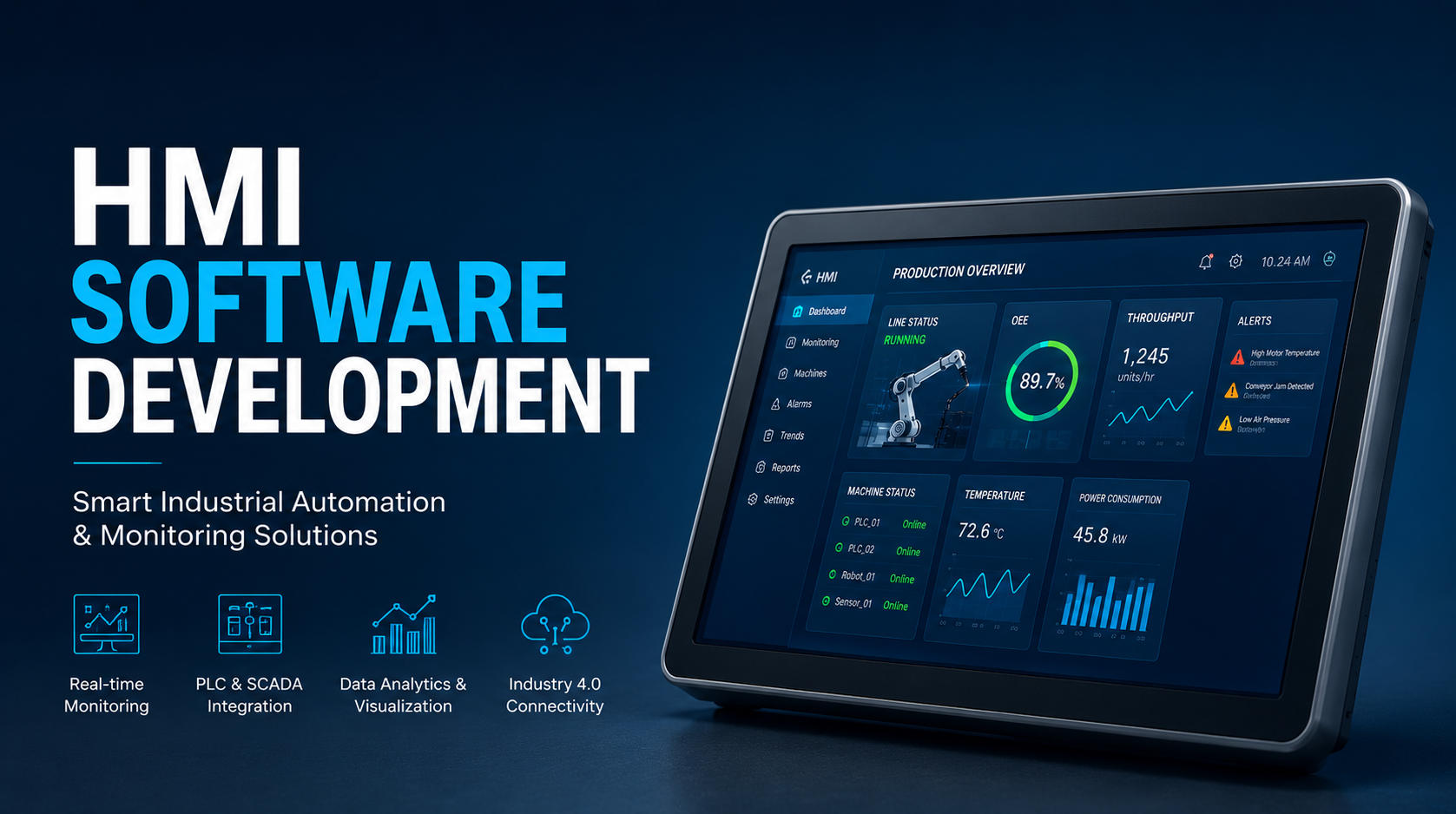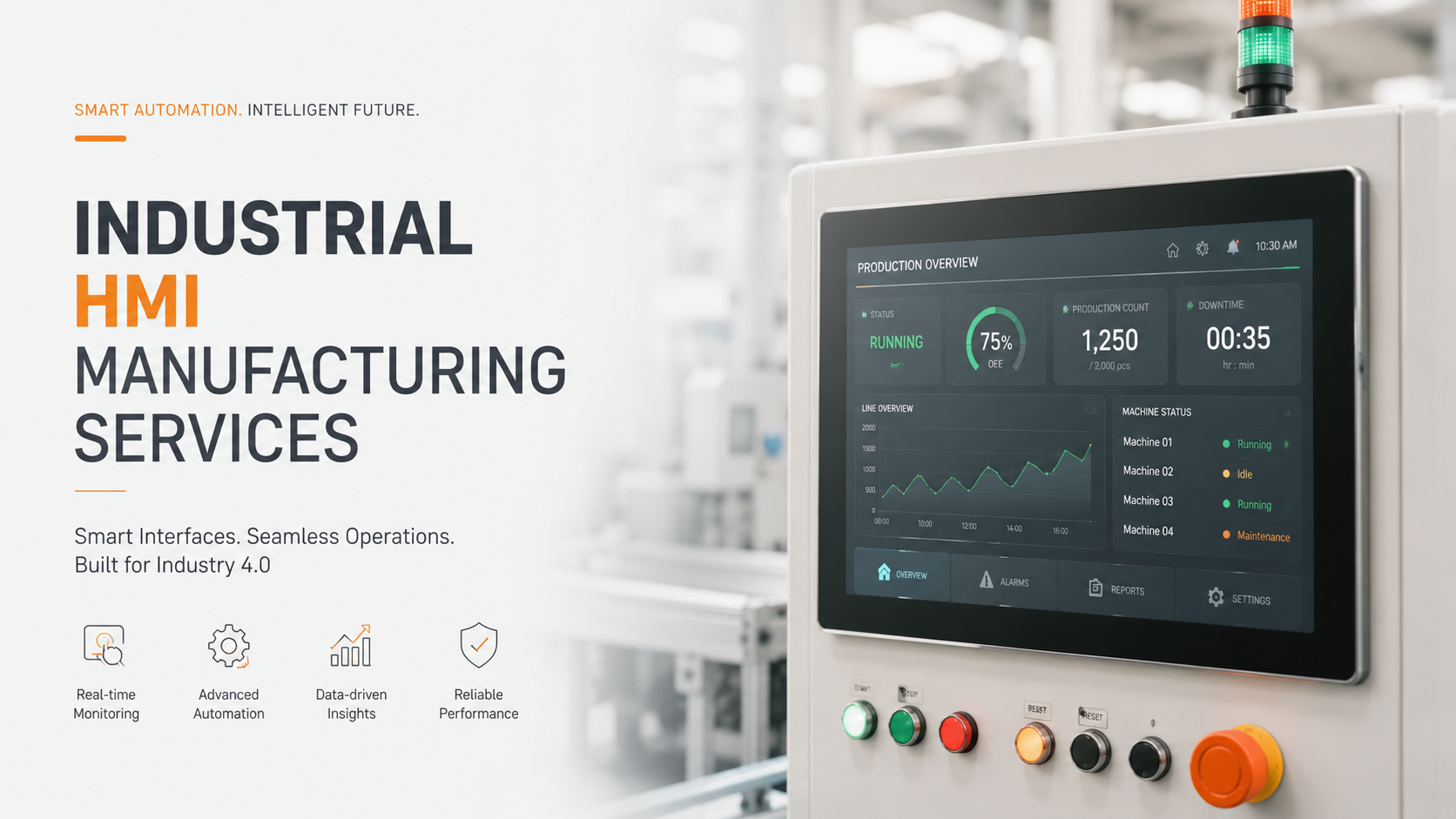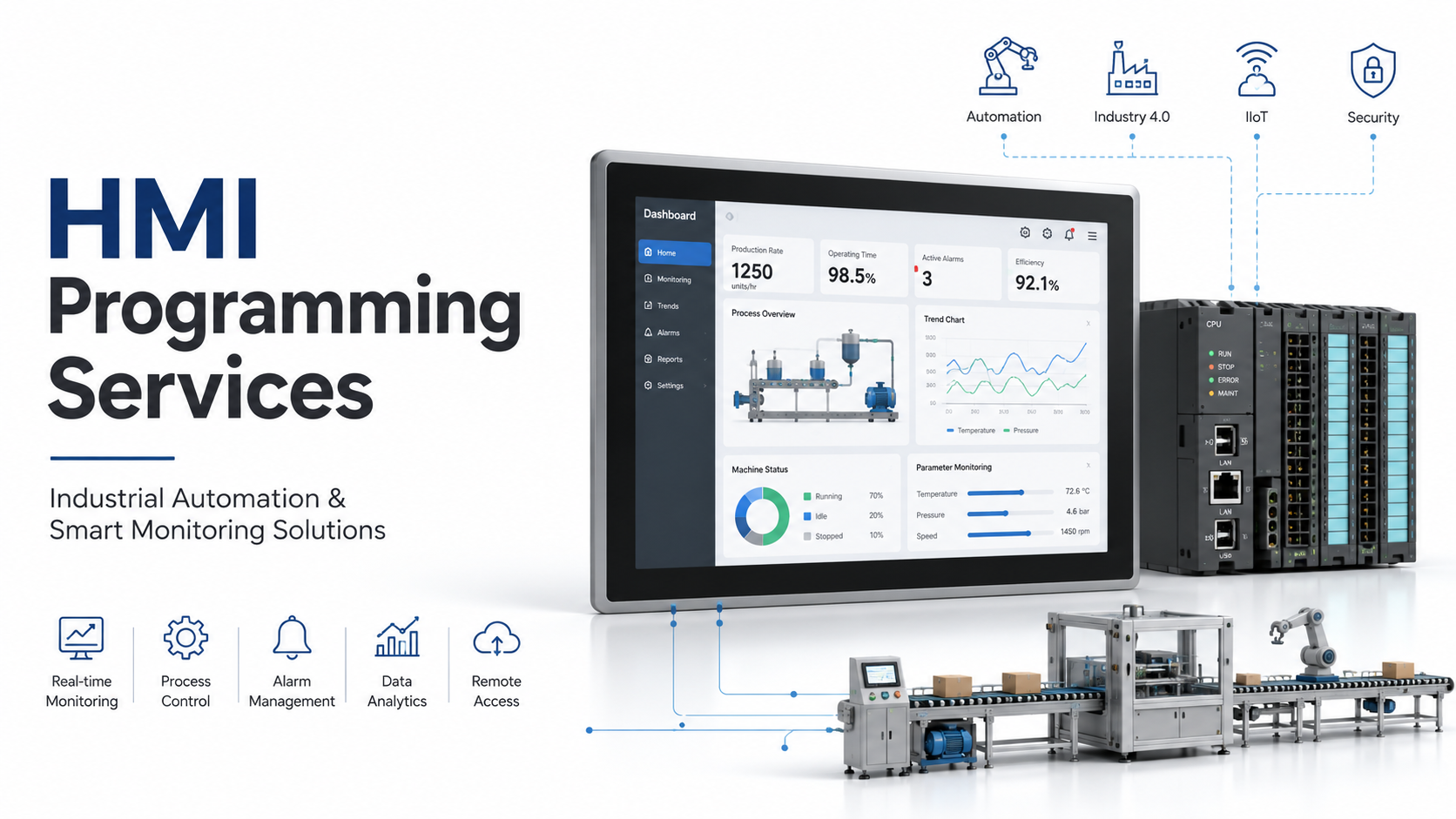
In modern industrial environments, machines cannot run efficiently on their own. Operators need a clear, fast, and reliable way to monitor what is happening on the production floor and take control when needed. This is where HMI programming services become essential.
HMI stands for Human Machine Interface. It is the visual layer between an operator and a machine or automated system. Through an HMI screen, operators can see live data, control equipment, receive alarms, and make real-time decisions without manually inspecting every machine.
HMI programming services help industries create touchscreen interfaces that allow operators to monitor, control, and manage machines in real time. These systems improve automation visibility, efficiency, safety, and operational control.
Modern factories depend on HMI systems because they connect directly with PLCs (Programmable Logic Controllers) and SCADA systems, turning raw machine data into visual, actionable information. Whether it is a food processing line, a packaging machine, or a water treatment plant, HMI interfaces are at the core of smart manufacturing.
AutomatexLab specializes in building reliable, custom HMI solutions that give your team complete visibility and control over industrial operations.
What Are HMI Programming Services?
HMI programming services involve designing, developing, and deploying Human Machine Interface software that connects operators to industrial machines and automated systems. At its core, an HMI is the graphical screen or control panel that makes machine data readable and actionable for human operators.
In industrial automation, machines generate enormous amounts of data every second. Without a structured interface, this data is useless to an operator standing on the factory floor. HMI programming translates that raw data into visual dashboards, live charts, alarm notifications, and simple controls that any trained operator can use effectively.
A well-programmed HMI does several things:
- Displays real-time machine status and production data
- Allows operators to start, stop, or adjust equipment
- Monitors variables like temperature, pressure, flow rate, and speed
- Triggers alarms when values go out of range
- Logs historical data for reporting and analysis
HMI programming services span industries and applications. You will find industrial HMI development in:
Factory production lines where operators need to monitor conveyor speed, output counts, and machine health from a single panel.
Packaging machines where the interface controls fill rates, seal temperatures, and label alignment.
Water treatment plants where operators manage pump operations, chemical dosing, and tank levels through touchscreen interfaces.
Automotive manufacturing where production data, robot status, and quality metrics are tracked in real time.
Food processing systems where hygiene, temperature control, and batch accuracy are managed through operator panels.
Industrial HMI development requires knowledge of industrial communication protocols, PLC systems, real-time data handling, and user interface design. It is a specialized discipline that sits at the intersection of automation engineering and software development.
How HMI Programming Works in Industrial Automation
Understanding how HMI programming works helps you appreciate the depth of engineering involved in building these systems. An HMI is not just a screen. It is a communication bridge between field-level devices and the operators who run them.
PLC Communication
The HMI connects directly to PLCs (Programmable Logic Controllers), which are the brains of industrial machines. The HMI reads and writes data from the PLC using industrial communication protocols:
- Siemens PLC: Uses protocols like Profinet and S7 communication
- Allen Bradley PLC: Uses Ethernet/IP and Logix tag-based communication
- Modbus: A widely used open protocol for connecting older machines and third-party devices
- Ethernet/IP: A flexible protocol used across modern factory automation systems
- Profinet: Siemens standard for real-time industrial networking
HMI software collects machine data from PLC systems and displays it through graphical dashboards that operators can interact with in real time.
Real-Time Data Monitoring
Once the HMI is connected to a PLC, it continuously reads process variables and displays them live on screen. Common parameters monitored include:
- Temperature readings from sensors across production zones
- Pressure levels in hydraulic or pneumatic systems
- Motor speed and conveyor belt velocity
- Production counts and batch progress
- Alarm conditions and fault codes
This live visibility allows operators to detect problems instantly rather than discovering them after damage has occurred.
Operator Control Interface
The control side of the HMI gives operators a structured way to interact with the machine. A good control interface includes:
- Start and stop buttons for individual machines or entire lines
- Setpoint adjustment panels for speed, temperature, or pressure targets
- Dashboards that summarize overall system health at a glance
- Alert panels that display active and historical alarms
- Trend graphs that show how key values have changed over time
A well-designed operator interface reduces training time, lowers error rates, and helps operators stay in control even during high-pressure production situations.
Benefits of HMI Programming in Manufacturing
Investing in professional HMI programming services delivers measurable operational improvements across virtually every type of industrial facility. Here is a detailed look at the key benefits.
Better Machine Visibility
HMI systems give operators a complete, real-time picture of what is happening across all connected machines. Instead of walking the floor to manually check gauges and sensors, a single HMI screen can display the full operational status of an entire production line. This saves time and reduces the risk of missing a developing problem.
Faster Decision Making
When process data is displayed clearly and updated in real time, operators can make faster, better-informed decisions. If a temperature sensor reads outside normal range, the operator sees it immediately on the dashboard and can act before the problem escalates.
Reduced Downtime
Unplanned downtime is one of the most costly events in manufacturing. HMI systems reduce downtime by surfacing faults, equipment warnings, and abnormal conditions before they cause failures. Alarm management and diagnostic screens guide operators to the source of a problem quickly.
Improved Operator Efficiency
Touchscreen HMI interfaces simplify complex operations. Tasks that once required manual adjustment of multiple physical controls can now be completed with a few taps on a modern HMI panel. Operators spend less time on routine interactions and more time focusing on production quality.
Real-Time Alarm Monitoring
Alarm systems in HMI software notify operators immediately when a value crosses a defined threshold. These alerts can be color-coded, audible, or escalated to supervisors depending on severity. A well-configured alarm system prevents operators from missing critical events.
Increased Production Accuracy
HMI systems enable precise setpoint control. When operators can adjust machine parameters through a calibrated interface rather than manual mechanical controls, production accuracy improves significantly. This is particularly important in pharmaceuticals, food processing, and electronics manufacturing.
Easier Maintenance
HMI systems log fault history, runtime data, and maintenance records. Maintenance teams can use this data to schedule preventive maintenance, identify recurring faults, and reduce the time spent diagnosing equipment problems. Some systems even support remote diagnostics, allowing engineers to review machine data without traveling to the plant.
These benefits align directly with the goals of smart factory development and Industry 4.0 digital transformation strategies.
Industries Using HMI Programming Solutions
HMI programming services are applied across a wide range of industrial sectors. Any environment where machines need to be monitored and controlled by human operators can benefit from a well-designed HMI system.
Manufacturing Plants
General manufacturing facilities use HMI systems to monitor production lines, track output targets, and manage machine health. Dashboards show real-time data across multiple production zones, helping supervisors make quick decisions about capacity and performance.
Food and Beverage
In food and beverage facilities, HMI systems control temperature zones, mixing speeds, fill volumes, and hygiene protocols. Batch tracking and recipe management are commonly built into food industry HMI solutions to ensure consistency and regulatory compliance.
Pharmaceutical Industry
Pharmaceutical manufacturing has strict quality requirements. HMI systems support batch processing, environmental monitoring, clean room controls, and detailed audit trails. Every action taken on the interface is logged to support regulatory inspections and validation requirements.
Oil and Gas
In oil and gas operations, HMI systems monitor pipeline pressure, flow rates, valve positions, and safety shutdowns. These systems must operate reliably in harsh environments and support remote monitoring for offshore or remote installations.
Water Treatment
Water treatment plants use HMI interfaces to manage pump operations, chemical dosing, tank levels, and filtration systems. Operators can monitor the entire treatment process from a central control room and respond to alarms without visiting each piece of equipment physically.
Automotive Industry
Automotive plants use HMI systems for robot monitoring, production counting, quality control data collection, and line efficiency reporting. HMI interfaces help floor supervisors track output targets and respond to equipment issues during high-volume production runs.
Packaging Industry
Packaging operations require precise control over machine speed, seal quality, label placement, and fill accuracy. HMI systems allow operators to adjust these parameters dynamically and monitor the line from a central panel, reducing product rejects and machine stoppages.
Popular HMI Platforms and Technologies
HMI programming services are built on a range of software platforms, each suited to different industrial environments, PLC brands, and project requirements.
Siemens WinCC is one of the most widely used HMI platforms for industrial automation and factory monitoring systems. It integrates tightly with Siemens PLCs and the TIA Portal engineering environment, making it a natural choice for Siemens-based automation projects.
FactoryTalk View by Rockwell Automation is the standard HMI platform for Allen Bradley PLC environments. It supports both panel-mounted displays and PC-based supervisory solutions.
Wonderware (now AVEVA) is a widely adopted platform for supervisory HMI and SCADA applications in process industries including oil and gas, water management, and utilities.
Ignition SCADA by Inductive Automation is a flexible, web-based platform that supports both HMI and SCADA functionality. It is particularly popular for its licensing model and cloud-connectivity options.
Schneider Electric HMI platforms integrate with Schneider PLCs and are common in building automation, energy management, and process control applications.
Delta HMI and Weintek HMI are widely used in Asia-Pacific manufacturing environments and are known for their cost-effectiveness and compatibility with a broad range of PLCs.
PLC Integration
Every HMI project involves configuring the interface to communicate with one or more PLCs using the appropriate protocol. Experienced HMI programmers understand the nuances of each PLC brand and protocol to ensure stable, low-latency data exchange.
SCADA Integration
HMI systems at the machine level often feed data upward into a SCADA system for plant-wide visibility and reporting. Proper integration between HMI and SCADA layers ensures data consistency and a unified view of operations.
Cloud Connectivity
Modern HMI platforms support cloud connectivity, enabling organizations to push production data to cloud dashboards for remote monitoring, executive reporting, and cross-facility benchmarking.
Industrial IoT Integration
IIoT-enabled HMI systems connect to sensors, edge devices, and cloud platforms, adding a new layer of intelligence to industrial operations. This connectivity supports predictive analytics and condition monitoring beyond traditional HMI capabilities.
Remote Monitoring
Many current HMI platforms support web-based remote access, allowing engineers and managers to view live machine data from anywhere without needing to be on the production floor.
Custom HMI Programming Services by AutomatexLab
AutomatexLab delivers professional HMI programming services designed for real industrial environments. Every project is engineered to meet the specific operational, safety, and usability requirements of your facility.
Custom Dashboard Design
AutomatexLab builds HMI dashboards that present the right information in the right format for your operators. This means clean layouts, logical navigation, meaningful color coding, and data that is easy to interpret at a glance. Good dashboard design is as important as good engineering.
PLC and SCADA Integration
The AutomatexLab engineering team has hands-on experience integrating HMI systems with Siemens, Allen Bradley, Schneider, Delta, and other major PLC brands. We also support integration with SCADA platforms to build a connected, plant-wide visibility layer.
Alarm Management Systems
Poorly designed alarm systems are one of the most common causes of operator error and production incidents. AutomatexLab designs structured alarm systems with proper prioritization, suppression logic, and escalation workflows that give operators meaningful alerts without alarm fatigue.
Machine Visualization
We develop detailed machine visualization screens that mirror the physical layout of your equipment. Operators can see pump status, valve positions, conveyor states, and process flow in a graphical format that reflects the actual plant layout, reducing the cognitive load on operators.
Industrial Automation Consulting
Not sure where to start? AutomatexLab provides consulting services to help you evaluate your current automation setup, identify gaps in machine visibility, and plan an HMI implementation roadmap that fits your budget and timelines.
Remote Monitoring Solutions
AutomatexLab develops remote monitoring interfaces that allow your engineering and management teams to view live production data from any location. This is particularly valuable for multi-site operations or facilities with lean on-site staffing.
Legacy System Upgrades
Many manufacturing facilities still run older HMI systems that lack modern usability, connectivity, or performance. AutomatexLab specializes in upgrading legacy HMI systems to modern platforms while preserving operational continuity and protecting your existing PLC investment.
AutomatexLab helps industries build reliable, scalable, and operator-friendly HMI systems tailored to real production environments.
Features Every Modern HMI System Should Have
Not all HMI systems are equal. Whether you are evaluating a vendor or designing a new system, these are the features that separate a good HMI from an exceptional one.
Clean dashboard layout: Information should be organized logically with clear visual hierarchy. Operators should never have to search for critical data.
Fast response time: The interface should update in real time with minimal latency. Slow HMI screens create frustration and can cause operators to miss important events.
Alarm notifications: A structured alarm system with visual and audible alerts ensures operators are immediately aware of abnormal conditions.
Historical data tracking: The ability to review past process data is essential for troubleshooting, quality reporting, and maintenance planning.
User access control: Different operators and supervisors should have access levels appropriate to their role. This prevents unauthorized changes and protects critical settings.
Multi-device support: Modern HMI systems should work across panel PCs, industrial tablets, and web browsers so operators and managers can access data from multiple points.
Real-time analytics: Trend graphs, performance KPIs, and live production counts help operators and supervisors make data-driven decisions during the shift.
Remote accessibility: Web-based or VPN-accessible HMI screens allow engineering teams to support operations without being physically present on the plant floor.
HMI vs SCADA: What Is the Difference?
HMI and SCADA are both tools used in industrial automation, but they serve different purposes and operate at different scales. Understanding the distinction helps you plan the right solution for your facility.
| Feature | HMI | SCADA |
|---|---|---|
| Main Purpose | Machine interaction | System-wide monitoring |
| Scale | Local machine level | Plant-wide or enterprise-wide |
| Data Collection | Limited to connected machines | Advanced, across multiple systems |
| Reporting | Basic operational data | Detailed historical and analytical |
| Control | Operator-focused, local | Centralized, supervisory |
An HMI is typically mounted near the machine it controls and gives local operators direct interaction with that equipment. A SCADA system sits at a higher level, collecting data from multiple HMIs and PLCs across an entire facility or multiple facilities.
In many modern automation architectures, HMI and SCADA systems are integrated. The HMI handles local operator interaction while the SCADA system handles centralized monitoring, data logging, and reporting. AutomatexLab designs and delivers solutions that span both levels.
Common HMI Programming Challenges
HMI development is a technically demanding discipline. Understanding the most common challenges helps you plan your project and choose the right engineering partner.
Poor interface design: Many HMI screens are cluttered, confusing, or inconsistent. When operators struggle to read or navigate the interface, errors increase and response times slow down. Good HMI design follows industrial usability standards and is validated with real operators.
Slow system performance: Overloaded screens with too many animations, high-refresh data points, or inefficient communication polling can cause HMI lag. This undermines operator confidence in the system and can create safety risks.
Communication issues: Unstable PLC-to-HMI connections cause data dropouts, false alarms, and unreliable control. Correct protocol configuration and network architecture are essential to avoid these problems.
Alarm overload: Systems with hundreds of alarms and no prioritization create alarm fatigue, where operators begin ignoring alerts. Disciplined alarm management engineering is necessary to build a system that operators actually trust.
Security risks: Industrial HMI systems connected to corporate networks or the internet are potential targets for cyberattacks. Proper access control, network segmentation, and software updates are essential security measures.
Legacy machine compatibility: Many factories run equipment from different eras and different manufacturers. Connecting older machines to modern HMI platforms requires protocol translation, hardware gateways, or custom communication drivers.
AutomatexLab addresses each of these challenges through disciplined engineering, proper project scoping, and deep experience across HMI platforms and PLC systems.
Future Trends in HMI Programming
The HMI industry is evolving rapidly alongside broader trends in digital manufacturing, smart factory development, and industrial connectivity. Here is where HMI programming is headed.
AI-powered interfaces: Future HMI systems will use artificial intelligence to detect anomalies, suggest operator actions, and predict equipment failures before they happen. AI layers on top of traditional HMI data streams will transform how operators interact with machines.
Predictive maintenance dashboards: Rather than simply displaying current machine status, next-generation HMI systems will display maintenance predictions based on historical patterns, vibration analysis, and sensor degradation trends.
Cloud-connected HMI: Cloud connectivity is becoming standard in new HMI installations. Operators and managers can access live and historical production data from any location, and cloud platforms support cross-facility performance comparison.
IIoT integration: Industrial IoT expands what HMI systems can see. Wireless sensors, smart instruments, and edge computing devices add new data sources to HMI dashboards, giving operators a more complete view of plant operations.
Mobile HMI systems: Industrial-grade tablets and mobile devices are becoming common on the production floor. Future HMI solutions will be designed mobile-first, allowing operators to move freely while staying connected to machine data.
Smart factory ecosystems: HMI systems are becoming one component of a larger smart factory architecture that includes ERP integration, MES (Manufacturing Execution Systems), and digital twin technologies.
Augmented reality interfaces: AR-based HMI overlays allow technicians to point a device at a machine and see live diagnostic data superimposed on the physical equipment. This technology is moving from research into early industrial deployment.
These trends are reshaping what it means to build and operate an industrial HMI system. AutomatexLab stays current with these developments to deliver future-ready solutions for our clients.
Looking for Professional HMI Programming Services?
Industrial automation moves fast, and the quality of your HMI system directly impacts how well your team can keep up. A well-built HMI gives operators the visibility, control, and confidence they need to run production efficiently and respond to problems quickly.
AutomatexLab delivers custom HMI programming services built around the real demands of industrial environments. Whether you are starting a new automation project, upgrading an outdated system, or integrating HMI with a larger SCADA or IIoT infrastructure, our engineering team has the experience to deliver a solution that works.
We design systems that are operator-friendly, technically sound, scalable as your operations grow, and built on platforms that fit your specific environment.
Ready to improve visibility and control across your production operations?
FAQs
HMI programming services involve designing and developing software interfaces that allow operators to monitor and control industrial machines and automated systems. These services include screen design, PLC integration, alarm configuration, data visualization, and system testing across a range of industrial platforms.
The purpose of an HMI in automation is to give human operators a clear and controllable view of machine operations. It translates raw machine data from PLCs and sensors into visual displays, allowing operators to make real-time decisions, respond to alarms, and adjust process parameters without direct mechanical interaction.
HMI systems are used across manufacturing, food and beverage, pharmaceuticals, oil and gas, water treatment, automotive, packaging, energy, and many other industrial sectors. Any industry that relies on automated machines and needs human oversight can benefit from a professionally programmed HMI system.
A PLC (Programmable Logic Controller) is the control brain that executes automation logic and communicates with field devices like motors, sensors, and valves. An HMI is the visual interface that displays PLC data to operators and allows them to send commands back to the PLC. They work together: the PLC does the control, and the HMI handles the human interaction.
Yes. HMI systems are frequently integrated with SCADA platforms to create a layered automation architecture. The HMI handles local machine control and display, while the SCADA system provides plant-wide data collection, supervisory monitoring, and advanced reporting. AutomatexLab has experience designing both HMI-only and full HMI-SCADA solutions.
Common HMI programming platforms include Siemens WinCC, Rockwell FactoryTalk View, Wonderware (AVEVA), Ignition by Inductive Automation, Schneider EcoStruxure, Delta HMI software, and Weintek cMT series tools. The right platform depends on your PLC brand, facility scale, budget, and connectivity requirements.
HMI programming costs vary based on project complexity, the number of screens, PLC types, communication protocols, and the level of custom development required. Small projects may start at a few thousand dollars, while large multi-panel or SCADA-integrated systems can require significantly more investment. AutomatexLab provides project-specific quotations after an initial consultation.
AutomatexLab brings deep industrial automation experience, cross-platform HMI expertise, and a structured engineering process to every project. We focus on building operator-friendly systems that improve production efficiency, reduce downtime, and scale with your facility as your automation needs evolve.
Yes. Legacy machines can be upgraded with modern HMI systems using protocol converters, communication gateways, or by retrofitting compatible PLCs. AutomatexLab specializes in legacy system upgrades that modernize the operator interface while preserving the underlying machine investment and minimizing production disruption.
Touchscreen HMIs eliminate the need for physical buttons and switches, reduce panel wiring complexity, allow for flexible screen layouts, and simplify operator training. They support dynamic data display, multi-step navigation, and modern interface design that improves usability compared to traditional hard-panel controls.