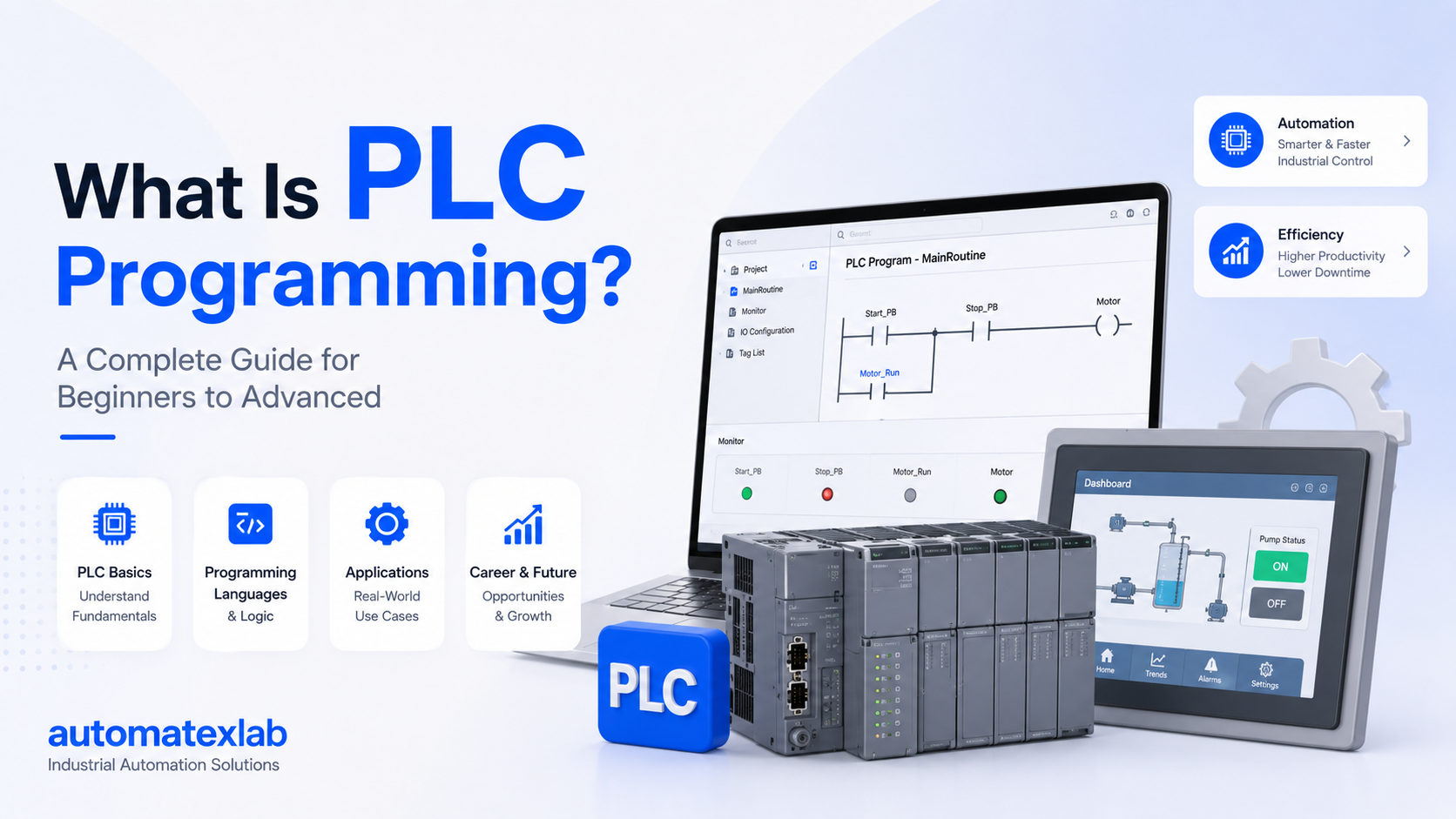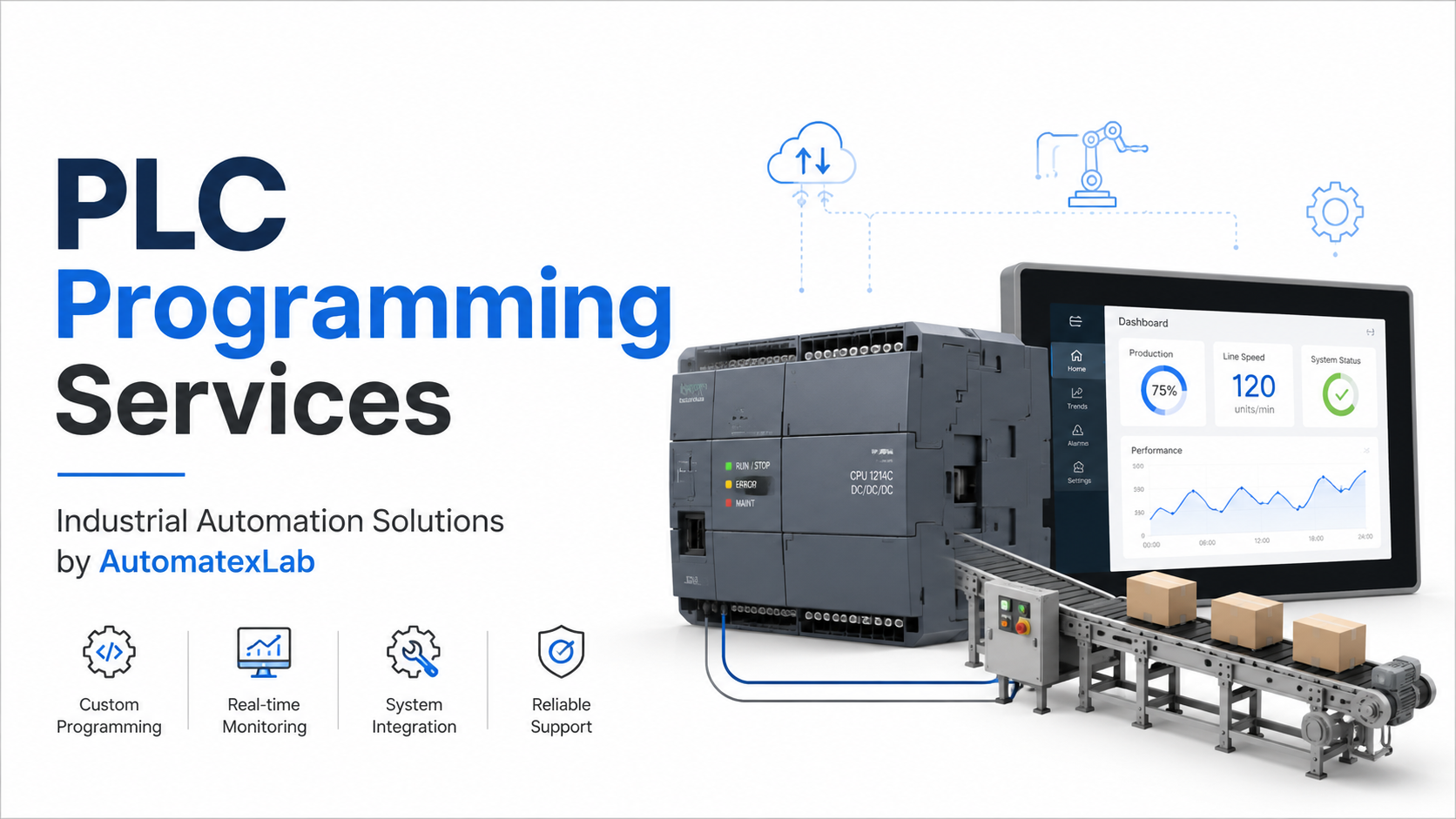
AutomatexLab delivers professional PLC programming services that help manufacturers, plant operators, and industrial facilities automate processes, reduce downtime, and achieve smarter production outcomes. Whether you need a new automation system built from scratch or an existing one upgraded and modernized, our engineers provide reliable, scalable, and industry-tested solutions built around your specific operational requirements.
Our team works across industries, PLC brands, and automation complexity levels, making AutomatexLab a trusted partner for businesses that need precision engineering and dependable long-term support.
What Are PLC Programming Services?
PLC programming services involve designing, developing, testing, and deploying automation logic for Programmable Logic Controllers. These are the rugged industrial computers that control machinery, production lines, conveyor systems, and critical equipment across factories, plants, and processing facilities worldwide.
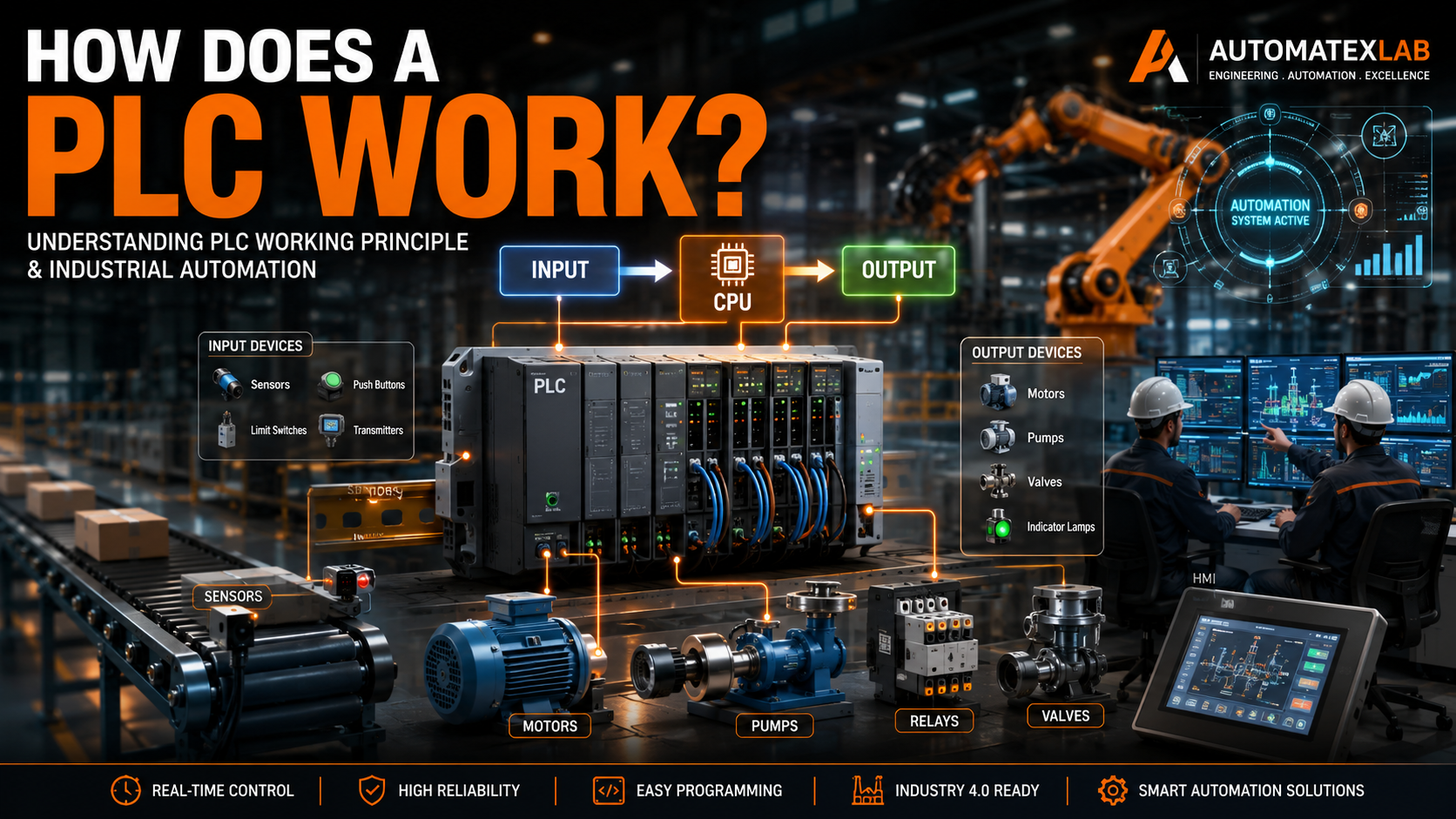
A Programmable Logic Controller reads signals from physical input devices, processes that information using pre-written logic programs, and then triggers the correct output responses in real time. This cycle runs continuously, often hundreds of times per second, giving industrial systems the speed, consistency, and precision that manual control simply cannot match.
Key concepts within PLC programming services include:
- Programmable Logic Controller (PLC): A ruggedized digital computer designed for industrial environments, used to monitor inputs and control outputs based on custom logic programs.
- Industrial Automation Systems: Integrated networks of hardware and software that replace or reduce manual processes with automated, real-time machine control.
- Process Control Systems: Engineering frameworks that manage and regulate process variables such as temperature, pressure, flow rate, speed, and level in manufacturing and industrial operations.
- Machine Automation: The application of PLC logic to make individual machines or entire production lines operate automatically with minimal human input.
- PLC Automation Solutions: Custom-engineered control programs designed to make specific machines, systems, or processes respond intelligently and safely to real-world conditions.
In practical terms, if a machine in your facility needs to start, stop, measure, react, sequence, or communicate, a PLC is running the logic behind it. PLC programming is what makes that logic work correctly, safely, and efficiently.
How PLC Programming Works in Industrial Automation
PLC-based automation follows a structured input, process, and output cycle that operates in real time across every connected machine and system.
Input Devices
Input devices collect data from the physical environment and transmit it to the PLC for processing. Common input devices include:
- Proximity sensors, temperature sensors, pressure transmitters, and flow meters
- Limit switches, push buttons, and selector switches
- Rotary encoders and position transducers
- Vision systems, barcode readers, and RFID readers
Each of these devices sends a signal to the PLC whenever a condition changes, giving the controller an accurate, real-time picture of the process state.
PLC Logic Processing
Once input signals are received, the PLC processes them using a pre-programmed logic set. Depending on the application and platform, engineers may use one or more of the following IEC 61131-3 standard programming languages:
- Ladder Logic (LD): The most widely used PLC language, designed to resemble electrical relay diagrams and ideal for discrete machine control.
- Structured Text (ST): A high-level text-based language similar to Pascal, well suited for complex mathematical calculations and data processing.
- Function Block Diagram (FBD): A graphical, block-based programming approach that works well for parallel process control and signal routing.
- Sequential Function Chart (SFC): Designed for processes with clearly defined sequential stages, such as batch manufacturing or wash cycles.
- Instruction List (IL): A low-level language used in memory-constrained applications, though less common in modern systems.
The logic program determines exactly what action to trigger based on the combination of input conditions received at any given moment.
Output Devices
After processing the logic, the PLC sends commands to output devices that physically interact with the process. These include:
- Electric motors, servo drives, and variable frequency drives (VFDs)
- Conveyors, robotic actuators, and solenoid valves
- Alarm systems, indicator lights, and audible buzzers
- Pumps, compressors, heaters, and cooling systems
Outputs can be switched on or off (digital outputs) or modulated to precise values (analog outputs), giving operators fine control over every aspect of the process.
Real-Time Monitoring
Modern PLC systems connect directly with HMI (Human-Machine Interface) panels and SCADA (Supervisory Control and Data Acquisition) platforms. This integration gives plant operators and engineers real-time visibility into machine status, production metrics, alarm history, and process trends from a central dashboard accessible on the shop floor or remotely.
Why Industries Need PLC Programming Services
Reduce Manual Operations
Automating repetitive, hazardous, or precision-dependent tasks eliminates the need for constant human intervention. This lowers labor costs, reduces operator fatigue, and significantly decreases the chance of human error in critical production steps.
Improve Production Efficiency
PLCs execute programmed logic faster and more consistently than any manual control method. Automated lines run at optimized speeds with minimal idle time between cycles, directly improving production throughput and reducing per-unit manufacturing costs.
Minimize Downtime
PLC systems continuously monitor equipment health and detect faults in real time. When an abnormal condition is detected, the system can trigger automatic shutdowns, safety interlocks, or operator alerts before small issues develop into expensive equipment failures or production stoppages.
Enhance Industrial Safety
Safety PLCs and fail-safe programming protect workers by immediately responding to dangerous conditions. Emergency stops, zone isolation, pressure relief triggers, and machine guarding interlocks all depend on reliable PLC logic to function correctly under any circumstance.
Enable Smart Manufacturing
With Industrial IoT connectivity, PLC systems feed live production data into analytics platforms and cloud dashboards, enabling data-driven decisions, predictive maintenance scheduling, and continuous process improvement across the entire facility.
Improve Process Accuracy
Automated control maintains precise process parameters such as temperature, pressure, speed, and timing far more consistently than manual operation. This precision directly improves product quality, reduces material waste, and ensures batch-to-batch repeatability in regulated industries.
Industries That Use PLC Programming
Manufacturing Plants
From assembly lines to CNC machining cells, PLCs coordinate every stage of manufacturing by synchronizing machines, managing material flow, and ensuring consistent, high-speed production with minimal scrap and waste.
Food and Beverage Industry
PLCs control mixing, filling, pasteurization, conveyor sequencing, and packaging operations while helping facilities maintain hygiene standards, regulatory traceability, and consistent product quality across every production run.
Pharmaceutical Industry
Precise batch control, cleanroom environmental monitoring, and strict compliance with Good Manufacturing Practice (GMP) regulations make PLC automation a critical requirement in pharmaceutical and nutraceutical production environments.
Water Treatment Plants
PLCs automate pumping stations, chemical dosing systems, filtration cycles, and flow regulation, ensuring consistent water quality treatment while supporting remote monitoring and SCADA integration across distributed infrastructure.
Automotive Industry
Robotic welding stations, paint spray booths, body press lines, and final assembly systems in automotive manufacturing all depend on tightly synchronized PLC automation to maintain the speed, quality, and repeatability that modern vehicle production demands.
Oil and Gas Facilities
In hazardous and remote environments, PLCs manage pipeline control, wellhead automation, emergency shutdown systems (ESD), and remote field monitoring, ensuring safe and reliable operations across geographically distributed assets.
Packaging Industry
High-speed labeling machines, filling lines, shrink wrap systems, and carton erectors all rely on precisely programmed PLC logic to maintain synchronization, accuracy, and throughput across complex multi-station packaging lines.
PLC Programming Services Offered by AutomatexLab
Custom PLC Programming
We develop application-specific PLC programs tailored to your exact process requirements. From simple single-machine control to complex multi-axis, multi-zone automation systems with advanced interlocking and safety logic, our engineers write clean, well-documented code built for reliability and long-term maintainability.
PLC Troubleshooting and Diagnostics
When production stops, every minute counts. Our engineers diagnose and resolve PLC faults, logic errors, communication failures, and hardware issues quickly and systematically, minimizing production downtime and restoring normal operations as fast as possible.
PLC Upgradation and Migration
Running on outdated or end-of-life PLC hardware? We migrate your existing control systems to modern platforms without disrupting your production schedule. We preserve your proven process logic while upgrading performance, connectivity, and long-term supportability.
SCADA Integration Services
We connect your PLC systems to leading SCADA platforms for centralized, real-time supervisory control and data acquisition. This gives your operations team full visibility into production status, alarms, trends, and historical data from a single unified interface.
HMI Development Services
Our team designs intuitive, purpose-built operator interfaces that make machine control straightforward, visual, and efficient for your shop floor personnel. Well-designed HMIs reduce operator error, improve response times, and make training new staff significantly easier.
Remote PLC Support
We provide secure online diagnostics, remote program modifications, and real-time troubleshooting via encrypted industrial network connections, reducing support response times and avoiding costly on-site service visits for issues that can be resolved remotely.
Industrial Automation Consulting
Not sure where to begin with automation? Our consultants assess your current production processes, identify the highest-value automation opportunities, evaluate your existing control infrastructure, and design a clear, cost-effective roadmap for implementation.
PLC Brands Supported by AutomatexLab
Our engineering team holds proficiency across all major industrial PLC platforms, allowing us to work within your existing infrastructure or recommend the most suitable platform for your new project:
- Siemens PLC: S7-200, S7-300, S7-400, S7-1200, and S7-1500 series with TIA Portal programming environment
- Allen Bradley (Rockwell Automation): MicroLogix, CompactLogix, and ControlLogix platforms with Studio 5000 and RSLogix software
- Mitsubishi PLC: MELSEC iQ-R, iQ-F, Q-Series, and FX-Series with GX Works programming software
- Delta PLC: DVP and AS Series platforms, offering reliable and cost-effective automation for a wide range of applications
- Omron PLC: Sysmac NJ and NX series with Sysmac Studio, plus CP and CJ series legacy systems
- Schneider Electric PLC: Modicon M221, M241, M340, and M580 platforms with EcoStruxure Machine Expert
This multi-brand expertise ensures that AutomatexLab can support nearly any industrial environment, regardless of which automation hardware is already installed.
Our PLC Programming Process
Step 1: Industrial Requirement Analysis
Every project begins with a thorough discovery phase. We meet with your engineering and operations teams to understand your process in detail, define your automation objectives, identify safety requirements, and document the scope of work before any design decisions are made.
Step 2: Automation System Design
Based on the requirements gathered, our engineers develop the full control architecture. This includes I/O mapping, network topology, safety system design, hardware selection, and panel layout before any programming work begins.
Step 3: PLC Logic Development
We write, structure, and fully document the PLC program using the most appropriate IEC 61131-3 language for your application. All programs follow industry best practices for naming conventions, comment density, modular structure, and version control.
Step 4: Simulation and Testing
Before deployment on live equipment, the program is thoroughly tested in a simulated environment. We verify logic sequences, test edge cases and fault conditions, and confirm that all safety interlocks function correctly under every anticipated scenario.
Step 5: Deployment and Commissioning
We deploy the verified program on your actual hardware, configure all physical I/O and network connections, conduct production trials, and work alongside your team to confirm that the system performs exactly as specified under real operating conditions.
Step 6: Maintenance and Technical Support
After commissioning, we remain available for ongoing support, scheduled program audits, system upgrades, and fast-response assistance whenever your team encounters operational issues. Long-term partnership is a core part of how we work.
Key Features of Our PLC Automation Solutions
- Real-time machine monitoring with configurable alarm management
- Industrial IoT readiness for connected, data-driven manufacturing
- Scalable system architecture designed to grow with your production needs
- Remote access and diagnostics capability via secure industrial networks
- Safety-focused programming with certified fail-safe interlocks and emergency shutdown logic
- Energy-efficient automation that minimizes unnecessary machine runtime and power consumption
- Built-in error detection with automatic fault logging and recovery sequences
- Structured, fully documented code for easy future modification and support
Benefits of Choosing AutomatexLab for PLC Programming
Deep Industrial Expertise
Our engineers bring hands-on experience across a wide range of industries and automation complexity levels. We understand the real pressures of industrial environments including safety standards, uptime requirements, regulatory compliance, and the true operational cost of unexpected downtime.
Genuinely Customized Engineering
Every automation project we take on is treated as a unique engineering challenge. We design systems around your specific process, your equipment constraints, and your operational goals rather than applying generic templates to problems that deserve tailored solutions.
Reliable Long-Term Support
We do not disappear after commissioning. AutomatexLab provides ongoing maintenance agreements, proactive system health reviews, and fast response to technical issues, keeping your automation systems operating reliably over the long term.
Multi-Brand Platform Proficiency
Our team works fluently across Siemens, Allen Bradley, Mitsubishi, Delta, Omron, and Schneider Electric platforms, meaning we can integrate with what you already have or guide you toward the best available option for your new project.
Process Optimization Focus
Beyond writing control code, we look for opportunities to optimize your process logic for better throughput, improved energy efficiency, reduced material waste, and greater overall system reliability. Good automation engineering does more than automate the status quo.
PLC Programming vs Traditional Relay Control Systems
| Feature | PLC Systems | Relay Control Systems |
|---|---|---|
| Flexibility | Easily reprogrammable via software | Fixed hardwired logic requiring physical changes |
| Troubleshooting | Fast diagnosis via software monitoring | Time-consuming physical inspection |
| Real-Time Monitoring | Full visibility through HMI and SCADA | Limited or no process visibility |
| Modifications | Software updates only | Rewiring and panel modifications required |
| Scalability | Highly scalable with additional I/O modules | Very limited expansion capability |
| Maintenance Cost | Lower long-term operational cost | Higher cost due to physical component wear |
| Space Requirement | Compact, space-efficient panels | Large footprint with extensive relay banks |
| Integration | Native connectivity with SCADA, HMI, and IIoT | Standalone operation only |
For any facility still operating on relay-based control systems, migration to PLC automation represents one of the highest-return investments available in industrial operations today.
PLC Programming and Industry 4.0
Modern PLC systems are no longer isolated machine controllers. They are the operational foundation of smart manufacturing. In the context of Industry 4.0, well-programmed PLC systems integrate seamlessly with:
Industrial IoT (IIoT): PLCs transmit real-time machine data to cloud platforms and analytics systems, enabling remote monitoring, performance benchmarking, and enterprise-wide operational visibility.
Predictive Maintenance: Sensor data processed through PLC logic and connected analytics platforms can identify the early signs of equipment wear or failure, allowing maintenance teams to act before an unplanned breakdown occurs.
AI-Driven Process Optimization: Advanced control architectures combine deterministic PLC logic with machine learning algorithms that can self-optimize production parameters based on real-time process feedback.
Cloud Monitoring and Reporting: Production KPIs, energy consumption data, alarm histories, and quality metrics captured by PLC systems stream to cloud dashboards that management can access from any location.
Data-Driven Manufacturing: Every event, fault, and measurement logged by the PLC becomes actionable operational data for quality management, regulatory compliance reporting, and continuous improvement programs.
AutomatexLab designs PLC systems with Industry 4.0 compatibility built into the architecture from the start, so your automation investment supports your broader digital transformation roadmap without requiring a complete system rebuild later.
Common Industrial Automation Challenges
Many manufacturing facilities struggle with automation-related challenges that directly impact productivity, safety, and profitability:
Outdated PLC Systems: Legacy controllers that have reached end-of-life can no longer be expanded, properly supported, or integrated with modern systems. Spare parts become scarce and single points of failure carry serious operational risk.
Machine Integration Problems: When new equipment is installed alongside legacy systems using different communication protocols, integration failures create production gaps and unreliable data flow between machines.
Unexpected Production Downtime: Undiagnosed PLC faults, corrupted programs, or hardware failures that occur without warning cause costly unplanned stoppages that affect delivery schedules and customer commitments.
Lack of Real-Time Process Visibility: Without proper HMI and SCADA integration, operators and managers cannot see what is actually happening across the production floor, making it impossible to respond quickly to deviations or identify the root causes of quality issues.
Inefficient Automation Logic: Control programs that were never optimized after initial installation often contain inefficiencies, redundant sequences, or logic that no longer reflects how the process actually runs, resulting in avoidable waste and slower cycle times.
Rising Maintenance Costs: Aging hardware and poorly documented legacy programs result in escalating maintenance expenditure and an increasing dependence on institutional knowledge that may not be captured anywhere in writing.
AutomatexLab addresses each of these challenges directly through diagnostics and troubleshooting, system migration, custom programming, SCADA integration, and structured ongoing support.
Why Modern Factories Are Investing in PLC Automation
The business case for industrial automation investment has never been clearer. Across global manufacturing and process industries, forward-thinking facilities are accelerating their commitment to PLC-based automation for measurable, strategic reasons.
Labor Optimization: Automation handles the repetitive, physically demanding, and precision-critical tasks that are most prone to human error, freeing your skilled workforce to focus on higher-value activities such as quality oversight, process improvement, and technical problem-solving.
Production Scalability: PLC-controlled production lines can be reconfigured for new products, adjusted for higher volumes, or modified for changed specifications far faster than manually operated systems, giving manufacturers the agility to respond to market demand.
Smart Manufacturing Readiness: Competitive pressure across virtually every manufacturing sector is accelerating the shift toward connected, data-driven production environments. PLC automation is the operational backbone that makes smart manufacturing possible.
Energy Efficiency Gains: Well-engineered automation logic reduces energy waste by ensuring that equipment runs only when required, at optimized parameters, avoiding the unnecessary power consumption that frequently occurs in manually controlled operations.
Operational Transparency: Real-time dashboards and production reports powered by PLC data give plant managers and executives the accurate, timely information they need to make faster and better decisions about production scheduling, maintenance prioritization, and resource allocation.
Facilities that invest in modern PLC automation today are building the operational infrastructure for sustainable, competitive, and scalable manufacturing operations well into the future.
Contact AutomatexLab for PLC Programming Services
Ready to automate your industrial operations, resolve ongoing system problems, or upgrade aging control infrastructure? The AutomatexLab engineering team is prepared to assess your requirements, evaluate your current systems, and design a solution that fits your process, your timeline, and your long-term operational goals.
Request an Automation Consultation: Speak directly with our PLC engineers about your project requirements and receive expert guidance on the best approach for your application.
Get an Industrial Automation Assessment: Let our team evaluate your current control systems, identify performance gaps, and outline the most effective path toward improved automation.
Upgrade Your Factory Automation: Start the conversation about modernizing your PLC infrastructure and positioning your facility for the demands of smart manufacturing.
Get in touch with AutomatexLab today and take the first step toward a more productive, reliable, and intelligent industrial operation.
FAQs
PLC programming is the process of writing and deploying logic into a Programmable Logic Controller, the industrial computer that automates machinery and process control in manufacturing plants, utilities, and industrial facilities.
PLC programming is used across manufacturing, food and beverage, pharmaceuticals, automotive, water treatment, oil and gas, packaging, and virtually any industry that relies on automated machinery or continuous process control.
The primary benefits include reduced labor costs, improved production throughput, minimized unplanned downtime, enhanced worker safety, consistent process accuracy, and the ability to integrate with modern IIoT and SCADA systems for real-time operational visibility.
AutomatexLab supports Siemens, Allen Bradley, Mitsubishi, Delta, Omron, and Schneider Electric PLC platforms, along with several other industrial automation brands.
Project costs vary based on scope, complexity, hardware requirements, and the level of integration involved. Contact AutomatexLab for a detailed assessment and a project-specific quotation tailored to your requirements.
A PLC executes real-time control logic at the machine or process level. SCADA is a supervisory software system that collects data from multiple PLCs and presents it through a centralized monitoring and control interface. They serve different but complementary roles and are most powerful when used together.
Yes. AutomatexLab specializes in PLC migration and modernization projects, transferring your proven process logic to current hardware platforms while minimizing disruption to your production operations.
Yes. We provide secure remote diagnostics and programming support for PLC systems with network connectivity, enabling fast fault resolution without requiring an engineer to travel to your site for every issue.
Project timelines depend on the scope and complexity of the work involved. A straightforward single-machine control program may be completed in a few days, while a large multi-machine automation system with full SCADA integration may require several weeks. We provide clear, detailed timelines during the project planning phase.
AutomatexLab combines genuine industrial automation expertise, broad multi-brand PLC proficiency, a structured engineering process, and committed long-term support to deliver automation solutions that perform reliably in real industrial environments over the long term.