Manufacturing plants lose money every day they run on outdated processes. Downtime, manual reporting, and inconsistent quality quietly eat into margins long before anyone notices the pattern.
An industrial automation consultant steps in before that damage compounds. Instead of pushing a plant toward new equipment right away, a consultant studies how the operation actually runs and finds the gaps costing time and money.
The right consultant reduces downtime, improves productivity, and lowers operating costs without forcing unnecessary capital spending. AutomatexLab has built its practice around exactly this approach, helping manufacturers modernize with solutions that match their actual production goals.
What Is an Industrial Automation Consultant?
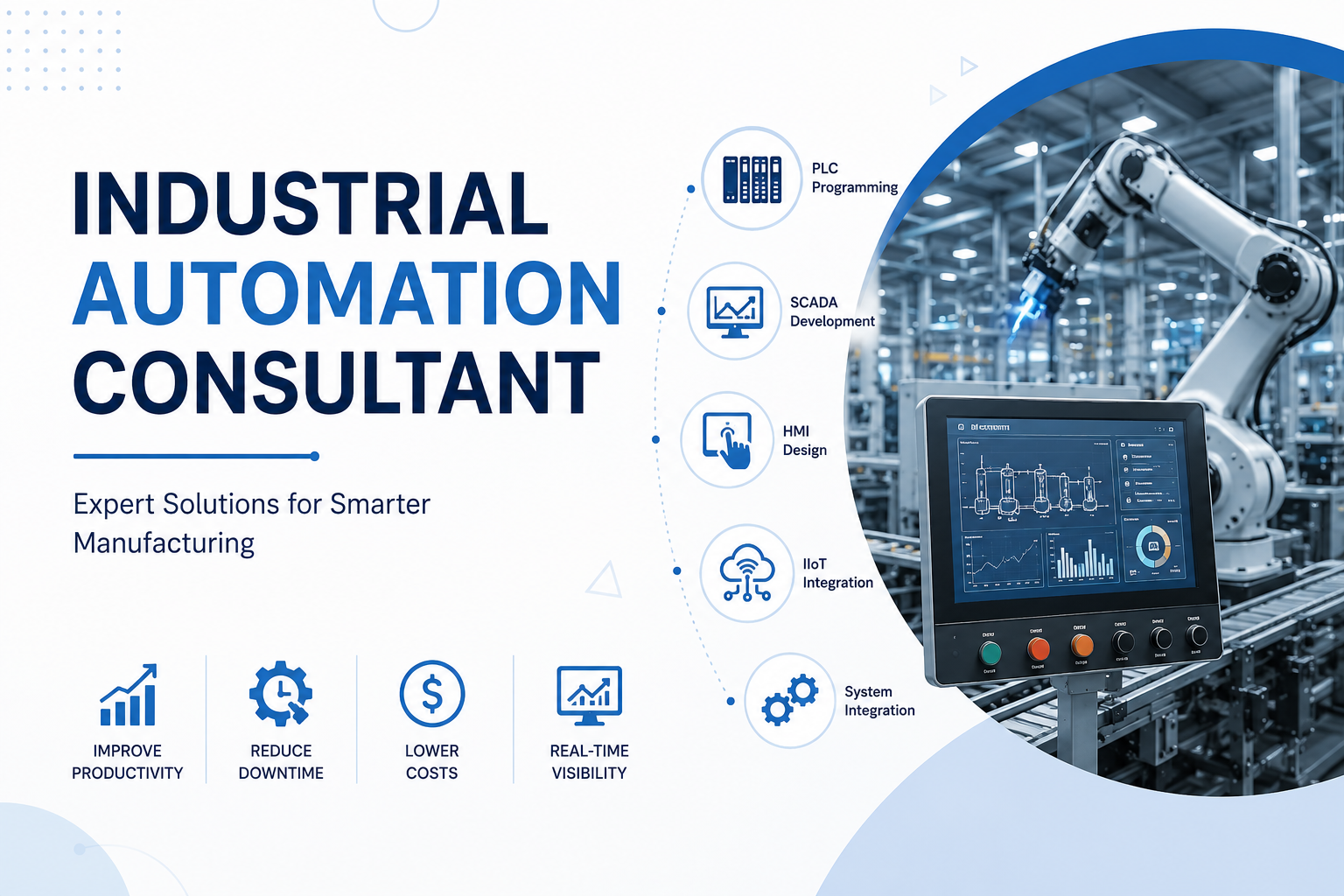
An industrial automation consultant analyzes manufacturing processes, identifies inefficiencies, and designs automation solutions using PLCs, SCADA, HMIs, robotics, industrial IoT, and control systems to improve production efficiency.
The work happens in stages. A consultant evaluates the existing process, plans an automation approach, selects the right technology for the job, integrates it into the plant, and then optimizes performance over time.
This is different from simply buying automation equipment off the shelf. A consultant looks at the whole system first, then recommends solutions that fit the plant rather than forcing the plant to fit a generic product.
Why Companies Hire Industrial Automation Consultants
Most manufacturers don’t call a consultant because automation sounds appealing. They call because specific problems are costing them money.
High downtime. Machines going down unexpectedly halts production and creates a ripple effect across the whole line.
Manual processes. Paper logs and manual data entry slow decisions and introduce errors that automated systems avoid entirely.
Poor production visibility. Without real-time data, managers make decisions based on guesswork instead of facts.
Quality inconsistencies. Manual control leaves more room for variation, which shows up as rework and rejected product.
High labor costs. Repetitive manual tasks tie up workers who could be doing higher-value work.
Energy waste. Systems without proper monitoring often run inefficiently without anyone noticing.
Aging control systems. Legacy PLCs become harder to maintain and more prone to failure every year they stay in service.
Difficult maintenance. Without proper documentation and monitoring, maintenance becomes reactive instead of planned.
A consultant addresses each of these directly, matching a specific automation solution to each root cause instead of applying a blanket fix.
Services Offered by Industrial Automation Consultants
PLC Programming
PLC work covers new development, upgrades to existing systems, logic optimization, troubleshooting, and migration from legacy platforms to modern controllers. This is often the starting point for a plant that wants better control without replacing every piece of hardware.
SCADA Development
SCADA systems give plants real-time monitoring, alarm management, historical data logging, production dashboards, and remote monitoring capability. Once a plant can see what’s actually happening on the floor, decisions get faster and more accurate.
HMI Design
Good HMI design means operator-friendly interfaces, better machine control, faster troubleshooting, and fewer operator errors. A poorly designed HMI can undo the benefit of an otherwise solid automation system, so this step matters more than most plants expect.
Industrial IoT Integration
IoT integration brings smart sensors, cloud monitoring, predictive maintenance, data analytics, and remote diagnostics into the plant. This is where automation starts moving from reactive to predictive.
Control System Design
This covers electrical architecture, control philosophy, panel design, and safety integration. It’s the technical backbone that everything else depends on.
Automation System Integration
A consultant connects PLCs, SCADA, ERP, MES, sensors, robots, VFDs, and servo systems into one working system. Integration is often where the real value shows up, since disconnected systems limit the benefit of automation even when each piece works well individually.
Benefits of Hiring an Industrial Automation Consultant
| Without Consultant | With Consultant |
|---|---|
| Higher downtime | Reduced downtime |
| Manual reporting | Real-time monitoring |
| Lower productivity | Higher efficiency |
| Higher maintenance costs | Optimized maintenance |
| Poor process visibility | Complete production insights |
Industries That Benefit from Industrial Automation Consulting
Automotive. Robotic assembly and precision quality control keep production lines moving at scale.
Food and beverage. SCADA monitoring supports hygiene compliance and consistent batch quality.
Pharmaceuticals. Automation supports the strict traceability and validation requirements common in this industry.
Chemical plants. Process control systems manage safety-critical operations with tighter tolerances than manual control allows.
Textile manufacturing. Automated systems improve throughput and reduce material waste.
Steel industry. Heavy machinery control benefits from PLC-driven precision and reduced downtime.
Packaging. High-speed lines depend on reliable automation to hit volume targets.
Plastics. Injection molding and extrusion processes rely on consistent control parameters.
Cement. Continuous process monitoring reduces energy waste in high-consumption operations.
Paper mills. Automation supports consistent quality across long, continuous production runs.
Water treatment. Remote monitoring through industrial IoT keeps operations running with minimal on-site staffing.
Renewable energy. Automated systems manage variable inputs like solar and wind generation more efficiently than manual oversight.
Industrial Automation Consulting Process
Process assessment. The consultant reviews existing equipment, analyzes production, and identifies bottlenecks.
Requirement analysis. This stage covers production goals, budget, and existing infrastructure.
Automation strategy. The consultant recommends technology, estimates ROI, and builds an implementation roadmap.
System design. This includes PLC architecture, SCADA architecture, control logic, and network planning.
Development and testing. Programming happens alongside simulation and factory acceptance testing.
Installation and commissioning. The system moves to site deployment, validation, and startup support.
Training and support. Operators receive training, maintenance documentation gets delivered, and the consultant supports ongoing optimization.
Signs Your Factory Needs an Industrial Automation Consultant
A few warning signs tend to show up before a plant realizes it needs outside help.
Frequent machine failures and high maintenance costs are usually the first symptoms. Manual data collection and production delays follow close behind. Rising labor expenses, legacy PLC systems, and no SCADA monitoring often mean the plant has fallen behind without anyone tracking it closely. Poor OEE, frequent quality issues, and energy inefficiency round out the list.
Any one of these on its own might not justify a consultant. Several appearing together usually does.
Industrial Automation Technologies Consultants Use
Consultants draw on a wide technology stack depending on the plant’s needs. This includes PLCs, SCADA, HMIs, and DCS systems for core control. VFDs and servo drives handle motor control. Industrial robots and machine vision support precision tasks. Industrial IoT, OPC UA, Modbus, Ethernet/IP, and Profinet handle connectivity and communication between systems. Edge computing and AI-based predictive maintenance are increasingly common additions for plants looking to get ahead of failures rather than react to them.
How Industrial Automation Consulting Improves ROI
The return on automation consulting shows up in several measurable ways: reduced downtime, higher throughput, lower energy consumption, better product quality, faster production cycles, improved worker safety, lower maintenance costs, and better data-driven decisions.
A simple example. A packaging plant losing 4 hours of production weekly to unplanned downtime, at an estimated cost of $2,000 per hour, loses roughly $416,000 annually. A PLC optimization project that cuts that downtime by half recovers over $200,000 per year, often well above the cost of the consulting engagement itself.
Why Choose AutomatexLab as Your Industrial Automation Consultant
AutomatexLab brings experienced automation engineers who build customized strategies rather than generic packages. The team’s core strength spans PLC and SCADA expertise alongside industrial IoT solutions, backed by both remote and on-site support.
AutomatexLab focuses on practical, scalable automation solutions tailored to each manufacturing environment rather than one-size-fits-all implementations. This includes helping plants get ready for Industry 4.0 without disrupting current operations, along with long-term technical support after the initial project wraps up.
Real-World Consulting Scenarios
Packaging plant. Reduced downtime through targeted PLC optimization.
Food processing facility. SCADA implementation gave management full production visibility for the first time.
Automotive manufacturer. Robotic integration cut assembly time significantly.
Water treatment plant. Remote monitoring through industrial IoT reduced the need for constant on-site staffing.
Cost of Hiring an Industrial Automation Consultant
Several factors affect consulting cost: project complexity, number of PLCs involved, SCADA scope, number of site locations, system integration requirements, commissioning support, and training needs.
ROI typically matters more than the upfront fee. A higher initial cost that delivers faster payback and long-term efficiency gains is usually the better investment compared to a cheaper solution that underdelivers.
Common Mistakes Manufacturers Make
Manufacturers often choose automation technology before clearly defining their business goals, which leads to systems that don’t actually solve the right problem. Ignoring scalability is another common issue, since a system built only for today’s volume creates rework later.
Delaying maintenance, skipping operator training, and using incompatible systems all create long-term headaches. Skipping cybersecurity planning is increasingly risky as more equipment connects to networks. Selecting vendors based only on price, without weighing experience or long-term support, tends to backfire once the system is in operation.
Conclusion
Industrial automation consulting helps manufacturers reduce downtime, improve productivity, and modernize operations without unnecessary capital expenditure. The right consultant looks at the whole plant before recommending a solution, which is what separates a lasting improvement from a quick fix that creates new problems down the line.
AutomatexLab provides end-to-end consulting, from process assessment and automation strategy through PLC and SCADA implementation, commissioning, and ongoing optimization, helping businesses build efficient, future-ready manufacturing systems.
Frequently Asked Questions
What does an industrial automation consultant do?
A consultant evaluates manufacturing processes, identifies inefficiencies, and designs automation solutions covering PLCs, SCADA, HMIs, and related systems to improve efficiency and reduce costs.
When should I hire an automation consultant?
The right time is usually when downtime, manual processes, or rising maintenance costs start affecting production consistently, rather than waiting until a major failure forces the issue.
Can automation consultants upgrade existing PLC systems?
Yes. PLC upgrades and migrations from legacy systems are a core part of most consulting engagements.
Do consultants work with legacy equipment?
Yes. Many projects involve integrating new automation technology alongside existing legacy equipment rather than replacing everything at once.
How long does an automation consulting project take?
Timelines vary based on scope, but most projects run from a few weeks for smaller PLC or HMI work to several months for full SCADA and system integration projects.
What industries benefit most from automation consulting?
Manufacturing-heavy industries like automotive, food and beverage, pharmaceuticals, and chemical processing see some of the strongest returns, though the benefits extend across most industrial sectors.
Can SCADA be added to an existing factory?
Yes. SCADA systems can typically be layered onto existing infrastructure without requiring a full equipment overhaul.
How much does industrial automation consulting cost?
Cost depends on project complexity, number of systems involved, and the scope of integration and training required, so pricing is usually determined after an initial assessment.
What is the difference between a system integrator and an automation consultant?
A system integrator typically focuses on implementing a defined solution, while a consultant is involved earlier, helping define the right strategy and technology approach before implementation begins.
Does AutomatexLab provide remote automation consulting?
Yes. AutomatexLab supports both remote and on-site consulting depending on the project’s needs.