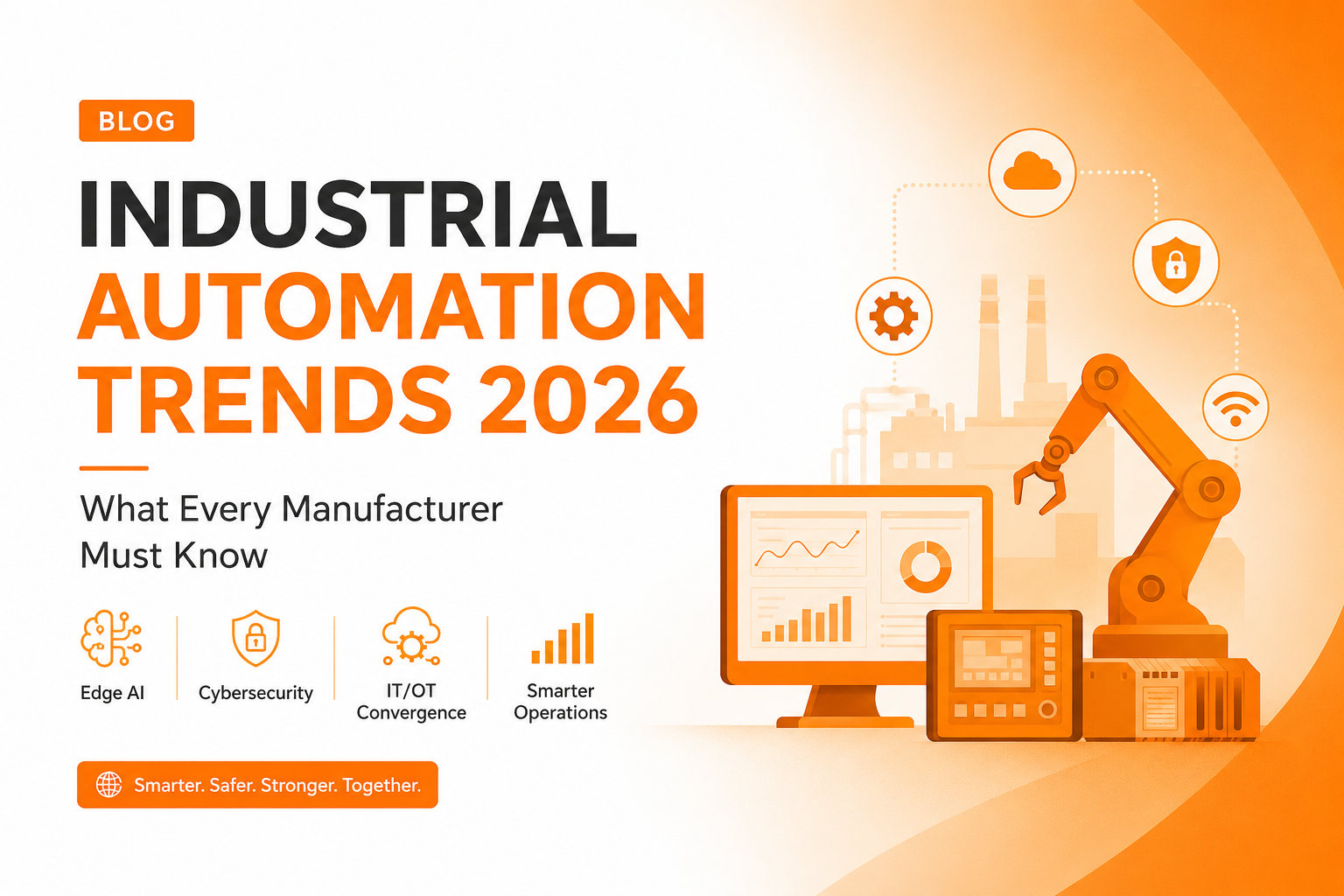
In 2026, the difference between factories that simply automate and those that intelligently automate is becoming impossible to ignore.
For years, many manufacturers treated automation as a set of fixed PLC programs, basic SCADA screens, and occasional hardware upgrades. That approach is no longer enough. Artificial intelligence has moved from distant cloud servers onto the factory floor. IT and OT systems are finally exchanging data in live production environments. Cyber threats targeting industrial control systems have grown more sophisticated. Energy efficiency, traceability, and remote visibility have become competitive requirements rather than optional extras.
The manufacturers who understand these shifts and act on them will reduce downtime, improve consistency, and respond faster to market changes. Those who continue with outdated systems risk higher operating costs, more unplanned stoppages, and slower decision-making.
This article examines the most important industrial automation trends of 2026 in practical language. It is written for plant managers, production heads, maintenance leaders, and decision-makers who need clear insight rather than marketing hype. Whether you operate a large plant or a mid-size facility, these trends will shape how competitive your operations remain over the next several years.
Why 2026 Marks a Turning Point for Industrial Automation
Several forces have converged to make 2026 different from previous years of Industry 4.0 discussion.
First, AI inference has become practical at the edge. Lightweight models can now run on industrial controllers, gateways, and even advanced PLCs. This removes the earlier dependence on constant high-bandwidth cloud connections and reduces latency to near real-time levels.
Second, IT/OT convergence has moved beyond pilot projects. Many plants now run production systems where manufacturing execution software, historians, and enterprise platforms exchange data with PLCs and SCADA in daily operations. The conversation has shifted from technical feasibility to governance, security, and data quality.
Third, cybersecurity expectations for operational technology have risen sharply. Connected industrial systems are attractive targets, and regulators as well as customers increasingly expect basic security hygiene.
Fourth, the market for automation solutions has become more accessible. Mid-size manufacturers and ambitious SMEs can now implement modular upgrades, remote support models, and phased modernization instead of waiting for multi-year, multi-crore digital transformation programs.
Finally, data itself has become a strategic asset. Plants that only collect numbers without context struggle to extract value. Those that structure, clean, and contextualize their industrial data are better positioned to use AI, predictive tools, and advanced analytics.
Together, these changes mean that automation is no longer just about controlling machines. It is about creating systems that sense, decide, and improve continuously while remaining reliable and secure.
Top Industrial Automation Trends for 2026
1. Edge AI and Real-Time Decision Making on the Factory Floor
One of the most significant developments in 2026 is the movement of artificial intelligence from the cloud to the edge of the industrial network.
Instead of sending every sensor reading to a remote server for analysis, plants now run lightweight AI models directly on industrial PCs, edge gateways, or even advanced controllers. This approach delivers several practical advantages. Latency drops dramatically, so decisions can be made in milliseconds rather than seconds. Operations continue even if internet connectivity is temporarily lost. Bandwidth costs decrease because only relevant insights or exceptions need to be transmitted upstream.
Common applications already delivering value include:
- Predictive maintenance that detects developing faults from vibration, temperature, or current signatures before equipment fails.
- Machine vision systems that inspect products at line speed and flag defects without waiting for cloud processing.
- Process optimization loops that adjust setpoints within safe boundaries based on real-time conditions.
For many manufacturers, the biggest mindset shift is realizing that AI does not always require a massive data science team or expensive cloud infrastructure. Targeted edge models focused on specific high-value problems often deliver faster returns. Plants that still rely solely on fixed thresholds and simple alarms are missing opportunities to catch problems earlier and reduce unplanned downtime.
2. IT/OT Convergence Reaches Operational Maturity
The long-discussed convergence of information technology and operational technology has moved from strategy documents into daily plant operations in 2026.
In earlier years, connecting a PLC network to enterprise systems was often treated as a special project with heavy engineering effort and security concerns. Today, more facilities run stable architectures where production data flows reliably into higher-level systems while control networks remain properly segmented.
This maturity brings clear benefits. Production managers gain better visibility into overall equipment effectiveness. Maintenance teams receive earlier warnings. Quality and traceability requirements become easier to satisfy. At the same time, new challenges appear. Data ownership must be clear. Security policies need to cover both IT and OT domains. Change management processes must prevent a software update on the enterprise side from disrupting control systems.
Successful manufacturers treat IT/OT integration as an ongoing capability rather than a one-time project. They invest in secure gateways, consistent tagging standards, and people who understand both the plant floor and the enterprise systems. The result is faster decision-making and fewer information silos.
3. From Automated to Autonomous Operations
Traditional automation executes the logic that engineers write. In 2026, a growing number of systems can adjust their own behavior within defined limits based on live data.
AI-augmented controllers and advanced process control applications monitor performance and make small, continuous corrections. This moves plants closer to autonomous operation without removing human oversight. Most facilities still keep operators and engineers in the loop for exceptions, safety decisions, and higher-level strategy. The practical goal is not a completely lights-out factory for the majority of manufacturers. Instead, it is higher consistency, fewer manual interventions, and faster recovery when conditions change.
Examples include packaging lines that automatically compensate for material variations, process units that maintain tighter quality bands, and material handling systems that re-route around temporary bottlenecks. Plants that implement these capabilities carefully often see measurable reductions in variability and scrap. Those that chase full autonomy without strong process understanding or safety layers risk creating new problems.
4. Cybersecurity Becomes a Core Operational Requirement
As industrial systems become more connected, they also become more exposed. In 2026, cybersecurity is no longer treated as an optional IT concern. It is a core operational requirement.
Attackers increasingly target PLCs, SCADA systems, HMIs, and industrial networks because disruption can halt production and create safety risks. Many plants still run older Windows-based operator stations, use default credentials, or maintain flat network architectures that allow lateral movement once a single device is compromised.
Practical steps that leading manufacturers are taking include network segmentation between IT and OT, secure remote access solutions instead of open VPN tunnels, regular firmware and software updates, continuous monitoring for unusual traffic patterns, and clear incident response plans that involve both IT and plant teams.
The cost of neglecting these basics continues to rise. Customers, insurers, and regulators increasingly expect evidence of basic cyber hygiene. Manufacturers that treat security as an afterthought face growing risk of production interruption and reputational damage.
5. Modern SCADA Combined with AI Delivers Smarter Visibility
Classic SCADA systems remain excellent at real-time monitoring, alarming, and basic supervisory control. In 2026, however, many plants are discovering that traditional SCADA alone is no longer sufficient for competitive operations.
Leading facilities are layering analytics and AI capabilities on top of existing SCADA platforms. These additions enable automatic anomaly detection, predictive insights, better alarm prioritization, and even natural-language queries that allow engineers to ask questions of their production data. Mobile access and modern visualization further improve usability for both control room staff and field teams.
Importantly, most successful projects do not involve complete replacement of the existing SCADA system. Instead, plants modernize incrementally — improving graphics, adding historical analysis, integrating AI modules, and strengthening cybersecurity — while preserving the reliability of core control functions. This approach delivers better visibility and decision support without the risk and cost of a full rip-and-replace.
6. Software-Defined Automation and Virtual PLCs Increase Flexibility
Hardware-centric automation architectures are giving way to more software-defined approaches. Virtual PLCs and software-based control platforms allow plants to change logic, scale capacity, and adapt to new products more quickly than traditional fixed hardware systems.
This flexibility is especially valuable for manufacturers with high product mix, frequent changeovers, or evolving process requirements. Instead of waiting for new physical controllers or extensive rewiring, teams can update control strategies through software. When combined with good simulation and testing practices, the result is faster response to market demands and lower long-term engineering effort.
Not every application is ready for fully virtualized control, particularly those with extremely strict real-time or safety requirements. However, the trend toward software-defined automation is clear and growing in 2026.
7. Stronger Data Foundations Through Industrial IoT
Collecting industrial data has become relatively easy. Turning that data into reliable, usable information remains difficult. In 2026, manufacturers are paying more attention to data foundations.
This includes consistent tag naming, proper contextualization (so that a temperature reading is clearly linked to a specific machine and process step), clean historian structures, and architectures that avoid creating new data silos. Without these basics, advanced analytics and AI projects struggle or produce misleading results.
Industrial IoT continues to expand the volume of available data from sensors, drives, and machines. The plants that extract value are those that treat data quality and structure as engineering priorities equal to the control logic itself.
8. Practical, Scalable Solutions for Mid-Size Plants and SMEs
Not every manufacturer needs a multi-million-dollar digital twin or a fully autonomous factory. In 2026, a strong trend is the availability of practical, modular solutions that deliver measurable results for mid-size plants and SMEs.
These include targeted PLC and HMI upgrades, modern SCADA improvements, remote troubleshooting capabilities, phased control panel modernization, and focused predictive maintenance projects. Many of these initiatives can be implemented with limited disruption and shorter payback periods.
This is particularly relevant in markets such as India, where a large number of factories want the benefits of modern automation without the complexity or capital intensity of full-scale Industry 4.0 programs. Remote support models further reduce the need for constant on-site specialist presence, helping plants resolve issues faster and keep production running.
What These Trends Mean in Practice for Different Manufacturers
Large multi-site enterprises are typically focused on standardizing architectures, scaling AI use cases, and building internal platforms that serve many plants. Their challenges center on governance, data consistency across locations, and integrating legacy systems with newer technologies.
Mid-size manufacturers often achieve the strongest near-term returns by concentrating on high-impact problems: reducing unplanned downtime, improving process visibility through better SCADA and HMI systems, strengthening cybersecurity, and enabling reliable remote support. These plants usually benefit from partnering with experienced automation teams that understand both the technology and real plant-floor constraints.
Smaller factories and SMEs gain the most from incremental, well-scoped projects. Modernizing a critical control panel, upgrading an outdated HMI, adding basic remote monitoring, or improving PLC logic for a chronic bottleneck can deliver noticeable improvements in reliability and operator efficiency without requiring large capital budgets.
Across all sizes, the common success factor is starting with clear operational problems rather than technology for its own sake.
Practical Next Steps Manufacturers Should Take in 2026
Begin with an honest assessment of your current automation landscape. Document the age and condition of PLCs, SCADA systems, HMIs, and control panels. Identify single points of failure, cybersecurity gaps, and areas where operators lack clear visibility.
Prioritize initiatives that address measurable pain points such as frequent downtime, quality variation, slow troubleshooting, or excessive manual intervention. Calculate potential returns before committing significant resources.
Strengthen basic cybersecurity practices early, especially if you plan to increase connectivity or enable remote access.
Improve the structure and quality of production data so that future analytics or AI projects have a solid foundation.
Finally, decide whether to build internal capability, work with external specialists, or use a combination of both. Many plants benefit from partners who can deliver both on-site execution and secure remote support when issues arise.
Conclusion
Industrial automation in 2026 is defined less by individual machines and more by intelligent, connected, and resilient systems. Edge AI, mature IT/OT integration, modern SCADA enhanced with analytics, stronger cybersecurity, software-defined flexibility, better data foundations, and practical solutions for plants of all sizes are the trends that will separate high-performing manufacturers from those that struggle.
These changes do not require every factory to become fully autonomous overnight. They do require clear understanding of where current systems fall short and deliberate steps to improve reliability, visibility, and decision-making.
The manufacturers that act with focus in 2026 selecting high-impact projects, measuring results, and building sustainable capabilities will operate more efficiently, respond faster to disruption, and create stronger competitive positions in the years ahead.
If your plant is evaluating PLC programming, SCADA modernization, HMI improvements, control panel upgrades, or practical automation projects, the team at AutomateXLab is prepared to help you assess options and implement solutions that fit real operational needs, whether through on-site work or secure remote support.
The future of industrial automation is already unfolding on the factory floor. The only remaining question is how prepared your operations will be.
Need Help With PLC, HMI, or SCADA Modernization?
If you are evaluating a PLC upgrade, HMI modernization, SCADA upgrade, PLC programming, or remote industrial automation support, AutomateXLab can help assess your existing system and identify a practical modernization path.
Talk to the AutomateXLab team about your PLC, HMI, or SCADA requirements.