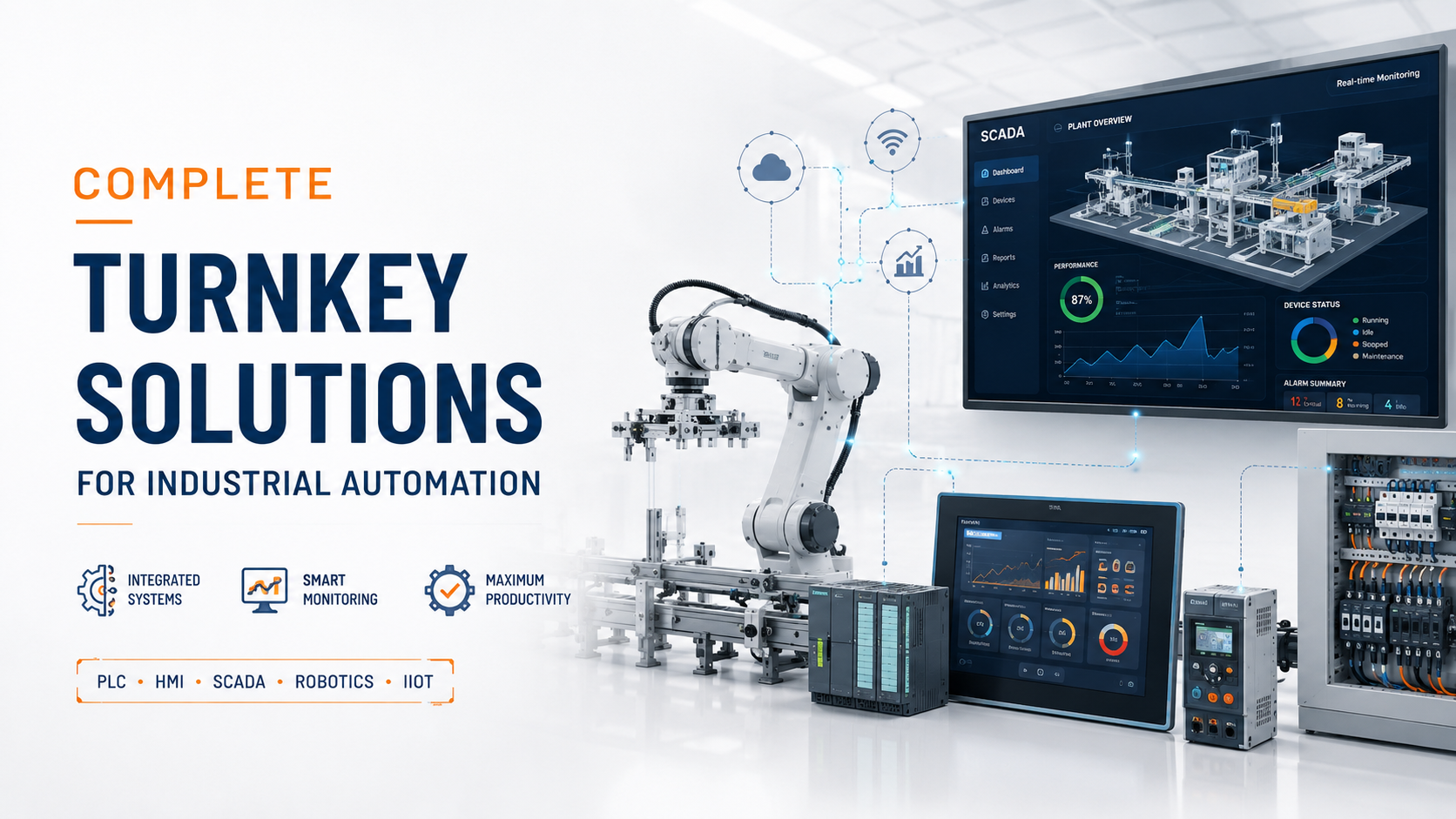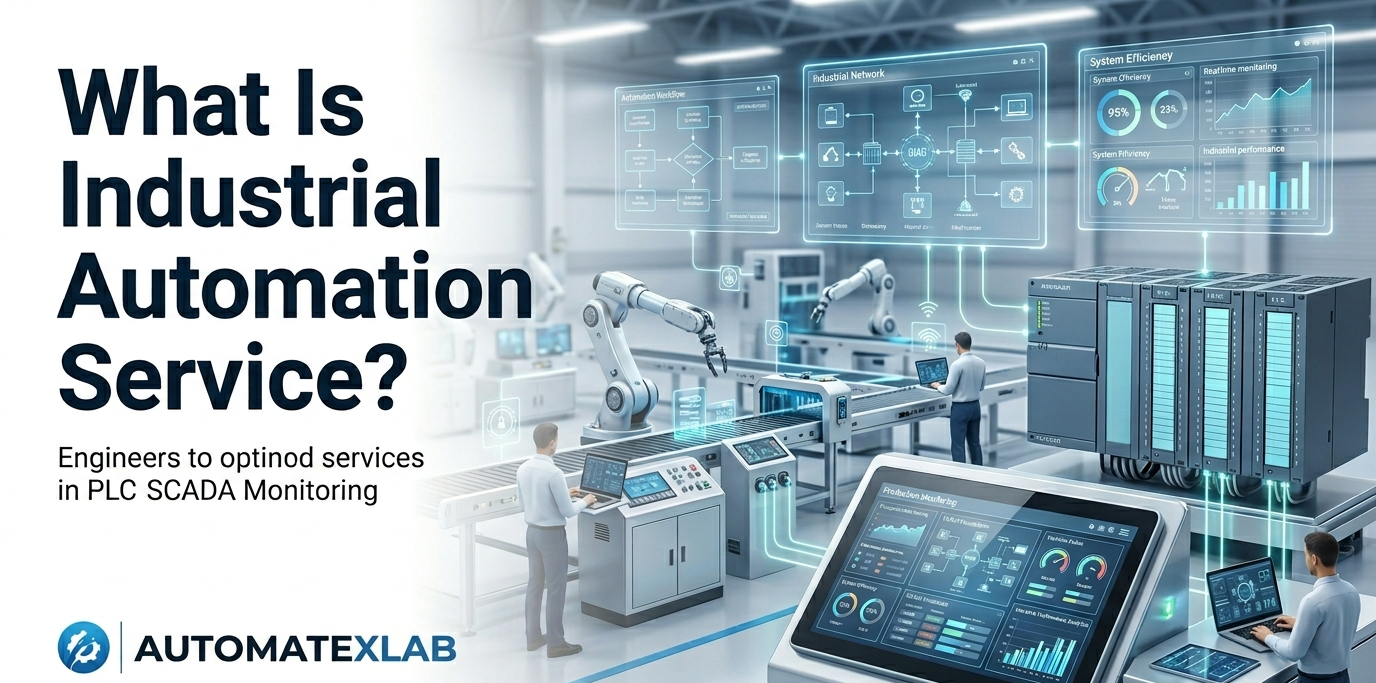
Industrial automation is the use of control systems, software, sensors, robotics, and industrial machines to perform manufacturing and industrial processes with minimal human intervention. It improves productivity, quality, safety, and operational efficiency by automatically monitoring and controlling equipment in factories, warehouses, and production facilities .
Modern industrial automation combines technologies like PLCs, SCADA systems, HMIs, industrial robots, IIoT devices, AI, and machine vision to create smart manufacturing environments capable of making real-time decisions. Global smart-manufacturing adoption reached roughly 47% in early 2026, making automation the mainstream approach rather than an experimental frontier .
How Industrial Automation Works
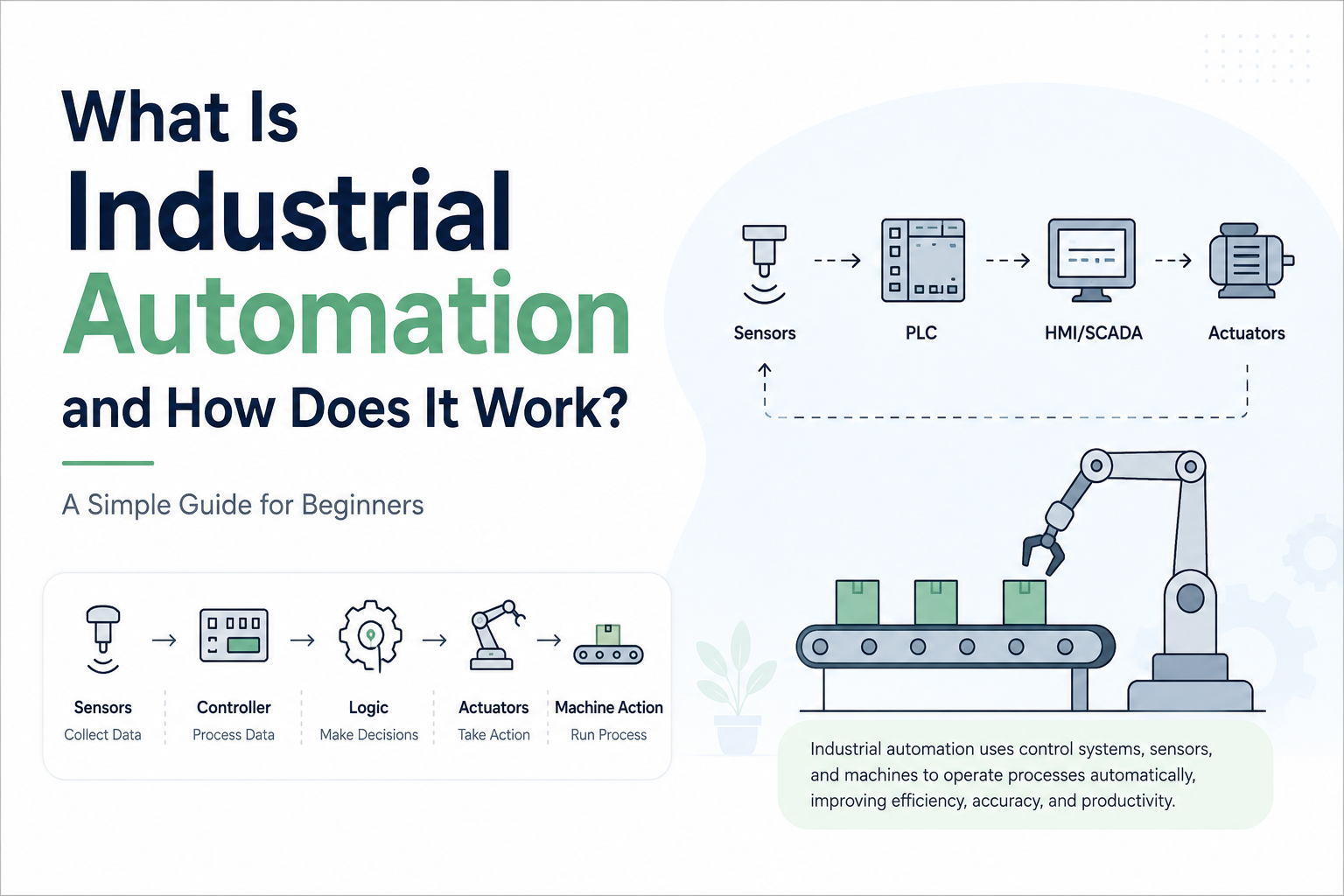
Industrial automation works by collecting data from sensors, processing that data inside controllers like PLCs, making decisions based on programmed logic, and sending commands to machines that perform specific actions automatically.
Step one: Data collection. Industrial sensors constantly monitor temperature, pressure, speed, position, vibration, flow rate, weight, humidity, and proximity. These sensors convert physical conditions into electrical signals.
Step two: Signal transmission. Sensor signals travel through industrial networks like PROFINET, EtherNet/IP, Modbus, and PROFIBUS. These communication protocols deliver data to controllers .
Step three: Processing. A PLC or industrial controller analyzes incoming data. The PLC compares sensor readings with predefined program logic. For example: If a bottle is present and the conveyor is running, then activate the filling valve. The controller makes decisions within milliseconds.
Step four: Machine control. The controller sends commands to motors, servo drives, valves, pumps, cylinders, robotic arms, and conveyors. Machines perform the required task automatically.
Step five: Monitoring. SCADA software continuously monitors machine status, production rate, alarm conditions, energy consumption, and equipment health. Operators supervise the entire plant through dashboards .
Step six: Feedback loop. Sensors verify whether the desired action was completed successfully. If an error occurs, the system stops production, generates alarms, adjusts machine settings, or records the event. This continuous feedback loop ensures accuracy.
Main Components of an Industrial Automation System
Sensors collect real-time process data. Examples include temperature sensors, pressure sensors, photoelectric sensors, inductive sensors, ultrasonic sensors, and vision sensors .
PLCs (Programmable Logic Controllers) serve as the brain of industrial automation. They execute control logic, process sensor data, control outputs, and communicate with other devices. PLCs are ruggedized computers designed for industrial control and can withstand harsh environments .
HMIs (Human Machine Interfaces) allow operators to start machines, stop production, view alarms, adjust parameters, and monitor equipment. Modern HMIs feature touchscreen interfaces.
SCADA systems provide centralized monitoring for entire plants. Capabilities include remote monitoring, historical data logging, alarm management, production reporting, and trend analysis .
Actuators convert electrical commands into physical movement. Examples include electric motors, pneumatic cylinders, hydraulic cylinders, and solenoid valves.
Industrial robots perform repetitive tasks like welding, painting, packaging, assembly, material handling, and inspection. The International Federation of Robotics reported 542,000 industrial robots installed globally in 2024, more than double the number installed a decade earlier .
Industrial networks connect all automation devices. Common protocols include PROFINET, EtherCAT, Modbus TCP, OPC UA, and Ethernet/IP .
Types of Industrial Automation
Fixed automation uses dedicated equipment for one high-volume task. It offers high speed and efficiency but very little flexibility. Examples include automotive assembly lines and beverage bottling plants .
Programmable automation can be reconfigured for different batch production runs. The physical machinery remains in place, but the logic governing what it does is modified between production runs. Examples include CNC machines and batch processing plants .
Flexible automation systems can switch between product variants automatically with minimal downtime between batches. Machines adjust without having to stop production, making flexible processes ideal for high-mix, low-volume outputs. Examples include electronics manufacturing and automotive component production .
Integrated automation involves fully connected smart factories where machines communicate automatically. This approach uses IIoT, cloud platforms, AI, and robotics to create interconnected systems .
Levels of Industrial Automation
Level 0: Field devices. This includes sensors and actuators that collect and execute data.
Level 1: Machine control. PLCs and motion controllers handle machine control functions.
Level 2: Supervisory control. SCADA and HMIs provide monitoring and visualization.
Level 3: Manufacturing operations. MES systems manage production workflows.
Level 4: Enterprise management. ERP systems handle business management and production planning .
Technologies Used in Industrial Automation
PLC Programming creates the logic that controls machines. Programmers use ladder logic, structured text, or function block diagrams to define automation sequences .
SCADA Development builds supervisory systems that monitor and control entire plants. SCADA platforms aggregate data from PLCs, remote terminal units, and field devices .
HMI Design creates user interfaces that operators use to interact with automated systems. Good HMI design focuses on clarity, ease of use, and efficient alarm management.
Industrial IoT (IIoT) comprises the network of interconnected sensors, devices, controllers, and systems that continuously collect and transmit operational data .
Artificial Intelligence and Machine Learning enable predictive maintenance, process optimization, and quality inspection. Models trained on sensor data learn to identify degradation patterns and schedule maintenance before failures occur .
Digital Twins are virtual duplicates of physical objects, assets, processes, or systems. Engineers feed real-world data into these simulations to predict how design changes or process adjustments will affect outcomes .
Computer Vision uses AI-powered quality control systems to automatically detect defects and verify assemblies, boosting the speed and consistency of inspections .
Edge Computing processes data close to the source rather than sending everything to the cloud. This reduces latency and enables faster decision-making.
Predictive Maintenance analyzes equipment data to predict failures before they occur. This reduces unplanned downtime and extends equipment life .
Industrial Cybersecurity protects automation systems from threats. As manufacturing systems become more connected, cybersecurity becomes increasingly critical.
Benefits of Industrial Automation
Higher productivity comes from faster production cycles. Automated systems operate round-the-clock with consistent speed and accuracy .
Improved quality results from fewer defects. Automated systems maintain consistent output with reduced human error .
Lower labor costs come from reduced manual work. While initial investment is high, long-term labor costs decrease significantly .
Better safety means fewer workplace accidents. Hazardous tasks are handled by machines, protecting workers from dangerous conditions .
Energy efficiency reduces operating costs. Automated systems optimize energy consumption based on real-time conditions.
Less downtime increases equipment availability. Predictive maintenance and real-time monitoring help minimize unplanned downtime .
Real-time monitoring enables faster decision-making. Shop floor managers get immediate visibility into production performance, quality metrics, and equipment health .
Predictive maintenance reduces failures. Machine learning models trained on sensor data can identify degradation patterns before failures occur .
Scalability makes production expansion easier. Production can increase without proportional hiring .
Data analytics enables better optimization. Manufacturers can use operational data to continuously improve processes .
Challenges in Industrial Automation
High initial investment remains a significant barrier. Automation equipment, software, and integration services require substantial upfront capital.
Employee training is essential but costly. Workers need new skills to operate and maintain automated systems. Nearly 60% of manufacturers cited talent attraction as their top challenge in a 2024 US-based survey .
Cybersecurity risks increase with connectivity. As manufacturing systems become more connected, they become more vulnerable to cyberattacks.
Integration with legacy systems presents technical challenges. Many factories operate mixed environments that combine legacy infrastructure with new technologies from multiple vendors .
Maintenance requirements shift from mechanical to technical. Automated systems require specialized maintenance skills.
Skill shortages make it difficult to find qualified personnel. Traditional OT systems require years of specialized training .
Change management can slow adoption. Workers may resist automation due to fear of job loss or unfamiliarity with new technologies.
System downtime during upgrades impacts production. Transitioning from manual to automated operations requires careful planning to minimize disruptions.
Practical strategies to overcome these challenges include starting with measurement rather than buying. Real-time OEE monitoring on existing machines reveals where real losses are within days, with no production change. That baseline tells you which automation investment will pay back fastest .
Real-World Applications
Automotive manufacturing uses robotic welding, automated painting, and quality inspection systems. These applications demonstrate how automation handles high-volume, repetitive tasks with precision .
Food processing implements filling, packaging, sorting, and labeling automation. These systems maintain hygiene standards and consistent product quality .
Pharmaceutical industry relies on sterile production, batch control, and traceability systems. Automation ensures regulatory compliance and product safety .
Warehousing uses automated storage systems, AGVs, and conveyor systems. These technologies improve efficiency and reduce labor costs in logistics operations .
Oil and gas implements pipeline monitoring, pump automation, and remote SCADA systems. Automation is essential for safety and risk prevention in hazardous environments .
Water treatment plants use chemical dosing, pump control, and remote monitoring systems. These applications ensure water quality and operational efficiency .
Future of Industrial Automation
AI-powered factories are becoming reality. Physical AI, humanoid robotics, and software-defined automation have transformed from immature concepts to ROI-generating deployments .
Collaborative robots (Cobots) work alongside humans without safety fencing. Recent advances in programming interfaces have made cobots more accessible to manufacturers of all sizes .
Digital Twins are becoming operational tools. Companies are moving toward virtualized automation environments where they can simulate outcomes, optimize processes, and understand how changes affect entire factories .
Industrial IoT expansion continues to grow. Manufacturers are connecting more equipment and collecting more data to drive continuous improvement .
Software-defined automation is reshaping the industry. Traditional automation architecture has barely changed in decades, but software-defined automation is freeing companies to update and control production through software rather than rewiring hardware .
Edge AI enables faster decision-making by processing data close to the source. This reduces latency and enables real-time responses to changing conditions .
Autonomous mobile robots (AMRs) are becoming more common. These robots navigate facilities without fixed guidance paths, providing flexible material handling.
5G-enabled manufacturing will provide faster, more reliable wireless connectivity for automation systems. This enables new use cases like real-time remote control and massive IoT deployments.
Sustainable automation focuses on energy efficiency and waste reduction. Manufacturers are using automation to meet environmental goals while improving profitability.
Smart factories and Industry 4.0 represent the fully connected vision. These environments integrate automation, data, and AI to create self-optimizing production systems .
Conclusion
Industrial automation has transformed modern manufacturing by replacing repetitive manual tasks with intelligent control systems that improve productivity, precision, safety, and operational efficiency. By integrating technologies such as PLCs, SCADA, HMIs, industrial robots, and IIoT, businesses can build connected production environments capable of real-time monitoring, data-driven decision-making, and continuous optimization.
As Industry 4.0 evolves, automation will remain a key driver of innovation, helping manufacturers stay competitive, reduce costs, and meet the growing demands of global markets. The industry is entering a period during which automation becomes more than an operational outcome. Automation is becoming an input into closed-loop system design, and that is how we will achieve higher levels of autonomy .
The transition from manual operations to intelligent systems is the essence of industrial automation. It is not about replacing people but building faster, smarter, and more competitive manufacturing systems. For manufacturers of all sizes, automation is becoming a necessity, not an option .
Ready to Modernize Your Manufacturing Operations?
Whether you’re planning a new automation project or upgrading an existing production line, the right automation strategy can significantly improve efficiency, quality, and operational reliability.
At AutomatexLab, we provide end-to-end industrial automation solutions, including PLC Programming, SCADA Development, HMI Design, Industrial IoT Integration, Control Panel Design, System Integration, Machine Automation, and Automation Consulting.
Get in touch with AutomatexLab today to discuss your automation requirements and discover how tailored solutions can help optimize your manufacturing processes.
Frequently Asked Questions
What is industrial automation in simple words?
Industrial automation uses machines and control systems to perform industrial tasks automatically with minimal human involvement .
How does industrial automation work?
It works by collecting data from sensors, processing that data inside controllers, making decisions based on programmed logic, and sending commands to machines that perform specific actions automatically.
What are the four types of industrial automation?
The four types are fixed automation (dedicated equipment), programmable automation (configurable for batches), flexible automation (quick changeovers), and integrated automation (fully connected systems) .
What is the purpose of industrial automation?
The purpose is producing products faster, more consistently, safely, and cost-effectively while reducing manual labor.
What industries use industrial automation?
Automotive, food processing, pharmaceuticals, warehousing, oil and gas, and water treatment all use industrial automation .
What is a PLC in industrial automation?
A PLC (Programmable Logic Controller) is a ruggedized computer designed for industrial control. Use a PLC when you need reliable, deterministic control of machinery with safety interlocks, multiple I/O points, and industrial communication protocols .
What is the difference between PLC and SCADA?
A PLC controls individual machines or processes, while SCADA provides centralized monitoring and control for entire plants or multiple sites .
Is industrial automation a good career?
Yes. Industrial automation offers strong job prospects with growing demand for skilled operators and technicians.
What skills are required for industrial automation?
PLC programming, HMI design, SCADA development, industrial networking, and understanding of sensors and actuators.
What is Industry 4.0?
Industry 4.0 represents the fourth industrial revolution, characterized by smart factories where machines communicate and make decisions using AI, IoT, and data analytics.