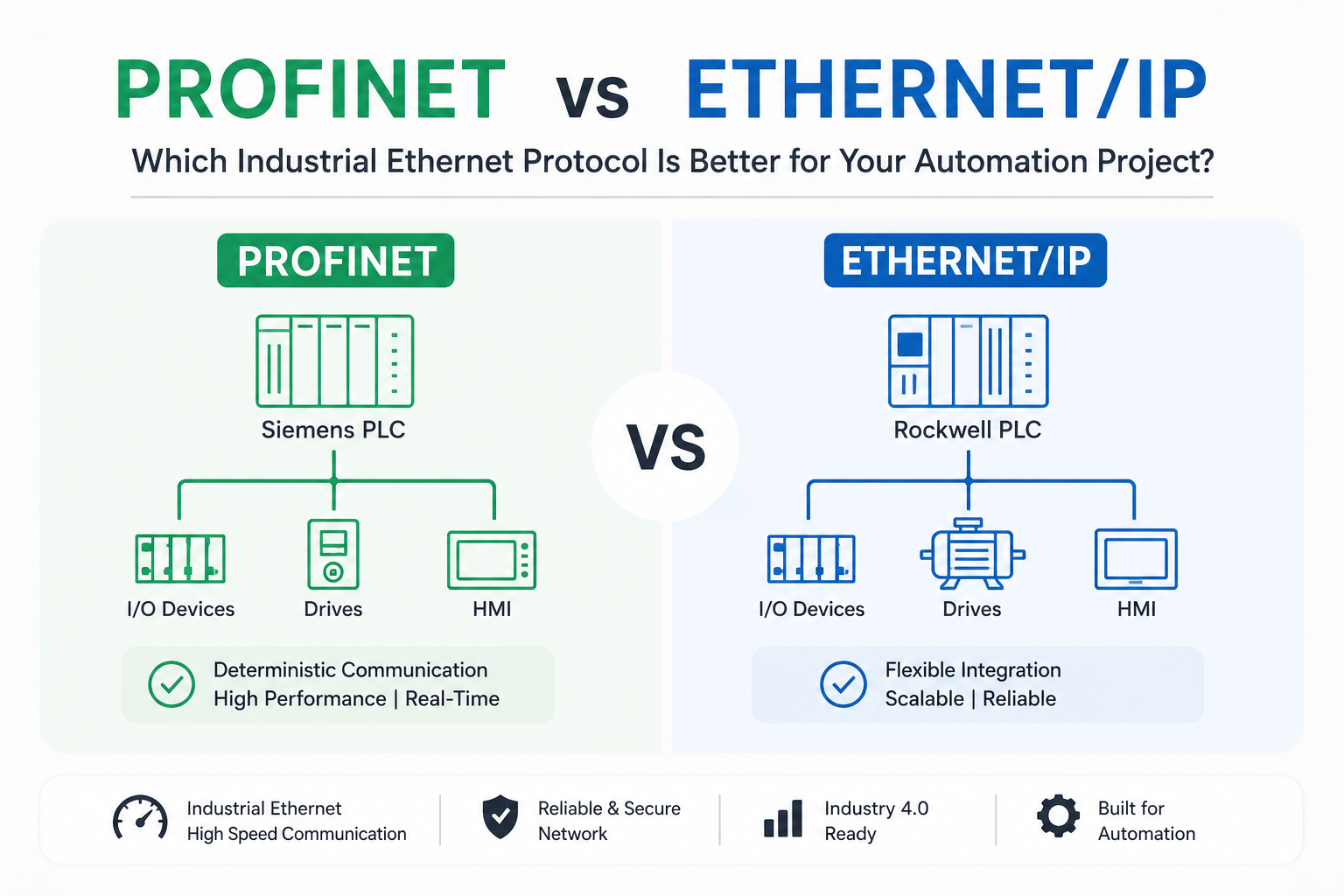
If your automation project mainly uses Siemens PLCs and requires deterministic, high-speed real-time communication, PROFINET is usually the better choice.
If your plant primarily uses Rockwell Automation PLCs and needs flexible integration with industrial devices, EtherNet/IP is generally the better option.
The best protocol depends on your PLC ecosystem, network architecture, motion control requirements, diagnostics, scalability, and future expansion plans.
What is PROFINET?
PROFINET is an Industrial Ethernet protocol developed by Siemens in conjunction with the PROFIBUS & PROFINET International (PI) organization. It was introduced in the early 2000s as an open standard designed to replace and expand upon the capabilities of its predecessor, PROFIBUS .
As an application-layer protocol residing at OSI Layer 7, PROFINET employs a unique multi-channel communication approach. For non-time-critical tasks like configuration and parameterization, it can utilize TCP/IP or UDP/IP. However, for time-critical tasks such as real-time (RT) and isochronous real-time (IRT) communication, it bypasses these layers and communicates directly through the Ethernet layer .
PROFINET supports three distinct communication levels:
- Non-real-time: Standard TCP/IP for configuration and diagnostics
- RT (Real-Time): Cycle times of approximately 1-10 ms for typical I/O control
- IRT (Isochronous Real-Time): Cycle times as low as 31.25 µs with jitter below 1 µs, enabling precise synchronized motion control
Devices on a PROFINET network are identified using device names rather than IP addresses, with IP addresses being automatically assigned. This approach is optimized for large Siemens-based systems and is widely used in automotive, food and beverage, packaging, and process industries across Europe and China .
What is EtherNet/IP?
EtherNet/IP (Ethernet Industrial Protocol) was developed by Rockwell Automation as a response to bringing Ethernet into the automation space. It is now managed by ODVA (Open DeviceNet Vendors Association) and was introduced around the same time as PROFINET in the early 2000s .
EtherNet/IP builds upon the Common Industrial Protocol (CIP), which is also used by DeviceNet and ControlNet. This provides seamless bridging and routing between these networks without requiring routing tables. The protocol combines three components: IEEE 802.3 physical and data link layer standards, the TCP/IP protocol suite, and the CIP application layer .
EtherNet/IP transmits two types of messages:
- Implicit messaging: Used for real-time I/O data transmission via UDP ports on a predetermined schedule
- Explicit messaging: Used for configuration, diagnostics, and non-real-time information exchange via TCP ports
A key differentiator of EtherNet/IP is that it uses pure TCP/UDP/IP and works with standard commercial or industrial-grade Ethernet switches. This makes it highly compatible with IT infrastructure, allowing IT staff to use their preferred management tools and components . EtherNet/IP devices are identified by IP addresses, making them easy to manage in standard IT environments.
PROFINET vs EtherNet/IP: At a Glance
| Feature | PROFINET | EtherNet/IP |
|---|---|---|
| Developer | Siemens / PI Organization | Rockwell Automation / ODVA |
| Year Introduced | 2002 (I/O control capability in V2.1) | 2001 |
| OSI Layer | Application (Layer 7) | Application (Layer 7) |
| Base Protocol | Ethernet (RT/IRT) | TCP/UDP/IP with CIP |
| Communication Model | IO Controller to IO Device | Scanner to Adapter |
| Real-Time Performance | RT: 1-10ms, IRT: <1ms to 31.25µs | Standard: ms cycle times |
| Synchronization | IRT: Sub-ms, <1µs jitter | CIP Sync (IEEE 1588): µs-ms |
| Motion Control | Superior with IRT | Capable with CIP Motion |
| Diagnostics | Comprehensive with GSDML | Good with EDS files |
| Topology Support | Star, Ring, Line, Tree | Star, Ring, Line, Tree |
| Redundancy | MRP (Media Redundancy Protocol) | DLR (Device Level Ring) |
| Vendor Ecosystem | Dominant with Siemens, strong in Europe/China | Dominant with Rockwell, strong in Americas |
| Typical Speed | 100 Mbps to 1 Gbps | 10/100 Mbps (auto-negotiated) |
| Configuration | TIA Portal, GSDML files | Studio 5000, EDS files |
| Device Identification | Device Names (IP auto-assigned) | IP Addresses |
| Hardware Requirements | May require IRT-capable switches for IRT mode | Standard Ethernet switches |
| IT Compatibility | More complex setup, proprietary elements for IRT | Fully compatible with IT infrastructure |
| Security Features | Supports IEC 62443 | Supports IEC 62443 |
| Scalability | High, optimized for large Siemens systems | High, thousands of devices |
| Cost | Higher for IRT-capable hardware | Lower for standard hardware |
| Best PLC Compatibility | Siemens S7-1200/1500 | Rockwell ControlLogix/CompactLogix |
| Typical Industries | Automotive, Food & Beverage, Packaging, Process | Automotive, Oil & Gas, Water Treatment, Manufacturing |
| Learning Curve | Steeper, more complex | Moderate, easier for IT professionals |
| Installation | Requires PROFINET-specific cabling | Standard Ethernet cabling |
| Network Management | More complex | Simpler, IT-friendly |
| Future Adoption | Strong in IIoT and Industry 4.0 | Strong in IIoT and Industry 4.0 |
Understanding Their Communication Architecture
How PROFINET Works
PROFINET uses a traditional master/slave architecture but with modern Ethernet technology:
text
PLC (IO Controller)
         │
         │ Industrial Ethernet
         │
    ┌────┴────┐
    │         │
    ▼         ▼
IO Device  IO Device
(Sensor)  (Actuator)
In this model, the IO Controller (typically a PLC) manages the communication cycle and exchanges data with IO Devices (sensors, actuators, drives) over standard Industrial Ethernet. The communication can be cyclic (real-time I/O data) or acyclic (configuration and diagnostics) .
PROFINET inserts I/O data between standard Ethernet frames, with virtual LAN (VLAN) priorities managing the sequence. The minimal overhead results in low jitter and highly deterministic communication .
How EtherNet/IP Works
EtherNet/IP uses a scanner/adapter model:
text
PLC (Scanner)
    │
    │ Ethernet (TCP/UDP/IP)
    │
┌───┴───┐
│       │
▼       ▼
Adapter Adapter
(Device) (Device)
The Scanner (typically a PLC) initiates all communication. Adapters (devices) respond to requests but cannot initiate communication independently . This architecture works well for Rockwell’s PLC-centric control philosophy but limits peer-to-peer device communication .
EtherNet/IP uses standard Ethernet frames and relies on TCP/IP and UDP/IP for data transmission. This means data is packaged and unpackaged through multiple layers, adding header information and overhead at each stage .
How PROFINET and EtherNet/IP Transfer Data
PROFINET Data Transfer
PROFINET employs cyclic and acyclic communication:
- Cyclic communication: Real-time I/O data is exchanged continuously at defined intervals. For RT mode, this is typically 1-10ms; for IRT mode, it can be as low as 31.25µs . This is essential for time-critical applications like motion control.
- Acyclic communication: Configuration, parameterization, and diagnostic data are exchanged on demand. This ensures that devices can be configured and monitored without interfering with the real-time data stream.
Real factory example: In an automotive body shop, PROFINET handles hundreds of welding robots. The IRT mode ensures all robots receive synchronized position commands with sub-millisecond precision, enabling precise welding seams despite the robots operating at high speeds.
EtherNet/IP Data Transfer
EtherNet/IP uses implicit and explicit messaging:
- Implicit messaging: This is the I/O data transmission, sent via UDP on a predetermined schedule. It is “implicit” because the meaning of the data is predefined and does not need to be specified in each message . It is used for real-time control data.
- Explicit messaging: This handles non-real-time data like configuration, diagnostics, and information exchange. These messages are sent via TCP and respond to specific requests, including the meaning of the data in each message .
Real factory example: In a bottling plant, EtherNet/IP connects the Rockwell PLC to hundreds of sensors on a filling line. Implicit messages handle the fast I/O data from proximity sensors and valve actuators, while explicit messages are used for configuration and diagnostics of the sensors during maintenance.
Real-Time Performance Comparison
Latency and Cycle Time
PROFINET RT typically achieves cycle times of 1-10ms, while PROFINET IRT can reach cycle times below 1ms, with some implementations achieving 31.25µs cycles . This provides extremely low latency, making PROFINET suitable for high-speed applications.
EtherNet/IP typically operates at cycle times in the millisecond range. While this is sufficient for many general automation applications, it cannot match PROFINET IRT for ultra-fast, deterministic motion control .
Deterministic Communication
PROFINET achieves determinism through its real-time channels and especially its IRT mode, where communication is scheduled to ensure data arrives precisely when expected. This creates a predictable and consistent data transmission, critical for synchronized motion control.
EtherNet/IP, while being deterministic to a degree, relies on standard TCP/UDP/IP, which introduces variability in transmission times. The integration with standard IT networks means that network traffic can impact determinism .
Jitter
PROFINET IRT boasts sub-microsecond jitter (<1µs), making it ideal for applications requiring precise synchronization like multi-axis robotics and high-speed printing .
EtherNet/IP’s jitter is significantly higher, measured in microseconds to milliseconds . This is due to the use of standard Ethernet and TCP/IP stacks, which cannot guarantee the same timing precision.
Industrial example: For a high-speed packaging machine running at 400 packages per minute, PROFINET IRT ensures that each cut, seal, and label operation occurs with microsecond accuracy. EtherNet/IP would be less suitable for such precise timing, as even a few milliseconds of jitter could result in misaligned packaging.
Motion Control Comparison
PROFINET IRT
PROFINET IRT (Isochronous Real-Time) is specifically designed for demanding motion control applications . It uses a precise schedule managed by IRT-capable switches to ensure deterministic data transmission. This enables:
- Precise synchronization of servo motors
- Coordinated multi-axis robotics
- High-speed packaging and printing machines
- Cycle times as low as 31.25µs with jitter below 1µs
Practical application: In a printing press, PROFINET IRT coordinates the rollers, ink jets, and cutting mechanisms with microsecond precision, ensuring that the printed image is sharp and the cuts are accurate, even at high speeds.
EtherNet/IP CIP Motion
EtherNet/IP utilizes CIP Motion and CIP Sync (based on IEEE 1588) for motion control . This provides synchronization capabilities but is less precise than PROFINET IRT. CIP Motion works well for:
- Simpler motion applications
- Applications where sub-millisecond precision is not critical
- Coordinated motion in packaging and material handling
Practical application: In a material handling conveyor system, EtherNet/IP CIP Motion coordinates multiple motors to ensure packages move smoothly from one conveyor to another. The timing requirements are less demanding than a printing press, and the system’s ability to integrate with standard Ethernet is beneficial.
Deterministic Communication Explained
Imagine a busy intersection without traffic lights. Cars arrive randomly, and there is no guarantee when any vehicle will get through. This is a non-deterministic network—like standard Ethernet in an office environment. Data packets arrive at unpredictable times, which is fine for emails but problematic for industrial control.
Now imagine a traffic light that cycles with perfect precision. Every car knows exactly when it will have the green light. This is a deterministic network—like PROFINET IRT. Data arrives at precisely scheduled times, enabling real-time control.
Industrial automation requires determinism because sensors and actuators must operate in perfect coordination. If a sensor’s data arrives a few milliseconds late, a robot could be commanded to move to the wrong position, causing a collision or product defect.
PROFINET, especially in IRT mode, provides this traffic-light-like precision . EtherNet/IP, while deterministic enough for many applications, operates more like a well-managed but less precisely timed intersection, making it suitable for general automation but not for high-speed, synchronized applications.
Network Topology Comparison
PROFINET
PROFINET supports a wide range of topologies:
- Star: The most common topology, using switches to connect devices in a star pattern. PROFINET can use standard industrial switches for RT mode but requires specialized IRT-capable switches for IRT mode .
- Ring: PROFINET supports Media Redundancy Protocol (MRP), which provides fast recovery (<200ms) if a cable fails . Ring topologies are commonly used in critical manufacturing lines where downtime must be minimized.
- Line: PROFINET supports daisy-chaining devices in a line, which is useful for conveyor systems and other linear applications.
- Tree: A combination of star and line topologies, creating a tree structure.
PROFINET’s flexibility in topology makes it suitable for a wide range of applications, from small machines to large, distributed plants .
EtherNet/IP
EtherNet/IP similarly supports multiple topologies:
- Star: The most common topology, using standard Ethernet switches . EtherNet/IP’s ability to work with off-the-shelf networking gear makes star topologies easy to implement.
- Ring: EtherNet/IP supports Device Level Ring (DLR), which provides redundancy. If a cable fails, the ring heals in milliseconds.
- Line: Support for daisy-chained devices.
- Tree: A combination of topologies.
EtherNet/IP’s primary advantage is that it can use standard Ethernet switches for any topology, reducing hardware costs and simplifying network design .
Comparison: For a high-speed production line where downtime is catastrophic, PROFINET with MRP provides a robust, redundant ring topology. For a factory with many distributed sensors and a need for IT compatibility, EtherNet/IP’s ability to use standard switches in a star topology is advantageous.
Diagnostics and Troubleshooting
PROFINET
PROFINET offers comprehensive diagnostic capabilities:
- Fault detection: PROFINET can detect cable breaks, device failures, and communication errors.
- Device replacement: When a device fails, PROFINET supports automatic device replacement. The new device receives its configuration automatically, reducing downtime .
- Alarm handling: PROFINET provides a detailed alarm system that reports the exact nature and location of faults.
- Maintenance: PROFINET supports predictive diagnostics, allowing maintenance teams to address issues before they cause failures.
- Diagnostic tools: The GSDML (General Station Description Markup Language) file contains all the information about a device, enabling detailed diagnostics .
Practical scenario: In a large Siemens-based automotive plant, when a weld controller fails, the maintenance team is notified through the TIA Portal. The diagnostic system identifies the exact module, and the technician can replace it. The new device is automatically configured because the controller has its GSDML file, and production resumes within minutes.
EtherNet/IP
EtherNet/IP provides good diagnostic capabilities:
- Fault detection: Standard diagnostics for device and network failures.
- Device replacement: EDS (Electronic Data Sheet) files contain device information, but the replacement process can be more manual than PROFINET.
- Alarm handling: Diagnostic information is available through explicit messaging.
- Maintenance: Supports basic predictive diagnostics.
- Diagnostic tools: EDS files provide device information, and standard network monitoring tools can be used because the protocol uses standard IP.
Practical scenario: In a Rockwell-based bottling plant, if a sensor fails, the Studio 5000 software reports the fault. The technician can use the device’s EDS file to configure a replacement, but this might require more manual configuration steps compared to PROFINET.
Expert insight: PROFINET is often considered to have superior diagnostics and easier device replacement due to its GSDML-based system. EtherNet/IP’s reliance on standard IT tools, however, means that IT staff are more comfortable with its diagnostics and network management .
Configuration and Engineering
PROFINET
PROFINET uses TIA Portal (Totally Integrated Automation Portal) as its primary engineering platform, especially with Siemens PLCs. Configuration involves:
- Hardware configuration: Adding devices to the project, specifying the network topology, and assigning device names .
- GSDML files: Device-specific files that describe the device’s capabilities, data structure, and communication parameters.
- Programming: Ladder logic, Structured Text, or other IEC 61131-3 languages.
- Commissioning: Downloading the configuration, assigning device names, and testing.
PROFINET configuration can be more complex due to its rich feature set, but the TIA Portal provides a comprehensive environment .
EtherNet/IP
EtherNet/IP uses Studio 5000 (formerly RSLogix 5000) as its primary engineering platform with Rockwell PLCs. Configuration involves:
- Hardware configuration: Adding devices to the I/O configuration tree.
- EDS files: Device-specific files that are similar to PROFINET’s GSDML files .
- Programming: Ladder logic, Function Block, or Structured Text.
- Commissioning: Downloading the configuration, setting IP addresses, and testing.
EtherNet/IP configuration is generally considered simpler and more intuitive, especially for engineers familiar with Rockwell’s software .
Cybersecurity Comparison
Both protocols support industrial security practices in line with IEC 62443 .
PROFINET
PROFINET supports:
- Authentication: Device authentication to prevent unauthorized access.
- Segmentation: VLANs to segment network traffic.
- Firewalls: Support for industrial firewalls to protect the network.
- Network isolation: Physical and logical isolation of critical systems.
- Remote access: Secure remote access capabilities.
- Zero Trust: Support for Zero Trust security models.
EtherNet/IP
EtherNet/IP supports:
- Authentication: Device authentication, leveraging standard IP security tools.
- Segmentation: VLANs and network segmentation.
- Firewalls: Compatibility with standard IT firewalls.
- Network isolation: Support for network isolation.
- Remote access: Secure remote access.
- Zero Trust: Support for Zero Trust models, with easier integration of standard IT security tools.
Expert observation: Because EtherNet/IP uses standard TCP/IP, it can leverage more standard IT security tools, which can be an advantage in plants where IT and OT converge. However, this also means it is subject to the same vulnerabilities as any IP network, requiring strong security measures .
Scalability
PROFINET
PROFINET is designed for high scalability:
- Small machines: Works well for small, single-machine applications.
- Medium factories: Can handle dozens of controllers and thousands of I/O points.
- Large manufacturing plants: Suitable for large-scale plants with thousands of devices and complex topologies .
- IIoT and Industry 4.0: Supports integration with IoT and cloud systems for data analytics and remote monitoring.
- Smart factories: Built for the digital transformation requirements of Industry 4.0.
Example: A large German automotive manufacturer uses PROFINET across its entire production network, connecting thousands of robots, conveyors, and sensors to a central control system.
EtherNet/IP
EtherNet/IP is also highly scalable:
- Small machines: Works well for standalone machines.
- Medium factories: Supports moderate-sized systems.
- Large manufacturing plants: Can handle thousands of devices .
- IIoT and Industry 4.0: Good integration with IT and cloud systems.
- Smart factories: Suitable for digital transformation.
Example: A North American consumer goods manufacturer uses EtherNet/IP across its plants, leveraging the protocol’s IT compatibility to integrate with enterprise systems and cloud platforms.
Real-World Applications
Where PROFINET is Mostly Used
PROFINET dominates in Siemens-centric environments and is particularly strong in:
- Automotive: Body shops, assembly lines, and paint shops. PROFINET IRT’s precision is critical for welding robots and synchronized conveyor systems.
- Food and Beverage: Processing and packaging lines where hygiene and speed are key.
- Packaging: High-speed packaging machines requiring precise timing.
- Process plants: Chemical, pharmaceutical, and other process industries requiring robust communication .
- Siemens factories: Any plant using Siemens PLCs, HMIs, and drives.
Geographic prevalence: PROFINET is most popular in Europe and China, where Siemens has a strong market presence .
Where EtherNet/IP is Mostly Used
EtherNet/IP is dominant in Rockwell Automation environments and is commonly found in:
- Automotive: Assembly and powertrain lines, especially in North American plants.
- Oil & Gas: Refineries, pipelines, and offshore platforms.
- Water treatment: Municipal and industrial water and wastewater treatment plants.
- Manufacturing: General manufacturing, especially in plants using Rockwell PLCs .
Geographic prevalence: EtherNet/IP is most popular in the Americas, where Rockwell has a strong presence .
Advantages of PROFINET
- Superior real-time performance: PROFINET IRT offers cycle times as low as 31.25µs and sub-microsecond jitter, ideal for demanding motion control .
- Excellent for high-speed applications: Supports up to 1 Gbps data rates .
- Advanced motion control: IRT provides the most precise synchronization for multi-axis robots and high-speed machinery.
- Comprehensive diagnostics: GSDML files and detailed alarm systems enable easy troubleshooting and device replacement.
- Scalability: Suitable for small machines to large, distributed plants.
- Flexible topology: Supports star, ring, line, and tree topologies, with MRP for redundancy .
- Strong in Industry 4.0: Designed for smart factory integration and IIoT.
- Vast device ecosystem: Supported by numerous vendors, with a wide range of devices available.
- Automatic device replacement: New devices can be automatically configured, reducing downtime.
- Strong Siemens integration: Seamless integration with Siemens TIA Portal and PLCs.
Disadvantages of PROFINET
- More complex: The protocol’s rich feature set makes it more complex to implement and configure .
- Hardware requirements: IRT mode requires specialized, IRT-capable switches .
- Higher cost: IRT-capable hardware and PROFINET-specific cabling can increase costs.
- Steeper learning curve: Engineers need more training to master PROFINET .
- Less IT-friendly: The protocol’s proprietary elements make it less compatible with standard IT tools .
- Ecosystem lock-in: Strong ties to Siemens and the PI organization can create vendor lock-in.
- Requires specific cabling: PROFINET has specific cabling requirements .
- North American adoption: Less common than EtherNet/IP in the Americas .
Advantages of EtherNet/IP
- IT-friendly: Uses standard TCP/IP and Ethernet, making it easy to integrate with IT infrastructure .
- Simpler configuration: Easier to set up and configure, especially for engineers familiar with standard IP networks .
- Lower hardware costs: Works with standard Ethernet switches, no proprietary hardware needed .
- Vast device ecosystem: Supported by numerous vendors, with a huge range of devices.
- Flexible integration: Seamless bridging and routing between DeviceNet, ControlNet, and EtherNet/IP.
- Strong Rockwell integration: Excellent integration with Rockwell Studio 5000 and PLCs.
- Good for general automation: Sufficient for most factory automation and process control applications.
- Lower learning curve: Easier to learn, especially for IT professionals moving into OT .
- Geographic dominance: Widely adopted in the Americas, making it easier to find skilled engineers in that region.
- Standard IP tools: Can use standard network management and security tools.
Disadvantages of EtherNet/IP
- Limited real-time performance: Not suitable for ultra-fast motion control or high-speed applications .
- Less precise motion control: CIP Sync is less precise than PROFINET IRT .
- No peer-to-peer communication: Devices cannot initiate communication; all communication is scanner/adapter .
- Higher jitter: Less deterministic than PROFINET IRT .
- European adoption: Less common than PROFINET in Europe and China.
- Vendor lock-in: Strong ties to Rockwell and the ODVA ecosystem .
- Diagnostics: Device replacement and diagnostics can be more manual than PROFINET.
- Security: As a standard IP protocol, it is subject to the same vulnerabilities as any IP network.
PROFINET vs EtherNet/IP: Detailed Technical Comparison
| Parameter | PROFINET | EtherNet/IP |
|---|---|---|
| OSI Model Layer | Application (Layer 7) | Application (Layer 7) |
| MAC Layer | IEEE 802.3 | IEEE 802.3 |
| Transport Protocol | TCP/UDP/IP for non-real-time, direct Ethernet for RT/IRT | TCP/UDP/IP |
| Bandwidth | 100 Mbps to 1 Gbps | 10/100 Mbps (auto-negotiated) |
| Frame | Standard Ethernet with VLAN priority | Standard Ethernet |
| Minimum Cycle Time (RT/Standard) | 1-10 ms | 1-10 ms |
| Minimum Cycle Time (IRT) | 31.25 µs | N/A |
| Jitter (IRT) | <1 µs | µs-ms |
| Motion Control | IRT for precise, synchronized motion | CIP Motion/CIP Sync (IEEE 1588) |
| Safety | PROFIsafe | CIP Safety |
| Redundancy | MRP (Media Redundancy Protocol) | DLR (Device Level Ring) |
| Synchronization | IEEE 1588 (in IRT), sub-ms | CIP Sync (IEEE 1588), µs-ms |
| Configuration Files | GSDML | EDS |
| Diagnostics | Comprehensive, with detailed alarms | Good, with standard IT tools |
| Vendor Support | Strong, especially Siemens | Strong, especially Rockwell |
| Device Ecosystem | Very large, especially in Europe/China | Very large, especially in Americas |
| PLC Compatibility | Best with Siemens S7-1200/1500 | Best with Rockwell ControlLogix/CompactLogix |
| Future Proofing | Strong in IIoT, Industry 4.0 | Strong in IIoT, Industry 4.0 |
| Industry Adoption | Strong in Europe, China | Strong in Americas |
| IIoT Readiness | Yes, with OPC UA integration | Yes, with standard IP |
| Maintenance | Easier with GSDML and automatic replacement | More manual configuration |
| Cybersecurity | Good, supports IEC 62443 | Good, supports IEC 62443 |
| Licensing | Open standard but vendor-specific for IRT | Open standard |
| Complexity | More complex | Simpler |
| Learning Curve | Steeper | More moderate |
| Performance | Superior for high-speed, motion control | Sufficient for general automation |
| Best Use Case | High-speed motion, robotics, automotive | General factory automation, process control, mixed systems |
Which One Should You Choose?
Choose PROFINET If:
- Your plant uses Siemens PLCs (S7-1200/1500) as the primary controllers .
- You require high-speed motion control, such as multi-axis robotics, high-speed packaging, or printing machines .
- You need sub-millisecond cycle times with precise synchronization .
- Your application is in automotive, food and beverage, or packaging, where PROFINET is widely adopted .
- You are in Europe or China, where PROFINET has strong market presence .
- You need advanced diagnostics and automatic device replacement .
Choose EtherNet/IP If:
- Your plant uses Rockwell Automation PLCs (ControlLogix/CompactLogix) .
- You require flexible integration with a wide range of industrial devices .
- Your application is in general factory automation or process control, where extreme determinism is not critical .
- You are in the Americas, where EtherNet/IP is more dominant .
- You value IT compatibility and want to use standard Ethernet switches and network management tools .
- You have a mixed-vendor environment where standard IP communication is beneficial .
Common Mistakes Engineers Make
- Choosing based on popularity: Selecting a protocol just because it’s “popular” without considering your specific PLC ecosystem and application requirements. The best protocol is the one that fits your environment, not the one with the most Google results.
- Ignoring PLC compatibility: Assuming a Siemens PLC can seamlessly communicate with an EtherNet/IP network or a Rockwell PLC with PROFINET. While gateways exist, they add complexity and cost .
- Ignoring topology: Not considering the network topology and redundancy requirements. Choosing a protocol without assessing the need for ring topologies, MRP, or DLR can lead to unexpected downtime .
- Ignoring diagnostics: Overlooking the diagnostic capabilities of each protocol. PROFINET’s advanced diagnostics can save hours of troubleshooting, while EtherNet/IP’s integration with standard IT tools may be more familiar to some teams .
- Ignoring maintenance: Not considering the long-term maintenance requirements. PROFINET’s automatic device replacement simplifies maintenance, while EtherNet/IP’s configuration may be more manual.
- Ignoring future expansion: Selecting a protocol without considering future plant expansion, IIoT integration, and smart factory goals.
- Ignoring vendor ecosystem: Not evaluating the available devices and support from different vendors. A protocol may be technically superior but lack the specific device you need .
Expert Tips Before Selecting an Industrial Ethernet Protocol
- Assess your PLC ecosystem: Your primary PLC brand is the biggest factor. Siemens = PROFINET, Rockwell = EtherNet/IP .
- Define your real-time requirements: If you need sub-millisecond performance, PROFINET IRT is the clear choice. For standard automation, EtherNet/IP may be sufficient .
- Evaluate your motion control needs: For high-speed motion applications, choose PROFINET IRT. For simpler motion, EtherNet/IP CIP Motion may work .
- Consider your network topology: If you need a ring topology with fast recovery, both support it (MRP for PROFINET, DLR for EtherNet/IP) .
- Evaluate diagnostic requirements: For easier troubleshooting, PROFINET’s GSDML and detailed alarms are superior. For IT-friendly diagnostics, EtherNet/IP may be better .
- Plan for maintenance: Consider automatic device replacement and the ease of adding new devices to the network.
- Think about future expansion: Consider IIoT and Industry 4.0 integration. Both protocols support smart factory goals, but your IT team might prefer EtherNet/IP’s standard IP compatibility .
- Check device availability: Ensure the specific sensors, actuators, and drives you need are available for your chosen protocol.
- Evaluate your team’s skills: If your team is experienced with Rockwell/Studio 5000, EtherNet/IP might be easier to adopt. If they are Siemens/TIA Portal experts, PROFINET is more natural .
- Consider geographic factors: PROFINET is more common in Europe and China, while EtherNet/IP dominates in the Americas . This affects the availability of skilled engineers and local support.
- Assess security requirements: Both protocols support IEC 62443 security practices . EtherNet/IP may integrate more easily with standard IT security tools .
- Don’t forget costs: While both are open standards, PROFINET IRT may require more expensive switches, and PROFINET-specific cabling may increase installation costs .
Final Verdict
Neither PROFINET nor EtherNet/IP is universally “better” than the other. The best protocol depends entirely on your specific application, environment, and requirements.
For most Siemens-based automation systems that require fast, deterministic communication, PROFINET is usually the stronger option. Its IRT mode provides unmatched performance for high-speed motion control, and its diagnostic capabilities simplify maintenance. If your plant is in Europe or China and you have a Siemens ecosystem, PROFINET is the natural choice.
For Rockwell Automation environments or plants built around the Common Industrial Protocol (CIP) ecosystem, EtherNet/IP is often the better fit. Its IT-friendly design and use of standard Ethernet components reduce costs and simplify integration. If your plant is in the Americas and you use Rockwell PLCs, EtherNet/IP is the logical choice.
Before making a final decision, evaluate your PLC platform, existing devices, real-time performance requirements, maintenance strategy, and long-term expansion plans. If you are starting a new project, the choice is often already made by your primary PLC vendor. If you are integrating existing equipment, you may need to use both protocols and implement gateways.
Ultimately, both protocols are capable, well-supported, and will continue to evolve with the demands of Industry 4.0 and the Industrial Internet of Things. Your job is to choose the one that best aligns with your organization’s ecosystem, skill set, and application needs.
Ready to Transform Your Industrial Automation?
Choosing the right protocol is just the first step implementing it effectively is where the real value lies. At AutomateXLab, we specialize in helping businesses like yours navigate the complexities of industrial automation.
Why Work With AutomateXLab?
- PLC Programming Expertise: From Siemens to Rockwell, we speak your protocol’s language
- SCADA & HMI Design: Intuitive interfaces that make monitoring and control effortless
- Industry 4.0 Ready: IIoT integration, digital transformation, and smart factory solutions
- Global Service Delivery: Remote consultation and on-site support available worldwide
- Trusted by Industry Leaders: We’ve delivered solutions for companies like Kawasaki and Tata
We Serve Industries Like Yours
- Automotive & Transportation
- Food & Beverage
- Oil & Energy
- Utilities & Manufacturing
- Consumer Products & Logistics
Let’s Build Your Future-Ready Factory
Whether you’re modernizing legacy systems, implementing PROFINET or EtherNet/IP for the first time, or scaling up for Industry 4.0 our team is ready to help.
Frequently Asked Questions
Is PROFINET faster than EtherNet/IP?
Yes, PROFINET is generally faster than EtherNet/IP, especially in IRT mode. PROFINET IRT can achieve cycle times as low as 31.25µs with sub-microsecond jitter, while EtherNet/IP typically operates in the millisecond range . For standard RT mode, both have similar 1-10ms cycle times .
Which protocol is more deterministic?
PROFINET, especially in IRT mode, is more deterministic. It provides guaranteed communication timing with sub-microsecond jitter, making it suitable for precise motion control. EtherNet/IP uses standard TCP/IP, which introduces variability in transmission times .
Can Siemens PLC communicate with EtherNet/IP?
Not natively. Siemens PLCs are designed for PROFINET. However, you can use a gateway or a protocol converter to allow a Siemens PLC to communicate with an EtherNet/IP network. This adds complexity and cost .
Which protocol is better for robotics?
PROFINET IRT is generally better for robotics, especially for multi-axis robots that require precise synchronization. PROFINET’s sub-millisecond cycle times and low jitter are critical for coordinated robotic motion. EtherNet/IP may be sufficient for simpler robotic applications .
Is EtherNet/IP an Ethernet protocol?
Yes, EtherNet/IP is a true Industrial Ethernet protocol. It uses standard Ethernet and TCP/IP, combined with the CIP (Common Industrial Protocol) application layer. This allows it to use standard Ethernet hardware and IT tools .
Which protocol supports Industry 4.0 better?
Both protocols support Industry 4.0 and IIoT. PROFINET has stronger integration with Siemens’ digital twin and smart factory offerings, while EtherNet/IP’s IT compatibility may make it easier to integrate with enterprise and cloud systems. The “better” protocol depends on your specific digital transformation strategy .
Which protocol is easier to troubleshoot?
PROFINET is often considered easier to troubleshoot due to its comprehensive diagnostic capabilities and GSDML-based device information. EtherNet/IP can leverage standard IT tools for network diagnosis, but device-specific diagnostics may be more manual .
Which protocol has better diagnostics?
PROFINET has more advanced diagnostics with detailed alarm handling and automatic device replacement. EtherNet/IP provides good diagnostics but may require more manual configuration during device replacement .
Can both protocols exist in one factory?
Yes, it is very common to have both PROFINET and EtherNet/IP in the same factory. Many plants use Siemens controllers for some lines and Rockwell for others. Gateways and protocol converters can enable communication between these networks .
Which protocol is more future-proof?
Both protocols are future-proof and will continue to evolve. PROFINET is heavily invested in Industry 4.0, while EtherNet/IP benefits from the continuous evolution of standard Ethernet. Your choice should be guided by your primary PLC vendor and application requirements rather than future-proofing concerns .