
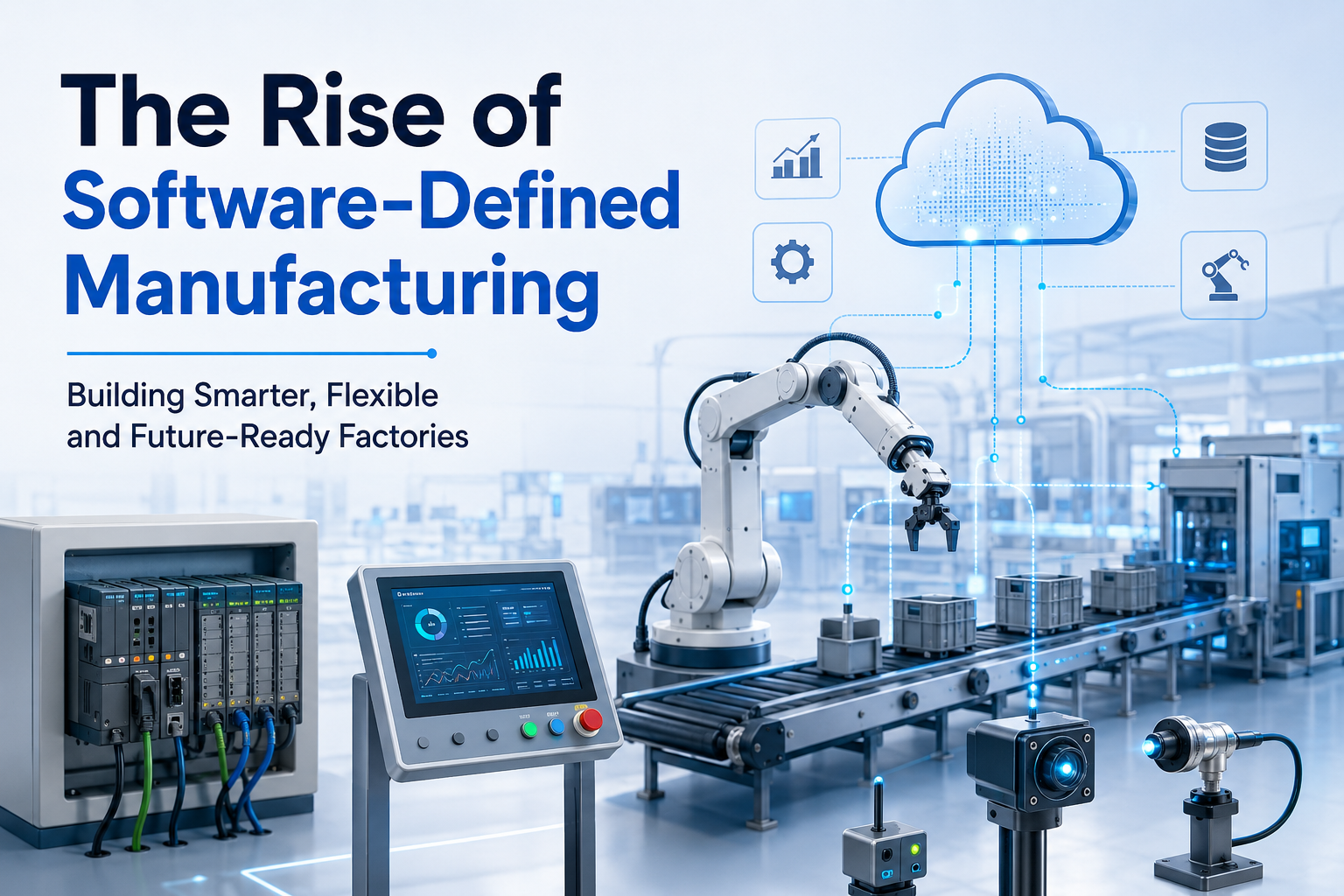
Software-defined manufacturing is reshaping how factories operate, produce, and adapt. As industrial demands shift faster than hardware can keep up, manufacturers are turning to software to run the show.
What Is Software-Defined Manufacturing?
Software-defined manufacturing is an approach where software controls, configures, and optimizes production systems rather than fixed, hardwired hardware logic. Instead of reprogramming machines physically or replacing components to change how a factory operates, engineers update software to modify production behavior.
The term borrows from “software-defined networking,” where IT infrastructure became programmable and flexible. The same principle now applies to factory floors.
Traditional manufacturing relied on dedicated machines built for specific tasks. Software-defined manufacturing treats production systems as programmable platforms that can be reconfigured through code, data, and digital instructions.
A simple example: instead of rewiring a PLC panel to change a production sequence, an engineer updates the control logic remotely through a software interface. The machines stay the same. The behavior changes instantly.
What Does “Software-Defined” Actually Mean in a Factory?
The phrase “software-defined” means software governs behavior that hardware once locked in place.
Separation of hardware and software means the physical machine and its operating logic are decoupled. A robot arm does not need to be rebuilt to perform a different task. Its instructions change through software.
Centralized control means one software platform manages multiple machines, lines, or even entire facilities from a single interface.
Virtualization means control logic, simulations, and even some PLC functions can run on industrial computers or in the cloud rather than on dedicated physical controllers.
Configurable production means production parameters, sequences, and workflows can be adjusted without physical intervention.
Software-first automation means new capabilities are added through updates, integrations, and data models rather than hardware upgrades.
Why Manufacturing Is Moving Toward Software-Defined Systems
Several pressures are pushing manufacturers in this direction.
Demand for flexible production is rising. Consumers want more product variants, shorter lead times, and faster delivery. Hardware-locked factories struggle to keep pace.
Faster product changes are required in industries like electronics and consumer goods. A product lifecycle that once lasted five years now lasts eighteen months. Factories need to retool quickly without massive capital investment.
Labor shortages are driving automation investments. Software-defined systems allow fewer operators to manage more complex production with better visibility and less manual intervention.
Digital transformation is now a board-level priority in most manufacturing companies. Connecting machines, data, and business systems is the core of that transformation.
Data-driven decision making is replacing intuition on the plant floor. Software gives manufacturers access to real-time performance data that helps them reduce waste and optimize output.
Industry 4.0 adoption is accelerating. Software-defined manufacturing is the practical implementation layer of Industry 4.0 concepts.
Traditional Manufacturing vs Software-Defined Manufacturing
| Factor | Traditional Manufacturing | Software-Defined Manufacturing |
|---|---|---|
| Machine control | Hardwired logic | Software-configurable |
| Hardware dependency | High | Low to moderate |
| Flexibility | Limited | High |
| Software updates | Not applicable | Remote and frequent |
| Maintenance | Reactive | Predictive |
| Scalability | Costly and slow | Modular and fast |
| Downtime | Unplanned | Minimized through monitoring |
| Cost of changes | High (hardware-based) | Lower (software-based) |
| Remote access | Rare | Standard |
| Analytics | Manual or absent | Built-in and automated |
The contrast is stark. Traditional manufacturing builds rigidity into every layer. Software-defined manufacturing builds adaptability in from the start.
Core Technologies Behind Software-Defined Manufacturing
Software-defined manufacturing is not a single product. It is an architecture built from several technologies working together.
PLCs (Programmable Logic Controllers) remain the backbone of machine-level control. Modern PLCs run IEC 61131-3 compliant code and support remote updates, making them compatible with software-defined approaches.
Industrial PCs run more complex control and data processing tasks that traditional PLCs cannot handle alone. They bridge the gap between machine control and higher-level software systems.
SCADA (Supervisory Control and Data Acquisition) provides centralized monitoring and control across machines, lines, and sites. It gives operators a real-time view of production.
HMI (Human-Machine Interface) gives operators touchscreen or display-based interfaces to interact with machines and production systems.
Edge Computing processes data at or near the machine rather than sending everything to the cloud. This reduces latency and keeps critical control functions local.
Industrial IoT (IIoT) connects sensors, actuators, and machines to networks and software platforms. It is the data collection layer of software-defined manufacturing.
OPC UA (Open Platform Communications Unified Architecture) is the communication standard that allows different machines, brands, and software platforms to exchange data securely and reliably.
MES (Manufacturing Execution Systems) manage production scheduling, work orders, quality tracking, and inventory in real time between the shop floor and the business layer.
Cloud Platforms host data storage, analytics engines, and some control functions. They enable multi-site visibility and centralized software management.
AI and Machine Learning analyze production data to find patterns, predict failures, and optimize processes automatically.
Digital Twins are virtual replicas of machines or entire production lines. Engineers use them to simulate changes before applying them to real equipment.
Architecture of a Software-Defined Factory
Understanding how a software-defined factory is structured helps clarify how all these technologies connect.
Cloud Layer
     ↓
MES (Manufacturing Execution System)
     ↓
SCADA (Supervisory Control)
     ↓
PLC / Edge Devices
     ↓
Robots / Automated Equipment
     ↓
Machines
     ↓
Sensors
Cloud layer stores historical data, runs analytics, and connects enterprise systems like ERP to production data.
MES layer translates business orders into production instructions and tracks output in real time.
SCADA layer monitors and controls operations across the facility. It collects data from PLCs and displays it for operators and engineers.
PLC and edge layer handles real-time machine control with the low latency that production requires. Edge devices also preprocess sensor data before sending it upstream.
Robots and equipment are the physical actuators executing commands from the control layer.
Machines perform the actual manufacturing operations, from cutting and welding to filling and packaging.
Sensors generate the raw data that feeds the entire system. Temperature, pressure, speed, vibration, and position sensors create a continuous data stream.
How Software Controls Modern Manufacturing
Here is a step-by-step view of how a software-defined production workflow operates.
Sensors collect data continuously from machines, conveyors, and production equipment. Every cycle, pressure reading, and temperature value is captured.
PLCs process signals in milliseconds. They execute control logic, trigger actuators, and maintain machine-level operations in real time.
SCADA visualizes operations by aggregating data from all PLCs and presenting it on dashboards. Operators can see the entire plant from one screen.
MES schedules production by receiving orders from business systems and translating them into specific machine instructions and production sequences.
AI analyzes trends across historical and real-time data. It identifies patterns that indicate potential failures or opportunities for optimization.
Software optimizes machines by adjusting parameters like speed, temperature, and timing based on AI recommendations or automated control rules.
Dashboards update in real time so operators, engineers, and managers always see current production status without walking the floor.
Key Characteristics of Software-Defined Manufacturing
These features define a software-defined manufacturing environment.
- Centralized management of machines and lines from a single platform
- Remote monitoring and control from any location
- Software updates applied without physical intervention
- Modular automation where new capabilities are added as software modules
- API integrations connecting machines to ERP, CRM, and supply chain systems
- Real-time analytics embedded into production workflows
- Predictive maintenance replacing time-based or reactive maintenance schedules
- Configuration changes instead of physical rewiring
- Scalability across machines, lines, sites, and geographies
- Digital workflows replacing paper-based processes
Major Benefits of Software-Defined Manufacturing
Increased flexibility is the most significant benefit. Factories can switch products, adjust volumes, and respond to market shifts without major capital investment.
Faster production changes reduce the time between product design and production start. Software configuration replaces physical retooling.
Reduced downtime comes from predictive maintenance and remote diagnostics. Problems are identified and addressed before machines stop.
Better quality control is achieved through continuous monitoring and automated adjustments. Defect rates drop when software maintains tighter process tolerances.
Lower maintenance costs result from moving away from reactive maintenance. Predictive systems schedule interventions at the right time rather than too early or too late.
Remote operations allow engineers and operators to monitor and adjust production without being on-site. This is especially valuable for multi-site manufacturers.
Easier scalability means adding a new production line or facility follows a software deployment model rather than a complete hardware redesign.
Better production visibility gives every stakeholder from plant manager to CEO real-time insight into output, quality, and efficiency.
Continuous optimization through AI and data analytics ensures factories improve over time rather than reaching a fixed performance ceiling.
Faster innovation is possible when new products can be introduced through software changes rather than hardware overhauls.
Challenges and Limitations
Software-defined manufacturing is not without obstacles.
Legacy equipment is the biggest barrier. Older machines lack the connectivity and computing power needed to participate in a software-defined architecture. Retrofitting adds cost and complexity.
Integration complexity is significant. Connecting PLCs, SCADA, MES, ERP, and IoT platforms from different vendors requires careful planning and middleware solutions.
Cybersecurity risks increase as more systems connect to networks and cloud platforms. Every connected device is a potential attack surface.
Skills gap is a real constraint. Software-defined manufacturing requires engineers who understand both industrial automation and software systems. That combination is rare.
High initial investment can be prohibitive for smaller manufacturers. The upfront cost of sensors, software platforms, and integration work is substantial.
Network reliability becomes critical when production depends on software. Downtime caused by network failures can halt entire facilities.
Data management at scale requires infrastructure for storage, processing, and governance that many manufacturers have not built.
Change management is often underestimated. Operators and engineers trained on traditional systems need time and support to adapt.
Industries Adopting Software-Defined Manufacturing
The transition is happening across sectors.
Automotive manufacturers use software-defined approaches to manage flexible assembly lines capable of producing multiple vehicle models on the same line.
Pharmaceuticals rely on software-defined systems for precise process control, regulatory compliance, and batch traceability.
Food and Beverage producers use it to manage recipe changes, allergen control, and real-time quality monitoring.
Electronics manufacturers benefit from the ability to rapidly switch between product variants and manage complex component traceability.
Packaging operations use software-defined control to handle different container types, fill volumes, and labeling configurations without hardware changes.
Chemical Processing plants use it for continuous process optimization and safety system integration.
Logistics centers use software-defined automation to manage dynamic routing, sorting, and storage in warehouses.
Consumer Goods companies benefit from faster time-to-market and more efficient changeovers between SKUs.
Aerospace manufacturers use software-defined systems for precision control, documentation, and quality assurance on complex assemblies.
Semiconductor fabrication facilities use it for ultra-precise process control where software management of environmental conditions is critical.
Real-World Examples
Tesla operates some of the most software-intensive factories in the automotive industry. Its Gigafactories use custom software to control manufacturing processes and enable over-the-air updates to factory systems, reducing the need for physical reconfiguration.
Siemens has implemented software-defined manufacturing across its own factories, notably in Amberg, Germany, where digital twins and MES systems coordinate production with minimal human intervention. The facility is considered a benchmark for digital manufacturing.
Bosch uses its own IoT platform to connect machines across global factories. The system enables cross-site performance benchmarking and remote process optimization.
Schneider Electric has deployed its EcoStruxure platform across its own manufacturing sites. The platform integrates IoT, SCADA, and analytics to manage energy and production simultaneously.
ABB applies software-defined automation through its Ability platform, connecting robots, drives, and process equipment to centralized software management systems that support remote diagnostics and predictive maintenance.
Software-Defined Manufacturing vs Smart Manufacturing
These terms are related but not identical.
Smart manufacturing is a broad goal. It describes a factory that uses data and technology to improve performance. It does not specify how that is achieved.
Software-defined manufacturing is a specific methodology. It describes how software becomes the primary control mechanism for production systems. It is one of the main paths to achieving smart manufacturing goals.
Think of smart manufacturing as the destination and software-defined manufacturing as one of the key routes to get there.
Software-Defined Manufacturing vs Industry 4.0
| Factor | Industry 4.0 | Software-Defined Manufacturing |
|---|---|---|
| Scope | Broad industrial concept | Specific operational approach |
| Focus | Digital transformation across all operations | Software-controlled production systems |
| Technologies | Covers AI, IoT, robotics, cloud, and more | Primarily software, control systems, and connectivity |
| Implementation | Strategic framework | Practical methodology |
| Origin | Academic and policy framework | Technology industry adoption |
Industry 4.0 is the conceptual framework. Software-defined manufacturing is how you implement parts of it on the shop floor.
Software-Defined Manufacturing vs Digital Manufacturing
Digital manufacturing uses digital tools like CAD, simulation, and product lifecycle management to design and plan production. It focuses heavily on the design and engineering phases.
Software-defined manufacturing focuses on real-time production control and operational flexibility. It takes over where digital manufacturing ends, managing the actual execution of production rather than just planning it.
They overlap in areas like digital twins and simulation. But digital manufacturing is design-oriented, while software-defined manufacturing is operations-oriented.
Role of PLC Programming in Software-Defined Manufacturing
PLCs remain essential. Software-defined manufacturing does not remove PLCs from the equation. It makes them more capable and more connected.
Modern PLC programming follows the IEC 61131-3 standard, which supports structured, reusable code across different hardware platforms. This makes PLC logic more portable and easier to update.
Remote deployment of PLC programs allows engineers to push updates to controllers without visiting the machine. Version control practices from software development now apply to PLC code, enabling rollback, testing, and documentation.
Virtual PLCs are emerging as an option in some applications. These run on industrial PCs or cloud infrastructure rather than dedicated hardware, further closing the gap between traditional automation and software-defined approaches.
AutomatexLab’s PLC programming services are designed to support this transition, building control logic that integrates cleanly with SCADA, MES, and IIoT platforms.
How SCADA and HMI Fit Into the Picture
SCADA is the nerve center of software-defined manufacturing. It collects data from every connected PLC and device, provides centralized monitoring, manages alarms, and stores historical data for analysis.
Modern SCADA systems support web-based interfaces, mobile access, and cloud connectivity. Operators are no longer confined to a control room. They can monitor production from anywhere.
HMI systems provide the operator-facing layer. Well-designed HMIs present relevant data clearly, reduce operator error, and make it easier to respond to abnormal conditions.
Together, SCADA and HMI create the visibility layer that makes software-defined manufacturing actionable for human operators.
Role of Industrial IoT
Industrial IoT is the data collection infrastructure of software-defined manufacturing.
Connected sensors monitor temperature, vibration, flow, pressure, and dozens of other variables continuously. This data feeds SCADA systems, edge devices, and cloud analytics platforms.
Real-time data enables immediate responses to process deviations. Predictive analytics built on IIoT data identify failure patterns weeks before a breakdown occurs.
Cloud integration through IIoT allows multi-site manufacturers to compare performance across facilities and apply best practices globally.
Asset monitoring through IIoT tracks equipment health, usage cycles, and performance trends, enabling smarter maintenance decisions.
Cybersecurity Considerations
Cybersecurity is not optional in a software-defined manufacturing environment.
Network segmentation separates operational technology (OT) networks from IT networks and the public internet. This limits the blast radius of any security incident.
Zero Trust architecture requires every user and device to authenticate continuously, regardless of their position within the network. No device is trusted by default.
IEC 62443 is the primary cybersecurity standard for industrial automation and control systems. It defines security levels for systems, components, and processes.
Secure remote access replaces insecure VPN tunnels with purpose-built industrial remote access solutions that log every session and enforce role-based permissions.
Backup and recovery strategies ensure that software configurations, PLC programs, and SCADA databases can be restored quickly after an incident.
User authentication with multi-factor requirements reduces the risk of unauthorized access to control systems.
Steps to Implement Software-Defined Manufacturing
Implementation does not require a complete factory overhaul. A phased approach reduces risk and delivers value at each stage.
Step one: Assess current automation. Document what machines, PLCs, and software systems exist. Identify what data is already available and what gaps exist.
Step two: Digitize machine data. Add sensors and connectivity to machines that currently have none. OPC UA-compatible gateways can connect older equipment to modern platforms.
Step three: Upgrade PLC communication. Ensure PLCs support standard communication protocols. Update programming practices to align with IEC 61131-3.
Step four: Deploy SCADA. Implement a SCADA platform that consolidates machine data into a single monitoring environment.
Step five: Integrate MES. Connect production scheduling and quality management to the SCADA layer and upstream business systems.
Step six: Connect IIoT devices. Add smart sensors and edge computing devices to extend visibility into equipment health and environmental conditions.
Step seven: Build dashboards. Create role-specific dashboards for operators, engineers, and managers that surface the most actionable data.
Step eight: Add predictive analytics. Apply machine learning models to historical data to begin predicting failures and optimizing processes.
Step nine: Train operators. Invest in training so operators understand and trust the new systems. Adoption failure is a common reason implementations underperform.
Step ten: Scale gradually. Expand the approach to additional lines, facilities, and use cases based on what worked in the initial deployment.
Common Mistakes to Avoid
Automating poor processes produces faster versions of broken workflows. Fix process problems before automating them.
Ignoring cybersecurity until after deployment creates vulnerabilities that are expensive to remediate. Build security in from the start.
Skipping operator training leads to underutilized systems and resistance from the people who use them daily.
Buying unnecessary software creates integration complexity without value. Start with what is needed and expand deliberately.
Lack of integration planning results in data silos. Every system should be chosen with its connectivity requirements in mind.
Future Trends in Software-Defined Manufacturing
AI-controlled factories where production scheduling and process optimization run autonomously are moving from concept to pilot across several industries.
Autonomous production scheduling uses AI to dynamically allocate machines, labor, and materials based on real-time conditions rather than fixed schedules.
Virtual PLCs that run entirely on industrial PCs or cloud servers will reduce hardware dependency and simplify updates and version management.
Digital twins everywhere means every major machine and production line will have a virtual replica used for simulation, troubleshooting, and optimization.
Edge AI brings machine learning inference directly to the machine level, enabling real-time quality inspection and anomaly detection without cloud dependency.
Self-healing production systems that detect faults and automatically reconfigure to maintain output are emerging in advanced automotive and semiconductor facilities.
Low-code industrial automation platforms are making it easier for engineers without deep programming backgrounds to build and modify automation workflows.
Cloud-native manufacturing platforms that manage control, data, and business systems in a unified cloud environment are gaining traction among multi-site manufacturers.
Conclusion
Manufacturing is shifting from hardware-centric to software-centric operations. The machines on the floor are not disappearing. They are becoming programmable platforms that software can configure, optimize, and monitor in real time.
Software-defined manufacturing does not require replacing every machine or rebuilding every process. It starts with connectivity, adds visibility, and builds intelligence layer by layer.
For manufacturers starting this journey, the right first steps are connecting existing PLCs to SCADA, capturing production data, and using that data to make better decisions. From there, MES integration, IIoT expansion, and predictive analytics follow naturally.
AutomatexLab helps manufacturers build this foundation through PLC programming, SCADA development, HMI design, and IIoT integration services. Whether you are starting with a single line or planning a facility-wide transformation, the path forward begins with software.
FAQs
It is an approach where software configures, controls, and optimizes production systems instead of fixed hardware logic. It makes factories more flexible, connected, and data-driven.
Industry 4.0 is a broad strategic framework. Software-defined manufacturing is a specific operational methodology that puts that framework into practice on the shop floor.
No. PLCs remain central to machine-level control. Software-defined manufacturing makes PLCs more connected, remotely programmable, and integrated with higher-level systems.
Common platforms include SCADA systems, MES platforms, IIoT gateways, OPC UA servers, edge computing software, cloud analytics tools, and digital twin environments.
Yes, through a phased approach. Small manufacturers can start with connected PLCs and SCADA before expanding to full software-defined architectures.
No. Many software-defined manufacturing implementations run entirely on-premise or use edge computing. Cloud is optional and often added later for analytics and multi-site visibility.
Costs vary widely based on facility size, existing infrastructure, and scope. Phased implementations spread cost over time and allow value to be demonstrated at each stage before further investment.
Automotive, electronics, pharmaceuticals, food and beverage, and semiconductor manufacturing see the strongest early returns due to their high need for flexibility and data-driven quality control.
Engineers need competency in PLC programming, SCADA configuration, network engineering, cybersecurity, and data analytics. Cross-functional skills bridging OT and IT are especially valuable.
It can be, with proper planning. Network segmentation, IEC 62443 compliance, secure remote access, and continuous monitoring make software-defined environments defensible.