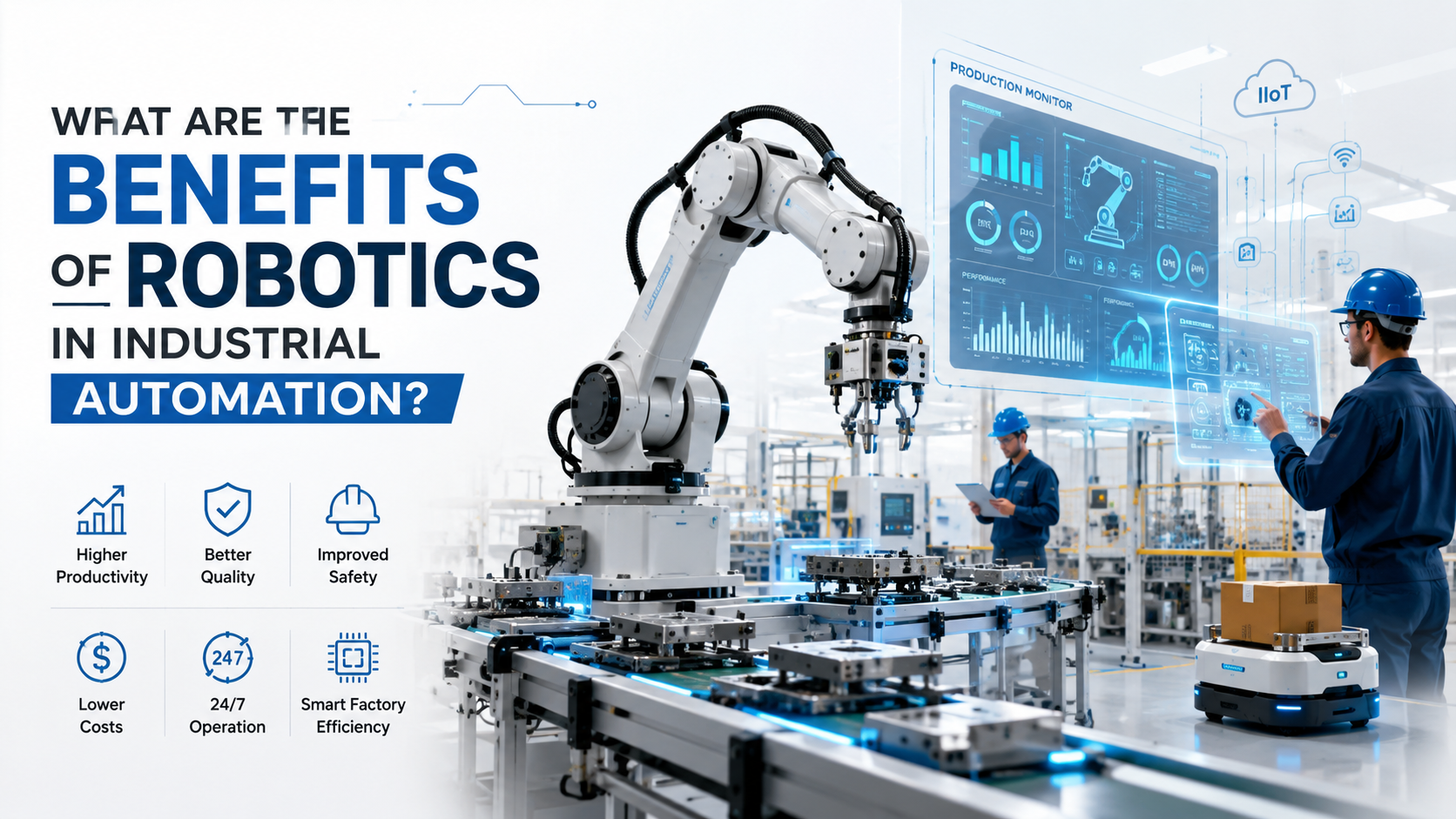
Robotics in industrial automation means using smart machines to handle repetitive tasks in factories. The benefits include faster production, better quality, improved safety, lower costs, 24/7 operations, and reduced waste.
Introduction
Factories today don’t look like they did 20 years ago.
Walk into a modern plant and you’ll see robotic arms welding, packaging, and assembling with speed and precision. What once felt futuristic is now normal.
Why? Because businesses face rising production pressure, labor shortages, and higher quality expectations. Customers want flawless products, and companies can’t afford mistakes.
That’s why industries are investing heavily in industrial automation. Robotics is no longer optional it’s the backbone of smart factories.
In this article, we’ll explore why robotics adoption is growing, how it fits into Industry 4.0, the difference between human work and machine work, and the challenges modern manufacturing faces.
What Are the Benefits of Robotics in Industrial Automation?
Robotics in industrial automation uses machines to perform repetitive or complex tasks in factories.
The major benefits are:
- Faster production
- Better quality
- Improved safety
- Lower costs
- 24/7 operations
- Reduced waste
Quick Summary Table
| Benefit | Main Result |
|---|---|
| Faster production | Higher output |
| Better accuracy | Fewer defects |
| Workplace safety | Lower injuries |
| Automation efficiency | Reduced downtime |
| Consistent quality | Better customer trust |
What Is Robotics in Industrial Automation?
Definition of Industrial Robotics
Industrial robotics means using programmable machines to perform tasks in factories.
Automation is about machines doing work automatically. Robotics is a step further—it’s about machines that can move, sense, and adapt.
In factories, robots are programmed to weld, paint, package, or assemble products with speed and precision.
Key Insight: Automation is the “system,” while robotics is the “tool” inside that system.
Common Types of Industrial Robots
- Articulated robots: Multi-jointed arms used in automotive assembly.
- SCARA robots: Great for pick-and-place tasks.
- Cartesian robots: Move in straight lines, often used for CNC machines.
- Delta robots: Fast and precise, used in packaging.
- Collaborative robots (Cobots): Work safely alongside humans.
Where Industrial Robots Are Used
- Manufacturing plants: Welding, painting, assembling.
- Warehouses: Moving goods, sorting packages.
- Automotive factories: Building cars with robotic arms.
- Food processing: Packaging and quality checks.
- Electronics assembly: Placing micro-components with precision.
Real-World Example
In automotive assembly, robotic arms weld car frames with exact precision. A human welder might take minutes and risk inconsistency. Robots do it in seconds, with perfect accuracy every time.
Practical Insight
Robotics is no longer “future technology.” It’s here, and it’s normal.
Factories that don’t adopt robotics risk falling behind competitors who produce faster, safer, and cheaper.
Bottom line: Robotics isn’t replacing humans—it’s helping industries meet modern challenges.
Why Robotics Is Growing So Fast in Manufacturing
Factories today are under more pressure than ever. Customers want products faster, global competition is fierce, and labor shortages make it harder to keep up. That’s why robotics adoption is skyrocketing in manufacturing it solves problems that traditional methods can’t.
Rising Production Demand
Customers expect quick delivery and flawless products.
Global competition means companies can’t afford delays. If one factory takes weeks, another competitor can deliver in days using robotics.
Example: Automotive companies use robotic arms to assemble cars faster, meeting rising demand without sacrificing quality.
Insight: Speed isn’t just about winning customers—it’s about survival in global markets.
Labor Shortages in Industrial Sectors
Finding skilled workers is tough. Many younger workers avoid repetitive factory jobs.
Robotics fills that gap by taking over tasks that are hard to staff. For example, packaging lines in food factories often struggle to hire enough workers. Robots step in and keep production steady.
Opinion: Robots don’t replace human creativity—they replace the boring, repetitive jobs most people don’t want.
Need for Higher Efficiency
Delays cost money. Inconsistent production hurts customer trust.
Robots reduce downtime by working nonstop and keeping output consistent. In electronics assembly, robots place microchips with precision, avoiding costly mistakes.
Key Point: Efficiency isn’t just about speed—it’s about reducing waste and keeping customers happy.
Industry 4.0 and Smart Factory Growth
We’re entering the era of smart factories.
Robots now connect with IoT sensors, AI systems, and data-driven platforms. This means factories can monitor production in real time, predict maintenance needs, and adjust output instantly.
Example: A smart factory might use robots connected to AI to detect defects before products leave the line.
Insight: Businesses that avoid automation may struggle later. Industry 4.0 isn’t a trend—it’s the new standard.
Practical Insight
Companies that hesitate to adopt robotics risk falling behind.
Competitors using smart automation will produce faster, safer, and cheaper. Customers will naturally choose them.
Bottom line: Avoiding automation today could mean losing market share tomorrow.
Major Benefits of Robotics in Industrial Automation
Robotics isn’t just about cool machines it’s about solving real problems in factories. Let’s break down the biggest benefits and see how they play out in everyday manufacturing.
Faster Production Speed
How Robots Increase Manufacturing Speed
Robots operate continuously without breaks. They execute repetitive tasks faster than humans, cutting cycle times.
Example: Robotic welding systems in automotive plants finish joints in seconds.
Insight: Speed is now a competitive advantage. Companies that produce faster win more customers.
Industries That Benefit Most
- Automotive: Welding, painting, assembly.
- Packaging: High-speed sorting and boxing.
- Electronics: Precision placement of micro-components.
- Logistics: Faster warehouse operations.
Improved Product Quality and Accuracy
Why Robots Reduce Human Errors
Robots follow programmed instructions with precision. They don’t get tired or distracted.
Example: PCB assembly robots in electronics manufacturing place thousands of components flawlessly.
Insight: Consistency often matters more than speed. Customers trust brands that deliver quality.
Importance of Consistency in Manufacturing
- Customer satisfaction improves when products meet expectations.
- Reduced recalls save money and protect brand reputation.
Better Workplace Safety
Dangerous Factory Tasks Robots Can Handle
- Welding
- Chemical handling
- Heavy lifting
- High-temperature operations
How Robotics Reduces Workplace Injuries
Robots reduce human exposure to hazardous environments. They also prevent repetitive strain injuries.
Safety Comparison Table
| Manual Work | Robotic Automation |
|---|---|
| High injury risk | Lower injury risk |
| Human fatigue | Continuous operation |
| Exposure to heat | Remote robotic handling |
Example: In steel plants, robots handle molten metal safely.
Insight: Safer workplaces boost morale and retention.
Lower Operational Costs Over Time
Understanding Long-Term ROI
Robots cost more upfront but save money in the long run.
How Robotics Reduces Costs
- Less waste
- Lower rework
- Reduced downtime
- Better energy efficiency
Example: Robotic palletizing in packaging plants reduces labor costs and errors.
Insight: Businesses should think long-term. ROI grows year after year.
24/7 Production Capability
Continuous Manufacturing Operations
Robots don’t need breaks, vacations, or sleep. They can run night shifts without supervision.
Benefits of Non-Stop Production
- Higher output
- Faster delivery timelines
- Better order fulfillment
Example: Warehouse automation in eCommerce ensures overnight shipping.
Insight: Continuous production is critical in markets where customers expect same-day delivery.
Reduced Material Waste
How Precision Automation Reduces Waste
Robots cut, measure, and dispense with accuracy. This reduces scrap and wasted materials.
Environmental Benefits of Robotics
- Better sustainability
- Improved resource management
Example: Robotic food portioning systems ensure exact servings.
Insight: Waste reduction boosts profitability and supports eco-friendly goals.
Better Scalability for Manufacturing Businesses
Easier Production Expansion
Robotic systems can be replicated across multiple lines. Scaling is faster compared to hiring and training workers.
Flexible Manufacturing Systems
Robots can adapt to new product lines quickly.
Example: Smart production cells in electronics manufacturing switch between devices easily.
Insight: Scalability matters for growing businesses that need to expand fast.
Improved Supply Chain and Warehouse Operations
Robotics in Logistics
- Automated picking systems
- Inventory robots
- Autonomous mobile robots
Faster Warehouse Operations
Robots reduce delays and improve order accuracy.
Example: Amazon-style robotic fulfillment centers move goods faster than humans.
Insight: Customer expectations have reshaped supply chains—speed and accuracy are non-negotiable.
Better Data Collection and Smart Manufacturing
Robotics and Industrial IoT
Robots now come with sensors for real-time monitoring.
Predictive Maintenance Benefits
They detect failures early, reducing downtime.
Data-Driven Manufacturing
Analytics from robots help track efficiency and improve processes.
Example: Smart robotic monitoring systems predict machine wear before breakdowns.
Insight: Data is becoming as valuable as production itself.
Improved Employee Productivity
Humans + Robots Working Together
Cobots work safely alongside humans. Workers supervise and manage robots instead of doing repetitive tasks.
Reducing Repetitive Manual Work
Robots handle boring jobs, freeing humans for creative roles.
Example: Collaborative robots in assembly operations assist workers without replacing them.
Insight: Automation often changes jobs instead of removing them. Workers move into higher-value roles.
Industries That Benefit Most From Industrial Robotics
Robotics isn’t limited to one sector—it’s transforming multiple industries at once. Let’s look at where robots are making the biggest impact and why.
Automotive Industry
Key Uses
- Welding
- Assembly
- Painting
- Material handling
Benefits
- Faster vehicle production
- Better precision in assembly and finishing
Example: Robotic welding systems in automotive plants ensure every joint is strong and consistent.
Insight: Speed and precision in car manufacturing directly improve safety and customer satisfaction.
Electronics Manufacturing
Key Uses
- PCB assembly
- Component placement
- Inspection systems
Benefits
- Microscopic accuracy
- Reduced defects and recalls
Example: Robots place thousands of micro-components on circuit boards with flawless precision.
Insight: In electronics, accuracy matters more than speed—one small defect can ruin an entire product line.
Food and Beverage Industry
Key Uses
- Packaging
- Sorting
- Palletizing
Benefits
- Better hygiene standards
- Faster production and distribution
Example: Robots package food items with consistent sealing, reducing contamination risks.
Insight: Hygiene and speed are critical in food production—robots deliver both.
Pharmaceutical Industry
Key Uses
- Sterile handling
- Packaging
- Lab automation
Benefits
- High precision in drug manufacturing
- Compliance with strict regulations
Example: Robots handle sterile packaging of medicines, ensuring zero contamination.
Insight: In pharma, precision and compliance aren’t optional—they’re life-saving requirements.
Logistics and Warehousing
Key Uses
- Inventory movement
- Autonomous robots
- Order picking
Benefits
- Faster deliveries
- Better warehouse efficiency
Example: Amazon-style robotic fulfillment centers use autonomous robots to move goods quickly.
Insight: Customer expectations for fast delivery have reshaped logistics—robots make it possible.
Challenges of Robotics in Industrial Automation
Robotics brings huge benefits, but it’s not without challenges. Businesses need to weigh costs, skills, and integration issues before diving in.
High Initial Investment
Discussion Points
- Equipment costs: Robots, sensors, and controllers are expensive upfront.
- Integration expenses: Setting up robots with existing systems requires planning.
- Maintenance costs: Regular servicing and spare parts add to expenses.
Insight: The upfront cost is high, but long-term savings often outweigh it.
Need for Skilled Workers
Discussion Points
- Robotics programming: Skilled programmers are needed to set up robots.
- PLC integration: Robots must connect with factory control systems.
- Automation troubleshooting: Workers need training to fix issues quickly.
Insight: Robots don’t eliminate jobs—they shift them toward higher-skill roles.
Integration With Old Systems
Discussion Points
- Legacy equipment compatibility: Older machines may not connect easily with robots.
- Infrastructure upgrades: Factories often need new layouts or wiring.
Insight: Integration challenges are real, but upgrades often lead to better efficiency.
Cybersecurity Risks
Discussion Points
- Smart factory vulnerabilities: Connected robots can be hacked if not secured.
- Industrial network protection: Strong firewalls and monitoring are essential.
Insight: As factories get smarter, cybersecurity becomes as important as physical safety.
Robotics vs Manual Manufacturing
Comparison Table
| Factor | Manual Manufacturing | Robotics Automation |
|---|---|---|
| Speed | Moderate | Very high |
| Accuracy | Variable | Highly consistent |
| Safety | Higher risk | Safer operations |
| Downtime | More frequent | Lower downtime |
| Labor dependency | High | Reduced |
Practical Insight
The best approach isn’t robots alone or humans alone it’s hybrid systems.
Humans bring creativity, problem-solving, and adaptability. Robots bring speed, precision, and endurance. Together, they create smarter factories that balance efficiency with innovation.
Bottom line: The future of manufacturing is human + robot collaboration, not replacement.
Are Robots Replacing Human Workers?
The Reality of Automation
Robots are replacing repetitive, routine tasks that humans often find tiring or unsafe. Instead of welding, packaging, or lifting heavy loads, workers are moving into technical roles like supervising, programming, and maintaining robotic systems.
Insight: Automation doesn’t erase human work—it shifts it toward higher-value skills.
New Jobs Created by Robotics
- Automation engineers: Design and optimize robotic systems.
- Robotics technicians: Maintain and repair robots.
- PLC programmers: Connect robots to factory control systems.
- System integrators: Ensure robots work smoothly with existing equipment.
Practical Insight: Automation skills are becoming some of the most valuable in manufacturing. Workers who upskill into robotics roles often see better pay and job security.
Future of Robotics in Industrial Automation
AI-Powered Robotics
- Machine learning integration: Robots learn from data to improve performance.
- Smarter robotic systems: AI allows robots to adapt to new tasks faster.
Example: AI-powered robots in electronics detect defects automatically.
Collaborative Robots (Cobots)
- Human-safe robotics: Cobots are designed to work safely alongside people.
- Small business automation: Affordable cobots make automation possible for smaller factories.
Insight: Cobots are bridging the gap between human creativity and machine efficiency.
Smart Factories and Industry 4.0
- Connected manufacturing: Robots link with IoT sensors for real-time updates.
- Real-time production monitoring: Managers can track efficiency instantly.
Example: Smart factories use robotics to adjust production lines on demand.
Autonomous Mobile Robots (AMRs)
- Smart warehouse operations: AMRs move goods without human guidance.
- Logistics automation: They speed up order picking and delivery.
Insight: AMRs are transforming supply chains into faster, more reliable systems.
Predictive Maintenance Growth
- AI monitoring systems: Robots track machine health continuously.
- Failure prediction: Issues are detected before breakdowns happen.
Example: Predictive robotics in automotive plants prevent costly downtime.
Key Benefits of Robotics in Industrial Automation
| Benefit | Business Impact |
|---|---|
| Faster production | Increased output |
| Better quality | Fewer defects |
| Improved safety | Lower injuries |
| Reduced waste | Higher profits |
| 24/7 operations | Better productivity |
| Supply chain efficiency | Faster delivery |
| Smart data collection | Better decisions |
Wrapping Up
Closing Discussion
Robotics is no longer optional—it’s becoming essential in manufacturing. Balancing humans and automation is key. Robots handle repetitive tasks, while humans bring creativity and problem-solving.
Smart factories powered by robotics and Industry 4.0 are the future. Companies that invest now gain a long-term competitive advantage.
Final Opinion Section
From a realistic standpoint, industrial automation is growing because it solves real problems: labor shortages, rising demand, and quality expectations.
Businesses shouldn’t wait for the “perfect time” to automate. Instead, they should start gradually—adding robotics step by step. This approach reduces risk, builds worker confidence, and ensures smoother integration.
Bottom line: The sooner companies embrace robotics, the stronger their future will be in a competitive global market.