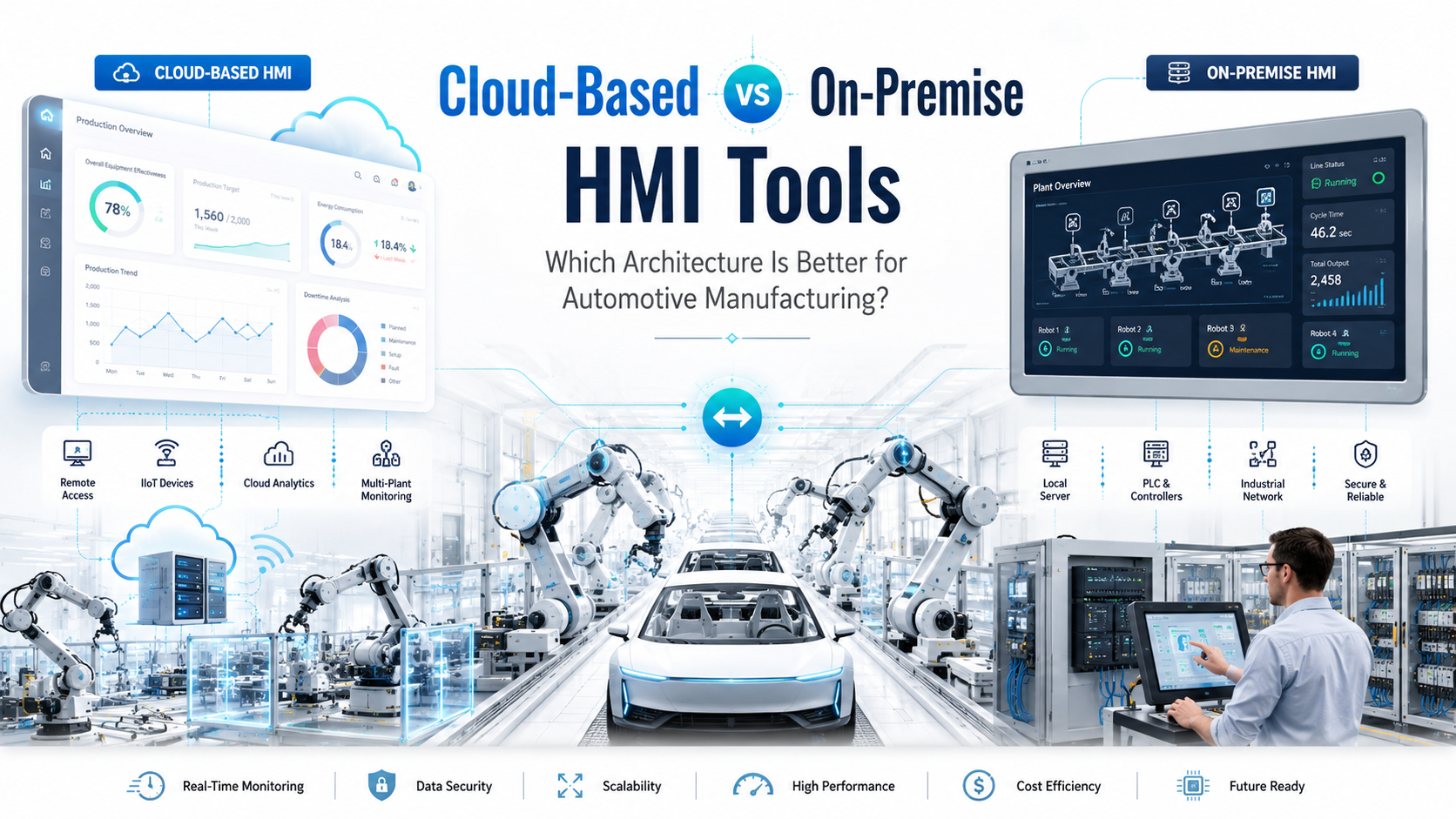
Cloud-based HMI tools give you remote access, easy scaling, and centralized management across multiple plants. On-premise HMI tools give you low latency, offline reliability, and full control over sensitive production data. Most modern automotive manufacturers are moving toward hybrid architectures that combine both.
Why Automotive Manufacturers Are Rethinking HMI Infrastructure
The automotive industry is not the same as it was ten years ago. EV production lines, connected factories, smart assembly systems, and Industry 4.0 requirements have completely changed how manufacturers think about visualization, diagnostics, and production monitoring.
Traditional on-premise HMI setups were designed for a single factory, a single line, and a single team. That worked fine when plants operated in isolation. But now manufacturers need to monitor robotic systems across five facilities, push software updates without production downtime, and pull analytics into centralized dashboards.
At the same time, you cannot simply abandon proven local control systems. A robotic welding line running at 1,200 cycles per hour cannot tolerate a 200ms internet hiccup. The stakes are too high.
This is why the cloud vs on-premise debate in automotive HMI is not a clear winner situation. It is a question of what your production environment actually demands.
What Are HMI Development Tools in Automotive?
HMI development tools are software platforms used to build operator interfaces that let humans interact with machines, production lines, and control systems inside automotive facilities.
HMI Defined Simply
HMI stands for Human-Machine Interface. In automotive manufacturing, it is the screen, dashboard, or control panel an operator uses to monitor a robotic arm, control a conveyor, or check an EV battery assembly station.
HMI development tools are the software environments used to design and build those interfaces. They connect to PLCs (Programmable Logic Controllers), SCADA systems, sensors, and industrial devices to display real-time data.
Two Types of HMI in Automotive
There is an important distinction to understand upfront:
- Manufacturing floor HMI controls production equipment, assembly robots, and factory processes
- Vehicle infotainment HMI is the in-car interface for drivers and passengers
This blog focuses entirely on manufacturing floor HMI, which is the backbone of automotive production operations.
Common Automotive HMI Applications
- Robotic assembly line monitoring and fault detection
- Paint shop temperature and flow visualization
- EV battery pack production dashboards
- CNC machine status and cycle time tracking
- Conveyor speed and jam detection
- SCADA integration for plant-wide oversight
- Quality inspection system interfaces
- Press shop tonnage and cycle monitoring
What Are Cloud-Based HMI Development Tools?
Cloud-based HMI tools are hosted on remote servers and accessed through browsers or connected clients. They allow centralized management, remote monitoring, and multi-site visibility without local server infrastructure at every facility.
How Cloud HMI Systems Work
Data flows from PLCs and industrial devices up through edge gateways to cloud servers. Operators and engineers access dashboards through web browsers or cloud-connected clients from anywhere with an internet connection.
The vendor manages the server infrastructure, software updates, and platform maintenance. Your team focuses on building the HMI applications and analyzing production data rather than managing servers.
Key Features of Cloud HMI Platforms
- Remote access from any location or device
- Multi-plant monitoring from a single dashboard
- Over-the-air (OTA) software and firmware updates
- AI and predictive analytics integration
- Elastic scaling without new hardware purchases
- Centralized data backup and disaster recovery
- Role-based access control across teams and locations
Popular Cloud-Based HMI Platforms in Automotive
Siemens WinCC Unified Cloud – Extends Siemens TIA Portal ecosystem with cloud connectivity and browser-based visualization.
Ignition Perspective – Inductive Automation’s web-based SCADA and HMI platform, widely used in automotive and discrete manufacturing.
AVEVA Insight – Cloud analytics and visualization platform built for industrial operations with strong OEM integrations.
FactoryTalk Optix Cloud – Rockwell Automation’s modern cloud-capable HMI development environment with a low-code approach.
AWS IoT SiteWise – Amazon’s industrial IoT service for collecting, organizing, and analyzing equipment data at scale.
What Are On-Premise HMI Development Tools?
On-premise HMI tools are installed directly inside your facility on industrial PCs or local servers. They communicate with PLCs and machines over your internal factory network without needing an internet connection.
How On-Premise HMI Systems Work
The HMI software runs on hardware physically located inside your plant. It communicates directly with PLCs using industrial protocols like OPC-UA, Modbus, PROFINET, and EtherNet/IP over your internal LAN.
All data stays within your factory walls. Your internal IT or automation team manages updates, backups, and system maintenance. There is no external dependency for core operations.
Key Features of On-Premise HMI Platforms
- Full offline operation with zero internet dependency
- Direct low-latency communication with PLCs and controllers
- Complete internal control over data and security
- Deterministic real-time performance for critical systems
- Air-gapped network capability for sensitive production lines
- Proven reliability for high-speed, high-cycle operations
Popular On-Premise HMI Platforms in Automotive
Siemens WinCC Professional – Industry standard for automotive facilities, deeply integrated with Siemens S7 PLCs and TIA Portal.
Rockwell FactoryTalk View – Widely deployed in North American automotive and Tier-1 supplier facilities.
Wonderware InTouch (AVEVA) – Mature platform with broad PLC compatibility and a large installed base in automotive.
Mitsubishi GT Works – Preferred platform for facilities running Mitsubishi Electric automation equipment.
Schneider EcoStruxure Operator Terminal Expert – Optimized for Schneider Electric environments with strong local visualization tools.
Cloud-Based vs On-Premise HMI Development Tools: Core Comparison
| Factor | Cloud-Based | On-Premise |
|---|---|---|
| Deployment Location | Remote vendor servers | Local factory hardware |
| Remote Access | Yes, from anywhere | Limited to factory network |
| Internet Dependency | High | None for core operations |
| Offline Reliability | Moderate | Excellent |
| Latency | Higher (network dependent) | Very low (local LAN) |
| Upfront Hardware Cost | Low | High |
| Ongoing Subscription Cost | High | Low |
| Scalability | Very easy | Requires hardware investment |
| Multi-Plant Management | Simple | Complex |
| Software Updates | Vendor managed | Internal team managed |
| Cybersecurity Control | Shared with vendor | Full internal control |
| IT Skill Requirement | Lower | Higher |
| Data Ownership | Shared/vendor hosted | Fully internal |
Security Comparison for Automotive Manufacturing
On-premise systems offer stronger isolation and direct control. Cloud systems offer better patch management and centralized monitoring, but introduce internet exposure risks.
Why Security Is Critical in Automotive Plants
Automotive manufacturing facilities carry enormous cybersecurity risk. Robotic systems, CNC machines, and assembly lines are direct physical assets. A cyberattack that halts production costs tens of thousands of dollars per hour in lost output.
Beyond production downtime, automotive plants hold sensitive intellectual property: tooling parameters, cycle times, design specifications, and supplier integration data. That information is a target.
Cloud HMI Security: Strengths and Weaknesses
Strengths:
- Automatic security patches and vulnerability updates managed by the vendor
- Centralized monitoring and threat detection across all facilities
- Multi-factor authentication and enterprise identity management
- Regular third-party security audits by the platform provider
Weaknesses:
- Internet-facing attack surface expands your vulnerability profile
- Third-party vendor access to production data creates compliance concerns
- Data sovereignty issues for multinational automotive groups
- Dependence on vendor security practices you cannot directly control
On-Premise HMI Security: Strengths and Weaknesses
Strengths:
- Air-gapped systems completely isolated from external networks
- Full internal control over who accesses production data
- No third-party exposure by default
- Better alignment with ITAR, ISO/TS 16949, and automotive cybersecurity standards
Weaknesses:
- Manual patch management creates vulnerability windows if teams are stretched
- Requires dedicated cybersecurity staff with OT (Operational Technology) expertise
- Legacy systems often run outdated software due to patch complexity
- Internal threats are harder to monitor without centralized tooling
The Compliance Factor
Automotive manufacturers subject to IATF 16949, TISAX, or government defense contracts often face strict data residency and security requirements. On-premise or private cloud solutions are typically easier to audit and certify for these frameworks. Cloud vendors are improving their compliance documentation, but the audit trail is more complex.
Performance and Reliability Comparison
On-premise wins for real-time critical control. Cloud wins for monitoring, analytics, and reporting workloads.
Why Latency Matters on Automotive Assembly Lines
A robotic welding cell operating at high speed cannot wait for a round-trip internet request to confirm a position value. Robot synchronization, press timing, and conveyor coordination depend on deterministic, sub-millisecond response times.
Cloud-based HMI introduces network latency that is simply incompatible with direct machine control at those speeds. This is not a platform limitation that vendors will engineer away. It is physics.
Cloud HMI Performance Profile
- Typical round-trip latency: 20ms to 150ms depending on network and geography
- Suitable for monitoring dashboards, production reporting, and analytics
- Edge computing reduces latency significantly for local data processing
- Not recommended for direct PLC control loops or real-time motion synchronization
- Excellent for cross-plant visibility where slight data delays are acceptable
On-Premise HMI Performance Profile
- Local LAN latency: under 5ms for most industrial network configurations
- Direct protocol communication with PLCs keeps control loops tight
- Deterministic operation suitable for safety-critical systems
- Stable and predictable regardless of external network conditions
- Standard for body shop, powertrain, and stamping operations where machine timing is critical
Reliability Under Network Conditions
On-premise systems keep running during internet outages, ISP disruptions, and WAN failures. Cloud-dependent systems that lack robust edge buffering can lose visibility or control capability when connectivity degrades. In a 24/7 automotive production environment, that is an unacceptable risk without a proper failover architecture.
Cost Comparison
Cloud-based HMI costs less upfront but more over time. On-premise costs more to start but offers lower long-term cost per year once infrastructure is established.
Cloud-Based HMI Cost Breakdown
Advantages:
- Low initial capital investment, no server hardware to purchase
- Subscription model spreads costs across operational budget rather than capital budget
- Vendor manages infrastructure maintenance, reducing internal IT overhead
- Faster deployment timelines reduce project labor costs
Hidden and Ongoing Costs:
- Monthly or annual subscription fees that grow with data volume and user count
- Industrial-grade internet connectivity and redundant WAN circuits
- Edge gateway hardware for local data collection
- Data transfer and storage fees that scale with production data volume
- Vendor lock-in can limit negotiation leverage over time
On-Premise HMI Cost Breakdown
Advantages:
- One-time software license purchase with predictable long-term cost
- No recurring subscription dependency for core operations
- Long hardware lifecycle reduces total cost of ownership over 7 to 10 years
- Full control over upgrade timing and scope
Hidden and Ongoing Costs:
- Industrial PC and server hardware with redundancy adds significant upfront cost
- Internal IT staff with OT knowledge commands premium salaries
- Backup infrastructure, UPS systems, and disaster recovery hardware
- Software upgrade licensing and annual maintenance contracts
- Downtime costs if internal team lacks capacity for rapid issue resolution
Which Is Cheaper Long-Term?
For a single facility running stable operations over 10 years, on-premise typically delivers lower total cost of ownership. For multi-facility operations, rapidly scaling environments, or companies without strong internal IT teams, cloud economics often win because you eliminate the per-site infrastructure cost.
Scalability and Multi-Plant Management
Cloud HMI scales faster and manages multiple plants more efficiently. On-premise requires significant per-site investment and effort to scale.
Cloud HMI Scalability Advantage
Adding a new production line or facility to a cloud HMI platform is primarily a software and configuration task. You install edge gateways, connect PLCs, configure data collection, and push the new site into your existing centralized dashboard.
Centralized dashboards let corporate engineering and operations teams monitor all global facilities from a single interface. Software updates, new screen templates, and configuration changes push to every site simultaneously without travel or per-site downtime.
On-Premise Scalability Challenges
Each new facility requires its own hardware, software licenses, network architecture, and qualified staff. Standardizing HMI applications across 12 plants running on-premise systems requires manual effort at every site. Version control becomes a significant operational challenge as different sites run different software versions.
Real-World Scaling Scenarios
EV manufacturing expansion: A startup scaling from one pilot facility to three production plants in 18 months benefits heavily from cloud HMI. The speed of deployment and centralized management outweighs the latency tradeoffs for monitoring-focused applications.
Tier-1 supplier network: A supplier managing 15 facilities across four countries can standardize reporting and production KPIs through a cloud platform while keeping local on-premise control for machine-critical operations.
Global automotive OEM: Large manufacturers like Ford or GM use hybrid architectures where corporate analytics run on cloud platforms while each plant maintains local on-premise control systems.
Integration with Industrial IoT and Smart Manufacturing
Cloud HMI integrates more easily with IIoT, AI, and big data platforms. On-premise integrates more reliably with local automation and control equipment.
Why Smart Integration Matters in Automotive
Modern automotive plants are not just making cars. They are generating enormous volumes of production data that can be turned into predictive maintenance alerts, quality improvements, energy optimization, and digital twin models.
Getting value from that data requires connecting HMI systems to broader analytics infrastructure. That is where cloud platforms have a significant advantage.
Cloud HMI IIoT Integration Strengths
- Native connectors to AI and machine learning platforms
- Big data pipelines for cross-plant production analytics
- Real-time energy monitoring and sustainability reporting
- Remote diagnostics for equipment OEMs and service teams
- Digital twin integration for virtual commissioning and simulation
- Seamless connection to ERP systems like SAP and Oracle
On-Premise IIoT Integration Strengths
- Faster, more deterministic local automation control
- Better performance for closed-loop control systems
- Tighter integration with legacy PLC and drive systems
- Predictable behavior without cloud dependency in automation sequences
Best Use Cases for Cloud-Based HMI in Automotive
Cloud HMI works best for multi-plant monitoring, analytics, remote operations, and environments where deployment speed and scalability matter more than ultra-low latency.
Ideal Cloud HMI Scenarios
Multi-factory automotive groups that need standardized dashboards and KPIs across all facilities without per-site server infrastructure.
EV startups and greenfield facilities without legacy systems that can build cloud-native automation infrastructure from day one.
Remote operations and NOC teams that need visibility into production status without being physically present in every plant.
Centralized maintenance and diagnostics centers that monitor equipment health across a supplier network from a single location.
Predictive maintenance programs that require aggregating sensor data across thousands of machines to train and deploy AI models.
When Cloud Makes More Sense
- You are scaling rapidly and cannot afford to build IT infrastructure at every new site
- Your production operations are distributed across multiple countries or time zones
- Your internal IT team is limited and you want vendor-managed infrastructure
- Your HMI use cases are primarily monitoring and reporting rather than real-time control
Best Use Cases for On-Premise HMI in Automotive
On-premise HMI is the right choice for high-speed robotic control, safety-critical systems, air-gapped facilities, and operations where internet dependency is unacceptable.
Ideal On-Premise HMI Scenarios
High-speed robotic assembly lines where robot synchronization and motion control require deterministic, sub-millisecond communication with PLCs.
Stamping and press operations where cycle timing and tonnage monitoring must operate without any network dependency.
Safety-critical production systems covered by functional safety standards like IEC 62061 or ISO 13849 where control system architecture must be locally validated.
Facilities with strict compliance requirements including ITAR, TISAX, or government defense manufacturing programs where data residency is mandated.
Plants with unreliable internet connectivity in regions where WAN infrastructure cannot guarantee the uptime required for production operations.
When On-Premise Makes More Sense
- Your production lines cannot tolerate any latency beyond local LAN performance
- Your facility handles sensitive tooling or design IP that cannot leave internal networks
- You need maximum operational independence from vendor platforms and internet services
- Your plant has a long established automation infrastructure already running proven on-premise tools
Hybrid HMI Architecture: The Emerging Standard
Hybrid HMI keeps real-time control local while pushing analytics, reporting, and multi-site visibility to the cloud. It is the architecture most serious automotive manufacturers are adopting.
What Hybrid HMI Looks Like in Practice
A hybrid architecture does not try to force cloud performance into real-time control. It puts the right workload in the right place.
Local PLCs communicate directly with on-premise HMI systems for control operations. That local HMI connects to an edge gateway that preprocesses and filters production data. The edge gateway then pushes relevant data to cloud platforms for analytics, reporting, and centralized visibility.
Typical hybrid data flow:
PLCs and field devices → Local on-premise HMI/SCADA → Edge gateway/historian → Cloud analytics and dashboards → Corporate reporting and AI platforms
Why Automotive Companies Prefer Hybrid
- Real-time factory control stays on the local network where it belongs
- Production analytics and OEE reporting move to cloud where scaling is easy
- Corporate teams get global visibility without compromising plant-floor reliability
- Cybersecurity architecture is cleaner because control and analytics are separated
- Gradual migration path from legacy on-premise to modern cloud platforms
Hybrid as a Migration Strategy
Hybrid architecture also solves the migration problem. You do not have to rip out working on-premise systems to gain cloud analytics capability. You add edge gateways and cloud connectors to existing infrastructure, migrate reporting and analytics workloads first, and evaluate whether additional cloud migration makes sense over time.
Future Trends in Automotive HMI Development
Technologies Shaping the Next Generation of Automotive HMI
AI-powered HMI interfaces that surface anomaly alerts, predicted failures, and production recommendations directly in the operator interface rather than requiring separate analytics tools.
Augmented reality operator interfaces that overlay equipment status, maintenance instructions, and fault diagnostics on physical machines through wearable AR headsets.
Edge AI visualization that runs machine learning inference locally at the production line without cloud round-trips, combining on-premise reliability with AI capability.
5G-connected factory floors that reduce wireless latency to levels acceptable for mobile operator interfaces and AGV (Automated Guided Vehicle) coordination.
Web-based industrial dashboards that replace legacy thick-client HMI software with browser-based interfaces that work on any device without local software installation.
Voice-controlled industrial HMI for hands-free operator interaction in assembly and inspection environments where touch interfaces are impractical.
The Future Architecture Direction
The industry is not moving toward pure cloud or doubling down on pure on-premise. It is moving toward edge-cloud hybrid architectures where intelligence lives closer to the machine and cloud platforms serve as the aggregation and analytics layer.
Cybersecurity-first design is becoming non-negotiable. New automotive HMI deployments are being designed with zero-trust network principles, segmented OT/IT architectures, and continuous monitoring from day one rather than as an afterthought.
Challenges Automotive Companies Face During Migration
Legacy compatibility, production downtime risk, and operator training are the biggest migration barriers in automotive HMI projects.
Common Migration Problems
Legacy PLC compatibility is the most common obstacle. Older PLCs using proprietary protocols or serial communication may not connect cleanly to modern HMI platforms without additional protocol converters or gateway hardware.
Production downtime risk makes automotive teams conservative about changes. A failed HMI migration during active production can halt an assembly line. The financial and schedule consequences of unplanned downtime drive extended migration timelines.
Cybersecurity concerns during transition create temporary vulnerabilities as old and new systems run in parallel with cross-network connections that would not exist in either standalone architecture.
Operator training resistance is real and underestimated. Experienced operators who know legacy HMI interfaces deeply often push back on new systems, especially if the new interface requires relearning workflows under production pressure.
Integration complexity multiplies when older SCADA systems, historians, and MES platforms need to communicate with new HMI infrastructure that uses different data models and protocols.
Practical Migration Strategies
Gradual hybrid deployment replaces monitoring and reporting functions first while leaving control functions on existing on-premise systems. This minimizes risk and delivers early value.
Pilot production line testing validates the new HMI architecture on a non-critical line before deploying to primary production. Automotive validation culture applies here: prove it works before it touches your highest-volume operation.
Edge-based transition adds edge gateways to existing infrastructure to unlock cloud analytics without touching the control layer. This is the lowest-risk first step for most automotive facilities.
How to Choose the Right HMI Development Approach
Match your HMI architecture to your production criticality, geographic distribution, security requirements, and internal IT capability.
Decision Framework
Choose cloud-based HMI if:
- You operate or plan to operate multiple facilities and need centralized visibility
- Your primary HMI workload is monitoring, analytics, and production reporting
- You want to minimize per-site IT infrastructure and vendor management
- You are building a greenfield facility without legacy system constraints
- Remote access for engineering and management teams is a key requirement
Choose on-premise HMI if:
- Your production lines require ultra-low latency for robot synchronization or press control
- Your facility operates in an air-gapped or internet-restricted environment
- You handle sensitive IP or are subject to data residency compliance requirements
- Your operation runs 24/7 and internet dependency creates unacceptable risk
- You have a strong internal automation and IT team capable of managing local infrastructure
Choose hybrid HMI if:
- You need local reliability for production control AND cloud scalability for analytics
- You are migrating from legacy on-premise systems and want a phased approach
- Your corporate teams need visibility across plants while your floor teams need reliable local control
- You want to future-proof your architecture without betting entirely on one model
Final Verdict
Cloud-based HMI tools are the right choice for scalability, multi-plant visibility, IIoT integration, and analytics-driven operations. They reduce infrastructure burden and accelerate deployment, especially for growing or multi-site automotive manufacturers.
On-premise HMI tools remain the correct architecture for real-time machine control, safety-critical systems, and facilities where security, compliance, or internet reliability make cloud dependency a production risk.
Hybrid HMI architecture is the practical standard for modern automotive manufacturing. It puts control where it belongs (local) and analytics where they scale best (cloud). Most automotive manufacturers running serious production operations are already there or moving in that direction.
The decision is not about which architecture is universally better. It is about matching your infrastructure to your production requirements, your security profile, and your operational scale.
Need Automotive HMI Development or Factory Automation Support?
At AutomatexLab, we help automotive manufacturers and industrial businesses build smart, scalable, and reliable automation systems tailored to their production environment.
Our Services:
- HMI Development (cloud, on-premise, and hybrid)
- PLC Programming
- SCADA System Design
- Industrial IoT Integration
- Smart Factory Consultation
- Automation Troubleshooting
- Industrial System Integration
Whether you need a cloud-based dashboard, an on-premise industrial HMI, or a hybrid smart factory solution built around your specific production requirements, AutomatexLab can help you design and implement the right automation architecture.