PLC Programming Services in Satara
Reliable PLC Programming Solutions for Manufacturers, OEMs, and Industrial Facilities in Satara
Improve machine reliability, reduce production downtime, and modernize your industrial automation systems with professional PLC programming services in Satara. AutomatexLab develops, modifies, troubleshoots, upgrades and commissions PLC programs for manufacturing plants, OEM machine builders, process industries and system integrators. Our engineers support projects ranging from single-machine automation to complete production line control using industry-standard programming practices and leading PLC platforms.
- Experienced industrial automation engineers
- Multi-brand PLC expertise
- Remote and on-site support
- Well-documented programs
- Fast response for critical issues
- Long-term technical support
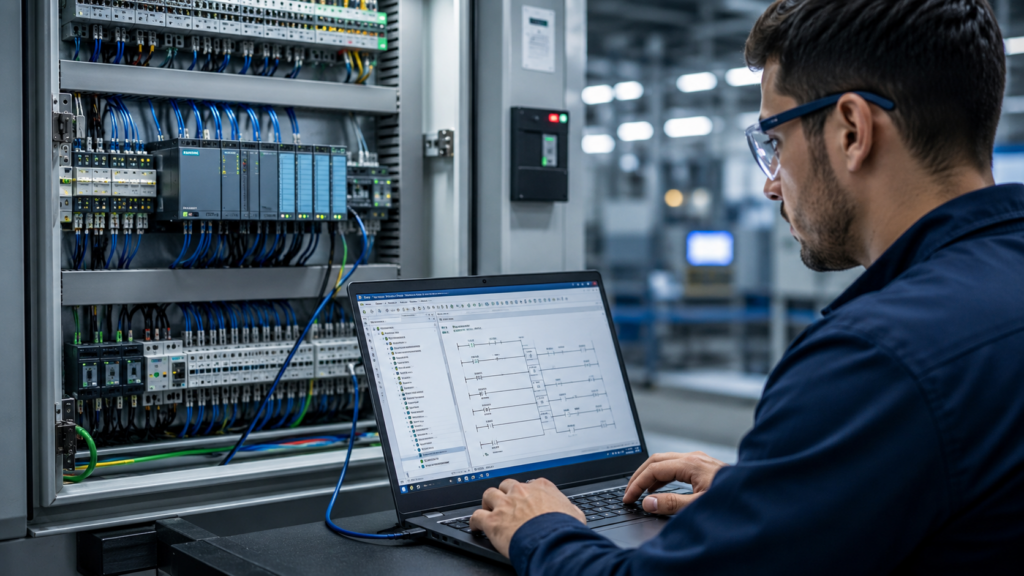
Your Industrial Automation Partner in Satara
AutomatexLab is an industrial automation engineering company providing PLC programming, HMI development, SCADA integration and control panel design for manufacturing plants, OEM machine builders and process industries across Satara. We specialize in writing, modifying, troubleshooting, migrating and commissioning PLC programs for equipment ranging from a single automated machine to a complete production line running multiple stations in sequence.
Our team has handled projects across automotive component manufacturing, food processing, pharmaceutical production, packaging lines, chemical processing and material handling systems, alongside OEM machine builders who need reliable, well-documented control logic for equipment they will support in the field. Every project follows a documented, standards-based approach, with a consistent focus on safety, maintainability and long-term support rather than simply writing code and moving on. We treat every engagement as an operational problem to solve, not just a programming task to complete, which is why our clients keep calling us back for the next machine, the next line, and the next upgrade.
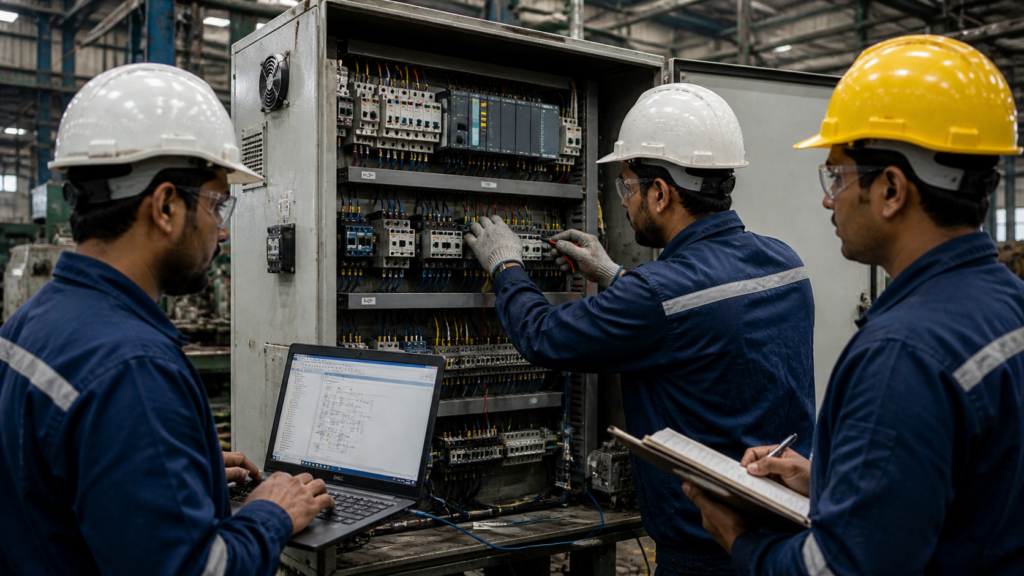
Why Choose Our PLC Programming Services?
Industrial Automation Expertise
Programming designed around real manufacturing processes, not generic templates copied from one machine to another.
Multi-Brand PLC Experience
Support for Siemens, Allen-Bradley, Mitsubishi, Delta, Omron, Schneider Electric, ABB, Beckhoff, Panasonic and Keyence.
Custom Engineering
Logic tailored to your equipment, production goals and operational requirements, not a one-size-fits-all script.
Reliable Documentation
Well-commented code, backups, I/O mapping and operational documentation handed over on every project.
Scalable Automation
Programs built for future machine expansion and additional production lines, not a dead end.
Reduced Downtime
Fast troubleshooting and optimized control logic help minimize production interruptions.
Long-Term Technical Support
Support after commissioning for updates, troubleshooting and ongoing optimization.
What Is PLC Programming?
PLC programming is the process of writing and configuring the control logic that runs on a Programmable Logic Controller, an industrial computer built to read sensor inputs, execute a defined sequence of logic, and drive outputs such as motors, valves and actuators in real time. PLCs are used in industrial automation because they are rugged, deterministic, easy to reprogram, and built to run continuously in harsh factory environments where a standard computer would fail. A PLC controls machinery by scanning its inputs, running the logic program, updating its outputs, and repeating this cycle many times per second, which is what allows a conveyor, packaging line or batch process to run automatically and consistently.
The most common PLC programming languages are ladder logic, function block diagram, structured text and sequential function chart, each suited to different types of logic, from simple interlocks to complex batch sequencing. Professional PLC programming brings benefits that go beyond simply making a machine move, including safer interlocking, cleaner fault diagnostics, better documentation for future maintenance, and logic structured for expansion rather than a tangle of undocumented code that only one person can understand.
- Ladder Logic
- Function Block Diagram
- Structured Text
- Sequential Function Chart
Industries We Serve Across Satara
Manufacturers across Satara MIDC, Karad, Phaltan, Wai and Koregaon rely on PLC programming for very different reasons depending on their industry. Here is how our PLC programming services in Satara apply across the sectors we work with most.
Automotive Manufacturing
Automotive component manufacturers in and around Satara depend on PLC controlled assembly stations, robotic cells and quality checking systems to hit tight cycle times. PLC programming here typically covers sequencing multiple stations, integrating vision or sensor based inspection, and coordinating with robots or servo axes so that a part moves through the line without manual intervention. Reliable fault handling matters heavily in this sector since a single station stoppage can halt the entire line.
Food Processing
Food processing plants need PLC programs that manage batch consistency, washdown-rated equipment, and strict sequencing between mixing, cooking, cooling and packaging stages. Programming for this industry often includes recipe management, hygienic sensor placement considerations, and precise timing control to protect product quality and shelf life.
Pharmaceutical Manufacturing
Pharmaceutical manufacturing demands tightly controlled batch processes, data logging for traceability, and validated logic changes. PLC programming in this space is built around repeatable, auditable sequences, with careful attention to alarm handling and recipe management for regulatory compliance.
Packaging
Packaging lines need PLC logic tuned for speed, including fill, seal, label and cartoning sequences that must stay synchronized across multiple machines. Jam detection, changeover logic for different product sizes, and downtime tracking are common programming requirements here.
Chemical Processing
Chemical processing plants rely on PLC programming for batch control, PID loop tuning, and safety interlocks around temperature, pressure and flow. Alarm management and clear operator visibility are critical in this industry due to the safety implications of process deviations.
Steel and Metals
Steel and metal processing units use PLC control for material handling, furnace sequencing, and rolling or cutting line coordination. Programming often needs to handle harsh electrical environments and high-power motor control alongside standard logic sequencing.
Cement
Cement plants depend on PLC systems for conveyor sequencing, silo level monitoring, and process interlocks across crushing, grinding and packing stages. Dust and vibration resistant hardware selection is often part of the programming and panel design conversation.
Textile
Textile manufacturing units use PLC programming for loom control, dyeing process sequencing, and material tensioning systems, often requiring precise speed synchronization between multiple motor driven stages.
Water and Wastewater Treatment
Water and wastewater treatment facilities rely on PLC logic for pump station control, chemical dosing, and level monitoring across multiple tanks, often tied into a SCADA system for remote plant-wide visibility and alarm notification.
Material Handling
Material handling systems including conveyors, sorters and AGVs need PLC programming focused on sequencing logic, sensor based routing, and safe interaction between multiple moving systems on the same floor.
FMCG
FMCG production lines need fast-cycle PLC logic for filling, packing and palletizing, along with production counting and downtime tracking to support tight delivery schedules and high-volume output targets.
Paper Industry
Paper manufacturing units use PLC control for pulping, pressing and roll handling sequences, often requiring tight synchronization between multiple large motors and drives across the production line.
Plastic Manufacturing
Plastic manufacturing, including injection molding and extrusion, relies on PLC programming for temperature zone control, cycle timing, and safety interlocks around molds and cutting mechanisms.
OEM Machine Builders
OEM machine builders need PLC programs that are portable, well documented and easy for their own field engineers to support once a machine is shipped to a customer site, often across multiple industries and multiple end customer locations.
Renewable Energy
Renewable energy installations use PLC and SCADA systems for monitoring generation output, managing switchgear interlocks, and logging performance data for reporting and maintenance planning.
PLC Brands We Support
AutomatexLab programs across the PLC brands most commonly found in manufacturing plants and OEM machines throughout Satara, using the native software platform for each brand.
We work in each brand’s native environment, including TIA Portal, Studio 5000, GX Works, CX-Programmer, EcoStruxure Machine Expert and TwinCAT, so your program stays fully supported by the original vendor’s toolchain rather than a workaround.
Complete PLC Programming Services in Satara
01Custom PLC Software Development
Complete PLC programs written from scratch for new machines or production lines, based on your functional specification and I/O list. This includes structuring the logic into readable, modular sections so future engineers can follow the sequence without needing to reverse-engineer the entire program, along with simulation testing before anything is deployed to site.
02PLC Program Modification
Safe, targeted changes to an existing PLC program, whether that means adding a new station, adjusting a timing parameter, or changing a sequence to match a new product variant. We document the original logic first so changes do not disturb parts of the machine that are already working correctly, and every modification is tested before being committed to the live machine.
03PLC Troubleshooting
Fault finding across hardware, wiring, I/O and program logic when a machine stops running as expected. Our engineers can work from existing documentation or reverse-engineer undocumented legacy logic when no records are available, and we provide a written summary of the root cause once resolved so the same fault does not recur.
04PLC Migration
Moving a program from an obsolete or unsupported PLC platform to a current one, including logic conversion, I/O remapping, and validation testing against the original machine behavior. Migration is one of the most common requests from Satara manufacturers running older Siemens S7-200 or discontinued Allen-Bradley platforms that are becoming difficult to source spare parts for.
05PLC Modernization
Beyond a straight platform swap, modernization projects restructure the logic itself, adding better fault diagnostics, cleaner alarm handling, and improved HMI feedback so operators get more useful information than the original system provided.
06Machine Automation
End-to-end automation of a single machine, from initial mechanical review through final commissioning, covering sensor selection guidance, actuator sequencing, and safety interlocking appropriate to the equipment.
07Conveyor Automation
Sequencing logic for conveyor systems including jam detection, zone control, and safe start-stop sequencing across multiple conveyor sections feeding into or out of a production line.
08Batch Process Automation
Recipe driven batch control for chemical, food and pharmaceutical processes, including ingredient sequencing, timing control, and data logging for batch traceability.
09Packaging Machine Programming
Fill, seal, label and cartoning line logic tuned for cycle speed and changeover flexibility across different product sizes and packaging formats.
10Servo Motion Programming
Motion profiles and axis coordination for servo driven equipment, including homing routines, position control, and synchronized multi-axis motion for precision applications.
11VFD Integration
Programming variable frequency drives into the PLC logic for speed control, ramp profiles, and energy efficient motor operation, communicating over standard industrial protocols where applicable.
12PID Control
Tuning and configuring PID loops for temperature, pressure, flow and level control, balancing responsiveness against process stability for your specific application.
13Alarm Programming
Structured alarm logic with clear priorities and messages, avoiding nuisance alarms that desensitize operators to genuine faults, and linking critical alarms to notification systems where required.
14Safety PLC Programming
Safety interlocks and safety-rated PLC logic for emergency stops, guard monitoring and light curtains, developed in line with applicable industrial safety standards for your equipment category.
15Industrial Network Configuration
Setting up Ethernet/IP, Profinet, Profibus, Modbus and OPC UA communication between PLCs, HMIs, drives and SCADA systems, so every device on the network exchanges data reliably.
16Production Line Automation
Coordinating multiple machines and stations into a single synchronized production line, including line-wide fault handling and centralized start-stop control.
17Data Logging
Configuring production counts, downtime events, quality parameters and cycle time logging, either stored locally on the PLC or forwarded to a SCADA and database system for reporting.
18Energy Monitoring
Logic and dashboards for tracking power consumption across machines or production lines, helping identify high-consumption equipment and supporting energy reduction initiatives.
19Factory Automation
Broader factory-wide automation planning that ties individual machine control into a coordinated plant strategy, often working alongside industrial automation consulting for larger multi-line facilities.
20Preventive Maintenance Support
Scheduled health checks covering PLC battery status, program backups, I/O verification and firmware updates, helping catch small issues before they become production stoppages.
Machine Types We Automate
Conveyor Systems
Packaging Machines
Filling Machines
Bottling Plants
Mixing Systems
Boiler Systems
Compressors
Material Handling Equipment
Assembly Machines
CNC Machines
Robotic Cells
Palletizers
AGVs
Pump Stations
HVAC Systems
Our PLC Programming Process
Every PLC programming project in Satara follows a structured sequence, from the first consultation through post-commissioning support, so nothing is missed along the way.
Initial Consultation
Understanding your project and goals.
Site Assessment
Reviewing the machine and environment.
Requirement Analysis
Defining exactly what the system must do.
Existing System Review
Documenting current hardware and logic.
Functional Specification
Writing down the agreed operating sequence.
I/O List Preparation
Mapping every sensor and actuator.
PLC Logic Design
Structuring the program architecture.
HMI Design
Designing the operator interface.
SCADA Integration
Connecting to plant-wide monitoring.
Simulation Testing
Validating logic before deployment.
FAT
Factory acceptance test and sign-off.
Site Installation
Deploying hardware and software on-site.
SAT
Site acceptance test with your team.
Commissioning
Bringing the machine live.
Operator Training
Training your operators on the system.
Documentation
Handing over complete program records.
Post-Commissioning Support
Ongoing help after go-live.
Technologies We Work With
Our PLC programming services in Satara are built on a wide technology base, so your system communicates cleanly with every other device on your plant floor.
In practice, this means a packaging line PLC can report cycle counts to a SCADA dashboard over OPC UA, a servo axis can synchronize with a VFD driven conveyor over EtherNet/IP, and a plant manager can check machine status remotely through a secured connection, all built on protocols proven in industrial environments.
HMI and SCADA Integration
A PLC program is only as useful as the visibility built around it. AutomatexLab designs HMI screens and SCADA systems that give operators and plant managers a clear, real-time view of what is happening on the floor. This covers HMI screen development, alarm management, historical trends, data logging, recipe management, production dashboards, remote monitoring, reporting and user management with role-based access. For dedicated pages on this topic, see our HMI and SCADA development services and HMI SCADA integration page.
PLC Upgrades and Legacy System Migration
Many plants across Satara are still running PLCs that are obsolete or approaching end of vendor support, which creates real risk if a controller fails and no replacement is available. AutomatexLab plans and executes PLC upgrades that replace obsolete hardware, convert the existing program to a supported platform, and validate the new system against the original machine behavior before going live. Migration planning includes a clear look at downtime minimization, since most manufacturers cannot afford an extended production stoppage during the changeover. Our approach covers replacing obsolete PLCs, migration planning, program conversion, hardware replacement, downtime minimization, and thorough validation and testing before final handover.
Troubleshooting Services
When a machine stops running, every hour of downtime has a cost. AutomatexLab troubleshoots PLC faults, communication failures, I/O problems, HMI issues, sensor failures, program errors and production stoppages, with emergency support available for critical situations.
PLC Faults
Communication Failures
I/O Problems
HMI Issues
Sensor Failures
Program Errors
Production Stoppages
Emergency Support
Benefits of Professional PLC Programming
Improved Productivity
Consistent, automated cycles instead of manual variability.
Better Machine Reliability
Clean logic reduces unexpected faults.
Lower Maintenance Costs
Documented, well-structured programs are cheaper to maintain.
Increased Equipment Life
Proper control reduces mechanical strain.
Improved Safety
Structured interlocks protect people and equipment.
Faster Troubleshooting
Clear diagnostics shorten downtime.
Better Production Visibility
Real-time data replaces guesswork.
Energy Savings
Smarter control of motors and drives.
Scalability
Programs built to grow with your operation.
Why Documentation Matters
A PLC program that only one person understands is a liability. AutomatexLab hands over complete documentation with every project, including I/O lists, network diagrams, PLC backups, program comments, functional descriptions and maintenance manuals, so your own team or any future engineer can support the system with confidence.
PLC vs DCS and PLC vs SCADA
| Comparison | Key Difference | Typical Use Case |
|---|---|---|
| PLC vs DCS | A PLC handles discrete, machine-level control with fast scanning, while a DCS manages large continuous processes with extensive loop control. | PLC for machines and lines, DCS for large continuous process plants. |
| PLC vs SCADA | A PLC executes control logic directly, while SCADA supervises and visualizes data from one or more PLCs. | PLC for control, SCADA for plant-wide monitoring and reporting. |
Frequently Asked Questions About PLC Programming in Satara
What is PLC programming?
How much does PLC programming cost in Satara?
How long does a PLC programming project take?
Which PLC brands do you support?
Do you provide remote PLC programming support?
Can you program safety PLCs?
Can you upgrade or retrofit an existing machine?
What is the difference between PLC and DCS?
What is the difference between PLC and SCADA?
Do you provide preventive maintenance support?
Do you offer emergency troubleshooting support?
Is there a warranty on your PLC programming work?
Do you assist with commissioning and startup?
Do you handle PLC and HMI software licensing?
Can you set up data logging for my production line?
Is PLC and SCADA cybersecurity something you address?
Do you provide documentation with the finished program?
Do you offer annual maintenance contracts?
Can you migrate an obsolete PLC to a current platform?
Do you work with OEM machine builders as well as end users?
PLC Programming Services Across Satara District
AutomatexLab supports manufacturing units and OEM machine builders throughout the Satara district, including Satara MIDC, Karad, Phaltan, Wai, Koregaon, Shirwal, Patan, Mahabaleshwar, and the industrial estates and manufacturing clusters spread across the region. Remote engineering support and on-site visits are both available depending on the nature of the project, so a plant in a smaller industrial cluster gets the same quality of PLC programming service as one located in a major MIDC zone.
Why Manufacturers Trust AutomatexLab
Case Studies
A look at how our PLC programming has solved real production problems for manufacturers. View all case studies.
Packaging Line Downtime
Frequent unplanned stoppages traced to aging relay-based control, resolved through a full PLC migration and sensor logic rebuild.
Legacy Controller Replacement
An obsolete PLC with no available spare parts, migrated to a current platform without changing the machine’s mechanical design.
Batch Process Optimization
Inconsistent batch cycles addressed through recipe management logic and improved PID tuning across the process.
What Our Clients Say
“The PLC migration was completed with almost no production disruption.”
“Documentation made it easy for our own maintenance engineers to take over after handover.”
“Remote troubleshooting saved us a full day of downtime during a critical production run.”
Explore More PLC and Automation Resources
Glossary of PLC and Automation Terms
- PLC (Programmable Logic Controller)
- An industrial computer that runs control logic to automate machines and processes.
- I/O (Input/Output)
- The sensors and actuators a PLC reads from and controls.
- HMI (Human Machine Interface)
- The screen operators use to monitor and control a machine.
- SCADA
- A supervisory system that monitors and logs data from multiple PLCs across a plant.
- FAT (Factory Acceptance Test)
- Testing and sign-off of the system before it leaves the workshop.
- SAT (Site Acceptance Test)
- Testing and sign-off of the system after installation on-site.
- Commissioning
- The process of bringing a newly programmed machine into live production.
Need PLC Programming Services in Satara?
Whether you are automating a new machine, upgrading a legacy PLC, integrating HMI and SCADA, or resolving production issues, AutomatexLab provides reliable PLC programming solutions tailored to your operational requirements across Satara MIDC, Karad, Phaltan, Wai and Koregaon. Contact our team to discuss your project and receive a customized automation strategy designed to improve productivity, reliability and long-term performance.