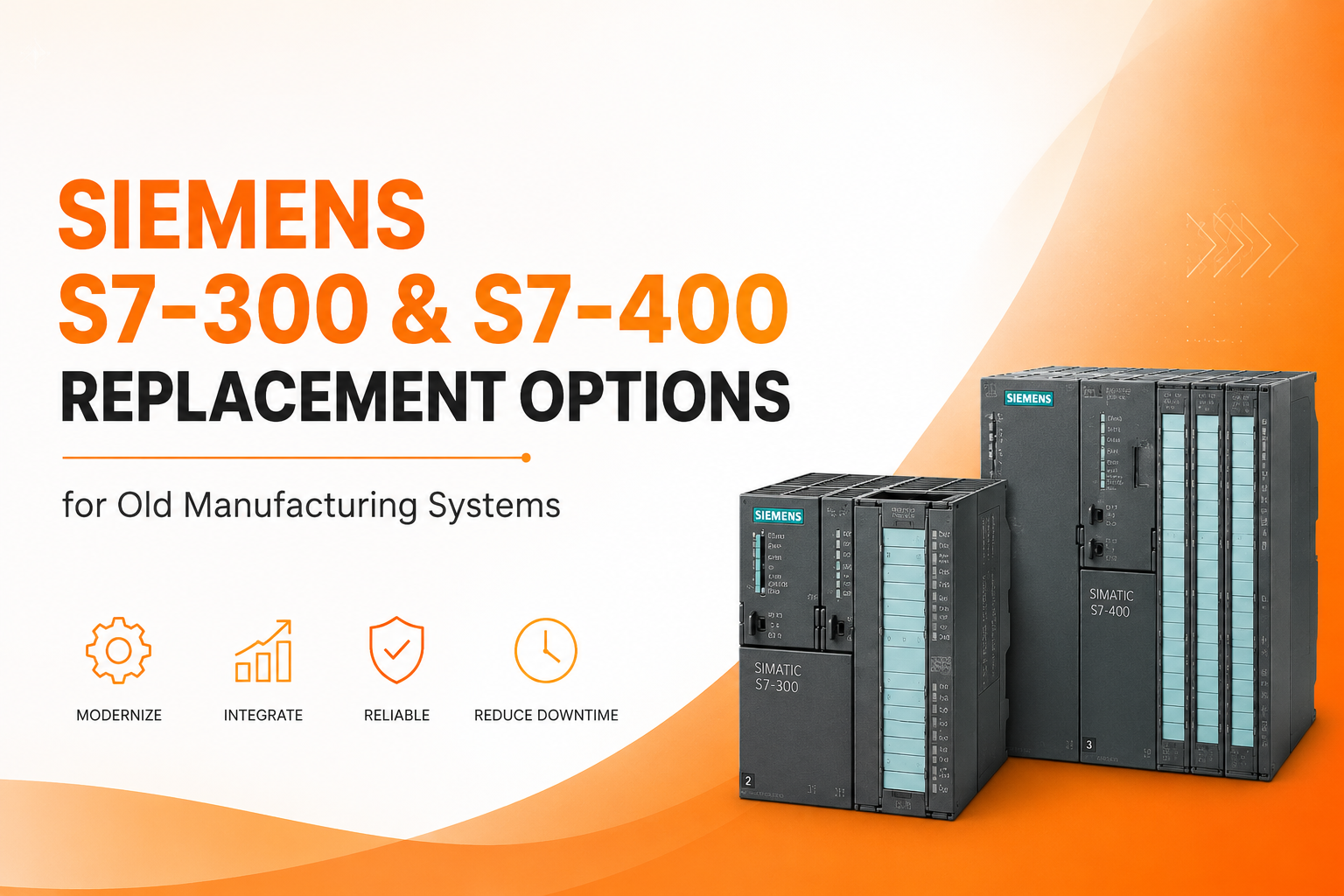
Legacy PLC systems continue to operate at the core of thousands of manufacturing facilities. Many production lines still depend on Siemens S7-300 and S7-400 PLC systems for machine control, process automation, material handling, production monitoring, and other critical operations.
However, keeping an aging PLC system running becomes more challenging over time. Manufacturers may face increasing maintenance requirements, difficulty sourcing reliable spare parts, limitations when expanding production, and challenges integrating legacy automation systems with modern technologies.
Replacing an old Siemens S7-300 or S7-400 PLC does not always mean rebuilding the entire manufacturing system. Depending on the existing automation architecture, manufacturers may choose partial modernization, phased migration, or complete PLC replacement.
The right approach depends on several technical and operational factors, including the existing machine architecture, PLC program complexity, I/O configuration, industrial communication networks, redundancy requirements, safety systems, production downtime constraints, and future expansion plans.
This guide explains the main Siemens S7-300 and S7-400 replacement options and the engineering factors manufacturers should consider before modernizing an old automation system.
Why Manufacturers Are Replacing Siemens S7-300 and S7-400 PLC Systems
Manufacturers replace Siemens S7-300 and S7-400 systems because aging hardware can increase maintenance risk, spare-part dependency, integration limitations, and the likelihood of unplanned production downtime.
A PLC may continue operating reliably for many years, but the long-term risk of maintaining the surrounding automation ecosystem can gradually increase. A manufacturing system should therefore be evaluated based on its complete lifecycle risk rather than only whether the PLC is currently functioning.
Aging Hardware Risks
One of the biggest challenges with legacy PLC systems is hardware availability. When critical components become difficult to source, a relatively small hardware failure can create a significant production risk.
Components that may require long-term maintenance planning include:
- PLC CPUs
- Power supplies
- Digital I/O modules
- Analog I/O modules
- Communication processors
- Remote I/O components
- Memory components
Some manufacturers keep spare modules in inventory to extend the operating life of their automation systems. While this can be a practical short-term strategy, relying heavily on aging or refurbished components may increase uncertainty over time.
A legacy PLC system may also require specialist engineering knowledge that is becoming less common. This can increase dependency on specific engineers or external automation providers.
Increasing Production Downtime Risk
A manufacturing line does not need a complete PLC system failure to experience downtime. A single failed component can interrupt machine operation.
For example, the failure of a CPU, power supply, communication module, or critical I/O component can affect the availability of the entire production process.
The financial impact depends on the application. For some facilities, downtime may result in delayed production. For high-output or continuous manufacturing environments, however, an unexpected automation failure can create a much larger operational problem.
This is why many manufacturers are moving from reactive replacement to planned modernization.
Difficulty Integrating Modern Manufacturing Technologies
Older automation systems were designed for the requirements of their time. Modern manufacturing environments increasingly require data exchange between production equipment and higher-level business or monitoring systems.
Manufacturers may want to connect production equipment with:
- IIoT platforms
- MES systems
- ERP systems
- Modern SCADA platforms
- Production databases
- Cloud monitoring tools
- Remote monitoring systems
- Industrial analytics platforms
These requirements do not automatically mean a legacy PLC must be replaced. However, integration requirements should be evaluated as part of the long-term modernization strategy.
Expansion Limitations
A production system that was originally designed for a fixed process may become increasingly difficult to expand.
Manufacturers may later need to:
- Add new production equipment
- Increase I/O capacity
- Connect additional machines
- Install new sensors
- Improve production data collection
- Add monitoring capabilities
When the existing PLC architecture has limited flexibility, modernization may provide an opportunity to create a more scalable automation foundation.
Is Siemens S7-300 and S7-400 Replacement Always Necessary?
No. A full PLC replacement is not always necessary. Manufacturers may continue operating a stable system, modernize selected components, or perform a complete PLC migration depending on system condition and production requirements.
The best approach is usually determined through an engineering assessment rather than a simple hardware-age decision.
Option 1: Continue Operating the Existing PLC
Continuing with an existing S7-300 or S7-400 system may be reasonable when:
- The system is stable
- Production requirements are unchanged
- Critical spare parts are available
- Maintenance knowledge is available
- Downtime risk is manageable
However, manufacturers should still maintain current backups, system documentation, spare-part planning, and a future migration strategy.
Waiting until a critical component fails can turn a planned engineering project into an emergency recovery project.
Option 2: Partial Modernization
Partial modernization can improve specific areas of an old manufacturing system without immediately replacing the entire PLC architecture.
Examples include:
- HMI modernization
- SCADA upgrades
- Communication improvements
- Remote monitoring integration
- Production data collection
- Selected I/O upgrades
This approach can reduce immediate capital expenditure and spread modernization work across multiple planned shutdown periods.
The trade-off is that the final architecture may temporarily contain both legacy and modern components.
Option 3: Complete PLC Migration
Complete migration may be more suitable when hardware reliability is declining, critical spare parts are difficult to source, major production expansion is planned, or downtime from a future failure would be expensive.
A complete project can also provide an opportunity to review the overall control architecture instead of only replacing an old CPU.
Siemens S7-300 Replacement Options
Siemens S7-300 PLC systems can be replaced with modern automation platforms, but the right replacement depends on CPU requirements, I/O architecture, communication systems, software compatibility, and future manufacturing requirements.
Migration to Siemens S7-1500
Migration to the Siemens S7-1500 platform is often considered during modernization projects because newer automation architectures may provide improved processing capabilities, integrated Ethernet communication, diagnostics, and scalability.
An S7-1500-based modernization may be considered for:
- Production machine upgrades
- Manufacturing line modernization
- PLC hardware replacement
- SCADA modernization
- Industrial data collection
- Digital manufacturing initiatives
However, an S7-300-to-S7-1500 migration should not be treated as a simple CPU swap.
The engineering team should review the existing:
- STEP 7 program
- Hardware configuration
- I/O architecture
- Communication interfaces
- Distributed I/O
- HMI integration
- Drive communication
- Third-party equipment
The migration effort can vary significantly depending on how deeply the PLC is integrated with the rest of the manufacturing system.
Migration to Siemens S7-1200
The Siemens S7-1200 platform may be suitable for certain smaller or less complex automation applications.
Potential applications may include:
- Compact machines
- Smaller control systems
- Systems with limited I/O requirements
- Cost-sensitive modernization projects
However, selecting a smaller platform simply because it has a lower initial hardware cost can create future limitations.
An S7-1200 may not be the most appropriate replacement where the application involves:
- Large distributed I/O systems
- Complex communication networks
- Large manufacturing lines
- High processing requirements
- Advanced redundancy requirements
PLC selection should therefore begin with system requirements rather than product cost alone.
Siemens S7-400 Replacement Options
Siemens S7-400 replacement projects often require more detailed engineering because these systems are commonly used in larger, more complex, or high-availability industrial applications.
S7-400 systems may be found in environments such as:
- Large manufacturing plants
- Process industries
- Chemical facilities
- Power-related applications
- Water and wastewater facilities
- Large production lines
These systems can contain extensive I/O architectures, multiple communication networks, complex control logic, and high availability requirements.
Migration from S7-400 to Siemens S7-1500
An S7-400-to-S7-1500 migration requires a detailed review of the existing automation architecture.
The assessment may include:
- CPU performance requirements
- Existing I/O architecture
- Communication systems
- Network topology
- Safety systems
- SCADA connectivity
- Process control requirements
- Production availability requirements
The correct approach is not to simply select a newer CPU and transfer the program. The replacement architecture should first be engineered around the actual operational requirements of the manufacturing process.
High Availability and Redundant System Replacement
For production environments where system availability is critical, redundancy must be considered early in the migration process.
The engineering assessment may need to review:
- Redundant CPU architecture
- Redundant power supplies
- Communication redundancy
- Network availability
- Failover requirements
- Process continuity
A migration project should preserve the required level of production availability. Changing a redundant legacy architecture to a simpler architecture without evaluating operational risk can create new vulnerabilities.
Siemens S7-300 vs S7-400 Replacement Complexity
S7-400 replacements are generally more complex because these systems are often deployed in larger, more distributed, and higher-availability industrial environments.
| Factor | S7-300 Replacement | S7-400 Replacement |
|---|---|---|
| Typical System Size | Small to medium | Medium to large |
| Migration Complexity | Moderate | Often high |
| I/O Architecture | Varies | Often extensive |
| Communication Networks | Moderate | Often complex |
| Redundancy Requirements | Less common | More common |
| Downtime Planning | Important | Often critical |
| Engineering Assessment | Required | Highly detailed |
This comparison is only a general guide. A heavily customized S7-300 system can be more complex than a relatively simple S7-400 installation.
The actual complexity should be determined through system documentation and engineering analysis.
How to Choose the Right Siemens PLC Replacement
The right Siemens PLC replacement depends on the existing automation architecture, machine complexity, I/O requirements, communication protocols, production criticality, and future expansion plans.
Evaluate the Existing PLC Hardware
Start by documenting the complete existing hardware configuration.
This should include:
- CPU model
- Power supply
- I/O modules
- Communication processors
- Remote I/O stations
- Expansion modules
A complete hardware inventory helps engineers understand which components can potentially remain and which parts require replacement.
Analyze the Existing PLC Program
The PLC software should be assessed before finalizing the replacement strategy.
Important areas include:
- Program size
- Programming languages
- Custom function blocks
- Libraries
- Motion logic
- Process control logic
- Safety logic
Software compatibility should never be assumed. Even when parts of an existing program can be reused, hardware configuration and communication logic may require modification.
Identify Connected Equipment
A PLC rarely operates as an isolated component. Before migration, manufacturers should create an equipment dependency map.
This may include:
- HMIs
- SCADA systems
- VFDs
- Servo drives
- Sensors
- Remote I/O
- Barcode systems
- Vision systems
- Robots
- MES platforms
- ERP-connected systems
This dependency map helps identify hidden integration risks before the production cutover.
Review Industrial Communication Protocols
Communication architecture can significantly influence migration complexity.
The existing system may use:
- PROFINET
- PROFIBUS
- Industrial Ethernet
- Serial communication
- Third-party protocols
Older devices may depend on specific communication interfaces. These dependencies should be identified before selecting the replacement PLC architecture.
Consider Future Manufacturing Requirements
A modernization project should not only solve today’s problem.
Manufacturers should ask:
- Will production capacity increase?
- Will additional machines be added?
- Is remote monitoring required?
- Is MES integration planned?
- Will production data be collected?
- Is predictive maintenance being considered?
A properly planned modernization project can prevent the new automation architecture from becoming another future bottleneck.
Can an Old S7-300 or S7-400 PLC Program Be Reused?
Parts of an existing S7-300 or S7-400 PLC program may be reusable, but hardware configuration, communication logic, system libraries, and certain program elements may require modification during migration.
Potential migration activities include:
- Program conversion
- Manual engineering changes
- Hardware mapping
- Address mapping
- Communication block updates
- HMI tag updates
- Third-party integration changes
The amount of reusable software depends on the original project architecture.
A good engineering process begins with reviewing the existing program and identifying reusable logic, required modifications, and components that need to be redesigned.
I/O Migration Considerations for S7-300 and S7-400 Systems
I/O migration must be carefully planned because replacing a PLC CPU does not automatically guarantee compatibility with existing local or distributed I/O systems.
The assessment should review:
- Existing I/O modules
- Digital signals
- Analog signals
- Remote I/O stations
- Field wiring
- Signal scaling
- Instrument compatibility
Can Existing Field Wiring Be Retained?
In some projects, manufacturers want to minimize panel modifications and wiring work.
Whether existing field wiring can be retained depends on:
- The new hardware architecture
- Terminal configuration
- I/O module selection
- Signal requirements
- Panel design
This is one reason why a detailed I/O survey should be completed before installation work begins.
Communication Migration Challenges
Communication migration is one of the most important parts of replacing legacy Siemens PLC systems because older production equipment may depend on legacy network configurations and protocols.
The PLC may communicate with:
- Older HMIs
- SCADA systems
- Drives
- CNC machines
- Robots
- Barcode scanners
- Production databases
- Third-party PLCs
A communication map should identify every important connection, protocol, device, and dependency.
Missing a single communication requirement can cause unexpected problems during commissioning.
How to Replace Siemens S7-300 or S7-400 Without Major Production Downtime
Production downtime can be reduced through detailed system documentation, offline engineering, testing, phased commissioning, and a planned cutover strategy.
Step 1: Complete an Automation System Assessment
Document the complete automation environment, including:
- Hardware
- PLC software
- I/O
- Networks
- Connected equipment
This creates the technical baseline for migration planning.
Step 2: Backup the Existing System
Before making changes, secure backups of:
- PLC programs
- HMI projects
- SCADA configurations
- Network configurations
- Parameter settings
Backups should be verified rather than simply stored.
Step 3: Develop the Replacement System Offline
Where possible, engineers should complete significant portions of the project before the production shutdown.
Offline work may include:
- PLC configuration
- Program migration
- Hardware mapping
- Communication configuration
This reduces the amount of engineering work required during the actual production cutover.
Step 4: Test Before Installation
Testing should be performed before live commissioning wherever practical.
Testing activities may include:
- Simulation
- I/O testing
- Communication testing
- Functional testing
- Alarm testing
The goal is to identify problems before they affect production.
Step 5: Plan the Production Cutover
The cutover plan should clearly define:
- Shutdown windows
- Engineering responsibilities
- Required spare components
- Installation sequence
- Rollback procedures
- Post-startup monitoring
A migration project should always consider what happens if the new system does not start as expected.
Phased Migration vs Complete PLC Replacement
Phased migration reduces immediate operational disruption, while complete replacement can simplify the final automation architecture and remove more legacy dependencies at once.
Phased Migration
Advantages include:
- Reduced initial downtime
- Lower immediate investment
- Gradual modernization
Challenges can include:
- Temporary mixed architecture
- Additional integration complexity
- Longer modernization timelines
Complete Replacement
Advantages include:
- Faster transition to a modern architecture
- Fewer legacy dependencies
- Simplified long-term maintenance
Challenges include:
- Higher upfront planning requirements
- Larger shutdown windows
- More extensive commissioning
The correct approach depends on production constraints, risk tolerance, budget planning, and technical dependencies.
Common Mistakes During Siemens PLC Replacement Projects
The biggest mistakes during PLC replacement projects usually involve underestimating software, communication, I/O, and production downtime requirements.
Common mistakes include:
- Replacing the CPU without reviewing the complete automation system.
- Ignoring communication dependencies.
- Assuming existing PLC code will work without modification.
- Failing to document field devices and I/O.
- Underestimating commissioning time.
- Not preparing a rollback strategy.
- Ignoring future expansion requirements.
- Selecting hardware based only on initial purchase cost.
A PLC migration is an engineering project involving hardware, software, networks, production processes, and operational risk.
When Should You Start Planning an S7-300 or S7-400 Replacement?
Manufacturers should begin planning before a critical PLC failure occurs, particularly when spare parts are becoming difficult to source or production downtime would be expensive.
Warning signs include:
- Increasing hardware failures
- Difficulty sourcing spare parts
- Dependence on refurbished components
- Aging engineering environments
- Planned production expansion
- New integration requirements
- Increasing maintenance costs
The best time to plan a migration is when the existing system is still operating. This gives the engineering team time to document the architecture, test the replacement strategy, and schedule the project around planned production downtime.
Siemens S7-300 and S7-400 Replacement Checklist
Before starting a migration project, manufacturers should complete the following checklist.
Hardware
- Existing CPU documented
- I/O modules documented
- Power supplies documented
- Communication modules documented
Software
- PLC program backed up
- HMI project backed up
- SCADA configuration documented
Communication
- Network topology documented
- Connected devices identified
- Protocol requirements reviewed
Production
- Downtime window identified
- Cutover plan prepared
- Rollback plan prepared
Future Requirements
- Expansion requirements reviewed
- Production data requirements reviewed
- IIoT integration considered
Siemens S7-300 and S7-400 Replacement Services
A professional PLC migration service can help manufacturers assess legacy systems, design the replacement architecture, migrate PLC software, test communication, and support commissioning.
AutomatexLab can support legacy Siemens PLC modernization projects through a structured engineering approach.
Legacy PLC Assessment
The first stage is understanding the existing system.
This may include:
- Hardware review
- System architecture analysis
- Migration feasibility assessment
Replacement Architecture Design
The replacement system can then be designed around the actual application requirements.
This may include:
- PLC selection
- I/O architecture
- Communication design
PLC Program Migration
PLC software migration may involve:
- Program review
- Logic migration
- Code modification
- Testing
HMI and SCADA Integration
Modernization may also require:
- Tag migration
- Communication updates
- Screen testing
Industrial Communication Integration
Automation systems often require communication between multiple platforms.
Integration services may include:
- PLC-to-device communication
- PLC-to-SCADA integration
- PLC-to-database integration
- Industrial network configuration
Commissioning and Migration Support
The final phase may include:
- Pre-commissioning testing
- Cutover planning
- Startup support
- Troubleshooting
Get Expert Help with Siemens Legacy PLC Replacement
Replacing an aging Siemens S7-300 or S7-400 PLC should be treated as a planned modernization project rather than an emergency hardware replacement.
A structured assessment can help manufacturers understand the current automation architecture, identify practical replacement options, evaluate PLC program migration requirements, and plan hardware, I/O, communication, and commissioning activities.
AutomatexLab can help manufacturers evaluate legacy Siemens automation systems and develop a practical migration strategy based on their production requirements.
If your manufacturing system depends on an aging Siemens S7-300 or S7-400 PLC, planning the replacement before a critical failure can help reduce modernization risk and provide more control over downtime, testing, and future automation expansion.
Frequently Asked Questions About Siemens S7-300 and S7-400 Replacement
What is the best replacement for Siemens S7-300?
The best replacement depends on the existing machine requirements, PLC program complexity, I/O architecture, communication requirements, and future expansion plans. A detailed engineering assessment should be completed before selecting the replacement platform.
What is the best replacement for Siemens S7-400?
The best replacement depends heavily on application complexity, system availability requirements, I/O architecture, communication networks, and redundancy requirements. Large or high-availability systems generally require a more detailed migration assessment.
Can S7-300 programs be migrated to a newer Siemens PLC?
Parts of an existing program may be reusable, but hardware configuration, communication logic, libraries, and integration components may require modification.
Can I replace an S7-400 without replacing the entire control panel?
In some cases, selected components of the control system can be modernized without replacing the complete panel. The feasibility depends on the existing wiring, I/O architecture, panel layout, and replacement hardware.
How long does an S7-300 PLC migration take?
Migration timelines vary based on program complexity, I/O quantity, connected equipment, testing requirements, and available production downtime. A smaller system may require significantly less engineering than a large production line.
How long does an S7-400 PLC migration take?
S7-400 migration timelines can be longer because these systems may involve larger I/O architectures, complex networks, redundancy requirements, and more extensive commissioning.
Can production continue during PLC migration?
In some cases, phased migration can allow parts of a facility to continue operating. However, the feasibility depends on the production architecture and whether systems can be isolated safely.
Can old PROFIBUS devices work with a new PLC?
Compatibility depends on the selected architecture, existing devices, communication requirements, and migration design. Existing devices should be assessed individually before planning the migration.
Do I need to replace my existing HMI during PLC migration?
Not always. The existing HMI may potentially remain if compatibility and communication requirements are satisfied. However, HMI modernization may be beneficial when the current system also has lifecycle, usability, or integration limitations.
Can a PLC migration be completed remotely?
Some parts of a PLC migration can be completed remotely, including software assessment, program review, program migration, configuration, and selected engineering tasks.
However, physical installation, wiring changes, hardware replacement, and on-site commissioning may require site personnel or local engineering support.