PLC Migration Services for Legacy and Obsolete Control Systems
Upgrade outdated PLC systems with a structured PLC migration strategy designed to reduce operational risk, improve system reliability, and extend the lifecycle of your industrial automation infrastructure. We help manufacturers migrate legacy PLC hardware, PLC programs, communication networks, HMIs, SCADA systems, and connected control components to modern automation platforms with minimal disruption to production.
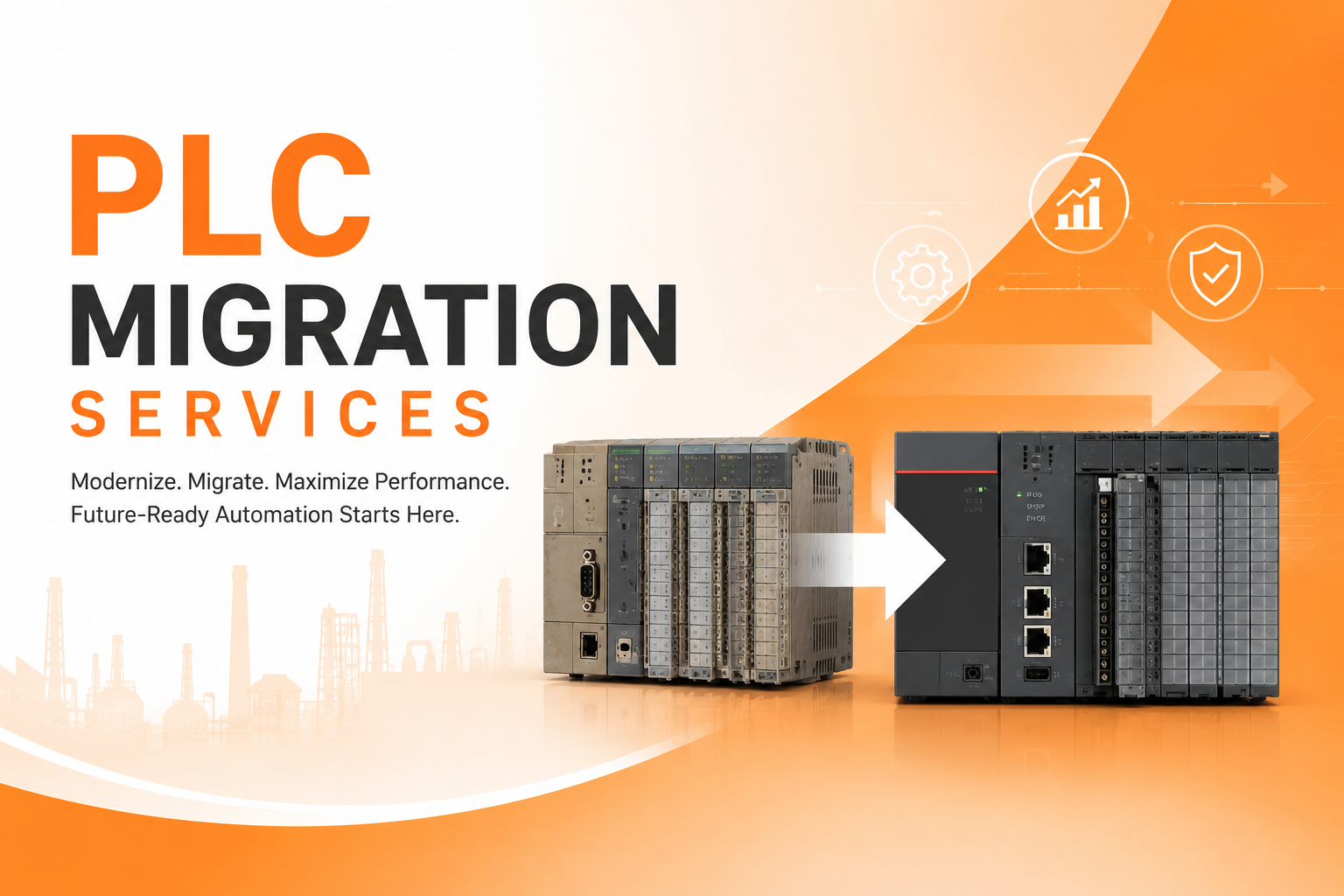
Replace Aging PLC Systems Before Obsolescence Creates Production Risks
Industrial facilities often continue operating legacy PLC systems long after hardware availability, software support, and technical expertise begin disappearing. A planned PLC migration replaces or modernizes aging automation infrastructure before an unexpected controller failure creates extended production downtime.
What Is PLC Migration?
PLC migration is the process of replacing or upgrading an existing programmable logic controller system while transferring, converting, validating, or rebuilding its control logic, hardware configuration, communications, HMI, SCADA, and connected industrial systems.
Obsolete PLC Hardware
Older PLC CPUs, I/O modules, power supplies, and communication cards may no longer be manufactured or readily available.
Unsupported Programming Software
Legacy engineering software can become incompatible with modern operating systems and difficult to maintain.
Difficult Spare-Part Availability
A failed module can create long downtime when replacement parts are discontinued or only available through unreliable secondary markets.
Lack of Technical Documentation
Many legacy systems have incomplete electrical drawings, outdated PLC programs, or undocumented modifications.
Growing Cybersecurity and Connectivity Limitations
Older automation platforms may not support modern industrial communication, remote monitoring, or secure integration requirements.
What Does PLC Migration Include?
PLC migration involves much more than replacing one PLC CPU with another. A complete PLC migration project may include the following scope.
PLC Migration Definition
PLC migration modernizes an existing industrial control system by replacing obsolete or unsuitable PLC hardware and software while preserving, improving, or rebuilding the control functionality required for the production process.
PLC Platforms and Legacy Systems We Can Assess for Migration
We assess migration requirements for the PLC platforms most commonly found running on aging production floors, evaluating each system on its own hardware, program and communication constraints.
Siemens PLC Migration
- Siemens S5 to S7 migration
- SIMATIC S7 legacy system modernization
- Older S7 systems to newer automation platforms
- STEP 5 to STEP 7 logic migration
- Legacy Siemens HMI modernization
- PROFIBUS to modern communication architecture planning
Mitsubishi PLC Migration
- MELSEC legacy PLC replacement
- Mitsubishi PLC hardware upgrades
- PLC program migration
- Legacy HMI modernization
- Ethernet communication integration
- Remote monitoring readiness
Rockwell Automation / Allen-Bradley PLC Migration
- Legacy Allen-Bradley PLC replacement
- PLC-5 migration
- SLC modernization
- ControlLogix migration planning
- CompactLogix migration
- RSLogix program modernization
Omron PLC Migration
- Legacy Omron PLC replacement
- Program conversion
- I/O migration
- Communication redesign
- HMI integration
Schneider Electric PLC Migration
- Modicon legacy PLC migration
- Control system modernization
- PLC program redevelopment
- Communication integration
Other Platforms
We can assess migration requirements for additional PLC manufacturers and legacy automation platforms based on hardware availability, program accessibility, I/O requirements, communication architecture, and production constraints. Contact us with your PLC details.
Our Complete PLC Migration Services
PLC Migration Assessment
Before recommending replacement hardware, we assess the existing automation environment. Assessment may include PLC CPU identification, I/O module inventory, rack configuration, power supply assessment, communication modules, network topology, existing PLC software availability, program backup status, electrical drawings, HMI and SCADA dependencies, third-party equipment interfaces, and production-critical sequences.
Request a Legacy PLC Assessment →Legacy PLC Hardware Migration
Replace obsolete or aging PLC components with suitable modern hardware. Scope may include CPU replacement, I/O module replacement, rack migration, power supply upgrades, communication module replacement, remote I/O modernization, and industrial network upgrades.
Hardware selection depends on the number of I/O points, motion requirements, safety requirements, scan time requirements, communication protocols, future expansion, environmental conditions, and existing panel space.
PLC Program Migration and Conversion
Legacy PLC programs may require direct logic conversion, manual program redevelopment, code restructuring, function block modernization, tag restructuring, alarm logic improvement, sequence validation, and interlock validation.
Not every PLC program can be automatically converted. Migration requirements depend on the source and target PLC platforms, programming languages, proprietary instructions, hardware dependencies, and communication architecture.
PLC I/O Mapping and Validation
I/O mapping covers digital input mapping, digital output mapping, analog input mapping, analog output mapping, signal scaling, sensor mapping, actuator mapping, spare I/O planning, and field device validation.
PLC and HMI Migration for Complete Control System Modernization
A PLC upgrade may require HMI updates because older panels, communication drivers, or visualization software may not work with the new controller. Services can include HMI project backup, screen migration, alarm migration, recipe migration, historical data configuration, user management, communication configuration, new HMI screen development, and operator interface improvements.
SCADA Migration and Integration
Support includes legacy SCADA upgrades, PLC communication reconfiguration, OPC connectivity, OPC UA integration, industrial Ethernet communication, database integration, production data collection, alarm configuration, and historian integration. See our SCADA development services.
Our PLC Migration Process
This section is designed to clearly reduce buyer concerns about downtime and technical risk by making every stage of the migration visible upfront.
Existing System Discovery
Collect and review PLC model information, PLC programs, electrical drawings, HMI projects, SCADA configuration, network details and production requirements.
Migration Feasibility Analysis
Evaluate hardware compatibility, software availability, program conversion requirements, communication dependencies, downtime constraints and potential technical risks.
Migration Strategy and Architecture
Develop the target PLC architecture, hardware selection, I/O mapping, communication architecture, migration sequence and testing strategy.
PLC Software Development
Perform program conversion, logic redevelopment, tag configuration, alarm configuration and communication programming.
Offline Testing
Where possible, test PLC logic, validate sequences, simulate I/O, test communications and identify errors before implementation.
Migration Preparation
Prepare PLC hardware, programs, documentation, backup files, rollback strategy and an implementation checklist.
Cutover and Commissioning Support
Support the transition from the legacy system to the new control platform according to the agreed migration plan.
Validation and Documentation
Finalize PLC backups, updated documentation, I/O lists, network documentation, program records and migration reports.
How We Plan PLC Migration Around Production Downtime
PLC migration does not necessarily mean uncontrolled or extended production downtime. A properly planned migration can reduce risk through advance program development, offline testing, preconfigured hardware, I/O documentation, migration checklists, planned shutdown windows, phased migration and rollback preparation.
Actual downtime depends on the complexity of the existing control system, equipment accessibility, hardware changes, testing requirements, and the migration strategy.
What Changes After a PLC Migration?
| Legacy PLC Environment | Modernized PLC Environment |
|---|---|
| Obsolete hardware | Supported automation hardware |
| Limited spare parts | Improved replacement availability |
| Older programming software | Modern engineering environment |
| Limited communication | Modern industrial connectivity |
| Difficult maintenance | Improved maintainability |
| Poor documentation | Updated system documentation |
| Limited expansion | Better scalability |
| Higher failure risk | Improved lifecycle planning |
Benefits of Modernizing Your PLC Control System
Reduced Obsolescence Risk
Move away from discontinued components before unexpected failures affect production.
Improved System Reliability
Modern hardware can improve maintainability and component availability.
Better Spare-Part Planning
Use supported hardware with a more predictable lifecycle.
Easier Troubleshooting
Modern programming tools and updated documentation can simplify diagnostics.
Improved Industrial Connectivity
Modern PLC platforms can support newer communication and integration requirements.
Future Expansion
Design the control architecture with additional capacity for future equipment or production changes.
Better Data Availability
Connect production systems to dashboards, databases, MES, ERP, and industrial analytics platforms where appropriate.
PLC Migration Engineering Services Available Remotely
Many engineering activities can be completed remotely when the required files and system information are available, which shapes how AutomatexLab prices and schedules migration projects.
Work That Can Often Be Done Remotely
- PLC program analysis
- Legacy PLC software review
- Migration planning
- PLC code conversion
- PLC program redevelopment
- I/O mapping
- HMI development
- SCADA development
- Communication configuration
- Database integration
- Documentation
- Remote troubleshooting support
What May Require On-Site Support
- Physical hardware replacement
- Electrical rewiring
- Panel modifications
- Field I/O testing
- Physical commissioning
PLC Migration Solutions for Industrial Applications
Manufacturing Plants
Production machines, assembly systems, packaging lines, and process automation.
Food and Beverage
Batch processes, conveyors, filling machines, packaging, and utilities.
Automotive Manufacturing
Assembly equipment, material handling, robotics integration, and production systems.
Chemical and Process Industries
Process control systems, pumps, tanks, dosing systems, and monitoring infrastructure.
Pharmaceuticals
Production equipment and automation systems requiring controlled processes and documented system changes.
Water and Wastewater
Pump control, treatment systems, remote monitoring, and distributed automation.
Material Handling and Warehousing
Conveyor systems, sorting equipment, automated handling, and warehouse automation.
When Does a PLC System Need Migration?
A PLC migration should be evaluated when any of the following apply to your production environment.
PLC Migration Technical Capabilities
PLC Programming
- Ladder Logic
- Function Block Diagram
- Structured Text
- Sequential logic
- State-based machine control
Industrial Communication
- Modbus
- Modbus TCP
- OPC UA
- OPC DA where applicable
- Ethernet/IP
- PROFINET
- PROFIBUS
- MQTT where appropriate
System Integration
- PLC to HMI
- PLC to SCADA
- PLC to database
- PLC to MES
- PLC to ERP
- PLC to industrial dashboards
- PLC to IIoT platforms
How We Reduce Risk During PLC Migration
Industrial buyers are often more concerned about risk than features, which is why risk reduction is built into every stage of a migration project rather than treated as an afterthought.
PLC migration should be treated as a control-system engineering project, not simply a hardware replacement.
Why Choose AutomatexLab for PLC Migration Services
Automation-Focused Engineering
Work centered on industrial control systems, PLC programming, HMI, SCADA, and automation integration.
Platform-Aware Migration Planning
Evaluate both the existing PLC architecture and the requirements of the target automation platform.
Remote Engineering Capability
Complete software development, migration planning, analysis, and integration tasks remotely where possible.
Custom Migration Approach
Migration requirements vary significantly based on legacy hardware, process complexity, and production constraints.
Documentation and Maintainability
Focus on delivering organized automation assets that are easier to understand and maintain.
What Information Do We Need to Assess a PLC Migration Project?
Providing the following details helps us qualify your migration requirements and respond with a meaningful assessment rather than a generic quote.
- Existing PLC manufacturer and model
- CPU model
- I/O modules
- PLC program backup
- HMI project files
- SCADA details
- Electrical drawings
- Communication protocols
- Number of machines or control panels
- Production process information
- Preferred target PLC platform
- Required completion timeline
Typical PLC Migration Scenarios
Every migration is shaped by the specific legacy system involved. These typical scenarios reflect the kind of migration challenges we assess and plan for. View our case studies for further project examples.
Discontinued CPU on a Single-Line Plant
A plant running its entire production line on one aging PLC CPU faces a discontinued hardware model with no direct replacement, requiring a full hardware and program migration plan alongside a rollback strategy for the cutover window.
Legacy HMI Blocking a Controller Upgrade
A manufacturer wants to upgrade the PLC but the existing HMI panel and communication driver cannot support the new controller, requiring HMI migration alongside the PLC hardware and program work.
Undocumented Legacy Logic
A facility has no available PLC program backup for an aging system, requiring the control logic to be reconstructed through machine observation, electrical drawings, and engineering investigation before a migration plan can be built.
PLC Migration Services FAQs
What is PLC migration?
Can an old PLC program be directly converted to a new PLC?
How long does a PLC migration take?
Can PLC migration work be completed remotely?
Do you migrate only PLC hardware?
Can you migrate an obsolete Siemens or Mitsubishi PLC?
Will PLC migration require production downtime?
What happens if the old PLC program is unavailable?
Explore More Automation Services
Planning a PLC Migration or Legacy Control System Upgrade?
If your facility operates an aging, unsupported, or obsolete PLC system, an early technical assessment can help identify migration requirements before a critical hardware failure affects production. Share your existing PLC details, available project files, and migration objectives to begin evaluating a suitable modernization approach.