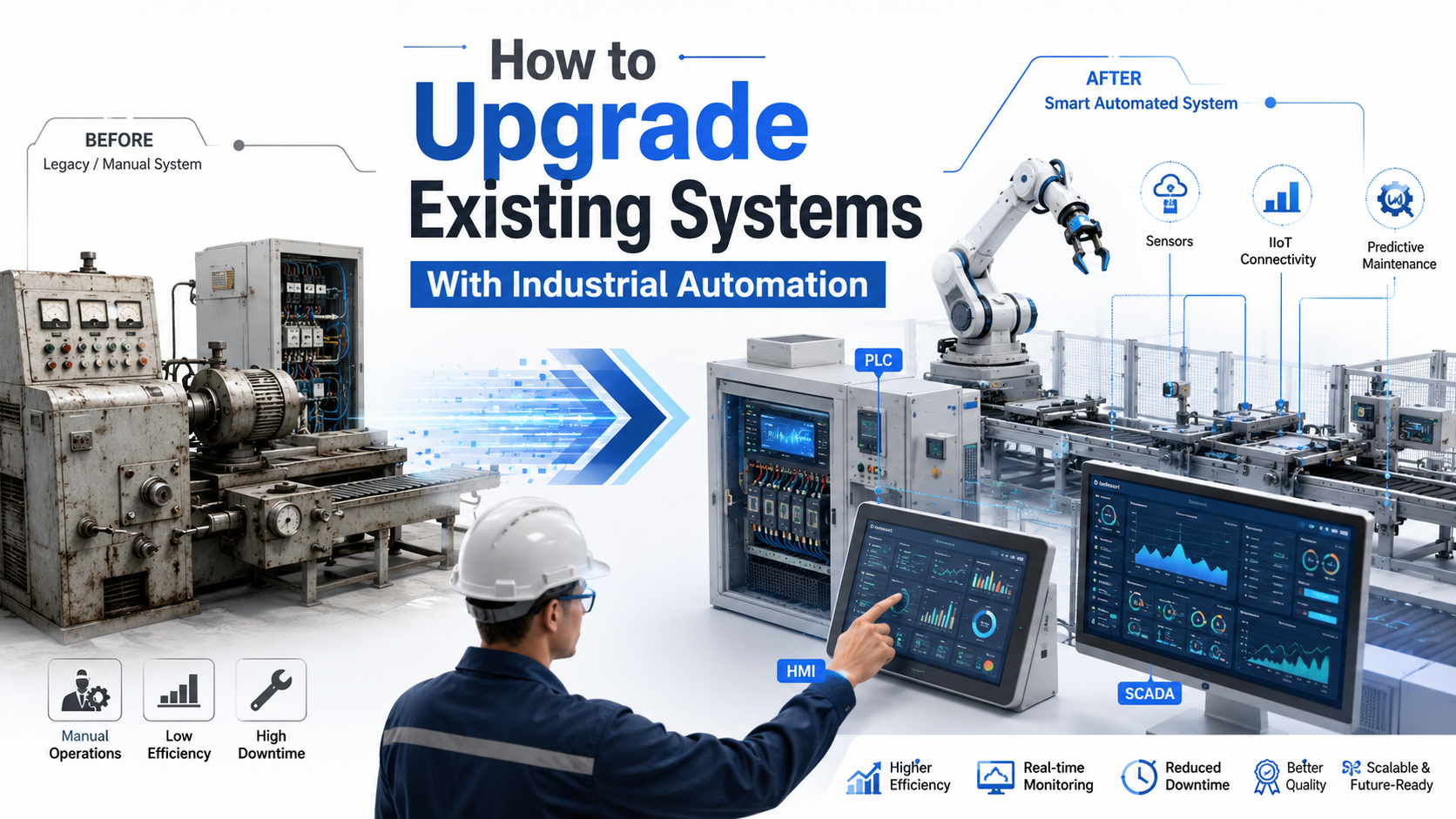
Upgrading existing systems with industrial automation means integrating modern technologies like PLCs, SCADA, sensors, IIoT, and smart controls into old industrial setups to improve efficiency, reduce downtime, and enable real-time monitoring without completely replacing machinery.
Introduction
Thousands of factories across the United States still operate with machinery from the 1980s and 1990s. These legacy systems work, but they lack the efficiency, monitoring capabilities, and connectivity that modern manufacturing demands.
The reality is simple. Replacing an entire production line costs millions of dollars. Most small to mid-sized manufacturers cannot afford complete overhauls. They need practical solutions that modernize existing equipment without breaking the bank.
Industrial automation offers that solution. By retrofitting old machines with PLCs, sensors, HMI panels, and SCADA systems, factories can dramatically improve productivity, safety, and data visibility while keeping their core equipment operational.
This approach extends machine life, reduces downtime, and positions manufacturers for Industry 4.0 without requiring massive capital investment.
What Does Upgrading Existing Industrial Systems Mean?
Upgrading existing industrial systems means modernizing old infrastructure by adding automation layers to machines that still have useful operational life.
Definition and Core Concept
The process involves retrofitting rather than replacing. You keep your existing motors, conveyors, pumps, and production equipment. You upgrade the control systems, add sensors, and integrate modern communication networks.
Think of it like renovating a house. You keep the foundation and structure but upgrade the electrical system, add smart thermostats, and install modern fixtures.
Common Upgrade Examples
Adding PLCs to relay-based systems transforms outdated hardwired logic into flexible, programmable control.
Replacing manual controls with HMI panels gives operators touchscreen interfaces instead of dozens of physical buttons and switches.
Integrating sensors into old production lines enables real-time monitoring of temperature, pressure, speed, and position.
Connecting machines to SCADA dashboards provides centralized visibility across the entire facility.
Adding predictive maintenance systems uses sensor data and analytics to predict equipment failures before they happen.
Why Industries Upgrade Existing Systems Instead of Replacing Everything
The decision to upgrade rather than replace comes down to economics, practicality, and operational continuity.
Lower Investment Cost
Reusing existing machinery cuts project costs by 60% to 80% compared to new equipment purchases. Your motors, frames, conveyors, and mechanical components still work fine. They just need smarter control systems.
Avoiding full factory shutdowns saves even more money. Gradual upgrades mean production continues while modernization happens in phases.
Reduced Downtime
Phased automation implementation allows you to upgrade one production line at a time. The rest of the factory keeps running.
This approach minimizes revenue loss and maintains customer commitments during the transition period.
Longer Equipment Life
Well-built industrial equipment from decades past often has superior mechanical construction compared to modern alternatives. Extending machine usability through control system upgrades makes financial sense.
Improved operational reliability comes from replacing failing electrical components while keeping proven mechanical systems.
Better Data Visibility
Real-time production monitoring becomes possible when you add sensors and connectivity to old machines.
Performance tracking, OEE calculations, and trend analysis transform how you manage operations. You move from gut feelings to data-driven decisions.
Improved Safety
Emergency stop integration, alarm systems, and safety PLCs protect workers better than outdated safety mechanisms.
Modern safety standards require capabilities that relay-based systems simply cannot provide.
Signs Your Existing System Needs Automation Upgrades
Several warning signs indicate your factory would benefit from automation retrofits.
Frequent machine downtime suggests aging electrical components and lack of predictive maintenance capabilities.
Manual data recording wastes operator time and introduces errors. Automated data collection eliminates both problems.
Lack of real-time monitoring means you discover problems after they impact production, not before.
Increasing maintenance costs often result from constantly replacing the same failing components in outdated control systems.
Low production efficiency happens when machines cannot communicate, synchronize, or optimize automatically.
Inconsistent product quality indicates control systems that cannot maintain tight tolerances or adapt to variations.
Difficulty scaling operations shows that current systems have reached their limits for expansion.
Obsolete electrical components create supply chain nightmares when replacement parts become unavailable.
Step-by-Step Process to Upgrade Existing Systems With Industrial Automation
Analyze the Current System
The first step requires understanding exactly what you have and how it works.
Machine Audit: Document every machine, controller, motor, sensor, and electrical component. Identify manufacturers, model numbers, and current configurations.
Understand control logic: Review existing relay logic, ladder diagrams, and electrical drawings. Map out how machines currently operate and interact.
Review electrical drawings: Locate and digitize all schematics. Many older factories have outdated or missing documentation that must be recreated.
Identify Bottlenecks: Walk the production floor and document where problems occur. Note downtime issues, manual operations that slow production, and energy waste from inefficient processes.
Check Compatibility: Verify that existing motors, drives, and communication infrastructure can work with modern automation components. Sometimes mechanical components are fine but electrical interfaces need adapters.
Define Automation Goals
Clear objectives guide technology choices and project scope.
Production Goals: Specify target throughput increases, cycle time reductions, or capacity expansions.
Energy Efficiency Goals: Set targets for power consumption reduction through variable frequency drives and optimized control.
Monitoring Requirements: Determine what data you need, how often you need it, and who needs access.
Remote Access Needs: Decide if operators, maintenance staff, or managers need mobile or off-site system access.
Quality Improvement Targets: Define acceptable defect rates and quality metrics the new system must achieve.
Choose the Right Automation Technologies
Technology selection directly impacts project success.
PLC Upgrades provide better machine control, faster processing, and programming flexibility. Siemens PLCs offer robust industrial-grade reliability. Rockwell Automation PLCs integrate seamlessly with existing North American infrastructure. Mitsubishi Electric PLCs deliver cost-effective performance for many applications.
HMI Integration replaces banks of indicator lights and buttons with intuitive touchscreen operator panels. Modern HMIs simplify machine operation and reduce training time.
SCADA Systems enable centralized monitoring across multiple production lines. They handle alarm management, data logging, and trend visualization from a single interface.
Industrial IoT Integration connects machines to cloud platforms for remote monitoring, predictive maintenance algorithms, and advanced analytics.
Sensor Modernization upgrades old limit switches and mechanical sensors to smart temperature sensors, pressure transmitters, vision systems, and proximity sensors that provide richer data.
Upgrade Electrical and Control Panels
Physical infrastructure must support new automation systems.
Replace Outdated Relay Logic: Swap electromechanical relays with solid-state components and PLC logic. This improves reliability and makes changes easy.
Modernize Wiring: Replace aging wire with current-rated cables. Label everything clearly. Use terminal blocks and proper strain relief.
Add Industrial Communication Networks: Install Ethernet switches, fiber optic links, or industrial wireless systems for machine connectivity.
Install Safety Systems: Integrate safety relays, light curtains, e-stops, and safety-rated PLCs that meet current OSHA requirements.
Improve Power Management: Add uninterruptible power supplies, voltage regulators, and proper grounding to protect sensitive electronics.
Integrate Communication Protocols
Modern factories require machines that talk to each other.
Modbus remains popular for simple serial communication between devices. It works well for basic sensor and drive integration.
OPC UA provides platform-independent, secure communication. It is becoming the Industry 4.0 standard for data exchange.
Ethernet/IP dominates in Rockwell Automation environments and offers high-speed network communication.
Profinet serves as the go-to protocol for Siemens ecosystems and European-designed equipment.
Machine-to-machine communication enables coordinated operation. Centralized monitoring becomes possible when all devices speak compatible protocols. Data collection feeds analytics and continuous improvement initiatives.
Implement SCADA and Monitoring Systems
SCADA platforms transform raw machine data into actionable intelligence.
Real-Time Dashboards display production status, machine states, and performance metrics at a glance.
Alarm Notifications alert operators immediately when problems occur. Escalation rules ensure critical issues get appropriate attention.
Historical Data Logging stores weeks or months of operational data for trend analysis and troubleshooting.
Remote Monitoring allows managers and engineers to check factory status from anywhere with internet access.
Production Analytics calculate OEE, identify bottlenecks, and highlight improvement opportunities automatically.
Test the Entire System
Thorough testing prevents production disasters.
FAT and SAT Testing: Factory Acceptance Testing happens before installation. Site Acceptance Testing verifies everything works in the actual production environment.
Safety Validation: Prove that all safety systems function correctly under normal and fault conditions.
Load Testing: Run the system at full production speed with actual materials to identify performance issues.
Sensor Calibration: Verify that every sensor reads accurately across its full range.
Operator Testing: Have actual operators use the new system and provide feedback before going live.
Train Operators and Maintenance Teams
Technology only works when people know how to use it.
HMI Training teaches operators how to start, stop, and monitor machines using new touchscreen interfaces.
Alarm Handling explains what different alarms mean and how to respond appropriately.
PLC Troubleshooting Basics gives maintenance staff the skills to diagnose and fix common control issues.
Maintenance Procedures document new preventive maintenance tasks for automation equipment.
Safety Training ensures everyone understands new safety features and emergency procedures.
Key Technologies Used in Industrial Automation Upgrades
PLC Systems form the brains of modern industrial control. They replace relay logic with flexible, programmable intelligence.
SCADA Platforms provide visualization, data logging, and centralized control across entire facilities.
HMI Interfaces give operators intuitive touchscreen control and real-time status information.
VFD Drives control motor speed precisely, saving energy and enabling process optimization.
Industrial Sensors measure temperature, pressure, flow, level, position, and dozens of other parameters.
Robotics Integration adds automated material handling, welding, painting, or assembly to existing lines.
Industrial IoT Gateways connect legacy equipment to cloud platforms and modern IT networks.
Edge Computing Devices process data locally for faster response times and reduced cloud bandwidth.
Challenges While Upgrading Existing Systems
No automation project proceeds without obstacles.
Compatibility Issues arise when new components must interface with equipment from multiple manufacturers and different eras.
Lack of Documentation makes understanding existing systems difficult. Reverse engineering takes time and expertise.
Legacy Machine Limitations sometimes prevent full automation. Mechanical constraints may limit what control systems can achieve.
Downtime During Installation requires careful planning to minimize production impact. Weekends and holidays become valuable installation windows.
Cybersecurity Risks increase when connecting factory networks to corporate IT or the internet. Proper network segmentation and security measures are essential.
Resistance to Change happens when experienced operators fear new technology or worry about job security. Change management and clear communication help overcome this.
Best Practices for Successful Automation Upgrades
Start With Critical Areas: Focus first on the production bottlenecks or quality problems that cost the most money.
Upgrade in Phases: Break large projects into manageable pieces. Prove value early and build momentum.
Keep Backup Systems: Maintain fallback options during transitions. Do not remove old systems until new ones prove reliable.
Use Standardized Components: Stick with mainstream brands and open protocols. Avoid proprietary solutions that lock you into single vendors.
Focus on Scalability: Choose systems that can grow. What works for three machines today should expand to twenty machines tomorrow.
Choose Reliable Automation Partners: Work with integrators who have proven track records in your industry. Check references carefully.
Prioritize Cybersecurity: Implement firewalls, network segmentation, user authentication, and regular security updates from day one.
Real-World Example of Industrial Automation Retrofit
An old packaging plant in Ohio operated relay-based controls installed in 1987. Frequent downtime, manual monitoring, and inability to track production metrics cost them thousands of dollars monthly.
The automation upgrade installed a Rockwell Automation CompactLogix PLC system to replace failing relay panels. An Allen-Bradley PanelView HMI touchscreen simplified operator control. A SCADA dashboard connected all packaging lines for centralized monitoring. Temperature, pressure, and speed sensors provided real-time process data.
Results came quickly. Downtime dropped 40% in the first six months. Production speed increased 25% through better synchronization. Quality consistency improved as automated controls maintained tighter tolerances. Real-time reporting enabled data-driven decisions instead of guesswork.
The total investment paid for itself in 18 months through reduced downtime and increased throughput.
Cost of Upgrading Existing Systems With Industrial Automation
Project costs vary widely based on scope and complexity.
Factory size directly impacts cost. Automating a 10,000 square foot facility costs far less than a 200,000 square foot campus.
Number of machines determines how many PLCs, sensors, and network connections you need.
Type of automation matters greatly. Simple PLC replacements cost less than full IIoT implementations with cloud analytics.
Software requirements add expense. SCADA platforms, HMI development tools, and analytics software require licensing fees.
Electrical modifications include new panels, wiring, network infrastructure, and power conditioning.
Basic retrofit projects for small facilities might range from $50,000 to $150,000. Mid-sized upgrades covering multiple production lines typically cost $200,000 to $500,000. Full smart factory transformations for large manufacturers can exceed several million dollars.
The key is matching investment to expected returns. Well-planned automation upgrades typically pay for themselves in 1 to 3 years through reduced downtime, lower labor costs, and increased throughput.
Future Trends in Industrial Automation Upgrades
AI-Based Predictive Maintenance uses machine learning algorithms to predict equipment failures days or weeks in advance. This transforms maintenance from reactive to proactive.
Smart Factories integrate automation, IoT, analytics, and AI into unified systems where machines optimize themselves.
Digital Twins create virtual replicas of physical production lines. Engineers test changes in simulation before implementing them on real equipment.
Edge AI in Manufacturing brings artificial intelligence directly to factory floors for real-time decision making without cloud latency.
Cloud-Based SCADA eliminates on-premise servers and enables access from anywhere while reducing IT infrastructure costs.
Autonomous Robotics advances beyond simple programmed tasks to robots that can learn, adapt, and collaborate with human workers.
How AutomatexLab Helps Industries Upgrade Existing Systems
AutomatexLab specializes in practical industrial automation solutions for manufacturers who need to modernize without massive investment.
Our PLC programming services cover Siemens, Rockwell Automation, Mitsubishi, and other major platforms. We write efficient, maintainable code that keeps your operations running smoothly.
SCADA development expertise delivers intuitive dashboards that give you real-time visibility into every aspect of production.
HMI design creates operator interfaces that are easy to learn and simple to use, reducing training time and operator errors.
Industrial IoT integration connects your legacy equipment to modern cloud platforms for advanced analytics and remote monitoring.
Automation retrofitting transforms old relay-based systems into flexible, programmable control without replacing proven mechanical equipment.
Factory monitoring systems provide the real-time data and alerts you need to optimize operations and prevent problems.
Troubleshooting and modernization services help when existing automation systems fail or need performance improvements.
Upgrade Your Existing Factory Systems Without Replacing Everything
At AutomatexLab, we help industries modernize old machines and production systems using practical industrial automation solutions. From PLC upgrades and SCADA integration to smart monitoring and IIoT connectivity, we help factories improve efficiency, reduce downtime, and build scalable automation systems.
Our engineers understand that every factory is unique. We assess your specific needs, design solutions that fit your budget, and implement upgrades that deliver measurable results.
Contact AutomatexLab today to discuss how industrial automation can transform your existing production systems without the cost and disruption of complete replacement.
Conclusion
Upgrading existing systems with industrial automation has become essential for manufacturers who want to remain competitive. The good news is that modernization does not require replacing everything at once.
Strategic retrofits allow factories to improve gradually, spreading costs over time while continuously improving performance. Each upgrade builds on previous improvements, creating momentum toward fully connected, optimized operations.
Industry 4.0 and smart manufacturing are not distant future concepts. They represent practical approaches that manufacturers of all sizes can adopt today. The factories thriving tomorrow are the ones investing in automation upgrades today.
Start where it hurts most. Automate your biggest bottleneck or most unreliable equipment first. Prove the value. Then expand systematically until your entire operation runs with the efficiency, visibility, and flexibility that modern manufacturing demands.
FAQs
Yes, most industrial equipment from the 1980s onward can be retrofitted with modern automation. As long as the mechanical components are sound, adding PLCs, sensors, and HMI systems makes old machines operate like new ones.
Retrofitting typically costs 60% to 80% less than buying new equipment. You save on the machinery itself plus installation, foundation work, and production downtime.
Start with a thorough assessment of your current equipment, control systems, and production bottlenecks. Understanding what you have and what problems need solving guides all subsequent decisions.
The best PLC depends on your existing infrastructure. Rockwell Automation works well in North American facilities. Siemens dominates in operations with European equipment. Mitsubishi offers cost-effective solutions for many applications. Choose based on compatibility, available support, and long-term parts availability.
Small projects might complete in 4 to 8 weeks. Medium-sized retrofits typically need 3 to 6 months. Large, complex upgrades can take a year or more. Phased implementations spread timelines but reduce production disruption.
Yes, modern SCADA platforms can communicate with older equipment through protocol converters and gateways. Modbus, for example, connects decades-old devices to contemporary SCADA systems.