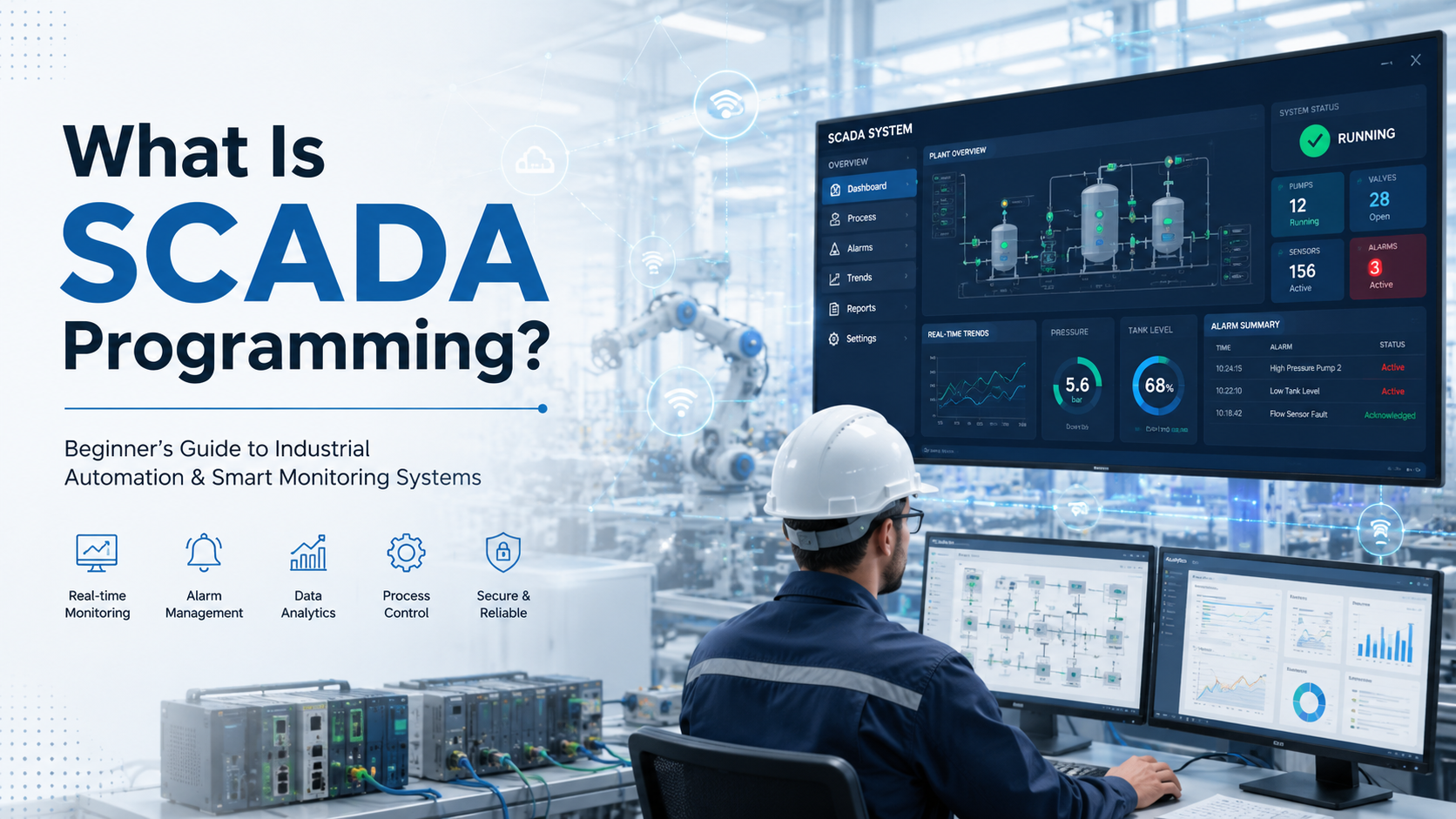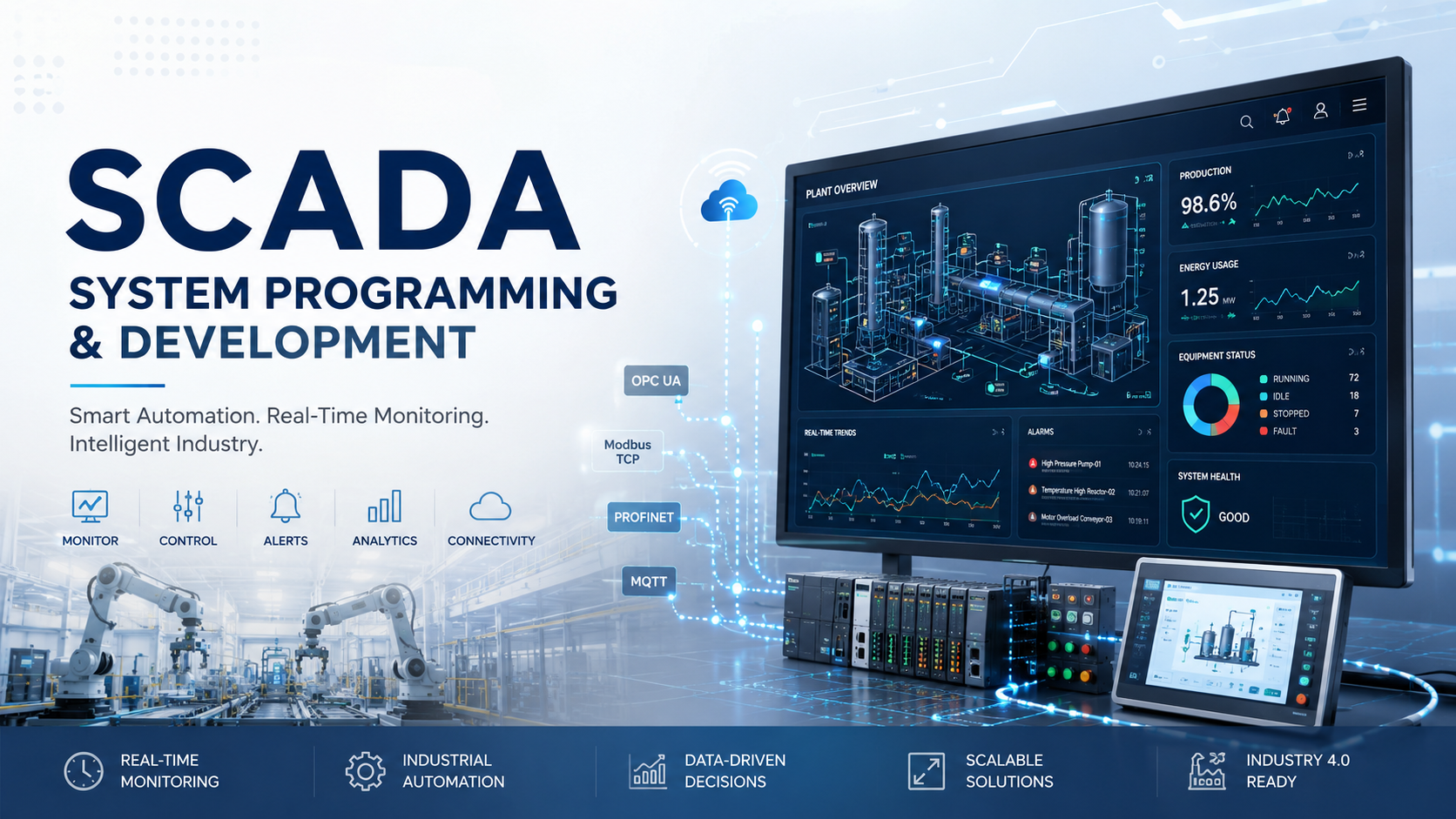
Industrial automation is growing rapidly across modern industries. Factories, manufacturing plants, power stations, water treatment facilities, and oil refineries are increasingly using smart automation systems to improve efficiency, reduce manual work, and increase productivity. As industries expand, managing multiple machines and processes manually becomes difficult, time-consuming, and prone to errors.
Today’s industrial facilities require centralized monitoring and control systems that allow operators to view, analyze, and manage all operations from a single platform. Industries need real-time access to machine data, instant alerts during faults, production monitoring, and remote operational control to ensure smooth and safe operations.
This is where SCADA integration becomes important.
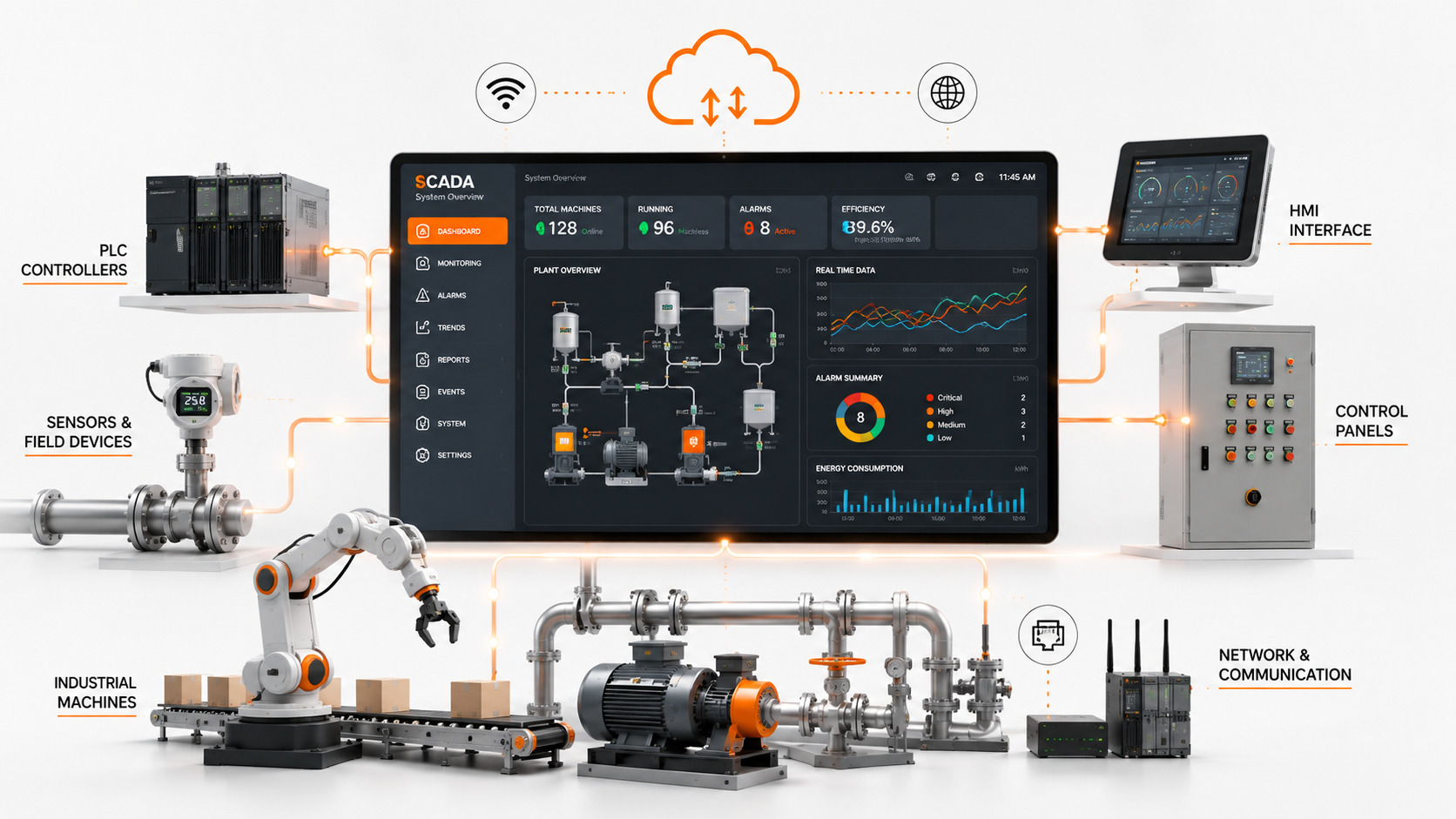
SCADA integration connects industrial machines, PLCs, sensors, RTUs, communication networks, databases, and software systems into one centralized automation platform. It enables industries to monitor and control entire processes from a central control room or even remotely through connected devices.
With SCADA integration, operators can:
- Monitor machine performance in real time
- Detect faults instantly
- Control industrial equipment remotely
- Analyze production data
- Improve operational efficiency
- Reduce downtime and maintenance costs
In modern industrial automation, SCADA integration acts as the backbone of intelligent monitoring and control systems.
What Is SCADA Integration?
SCADA integration is the process of connecting industrial machines, PLCs, sensors, RTUs, databases, and software systems into a centralized monitoring and control platform.
SCADA allows industries to collect real-time operational data from machines and display it on centralized dashboards for monitoring, control, and analysis.
SCADA stands for:
- Supervisory
- Control
- And
- Data
- Acquisition
Each term explains the core function of the system:
- Supervisory means overseeing industrial operations
- Control refers to controlling machines and industrial processes
- Data Acquisition means collecting real-time data from field devices and sensors
SCADA systems help industries automate operations while providing operators with complete visibility over machines and processes.
Why SCADA Integration Is Important
SCADA integration plays a critical role in modern industrial automation because it improves monitoring, control, efficiency, and operational reliability.
Centralized Monitoring
One of the biggest advantages of SCADA integration is centralized monitoring.
Operators can:
- View all machines and industrial processes from one location
- Monitor multiple production lines simultaneously
- Access real-time operational data instantly
Instead of manually checking each machine individually, industries can manage entire facilities through one SCADA dashboard.
This improves:
- Visibility
- Process management
- Operational control
Better Automation
SCADA integration significantly improves industrial automation.
It reduces manual intervention by automating:
- Machine control
- Process monitoring
- Alarm handling
- Production workflows
For example:
- Pumps can automatically turn ON or OFF
- Motors can adjust speed automatically
- Conveyor systems can synchronize operations
This helps industries increase productivity while reducing human errors.
Faster Decision-Making
Modern industries rely heavily on real-time data for decision-making.
SCADA systems provide:
- Live operational data
- Performance analytics
- Instant notifications
- Alarm management systems
If a machine fails or abnormal conditions occur, operators receive immediate alerts.
This allows faster decisions and quicker problem resolution.
Reduced Downtime
Unexpected machine downtime can cause major production losses.
SCADA integration helps reduce downtime by:
- Detecting equipment problems early
- Monitoring machine health continuously
- Supporting predictive maintenance strategies
For example:
- Rising motor temperature can indicate an upcoming failure
- SCADA alerts maintenance teams before breakdown occurs
This minimizes unplanned shutdowns and maintenance costs.
Improved Efficiency
SCADA systems improve operational efficiency across industrial facilities.
Industries can:
- Optimize production processes
- Reduce energy consumption
- Track machine performance
- Identify inefficiencies quickly
Better monitoring leads to:
- Higher productivity
- Lower operational costs
- Improved resource utilization
Increased Safety
Safety is extremely important in industrial environments.
SCADA integration improves industrial safety through:
- Alarm systems
- Emergency shutdown systems
- Real-time fault detection
- Hazard monitoring
For example:
- Gas leak detection systems can trigger automatic shutdowns
- High-pressure alarms can prevent equipment damage
SCADA systems help protect:
- Workers
- Equipment
- Industrial facilities
How SCADA Integration Works
SCADA integration works by collecting industrial data, processing it through controllers, transmitting it over communication networks, and displaying it on centralized monitoring systems.
Below is the step-by-step workflow of a SCADA system.
1. Data Collection
The first step in SCADA integration is data collection.
Industrial sensors and field devices gather real-time information from machines and processes.
Common examples include:
- Temperature sensors
- Pressure sensors
- Flow meters
- Voltage sensors
- Level sensors
- Speed sensors
These sensors continuously monitor industrial conditions and send signals to PLCs or RTUs.
For example:
- A temperature sensor measures boiler temperature
- A flow sensor monitors liquid movement in pipelines
- A voltage sensor tracks electrical supply levels
This real-time data becomes the foundation of the SCADA system.
2. PLC or RTU Processing
After data collection, PLCs or RTUs process the incoming signals.
PLC (Programmable Logic Controller)
PLCs are industrial computers used for machine automation and process control.
They:
- Execute automation logic
- Control motors and machines
- Process sensor signals
- Trigger automatic actions
RTU (Remote Terminal Unit)
RTUs perform similar functions but are commonly used in remote industrial locations such as:
- Power grids
- Oil pipelines
- Water treatment plants
The PLC or RTU decides how machines should respond based on programmed conditions.
For example:
- If pressure exceeds a safe limit, the PLC may shut down a pump automatically.
3. Communication Network
Once processed, industrial data is transmitted through communication networks.
SCADA systems use various communication technologies such as:
- Ethernet
- Wi-Fi
- Fiber optics
- Cellular networks
- Industrial communication protocols
These networks connect:
- Sensors
- PLCs
- RTUs
- SCADA servers
- HMIs
Industrial communication protocols commonly used include:
- Modbus
- OPC UA
- Profibus
- Ethernet/IP
Reliable communication is essential for smooth SCADA operations.
4. SCADA Software Receives Data
The SCADA software receives real-time industrial data from PLCs and RTUs.
The software then:
- Displays machine status
- Shows live dashboards
- Generates alarms
- Stores historical data
Operators can visualize the entire industrial process using:
- Graphs
- Charts
- System diagrams
- Real-time indicators
For example:
- Operators can monitor tank levels
- Track production speed
- View machine temperatures
- Analyze system performance
SCADA dashboards make industrial monitoring easier and more efficient.
5. Operator Monitoring and Control
Human operators monitor industrial operations through SCADA dashboards and HMIs (Human Machine Interfaces).
Operators can:
- Start or stop machines remotely
- Change operational parameters
- Respond to alarms
- Monitor production processes
For example:
- An operator can remotely start a water pump
- Adjust motor speed
- Shut down faulty equipment immediately
This centralized control improves operational management and response time.
6. Data Storage and Reporting
SCADA systems also store historical operational data for future analysis.
Industries use this data for:
- Performance analysis
- Maintenance planning
- Production reports
- Energy monitoring
- Trend analysis
SCADA software can generate:
- Daily production reports
- Downtime reports
- Alarm history logs
- Machine efficiency reports
Historical data helps industries improve long-term operational performance and decision-making.
Main Components of SCADA Integration
A SCADA integration system consists of multiple hardware and software components that work together to monitor, control, and automate industrial operations. Each component plays an important role in collecting data, processing signals, communicating information, and providing centralized control.
Understanding these components helps industries design efficient and reliable automation systems.
SCADA Software
SCADA software is the central monitoring and control platform of the entire SCADA system. It acts as the main interface between industrial equipment and human operators.
The software collects real-time data from PLCs, RTUs, sensors, and other industrial devices and displays it in an organized and easy-to-understand format.
SCADA software allows industries to:
- Monitor industrial operations
- Control machines remotely
- Analyze production data
- Generate alarms and reports
- Store historical data
Central Monitoring Software
The SCADA software provides centralized monitoring of all industrial processes from a single control room or computer system.
Operators can:
- View machine conditions
- Monitor production lines
- Check system performance
- Detect faults instantly
This centralized approach improves operational visibility and reduces manual monitoring efforts.
For example:
- A factory manager can monitor all production machines from one dashboard instead of checking each machine separately.
HMI Dashboards
SCADA software includes HMI (Human Machine Interface) dashboards that visually display industrial operations.
These dashboards use:
- Graphs
- Gauges
- Charts
- Process diagrams
- Alarm indicators
Operators can quickly understand machine status through visual interfaces.
For example:
- Green indicators may show normal operation
- Red indicators may show faults or alarms
HMI dashboards simplify industrial monitoring and improve operator efficiency.
Data Visualization
One of the biggest advantages of SCADA software is data visualization.
The system converts raw industrial data into:
- Real-time charts
- Trend graphs
- Performance reports
- Operational analytics
This helps industries:
- Identify inefficiencies
- Monitor energy consumption
- Track machine performance
- Improve production planning
Data visualization makes complex industrial operations easier to understand and manage.
Popular SCADA Software Examples
Several SCADA software platforms are widely used in industrial automation.
Wonderware
A popular industrial automation platform used for:
- Process visualization
- Data monitoring
- Industrial analytics
Ignition
A modern SCADA platform known for:
- Web-based monitoring
- Flexible integration
- IoT compatibility
WinCC
Developed by Siemens, WinCC is widely used for:
- Manufacturing automation
- Process control
- Industrial visualization
FactoryTalk
Developed by Rockwell Automation, FactoryTalk is used for:
- Industrial control
- Real-time monitoring
- Production management
PLC (Programmable Logic Controller)
A PLC, or Programmable Logic Controller, is an industrial computer used to automate machines and industrial processes.
PLCs are considered the “brain” of industrial automation systems because they execute control logic and make decisions based on sensor inputs.
Industries use PLCs because they are:
- Reliable
- Fast
- Durable
- Designed for harsh industrial environments
PLCs control equipment such as:
- Motors
- Pumps
- Conveyor belts
- Valves
- Robotic systems
Industrial Controllers
PLCs are specialized industrial controllers built to operate continuously in challenging conditions such as:
- High temperatures
- Dusty environments
- Electrical noise
- Vibrations
Unlike normal computers, PLCs are designed specifically for industrial automation tasks.
Machine Automation Brains
PLCs act as the decision-making units of machines.
They receive signals from sensors and execute programmed instructions.
For example:
- If a sensor detects high temperature, the PLC may activate a cooling system automatically.
PLCs make automation possible without requiring constant human intervention.
Main Functions of PLCs
Logic Execution
PLCs execute programmed logic based on:
- Sensor inputs
- Operational conditions
- Automation sequences
This logic controls industrial processes automatically.
Machine Control
PLCs directly control industrial equipment such as:
- Starting motors
- Opening valves
- Controlling conveyor movement
- Managing robotic operations
Without PLCs, automated manufacturing would not be possible.
RTU (Remote Terminal Unit)
An RTU, or Remote Terminal Unit, is a microprocessor-based industrial device used for monitoring and controlling equipment in remote locations.
RTUs perform functions similar to PLCs but are mainly designed for geographically distributed systems.
Used in Remote Locations
RTUs are commonly installed in remote industrial areas where direct human supervision is difficult.
Examples include:
- Oil pipelines
- Water distribution systems
- Electrical substations
- Solar power plants
RTUs collect field data and send it to SCADA systems through communication networks.
Common in Power Grids and Pipelines
RTUs are widely used in industries that require long-distance monitoring.
For example:
- Electrical utilities use RTUs for grid monitoring
- Oil companies use RTUs for pipeline pressure monitoring
RTUs help industries monitor remote assets efficiently and reliably.
Sensors and Field Devices
Sensors and field devices are responsible for collecting real-world operational data from industrial processes.
They act as the “eyes and ears” of the SCADA system.
Without sensors, SCADA systems would not be able to monitor industrial conditions.
Collect Real-World Data
Sensors continuously measure physical conditions and convert them into electrical signals.
The collected data is sent to:
- PLCs
- RTUs
- SCADA systems
This allows industries to monitor operations in real time.
Examples of Industrial Sensors
Pressure Sensors
Used to measure:
- Gas pressure
- Liquid pressure
- Hydraulic pressure
Common in:
- Pipelines
- Boilers
- Hydraulic systems
Flow Sensors
Used to monitor:
- Water flow
- Gas flow
- Chemical movement
Common in:
- Water treatment plants
- Oil industries
- Chemical processing plants
Temperature Sensors
Used to measure heat levels in:
- Boilers
- Motors
- Furnaces
- Production equipment
Temperature monitoring helps prevent equipment damage and overheating.
Communication Systems
Communication systems allow industrial devices to exchange information with SCADA platforms.
Without communication networks, industrial devices would operate independently without centralized monitoring.
Communication systems ensure smooth data transmission between:
- Sensors
- PLCs
- RTUs
- SCADA servers
- HMIs
Industrial Networking
Modern SCADA systems use industrial networking technologies such as:
- Ethernet
- Fiber optics
- Wireless communication
- Cellular networks
Industrial networks are designed for:
- High reliability
- Fast data transmission
- Secure communication
Reliable networking is critical for industrial automation.
Data Transmission Between Devices
Communication systems transfer:
- Sensor data
- Machine status
- Control commands
- Alarm notifications
Industrial communication protocols commonly used include:
- Modbus
- OPC UA
- Profibus
- Ethernet/IP
These protocols ensure proper communication between devices from different manufacturers.
HMI (Human Machine Interface)
HMI stands for Human Machine Interface.
An HMI is the graphical interface that allows operators to interact with industrial machines and SCADA systems.
It acts as the communication bridge between humans and automation systems.
Operator Control Screens
HMIs provide operator control screens for:
- Monitoring machine conditions
- Starting or stopping equipment
- Viewing alarms
- Adjusting machine settings
Operators can control industrial operations through touchscreens or computer interfaces.
Visualization Panels
HMIs display industrial data using:
- Graphical diagrams
- Process animations
- Charts
- Alarm indicators
- Status displays
Visualization panels make complex industrial systems easier to understand and manage.
For example:
- Operators can instantly identify faulty equipment through alarm indicators.
SCADA Integration Architecture
SCADA integration architecture refers to the structural arrangement of industrial devices, controllers, communication systems, and software platforms.
The architecture defines how data flows through the automation system.
Modern SCADA architecture is usually organized into multiple hierarchical levels.
Basic Architecture Overview
SCADA systems are commonly divided into four main levels:
- Field Level
- Control Level
- Supervisory Level
- Enterprise Level
Each level performs specific automation and monitoring functions.
Field Level
The field level is the lowest layer of the SCADA architecture.
This level includes physical industrial devices directly connected to processes and machines.
Components:
- Sensors
- Actuators
- Field instruments
Sensors
Sensors collect operational data such as:
- Temperature
- Pressure
- Flow
- Voltage
They provide real-time inputs to PLCs and RTUs.
Actuators
Actuators perform physical actions such as:
- Opening valves
- Moving motors
- Switching relays
Actuators convert control signals into mechanical movement.
Control Level
The control level processes sensor data and executes automation logic.
Components:
- PLCs
- RTUs
PLCs
PLCs automate industrial processes and control machinery based on programmed instructions.
RTUs
RTUs manage remote industrial operations and transmit field data to SCADA systems.
Supervisory Level
The supervisory level is responsible for centralized monitoring and control.
Components:
- SCADA servers
- HMI systems
SCADA Servers
SCADA servers:
- Process industrial data
- Generate alarms
- Store historical records
- Manage automation systems
HMI Systems
HMI systems allow operators to:
- View industrial dashboards
- Monitor operations
- Control equipment remotely
Enterprise Level
The enterprise level connects industrial automation systems with business management systems.
Components:
- ERP systems
- Cloud analytics
- Business intelligence platforms
ERP Systems
ERP systems integrate industrial data with:
- Inventory management
- Production planning
- Supply chain operations
Cloud Analytics
Cloud platforms provide:
- Remote access
- Data storage
- Advanced analytics
Business Intelligence
Business intelligence systems analyze industrial data for:
- Productivity improvement
- Cost reduction
- Strategic decision-making
Types of SCADA Systems
SCADA systems have evolved significantly over time. Different types of SCADA architectures are used depending on industrial requirements and technological capabilities.
Monolithic SCADA
Monolithic SCADA systems are the earliest generation of SCADA systems.
These systems were:
- Standalone
- Isolated
- Centrally controlled
They had very limited networking capabilities.
Characteristics of Monolithic SCADA
- Single mainframe computer
- Minimal communication capabilities
- Proprietary hardware and software
- Limited scalability
These systems were reliable but lacked flexibility and remote connectivity.
Distributed SCADA
Distributed SCADA systems improved reliability by distributing processing tasks across multiple systems.
Instead of relying on one central computer, multiple connected computers share operational responsibilities.
Advantages of Distributed SCADA
- Better system reliability
- Faster processing
- Improved scalability
- Reduced risk of total system failure
Distributed SCADA is commonly used in large industrial facilities.
Networked SCADA
Networked SCADA systems use:
- LAN networks
- WAN networks
- Internet connectivity
These systems allow real-time remote monitoring and control from multiple locations.
Features of Networked SCADA
- Remote access
- Multi-user operation
- Real-time communication
- Improved system integration
Modern industries widely use networked SCADA for centralized automation management.
IoT-Based SCADA
IoT-based SCADA systems combine industrial automation with Internet of Things (IoT) technologies.
These systems provide:
- Cloud connectivity
- Smart monitoring
- Advanced analytics
- Remote device access
Smart Industrial Monitoring
IoT-based SCADA allows industries to:
- Monitor equipment remotely
- Access real-time data through mobile devices
- Use AI-based predictive maintenance
- Improve operational intelligence
IoT integration is becoming a major part of Industry 4.0 and smart factory development.
SCADA Communication Protocols
Communication protocols are extremely important in SCADA integration because they allow industrial devices, controllers, sensors, and software systems to communicate with each other efficiently.
Different industrial environments use different protocols depending on:
- Speed requirements
- Device compatibility
- Communication distance
- Security needs
- Industry standards
Modern SCADA systems support multiple communication protocols to ensure seamless integration between machines and automation systems.
Modbus
Modbus is one of the most widely used industrial communication protocols in SCADA systems.
It was developed for simple and reliable communication between industrial devices such as:
- PLCs
- Sensors
- RTUs
- HMIs
- SCADA servers
Why Modbus Is Popular
- Easy to configure
- Low implementation cost
- Supported by many industrial devices
- Reliable communication
Common Applications
Modbus is commonly used in:
- Manufacturing plants
- Energy systems
- Water treatment facilities
- Building automation systems
Types of Modbus
- Modbus RTU
- Modbus ASCII
- Modbus TCP/IP
Modbus TCP/IP is commonly used in Ethernet-based industrial networks.
Profibus
Profibus is a high-speed industrial communication protocol widely used in factory automation systems.
It was developed for fast and reliable communication between industrial devices.
Key Features of Profibus
- High-speed communication
- Real-time data transfer
- Reliable industrial networking
- Supports multiple devices on one network
Common Uses
Profibus is commonly used in:
- Manufacturing automation
- Robotic systems
- Process industries
- Conveyor systems
Profibus is especially popular in industries using automation products from Siemens.
OPC UA
OPC UA (Open Platform Communications Unified Architecture) is a modern industrial communication standard designed for secure and platform-independent communication.
It is becoming increasingly important in Industry 4.0 and smart factory environments.
Main Advantages of OPC UA
- High cybersecurity standards
- Cross-platform compatibility
- Secure data exchange
- Scalable architecture
Why Industries Prefer OPC UA
OPC UA allows devices from different manufacturers to communicate smoothly without compatibility issues.
It supports:
- Real-time communication
- Cloud integration
- IoT connectivity
- Advanced industrial analytics
DNP3
DNP3 (Distributed Network Protocol) is commonly used in utility and infrastructure industries.
It is designed for reliable communication over long distances and remote locations.
Common Industries Using DNP3
- Electrical utilities
- Water distribution systems
- Power transmission networks
- Renewable energy systems
Advantages of DNP3
- Reliable remote communication
- Time-stamped event recording
- Efficient data handling
- Suitable for critical infrastructure
DNP3 is widely used in SCADA systems for power grid monitoring and remote substations.
Ethernet/IP
Ethernet/IP is an industrial Ethernet communication protocol used for high-speed industrial networking.
It combines standard Ethernet technology with industrial automation communication.
Features of Ethernet/IP
- Fast data transfer
- Real-time communication
- Scalable networking
- Integration with modern industrial systems
Common Applications
Ethernet/IP is commonly used in:
- Smart factories
- Packaging systems
- Automotive manufacturing
- Process automation
It supports communication between:
- PLCs
- SCADA systems
- Industrial robots
- HMIs
Industries That Use SCADA Integration
SCADA integration is widely used across many industries because it improves automation, operational visibility, efficiency, and safety.
Different industries use SCADA systems based on their specific operational requirements.
Manufacturing Industry
The manufacturing industry is one of the largest users of SCADA systems.
SCADA integration helps manufacturers automate production lines and monitor machines in real time.
Production Line Automation
SCADA systems automate:
- Conveyor systems
- Packaging lines
- Assembly operations
- Robotic systems
This increases production speed and reduces manual work.
Machine Monitoring
Manufacturers use SCADA to monitor:
- Machine performance
- Production efficiency
- Equipment health
- Downtime conditions
Real-time monitoring helps improve operational efficiency and reduce failures.
Oil and Gas Industry
The oil and gas industry relies heavily on SCADA integration for remote monitoring and process automation.
Operations are often spread across large geographic areas, making centralized monitoring essential.
Pipeline Monitoring
SCADA systems monitor:
- Pipeline pressure
- Flow rates
- Leak detection
- Valve operations
Operators can identify problems quickly and prevent major failures.
Refinery Automation
Oil refineries use SCADA systems for:
- Temperature control
- Pressure monitoring
- Chemical processing automation
- Safety management
SCADA improves operational safety and process efficiency in refineries.
Water Treatment Plants
Water treatment facilities use SCADA integration to automate water management processes.
Pump Control
SCADA systems control:
- Water pumps
- Valve systems
- Reservoir operations
Automatic control improves efficiency and reduces water waste.
Water Quality Monitoring
SCADA continuously monitors:
- pH levels
- Water pressure
- Chemical levels
- Flow conditions
Operators can quickly respond to water quality issues.
Power and Energy Sector
The power and energy industry uses SCADA systems for monitoring electrical infrastructure and energy distribution.
Grid Monitoring
SCADA systems monitor:
- Electrical substations
- Transmission lines
- Voltage conditions
- Power generation systems
This ensures stable power distribution.
Power Distribution Management
SCADA helps utilities:
- Detect faults
- Balance electrical loads
- Restore power quickly
- Improve grid reliability
Modern smart grids rely heavily on SCADA integration.
Food and Beverage Industry
SCADA integration is widely used in food processing and beverage manufacturing.
Automation helps maintain production quality and hygiene standards.
Batch Processing
SCADA systems automate:
- Mixing operations
- Ingredient control
- Filling systems
- Packaging lines
This improves production consistency.
Temperature Monitoring
Food industries use SCADA for:
- Cold storage monitoring
- Oven temperature control
- Refrigeration systems
Proper temperature control is critical for food safety.
Pharmaceutical Industry
The pharmaceutical industry requires highly accurate and controlled manufacturing processes.
SCADA systems help maintain compliance and product quality.
Compliance Monitoring
SCADA systems record:
- Production parameters
- Environmental conditions
- Process history
- Batch records
This supports regulatory compliance.
Precision Manufacturing
SCADA ensures precise control over:
- Chemical mixing
- Sterile environments
- Temperature conditions
- Production timing
This improves product consistency and safety.
Benefits of SCADA Integration
SCADA integration provides several important benefits for industrial operations.
These benefits help industries improve productivity, safety, efficiency, and operational control.
Real-Time Monitoring
One of the biggest benefits of SCADA systems is real-time monitoring.
Operators can instantly view:
- Machine conditions
- Production data
- Alarm notifications
- Equipment performance
This improves operational visibility and decision-making.
Remote Access
Modern SCADA systems allow remote monitoring and control from anywhere.
Operators can access industrial systems through:
- Computers
- Mobile devices
- Cloud platforms
Remote access improves operational flexibility and faster response times.
Predictive Maintenance
SCADA systems help industries detect equipment problems before failures occur.
By monitoring machine conditions continuously, industries can:
- Predict maintenance needs
- Reduce breakdowns
- Prevent costly downtime
This improves equipment reliability.
Improved Productivity
SCADA automation improves industrial productivity by:
- Reducing manual work
- Increasing operational speed
- Improving process coordination
Automated operations help industries produce more efficiently.
Data Analytics
SCADA systems store historical data for analysis.
Industries use this data for:
- Performance analysis
- Trend monitoring
- Energy optimization
- Production planning
Data-driven decisions improve operational efficiency.
Better Quality Control
SCADA systems help maintain consistent manufacturing quality.
Industries can monitor:
- Temperature
- Pressure
- Process timing
- Production conditions
Consistent monitoring improves product quality standards.
Scalability
Modern SCADA systems are highly scalable.
Industries can easily:
- Add new machines
- Expand production lines
- Integrate additional sensors
- Upgrade automation systems
This supports future industrial growth.
Challenges in SCADA Integration
Although SCADA integration provides many advantages, industries also face several implementation challenges.
Understanding these challenges helps organizations plan better automation strategies.
Cybersecurity Risks
As SCADA systems become connected to networks and cloud platforms, cybersecurity becomes a major concern.
Industrial Hacking Risks
Cyber attackers may target:
- Industrial control systems
- Power grids
- Manufacturing plants
- Critical infrastructure
Cyberattacks can disrupt operations and cause financial losses.
Need for Secure Networks
Industries must implement strong cybersecurity measures such as:
- Firewalls
- VPNs
- Access control systems
- Network encryption
Protecting industrial networks is critical for safe operations.
Legacy System Compatibility
Many industries still use older industrial equipment.
Integrating legacy systems with modern SCADA platforms can be difficult because:
- Old devices may use outdated protocols
- Hardware compatibility issues may occur
- Software upgrades may be limited
Careful integration planning is required.
High Initial Investment
SCADA integration can require significant investment in:
- Hardware
- Software
- Networking infrastructure
- Engineering services
Although long-term benefits are high, initial implementation costs may be expensive for some businesses.
Complex Configuration
SCADA systems involve:
- Multiple devices
- Industrial protocols
- Network configurations
- Software programming
Successful implementation requires skilled automation engineers and system integrators.
Network Reliability
SCADA systems depend heavily on communication networks.
If communication fails:
- Data transmission may stop
- Monitoring may become unavailable
- Automation processes may be disrupted
Reliable industrial networking is essential for stable SCADA operations.
SCADA Integration vs PLC
Many people confuse SCADA systems with PLCs, but they perform different functions in industrial automation.
PLCs control machines, while SCADA systems monitor and supervise the entire process.
SCADA vs PLC Difference Table
| Feature | SCADA | PLC |
|---|---|---|
| Main Purpose | Monitoring and supervision | Machine control |
| User Interface | Yes | Limited |
| Data Logging | Advanced | Basic |
| Remote Access | Yes | Limited |
| Visualization | Dashboards and graphics | Minimal |
Relationship Between SCADA and PLC
SCADA and PLC systems work together in industrial automation.
PLC Responsibilities
PLCs:
- Control machines
- Execute automation logic
- Process sensor inputs
- Operate equipment automatically
SCADA Responsibilities
SCADA systems:
- Monitor PLC operations
- Display machine data
- Generate alarms
- Store historical records
- Allow centralized control
In simple terms:
- PLCs perform machine control
- SCADA supervises and monitors the entire automation system
SCADA Integration vs HMI
SCADA and HMI are closely related but not identical systems.
HMI (Human Machine Interface)
An HMI is usually designed for:
- Single machines
- Local operator control
- Basic visualization
It provides a graphical interface for machine interaction.
SCADA System
SCADA systems monitor and control:
- Entire plants
- Multiple machines
- Large industrial networks
SCADA includes:
- Centralized monitoring
- Data logging
- Alarm management
- Historical analytics
In simple terms:
- HMI controls individual machines
- SCADA supervises complete industrial operations
SCADA Integration Process
Implementing a SCADA system involves multiple stages to ensure reliable and efficient automation.
Step 1: Requirement Analysis
The first step is understanding industrial processes and automation goals.
Engineers identify:
- Monitoring requirements
- Control requirements
- Production needs
- Safety requirements
Proper analysis ensures successful system design.
Step 2: System Design
Engineers create the SCADA system architecture.
This includes:
- Network planning
- Device selection
- Communication protocols
- Control strategies
Good design improves system performance and scalability.
Step 3: PLC and Device Integration
Industrial devices are connected to PLCs and RTUs.
This includes:
- Sensors
- Actuators
- Motors
- Valves
- Field instruments
Device integration enables real-time data collection and control.
Step 4: SCADA Software Development
SCADA engineers develop:
- Monitoring dashboards
- Alarm systems
- Data visualization screens
- Reporting systems
The software interface is customized according to industrial requirements.
Step 5: Communication Setup
Industrial communication protocols are configured to enable smooth data transfer.
This includes:
- Modbus
- OPC UA
- Ethernet/IP
- Profibus
Reliable communication is essential for SCADA performance.
Step 6: Testing and Commissioning
Before deployment, the SCADA system undergoes detailed testing.
Engineers verify:
- Data accuracy
- Alarm functionality
- Communication reliability
- System performance
Testing ensures stable industrial operations.
Step 7: Maintenance and Optimization
After deployment, regular maintenance is necessary.
Industries perform:
- Software updates
- Network monitoring
- Performance optimization
- Security upgrades
Continuous maintenance improves long-term reliability.
Features of Modern SCADA Integration
Modern SCADA systems include advanced technologies that improve automation intelligence and connectivity.
Cloud SCADA
Cloud SCADA allows industries to monitor operations through cloud platforms.
Benefits include:
- Remote accessibility
- Centralized data storage
- Easy scalability
- Reduced infrastructure costs
Mobile Monitoring
Modern SCADA systems support smartphone and tablet access.
Operators can:
- Monitor systems remotely
- Receive alarm notifications
- Access production dashboards
Mobile monitoring improves operational flexibility.
AI and Predictive Analytics
Artificial intelligence helps SCADA systems analyze operational patterns.
AI-based systems can:
- Predict equipment failures
- Detect abnormal behavior
- Optimize production efficiency
Predictive analytics improves maintenance planning.
IoT Connectivity
IoT-enabled SCADA systems connect smart industrial devices through internet technologies.
This enables:
- Real-time remote monitoring
- Smart automation
- Cloud integration
- Intelligent analytics
Real-Time Dashboards
Modern dashboards provide live operational visibility.
Industries can monitor:
- Machine performance
- Energy usage
- Production output
- Alarm conditions
Real-time dashboards improve faster decision-making.
SCADA Integration in Industry 4.0
Industry 4.0 refers to the next generation of smart manufacturing and connected industrial automation.
What Is Industry 4.0?
Industry 4.0 focuses on:
- Smart factories
- Connected machines
- IoT integration
- Artificial intelligence
- Automation intelligence
Machines communicate and share data automatically.
Role of SCADA in Industry 4.0
SCADA systems play a central role in Industry 4.0 by providing:
- Real-time industrial intelligence
- Data-driven automation
- Smart monitoring
- Connected operations
SCADA helps industries move toward intelligent manufacturing environments.
Future of SCADA Integration
SCADA technology continues to evolve with advancements in industrial automation and digital transformation.
AI-Based Automation
Future SCADA systems will use advanced AI for:
- Self-learning automation
- Intelligent decision-making
- Automatic fault correction
AI will make industrial systems smarter and more autonomous.
Edge Computing
Edge computing processes data closer to industrial devices instead of relying entirely on cloud servers.
Benefits include:
- Faster processing
- Reduced latency
- Improved reliability
Edge computing improves real-time industrial control.
Digital Twin Technology
Digital twins create virtual simulations of industrial systems.
Industries can:
- Test operations virtually
- Predict failures
- Optimize performance
Digital twins improve operational planning and maintenance.
Advanced Cybersecurity
Future SCADA systems will require stronger cybersecurity technologies to protect critical infrastructure.
Advanced security measures may include:
- AI-based threat detection
- Zero-trust security
- Advanced encryption
- Network segmentation
Cybersecurity will remain a major priority in industrial automation.
Best Practices for Successful SCADA Integration
Following best practices helps industries achieve reliable and efficient SCADA implementation.
Choose Scalable Systems
Industries should select automation systems that support future expansion.
Scalable systems allow:
- Easy upgrades
- Additional devices
- Production growth
Use Standard Protocols
Using industry-standard protocols improves:
- Device compatibility
- Easier integration
- Long-term flexibility
Prioritize Cybersecurity
Industries should secure SCADA systems using:
- Firewalls
- VPNs
- Access control systems
- Multi-layer security
Strong cybersecurity reduces industrial risks.
Train Operators
Proper operator training improves:
- System usage
- Fault handling
- Operational efficiency
Skilled operators reduce human errors.
Regular Maintenance
Routine maintenance ensures stable SCADA performance.
Industries should perform:
- Software updates
- Network checks
- Device calibration
- Performance monitoring
Regular maintenance improves system reliability.
Common SCADA Integration Examples
SCADA systems are used in many real-world industrial applications.
Smart Factory Example
In a smart factory:
- Sensors monitor machine conditions
- PLCs automate conveyor systems
- SCADA tracks production in real time
Conveyor Automation
SCADA systems coordinate conveyor movement and synchronize production processes automatically.
Real-Time Production Tracking
Managers can monitor:
- Production speed
- Machine efficiency
- Downtime conditions
- Product quality
This improves manufacturing efficiency.
Water Plant Example
Water treatment plants use SCADA systems to automate water distribution and monitoring.
Tank Level Monitoring
SCADA systems continuously monitor water tank levels and generate alerts during abnormal conditions.
Pump Automation
SCADA automatically controls:
- Water pumps
- Valves
- Distribution systems
This improves water management efficiency.
Solar Power Plant Example
Solar plants use SCADA systems for energy monitoring and operational optimization.
Energy Monitoring
SCADA systems track:
- Solar panel output
- Voltage levels
- Power generation efficiency
Performance Optimization
Operators can identify:
- Underperforming panels
- Fault conditions
- Energy losses
This improves renewable energy production efficiency.
Conclusion
SCADA integration has become one of the most important technologies in modern industrial automation. It connects machines, PLCs, RTUs, sensors, communication networks, and software platforms into one intelligent and centralized system. Instead of operating machines separately, industries can monitor and control complete processes from a single dashboard in real time.
By integrating industrial systems together, SCADA improves:
- Automation
- Centralized monitoring
- Operational efficiency
- Data visibility
- Industrial safety
- Production reliability
SCADA systems help industries reduce manual work, minimize downtime, improve productivity, and make faster operational decisions using real-time data and analytics. From manufacturing plants and oil refineries to power grids and water treatment facilities, SCADA integration plays a critical role in ensuring smooth and efficient industrial operations.
As Industry 4.0 and smart factories continue to grow, the importance of SCADA integration is increasing rapidly. Modern industries now require connected automation systems, cloud monitoring, AI-driven analytics, IoT connectivity, and intelligent decision-making capabilities. SCADA systems are becoming the foundation of these next-generation industrial environments.
In the future, SCADA integration will continue evolving with technologies such as:
- Artificial intelligence
- Edge computing
- Digital twins
- Advanced cybersecurity
- Smart predictive maintenance
Industries that invest in modern SCADA integration today will be better prepared for the future of intelligent automation and digital manufacturing.
Industrial automation is no longer just about controlling machines — it is about building smart, connected, data-driven systems that improve efficiency, reliability, and long-term business growth.
Need Professional SCADA Integration Services?
At AutomatexLab, we provide complete industrial automation and SCADA integration solutions tailored to modern industry requirements.
Our services include:
- SCADA system development
- PLC programming
- HMI design
- Industrial automation solutions
- Control panel integration
- Remote monitoring systems
We help industries build reliable, scalable, and efficient automation systems that improve productivity and operational control.
Contact AutomatexLab today to build smarter and more efficient industrial automation systems.
Frequently Asked Questions (FAQs)
SCADA integration is used for monitoring, controlling, and automating industrial processes from a centralized system. It connects machines, PLCs, sensors, RTUs, and software platforms into one intelligent network.
Industries use SCADA integration for:
Real-time machine monitoring
Industrial automation
Alarm management
Data collection and analysis
Remote equipment control
Production optimization
Predictive maintenance
SCADA systems are commonly used in manufacturing plants, power stations, oil and gas facilities, water treatment plants, and smart factories.
SCADA and PLC serve different roles in industrial automation.
PLC (Programmable Logic Controller)
A PLC is an industrial controller used to:
Control machines
Execute automation logic
Process sensor inputs
Operate motors, pumps, and valves
PLCs directly interact with industrial equipment.
SCADA (Supervisory Control and Data Acquisition)
SCADA is a monitoring and supervisory system used to:
Monitor multiple PLCs and machines
Display real-time data
Generate alarms
Store historical records
Provide centralized control
Simple Difference
PLC controls machines
SCADA monitors and supervises the entire system
SCADA and PLCs usually work together in industrial automation environments.
The cost of SCADA integration depends on:
Plant size
Number of machines
Hardware requirements
Software complexity
Communication infrastructure
Customization needs
Small SCADA systems may be relatively affordable, while large industrial automation projects can require significant investment.
Although the initial setup cost can be high, SCADA integration often reduces long-term operational costs by:
Improving efficiency
Reducing downtime
Lowering maintenance costs
Increasing productivity
For many industries, SCADA integration provides strong long-term return on investment (ROI).
SCADA systems are used across many industries that require automation, monitoring, and process control.
Common industries include:
Manufacturing
Oil and gas
Water treatment
Power and energy
Food and beverage
Pharmaceutical
Chemical processing
Mining
Renewable energy
Transportation infrastructure
Any industry that relies on industrial equipment and real-time monitoring can benefit from SCADA integration.
SCADA protocols are communication standards that allow industrial devices and automation systems to exchange data.
These protocols help devices such as:
PLCs
RTUs
Sensors
HMIs
SCADA servers
communicate reliably with each other.
Common SCADA communication protocols include:
Modbus
OPC UA
Profibus
DNP3
Ethernet/IP
Different protocols are used depending on:
Industry requirements
Communication speed
Security needs
Device compatibility
Protocols are essential for successful SCADA integration.
Yes, modern SCADA systems can work with IoT (Internet of Things) technologies.
IoT-enabled SCADA systems allow industries to:
Monitor equipment remotely
Access cloud-based dashboards
Collect real-time sensor data
Use predictive analytics
Improve smart automation
IoT integration helps SCADA systems become more intelligent, connected, and efficient.
This combination is widely used in:
Smart factories
Industry 4.0 environments
Smart energy systems
Remote industrial monitoring
SCADA integration can be secure if proper cybersecurity measures are implemented.
Because SCADA systems control critical industrial operations, they can become targets for cyberattacks if not protected properly.
Industries improve SCADA security using:
Firewalls
VPNs
Access control systems
Network segmentation
Encryption
Multi-factor authentication
Regular software updates
Modern SCADA systems also include advanced cybersecurity features to protect industrial networks and sensitive operational data.
Proper cybersecurity planning is essential for safe and reliable SCADA operations.