Quick Answer: PLC (Programmable Logic Controller) is a hardware device that controls machines in real-time, while SCADA (Supervisory Control and Data Acquisition) is a software system that monitors and visualizes what those machines are doing. Think of PLC as the brain that runs the equipment, and SCADA as the dashboard that shows you what’s happening across your entire operation.
Walk into any modern factory, and you’ll see machines humming along perfectly. But behind that smooth operation, there’s a lot happening.
Two systems make it all work: PLC and SCADA.
Here’s the thing most people get these confused. I’ve seen engineers mix them up, and that’s totally normal. They’re both part of industrial automation, but they do completely different jobs.
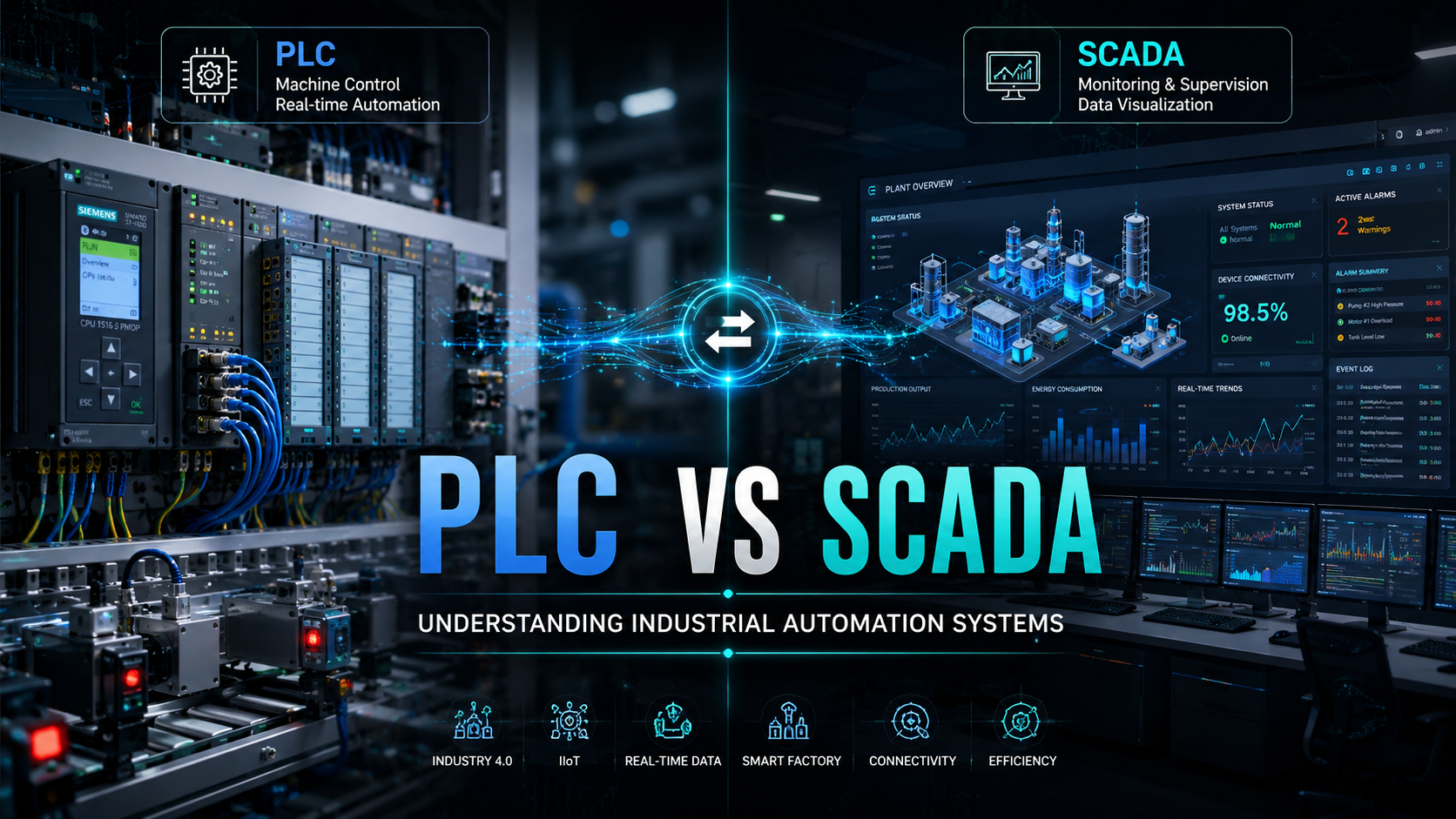
PLC controls the machines. SCADA monitors what those machines are doing.
If you’re trying to understand factory automation, knowing this difference is huge. It affects what equipment you buy, how you design your systems, and how your team operates day-to-day.
What Is PLC?
Definition of PLC
A PLC is a ruggedized industrial computer that controls machines automatically.
The full name is Programmable Logic Controller, but nobody calls it that. It’s just “PLC.”
Think of it like this: You know how your home thermostat controls your AC? A PLC does the same thing, but for factory equipment. It reads sensors, makes decisions, and controls motors, valves, and other devices.
The key word here is “control.” PLCs make things happen in real-time.
How PLC Works
PLCs work in a simple loop that repeats thousands of times per second.
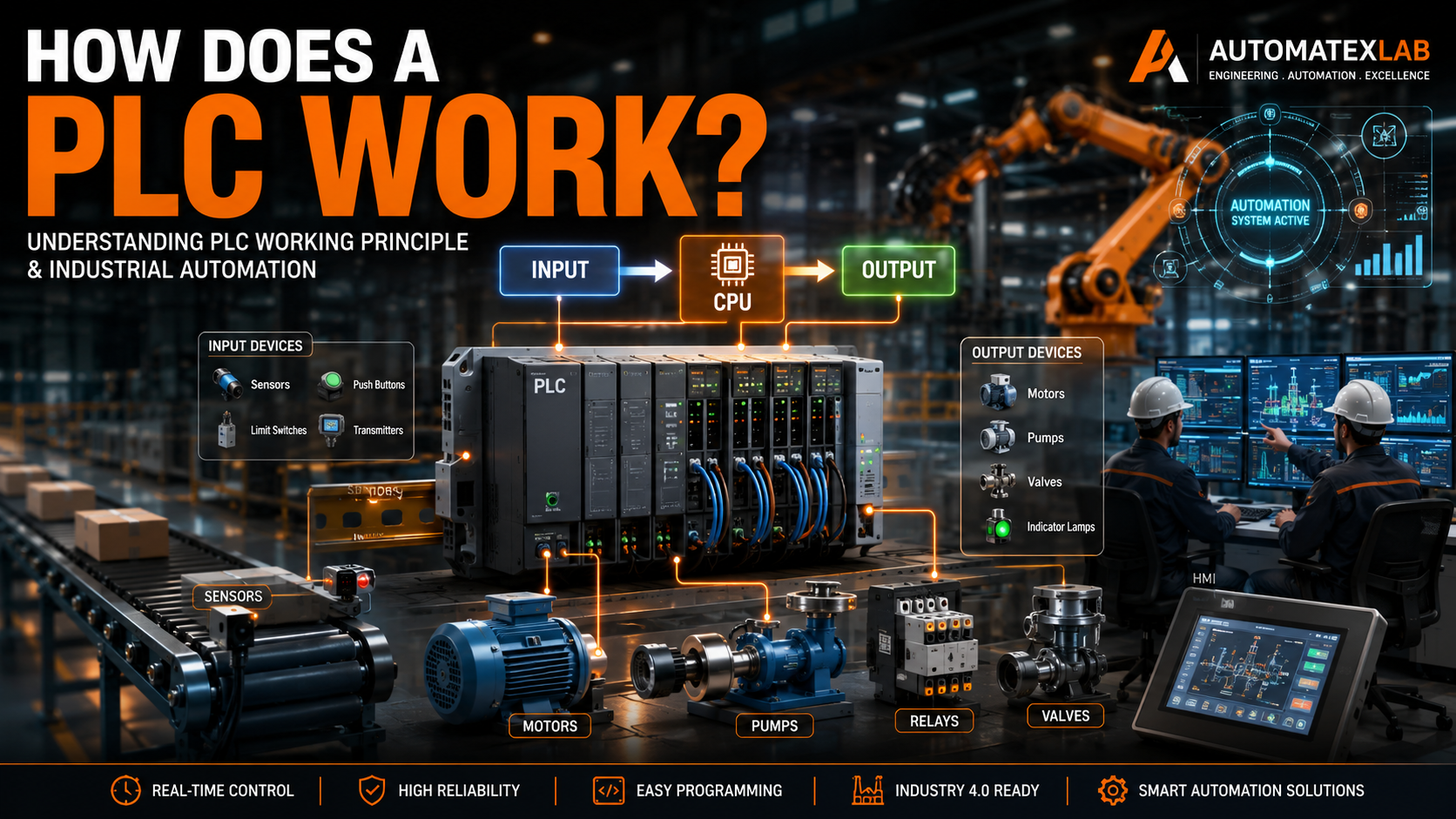
First, they read inputs—things like temperature sensors, pressure switches, or proximity detectors. Then they process that information using pre-programmed logic. Finally, they send outputs to control motors, lights, valves, or whatever needs to happen.
This whole cycle happens incredibly fast. We’re talking milliseconds.
For example, if a sensor detects a box on a conveyor belt, the PLC instantly tells the system to start wrapping it. No human needed. No delays.
That’s why PLCs are perfect for real-time control. They react faster than any person could.
Main Components of PLC
Every PLC has four basic parts.
The CPU is the brain it runs the program and does all the thinking. The I/O modules connect to sensors and equipment in the field. The power supply keeps everything running. And communication modules let the PLC talk to other systems like SCADA.
Some PLCs are tiny small enough to fit in your hand. Others are massive racks with dozens of modules.
But they all work the same way.
Where PLC Is Used
PLCs are everywhere in industrial settings.
Conveyor systems use them to move products at the right speed. Packaging machines rely on PLCs to fill, seal, and label boxes. Manufacturing lines use them to coordinate dozens of machines working together.
You’ll also find PLCs in robotics, water treatment plants, and even car washes.
Basically, if something needs to be automated and work reliably 24/7, there’s probably a PLC running it.
I’ve seen PLCs running non-stop for years without a single issue. They’re built tough.
Advantages of PLC
PLCs have some serious benefits.
They respond incredibly fast—we’re talking microseconds. They’re super reliable because they’re designed for harsh factory environments. Dust, vibration, temperature swings—PLCs handle it all.
They also use simple ladder logic programming, which makes them easier to troubleshoot than traditional relay systems.
And here’s the big one: Once programmed, they just work. No babysitting needed.
That’s why factories love them. Set it and forget it.
What Is SCADA?
Definition of SCADA
SCADA stands for Supervisory Control and Data Acquisition.
Yeah, that’s a mouthful. Just call it SCADA.
It’s basically a software system that monitors and controls industrial processes. While PLCs are out there running machines, SCADA is back in the control room showing operators what’s happening.
Think of it like the dashboard in your car. The engine does the work, but the dashboard tells you speed, fuel level, and if something’s wrong.
SCADA is that dashboard for factories.
How SCADA Works
SCADA collects data from PLCs, sensors, and other field devices.
It pulls in information like production rates, temperatures, pressures, and equipment status. Then it displays all that data on computer screens using graphics, charts, and alarms.
Operators sit in control rooms watching these screens. If something goes wrong, SCADA alerts them immediately.
But SCADA doesn’t just monitor—it can also send commands. An operator can use SCADA to start a pump, change a setpoint, or shut down a process remotely.
It’s monitoring + control from one central location.
Main Components of SCADA
SCADA systems have several pieces working together.
The HMI (Human-Machine Interface) is what operators see the screens and graphics. RTUs (Remote Terminal Units) or PLCs collect data from the field. SCADA software ties everything together and stores data.
There’s also a communication network connecting all the devices, and a database/server that logs everything for later analysis.
Modern SCADA systems can be huge—monitoring thousands of points across multiple sites.
Where SCADA Is Used
SCADA shines in operations that spread across large areas.
Power plants use SCADA to monitor entire electrical grids. Oil and gas companies use it to watch pipelines stretching hundreds of miles. Water utilities monitor reservoirs, pumping stations, and treatment facilities.
Smart factories use SCADA to oversee production across multiple buildings.
Basically, if you need to monitor a lot of equipment from one central location, SCADA is your solution.
I’ve seen control rooms with 20+ screens showing real-time data from facilities across three states. That’s SCADA doing its thing.
Advantages of SCADA
SCADA gives you incredible visibility.
You get centralized monitoring of everything in one place. You can access systems remotely—even from home if needed. Real-time analytics help you spot problems before they become disasters.
Alarm management is huge too. SCADA can alert you via text, email, or phone if something goes wrong.
And all that historical data? Gold mine for finding patterns and improving operations.
Bottom line: SCADA helps you run smarter, not just harder.
PLC vs SCADA: Core Difference Explained
Alright, let’s cut through the confusion.
PLCs control machines directly. SCADA monitors and supervises those machines.
Here’s a comparison table that makes it crystal clear:
| Feature | PLC | SCADA |
|---|---|---|
| Main Purpose | Machine control | Monitoring & supervision |
| Role | Executes logic | Visualizes and manages data |
| Speed | Very fast real-time control | Slower supervisory layer |
| Hardware/Software | Mostly hardware controller | Mostly software system |
| User Interaction | Limited | High |
| Data Handling | Minimal | Large-scale data storage |
| Remote Access | Limited | Yes |
| Best For | Controlling machines | Monitoring entire processes |
Think of it this way: PLC is the worker doing the job. SCADA is the supervisor watching and coordinating multiple workers.
Both are essential. But they’re not the same thing.
How PLC and SCADA Work Together
Here’s where it gets interesting PLC and SCADA are teammates.
The PLC controls the machinery down on the factory floor. It’s making split-second decisions, turning motors on and off, adjusting speeds, and keeping everything running smoothly.
Meanwhile, SCADA is collecting data from that PLC (and probably dozens of others). It’s displaying production rates, tracking downtime, and alerting operators to any issues.
Operators monitor the SCADA screens. If they need to adjust something, they can send commands through SCADA, which passes them to the PLC.
Let me give you a real example:
A PLC controls a conveyor belt speed based on production demand. SCADA shows the production supervisor how many units per hour are being processed. If there’s a bottleneck downstream, the supervisor uses SCADA to slow down the conveyor.
The supervisor doesn’t touch the PLC directly. They use SCADA, which talks to the PLC.
That’s the magic of integration. PLC handles execution. SCADA handles oversight.
Real-World Industrial Example
Let’s look at a food processing plant.
Imagine a factory that makes bottled juice. Here’s how PLC and SCADA work together:
PLC tasks:
- Controls the filling machine speed
- Monitors bottle sensors to detect if bottles are present
- Adjusts capping machine torque
- Triggers labeling machine at precise moments
- Manages conveyor speeds between stations
SCADA tasks:
- Displays current production rate (bottles per minute)
- Shows temperature of pasteurization tanks
- Tracks how many bottles have been filled today
- Alerts operators if a machine stops
- Stores historical data for quality reports
An operator in the control room watches the SCADA screen. They see production running at 200 bottles per minute. Suddenly, the capping machine slows down.
SCADA sends an alarm. The operator checks the screen, sees the issue, and dispatches a technician. Meanwhile, SCADA automatically logs the downtime.
The PLCs never stopped running their programs. They kept doing their jobs. SCADA just helped humans manage the situation better.
This happens in manufacturing, chemical plants, energy facilities—everywhere.
PLC vs SCADA: Which One Do You Need?
This question comes up a lot. Here’s the honest answer:
Most operations need both.
But let’s break it down anyway.
When You Need PLC
You definitely need a PLC when:
- You’re automating machines or equipment
- Real-time control is critical
- You need reliable, 24/7 operation
- You’re replacing old relay-based systems
- Equipment-level automation is your focus
Example: A small packaging line with three machines. You just need them to run automatically. A few PLCs will do the job perfectly.
When You Need SCADA
You need SCADA when:
- You’re monitoring multiple machines or sites
- Centralized visibility is important
- You need remote access to systems
- Data logging and reporting matter
- You have operators managing complex processes
Example: A water utility with 15 pumping stations across the city. You can’t have operators at each location. SCADA lets one team monitor everything from headquarters.
The Reality Check
Here’s what I’ve seen: Small operations often start with just PLCs. As they grow, they add SCADA for better monitoring.
Large operations almost always use both from day one.
Don’t overthink it. Start with what solves your immediate problem. You can always expand later.
Benefits of Using PLC and SCADA Together
When you combine PLC and SCADA, magic happens.
Improved efficiency comes first. Operators can spot bottlenecks and optimize processes faster. Better monitoring means fewer surprises and less downtime.
Faster troubleshooting is huge. Instead of running around the plant checking gauges, operators pinpoint problems from the control room.
You also get data-driven decision making. All that historical data helps you find patterns and improve operations over time.
Predictive maintenance becomes possible too. SCADA can track equipment performance and warn you before failures happen.
And let’s talk about smart factory enablement. Industry 4.0, IoT, all that modern stuff? It starts with solid PLC and SCADA infrastructure.
Bottom line: Together, they make your operation smarter, faster, and more reliable.
Common Misconceptions About PLC and SCADA
Let me clear up some myths I hear all the time.
“PLC and SCADA are competitors.” Nope. They work together. They’re partners, not rivals.
“SCADA can replace PLC entirely.” Wrong. SCADA needs PLCs (or similar controllers) to work. It doesn’t control machines directly fast enough for real-time operations.
“PLC is only for large factories.” Not true. Small businesses use PLCs all the time. Even a single machine can benefit from PLC control.
“SCADA is just fancy dashboards.” It’s way more than that. SCADA manages alarms, logs data, enables remote control, and supports compliance reporting.
“You can’t use PLC without SCADA.” Actually, you can. Plenty of standalone PLC systems exist. SCADA just makes monitoring easier.
I’ve seen people waste money because they believed these myths. Don’t be that person.
Future of PLC and SCADA in Industry 4.0
The future looks pretty exciting.
Industrial IoT is changing how PLCs and SCADA connect. Cloud-based SCADA systems are becoming popular, letting you monitor operations from anywhere with internet access.
AI-powered monitoring is starting to appear. Imagine SCADA systems that predict failures before they happen, automatically.
Edge computing is making PLCs smarter. They’re processing more data locally before sending it to SCADA.
Remote industrial operations are growing fast. The pandemic accelerated this—companies realized they could run facilities with fewer people on-site.
Smart manufacturing is the goal. PLCs and SCADA are foundational to getting there.
Here’s my take: The basics won’t change. PLCs will still control machines. SCADA will still monitor processes. But they’ll be faster, smarter, and more connected than ever.
If you’re investing in automation now, make sure your systems can grow with these trends.
Conclusion
Let’s wrap this up.
PLC and SCADA aren’t the same thing, and they’re not competitors. PLC is your real-time machine controller. SCADA is your monitoring and supervision system.
PLC makes things happen on the factory floor. SCADA shows you what’s happening and lets you manage it from a central location.
Most modern industrial operations use both. PLCs handle the execution. SCADA provides the visibility and control operators need.
As we move toward Industry 4.0 and smart manufacturing, both systems will become even more important. They’re the foundation that everything else builds on.
My advice? Don’t overcomplicate it. Understand what each system does. Choose based on your actual needs. And build a solid foundation you can expand as you grow.
The factories of the future will be smarter, more connected, and more efficient. And PLC and SCADA will be at the heart of it all.
Ready to Automate Your Industrial Operations?
At AutomatexLab, we specialize in PLC and SCADA automation solutions designed for modern manufacturing and industrial facilities.
Whether you’re setting up a new production line, upgrading legacy systems, or building a complete smart factory, our team has the expertise to make it happen.
Our PLC & SCADA Services Include:
- Custom PLC programming and configuration
- SCADA system design and implementation
- HMI development and optimization
- System integration and troubleshooting
- Remote monitoring solutions
- Industry 4.0 upgrades and modernization
- Training and ongoing support
We work with all major brands Siemens, Allen-Bradley, Schneider Electric, Mitsubishi, and more.
Don’t let outdated automation hold you back. Let’s build a system that gives you real-time control, complete visibility, and the efficiency your operation deserves.
Contact AutomatexLab today for a free consultation and discover how PLC and SCADA automation can transform your industrial processes.
FAQs
Not exactly. PLC is a separate hardware device. But SCADA systems use PLCs as data sources and control points. Think of PLCs as field devices that SCADA communicates with.
Technically yes, but it’s rare. SCADA can connect to RTUs (Remote Terminal Units) or other field devices. But in most industrial settings, PLCs are the workhorses that SCADA monitors.
Neither is “more important.” They serve different purposes. If you need machine control, PLC is critical. If you need monitoring and oversight, SCADA is essential. Most operations need both.
HMI (Human-Machine Interface) is the screen/interface part of SCADA. SCADA is the entire system—software, communications, data logging, and HMI. So HMI is one component of SCADA.
It’s not as hard as traditional programming. PLC programming uses ladder logic, which looks like electrical diagrams. It’s pretty intuitive once you learn the basics. Most electricians can pick it up with training.
Manufacturing, food and beverage, oil and gas, water treatment, power generation, chemical processing, automotive, pharmaceuticals, mining—basically any industry with automated processes.
Popular SCADA software includes Wonderware, Ignition, Siemens WinCC, GE iFIX, and Rockwell FactoryTalk. There are also open-source options like OpenSCADA. Choice depends on your specific needs and budget.