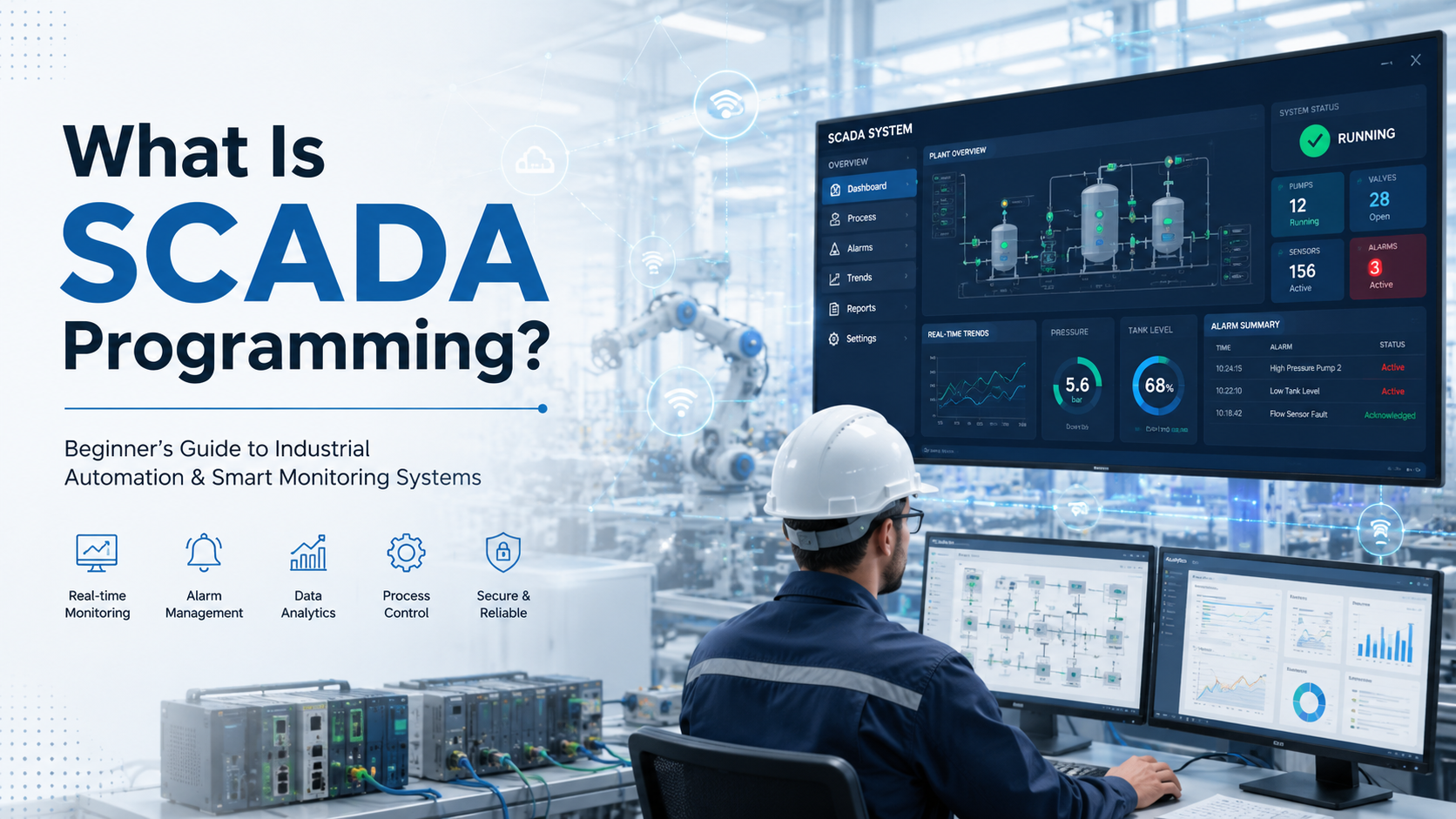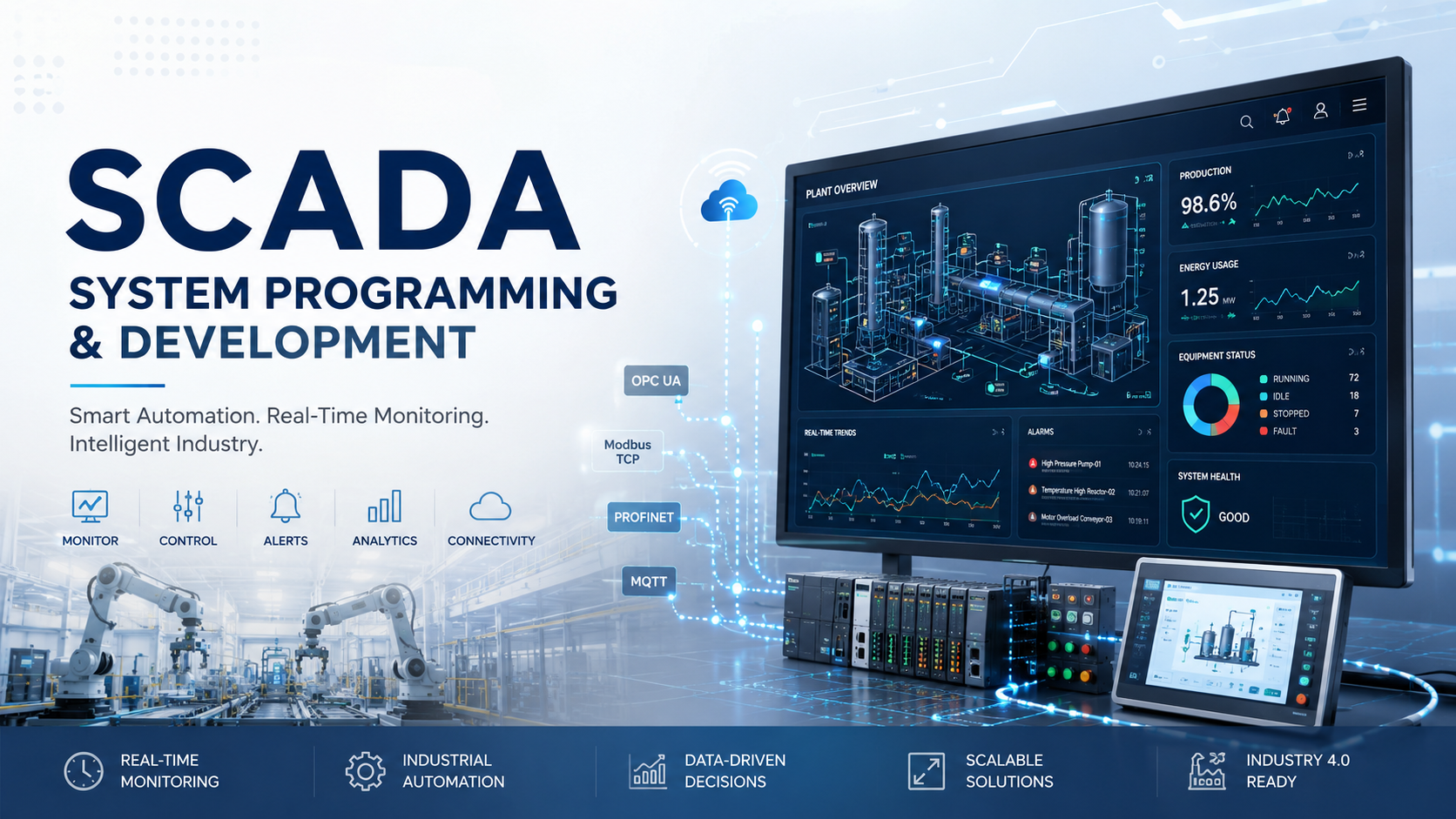
SCADA system programming and development involves designing, configuring, and integrating industrial automation systems that monitor and control machines, processes, and factory operations in real time. A well-developed SCADA system improves efficiency, reduces downtime, enables remote monitoring, and helps industries move toward smart manufacturing.
Introduction
Modern industries aren’t running on machines alone anymore.
They’re running on data, automation, and real-time monitoring.
That’s where SCADA systems come into play.
From manufacturing plants and water treatment facilities to power stations and smart factories, SCADA systems help industries monitor operations, collect data, automate processes, and cut down human errors.
I’ve seen factories transform overnight once they get their SCADA setup right. The difference is night and day.
In this guide, I’ll walk you through everything you need to know:
- What SCADA system programming really is
- How SCADA development actually works
- Key components of a SCADA architecture
- Real industrial applications
- Benefits and challenges you’ll face
- Future trends shaping the industry
- How AutomatexLab helps industries build advanced SCADA automation solutions
This isn’t just theory. It’s practical knowledge you can use.
What Is a SCADA System?
SCADA stands for Supervisory Control and Data Acquisition.
Sounds technical, right? Let me break it down.
It’s an industrial automation system used to:
- Monitor machines
- Control industrial processes
- Collect real-time operational data
- Trigger alarms
- Generate reports
- Improve operational efficiency
Think of a SCADA system as the brain of an industrial plant.
Instead of manually checking every machine, operators can monitor everything from a central dashboard. It’s like having eyes everywhere in your factory, all at once.
I’ve visited plants where operators used to walk miles every day just checking gauges. With SCADA, they do it all from one screen.
What Is SCADA System Programming?
SCADA programming is the development and configuration of software logic that controls industrial operations.
It involves working with:
- PLC integration
- HMI screen design
- Data communication
- Alarm management
- Real-time monitoring
- Industrial protocol integration
- Reporting systems
- Remote access systems
The main goal? Create a stable, scalable, and intelligent automation environment.
Here’s the thing most people miss: SCADA programming isn’t just coding. It’s understanding how machines talk to each other and making sure that conversation never breaks down.
A good SCADA programmer thinks like an operator, not just a developer.
What Is SCADA System Development?
SCADA development is the complete process of building and deploying industrial monitoring and automation systems.
It’s way more than just installing software.
Let me walk you through the typical process:
1. Requirement Analysis
Before writing a single line of code, you need to understand:
- Industrial workflow
- Machine architecture
- Production process
- Automation goals
- Safety requirements
I always tell clients: if you skip this step, you’ll pay for it later. Every single time.
You can’t automate what you don’t understand.
2. PLC Integration
SCADA systems communicate with PLCs to read and control industrial data.
Popular PLC brands include:
- Siemens
- Allen-Bradley
- Mitsubishi
- Schneider Electric
- Delta
- Omron
Each brand has its quirks. Allen-Bradley talks differently than Siemens. You need to know these differences.
Pro tip: Always test PLC communication before moving forward. A communication failure at 3 AM during production is nobody’s idea of fun.
3. HMI Design
The Human Machine Interface (HMI) is the visual dashboard operators use every day.
Good HMI design focuses on:
- Clean layouts
- Easy navigation
- Real-time visualization
- Alarm visibility
- Mobile responsiveness
- Operator safety
Here’s what I’ve learned: operators won’t use a complicated HMI. They’ll find workarounds. And workarounds create safety risks.
Keep it simple. Keep it visible. Keep it safe.
A cluttered dashboard with 50 buttons is worse than no dashboard at all.
4. Communication Protocol Configuration
SCADA systems use industrial protocols to communicate.
Common protocols include:
- Modbus
- OPC UA
- Profinet
- Ethernet/IP
- MQTT
- BACnet
These protocols allow devices and systems to talk properly.
Think of protocols as languages. If your device speaks Modbus and your system speaks OPC UA, you need a translator in between.
I’ve seen projects delayed for weeks because someone assumed all devices used the same protocol. Don’t make that mistake.
5. Alarm and Event Programming
A strong SCADA system instantly detects problems:
- Machine failures
- Temperature issues
- Voltage problems
- Pressure abnormalities
- Safety alerts
This is where SCADA really earns its keep.
Early warning systems prevent expensive shutdowns. I’ve seen a single alarm save a company $200,000 in one night because it caught a motor overheating before it failed.
But here’s the catch: too many alarms are as bad as no alarms. Operators start ignoring them.
6. Database and Reporting Integration
Modern SCADA systems collect massive amounts of industrial data.
Development includes:
- Historical data storage
- Production analytics
- Energy reports
- Maintenance reports
- Performance dashboards
Data without analysis is just noise. You need to turn that data into actionable insights.
I recommend keeping at least 3 months of historical data. Patterns emerge over time that you won’t see in daily reports.
7. Remote Monitoring Setup
Industries now want remote factory access from anywhere.
SCADA developers configure:
- Cloud connectivity
- Remote dashboards
- Mobile monitoring
- Remote troubleshooting
Remote monitoring changed the game during COVID.
Suddenly, plant managers could monitor operations from home. Maintenance teams could diagnose issues without being on-site.
It’s not just convenient. It’s essential now.
Core Components of a SCADA System
Let’s break down the essential parts:
PLCs (Programmable Logic Controllers)
PLCs control machines and industrial processes directly.
They’re the muscle of your automation system. SCADA is the brain, but PLCs do the heavy lifting.
RTUs (Remote Terminal Units)
RTUs collect field data from remote locations.
Think oil pipelines or water treatment plants spread across miles. RTUs gather data from these far-off locations and send it back to the central SCADA system.
HMI (Human Machine Interface)
The operator dashboard for monitoring and controlling systems.
This is what operators see and interact with every day. If your HMI is confusing, your operators will be frustrated.
SCADA Software
Central software platform that processes and visualizes industrial data.
Popular SCADA platforms include:
- WinCC
- Ignition
- Wonderware
- FactoryTalk
- Citect SCADA
My personal take? Ignition has been gaining ground fast. It’s web-based, unlimited licensing, and plays well with modern systems.
But each platform has strengths. Choose based on your industry and existing infrastructure.
Industrial Communication Network
Connects all industrial devices together.
Without a solid network, your SCADA system is useless. Network reliability is everything.
I always recommend redundant network paths for critical systems. Losing communication during production is not an option.
Types of SCADA Systems
SCADA has evolved significantly over the years.
Monolithic SCADA
Older standalone systems with limited connectivity.
These were the first generation. Big mainframe computers running proprietary software. They worked, but scaling was a nightmare.
You still see these in older plants. They’re reliable but outdated.
Distributed SCADA
Multiple systems connected through networks.
This was the next evolution. Systems could talk to each other across a plant network.
More flexible, but still limited to local networks.
Networked SCADA
Modern internet-enabled SCADA systems with cloud access.
This is where most industries are today. Systems connect through standard networks and protocols.
The advantage? You can access data from anywhere. The challenge? Cybersecurity becomes critical.
IoT-Based SCADA
Advanced SCADA integrated with:
- IoT sensors
- AI analytics
- Predictive maintenance
- Cloud computing
This is the future. Smart sensors everywhere. AI predicting failures before they happen.
I’ve worked with systems that can predict bearing failures 2 weeks in advance. That’s the power of IoT-based SCADA.
Benefits of SCADA System Programming and Development
Let’s talk about why companies invest in SCADA.
Real-Time Monitoring
Operators can monitor entire industrial operations instantly.
No more walking the floor with a clipboard. Everything is visible in real time.
This alone saves hours every day.
Improved Efficiency
Automation reduces manual work and production delays.
I’ve seen production efficiency jump 15-20% after proper SCADA implementation. That’s massive when you’re running 24/7 operations.
Reduced Downtime
Early detection of failures prevents expensive shutdowns.
Unplanned downtime costs money. Lots of it. SCADA helps you catch problems early.
One client calculated that SCADA paid for itself in 8 months just from reduced downtime.
Better Data Analytics
Industries can make smarter decisions using operational data.
You can’t improve what you can’t measure. SCADA gives you the data to make informed decisions.
Want to know why production dipped last Tuesday at 2 PM? SCADA has the answer.
Remote Access
Teams can monitor operations from anywhere.
Plant managers, maintenance teams, even executives can check operations remotely.
This flexibility is invaluable for modern businesses.
Enhanced Safety
SCADA systems improve industrial safety monitoring.
Safety should always be priority number one.
SCADA can enforce safety interlocks, monitor dangerous conditions, and alert operators to risks immediately.
I’ve seen SCADA systems prevent serious injuries by catching unsafe conditions early.
Energy Optimization
Industries can reduce energy consumption using automation insights.
Energy costs are huge for manufacturers. SCADA helps identify waste and optimize consumption.
One food processing plant I worked with cut energy costs by 12% just by analyzing SCADA data and adjusting operations.
Industries Using SCADA Systems
SCADA isn’t limited to one industry. It’s everywhere.
Manufacturing Plants
For machine monitoring and production automation.
From automotive to electronics, SCADA runs modern manufacturing.
Oil and Gas
Pipeline monitoring and remote infrastructure management.
Oil and gas was one of the first industries to adopt SCADA. When your equipment is spread across hundreds of miles, remote monitoring isn’t optional.
Power Generation
Electrical grid monitoring and power distribution control.
The power grid literally runs on SCADA.
Every time you flip a light switch, SCADA systems are managing that power flow.
Water Treatment Plants
Water flow monitoring and pump automation.
Clean water delivery depends on SCADA. Pumps, valves, treatment processes – all monitored and controlled through SCADA.
Pharmaceutical Industry
Process automation and compliance tracking.
Pharma needs strict process control. SCADA provides the documentation and control they need for FDA compliance.
Food and Beverage Industry
Production line automation and quality control.
From breweries to bakeries, SCADA ensures consistent quality and tracks every batch.
Common Challenges in SCADA Development
Let’s be real. SCADA development isn’t always smooth.
Cybersecurity Risks
Industrial systems are now connected to networks and cloud systems.
Security becomes critical.
Older SCADA systems weren’t designed with cybersecurity in mind. They assumed isolated networks.
Now? Everything’s connected. And that creates vulnerability.
I always recommend network segmentation, firewalls, and regular security audits. Don’t wait for a breach to think about security.
Legacy System Integration
Many factories still use older industrial equipment.
You can’t just rip out equipment that still works. So you need to integrate old and new.
This is where experience matters. Connecting a 20-year-old PLC to modern SCADA takes skill.
Scalability Issues
Poorly designed systems struggle during factory expansion.
Build for growth from day one.
Adding capacity later shouldn’t require rebuilding your entire SCADA system.
High Initial Investment
Advanced industrial automation requires strategic investment.
SCADA isn’t cheap. Good SCADA definitely isn’t cheap.
But the ROI is there if you do it right. Think long-term, not just upfront costs.
Modern Trends in SCADA Programming
The industry keeps evolving. Here’s where it’s heading.
AI-Powered Predictive Maintenance
AI helps predict machine failures before breakdowns happen.
This is huge. Instead of fixing things after they break, you fix them before they fail.
Machine learning algorithms analyze vibration patterns, temperature trends, and operational data to predict failures weeks in advance.
Cloud SCADA Systems
Industries are moving toward cloud-based monitoring platforms.
Cloud offers flexibility and accessibility. But it also raises security concerns.
My advice? Hybrid approaches work best. Keep critical control local, push analytics and reporting to the cloud.
Industrial IoT Integration
Smart sensors improve data collection accuracy.
More sensors mean more data. More data means better decisions.
IoT sensors are getting cheaper and smarter. This trend will only accelerate.
Mobile SCADA Applications
Operators can monitor systems directly from smartphones.
I’ve watched plant managers check production from their phones during dinner. That’s the new reality.
Mobile apps need to be secure and reliable. A buggy mobile app is worse than no mobile app.
Digital Twin Technology
Factories simulate operations virtually before implementation.
This is really exciting stuff.
You can test changes in a virtual environment before touching the real system. It reduces risk and speeds up optimization.
Why Businesses Need Professional SCADA Development
You might think: “Can’t we just install SCADA software and figure it out?”
No. You really can’t.
Industrial automation isn’t just about installing software.
A poorly developed SCADA system creates:
- Downtime
- Safety risks
- Communication failures
- Production inefficiencies
Professional SCADA development ensures:
- Stable architecture
- Reliable communication
- Secure infrastructure
- Long-term scalability
- Better ROI
Here’s the truth: Bad SCADA is worse than no SCADA.
I’ve been called to fix systems that were “implemented” by unqualified teams. The cost of fixing is always more than doing it right the first time.
Invest in professional development. Your operations depend on it.
How AutomatexLab Helps Industries With SCADA Development
AutomatexLab provides industrial automation and smart manufacturing solutions focused on:
- SCADA programming
- Industrial automation systems
- PLC programming
- HMI development
- Smart factory solutions
- Industrial IoT integration
- Process optimization
- Real-time monitoring systems
Their approach focuses on building scalable, efficient, and future-ready automation infrastructures for modern industries.
What sets them apart?
They understand that every industry is different. A water treatment plant has different needs than an automotive factory.
Custom solutions, not cookie-cutter templates.
Conclusion
SCADA system programming and development has become one of the most important parts of modern industrial automation.
It’s not optional anymore. It’s essential.
Industries today need:
- Real-time visibility
- Data-driven operations
- Smart automation
- Predictive maintenance
- Remote monitoring
A properly developed SCADA system helps businesses improve productivity, reduce downtime, and prepare for Industry 4.0 transformation.
The factories that invest in SCADA today will be the competitive leaders tomorrow.
Don’t wait for equipment failures or production losses to force your hand. Start planning your SCADA implementation now.
For businesses looking to modernize industrial operations, AutomatexLab provides scalable automation and SCADA solutions built for modern manufacturing environments.
The future of manufacturing is automated, connected, and intelligent. SCADA is how you get there.
FAQs
SCADA programming is the process of configuring industrial automation software to monitor and control machines, industrial processes, and operational data in real time. It involves PLC integration, HMI design, alarm management, and communication protocol setup.
Popular SCADA software includes Siemens WinCC, Ignition, Wonderware, FactoryTalk, and Citect SCADA. The choice depends on your industry, budget, and existing infrastructure.
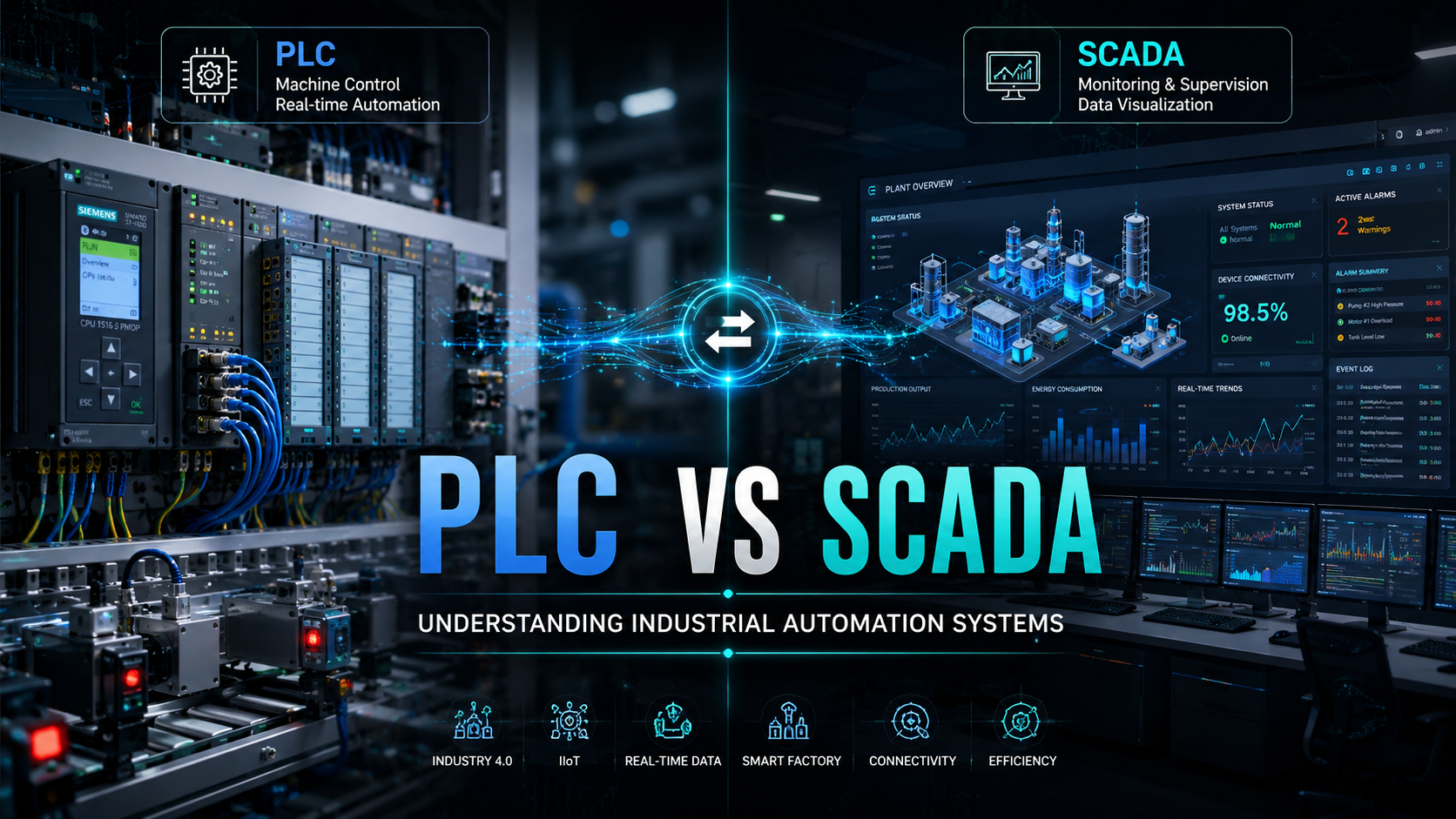
PLCs control machines directly through programmed logic. SCADA systems monitor, visualize, and manage the overall industrial process. Think of PLCs as the hands and SCADA as the brain.
Yes. Modern smart factories heavily rely on SCADA systems for automation, analytics, and remote monitoring. SCADA is a core component of Industry 4.0 implementations.
SCADA is widely used in manufacturing, oil and gas, power generation, water treatment, pharmaceuticals, and food processing industries. Any industry with automated processes benefits from SCADA.
Costs vary widely based on system complexity, number of monitoring points, software licensing, and integration requirements. Small systems might start at $50,000, while large enterprise systems can exceed $500,000.
Yes, if not properly secured. Modern SCADA systems need network segmentation, firewalls, secure protocols, and regular security updates. Cybersecurity should be built in, not added later.
Implementation timelines range from 3 months for simple systems to 12+ months for complex multi-site deployments. Proper planning and professional development are key to staying on schedule.