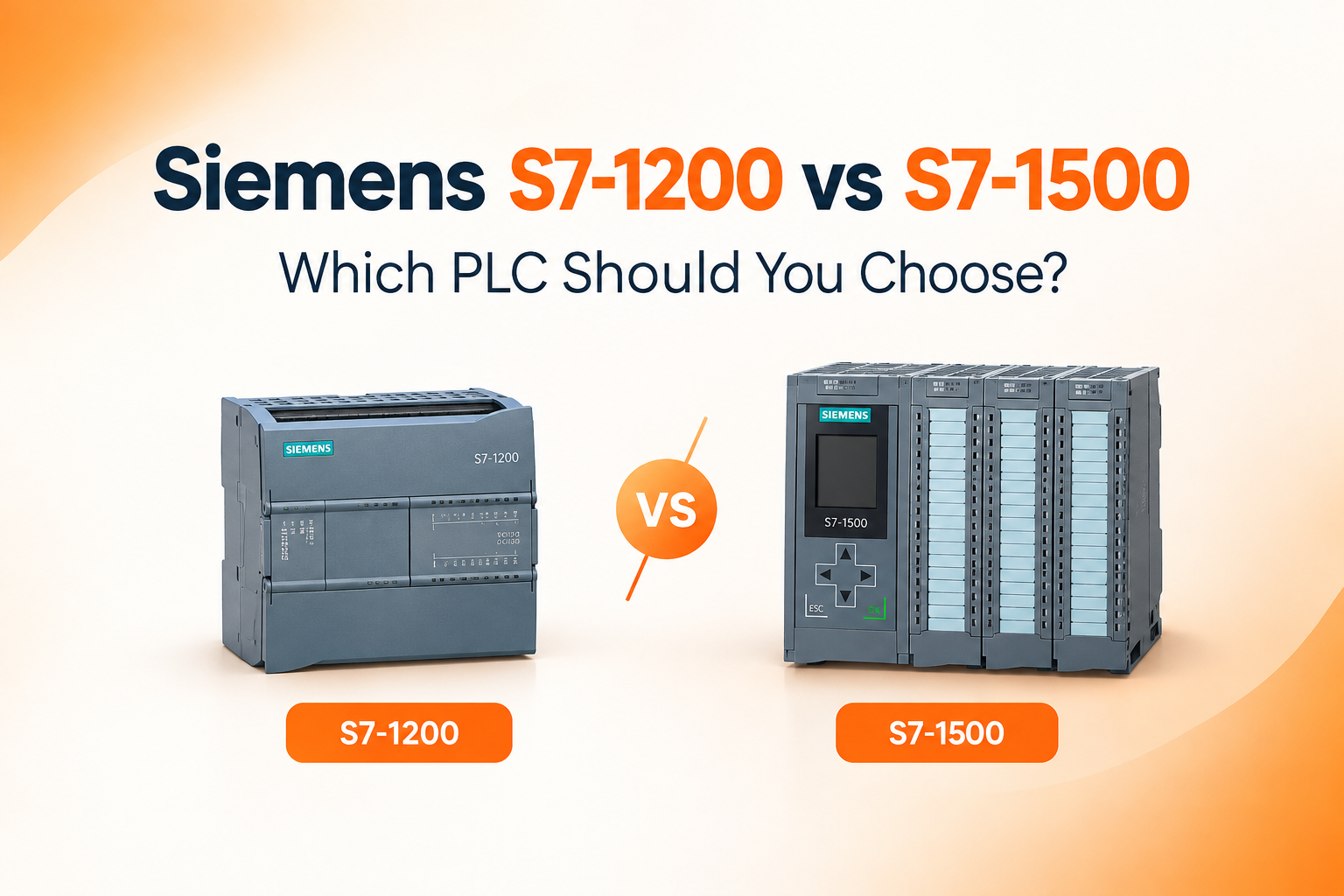
The Siemens S7-1200 is generally suited to compact and mid-sized automation systems where cost, simplicity, and sufficient performance are priorities. The S7-1500 is designed for larger, more demanding applications that require higher performance, greater scalability, advanced motion control, diagnostics, and communication capabilities.
Choosing the right PLC matters for machine performance, expansion, maintenance, and project cost. The wrong choice can lead to overspending on unnecessary hardware or facing limitations that require expensive redesigns later.
The S7-1200 and S7-1500 are two distinct platforms within the Siemens automation portfolio. Each serves different application needs. The right choice depends on your specific requirements rather than simply selecting the more powerful option.
This guide provides a detailed comparison to help automation engineers, controls engineers, system integrators, and plant managers make informed decisions for their next Siemens PLC project.
Siemens S7-1200 vs S7-1500 at a Glance
The following table summarizes the key differences between these two PLC families.
| Feature | S7-1200 | S7-1500 |
|---|---|---|
| Target applications | Compact to mid-sized | Mid-sized to complex |
| CPU performance | Lower | Higher |
| System scalability | Good | Excellent |
| I/O expansion | Moderate | Extensive |
| Motion control | Basic to advanced depending on CPU | Advanced |
| Communication | PROFINET and additional options | Extensive industrial communication |
| Diagnostics | Integrated | Advanced |
| Programming | TIA Portal | TIA Portal |
| Cost | Generally lower | Generally higher |
| Best suited for | Machines and smaller systems | Complex machines and production systems |
This table provides a starting point. The sections below offer detailed technical comparison to support your selection process.
What Is Siemens S7-1200?
The Siemens S7-1200 is a compact PLC platform designed for small to mid-sized automation tasks. It sits at the entry level of Siemens modern controller lineup, above the discontinued S7-200 series and below the S7-1500.
The S7-1200 uses a modular design with integrated I/O on the CPU and options for additional expansion through signal boards and signal modules. It is programmed using TIA Portal, the same engineering environment used for the S7-1500 and other modern Siemens devices.
This platform targets machine builders and end users who need reliable control for standard automation tasks without the cost and complexity of a higher-end system.
Key Features of S7-1200
The S7-1200 offers a range of features that make it suitable for many automation applications.
Compact CPU design: The CPUs are available in different sizes with varying performance levels. Even the smallest units include integrated communication and I/O.
Integrated digital and analog I/O: Depending on the specific CPU model, the S7-1200 includes built-in digital inputs, digital outputs, and analog inputs. This reduces the need for additional modules in simple applications.
PROFINET connectivity: Every S7-1200 CPU includes a PROFINET port for programming, HMI communication, and distributed I/O connectivity.
Signal boards and signal modules: Expansion options include signal boards that plug directly into the CPU and signal modules that snap onto the rail beside the CPU. This provides flexibility for adding I/O as needed.
Technology functions: The S7-1200 supports basic counting, measurement, and simple motion control functions depending on the CPU model.
Basic motion capabilities: Some S7-1200 CPUs support pulse train output for stepper and servo control. The number of axes and performance level depends on the specific CPU.
TIA Portal programming: The S7-1200 is programmed exclusively in TIA Portal, Siemens modern engineering software. This provides a consistent environment across Siemens automation products.
Web-server and diagnostic capabilities: Integrated web server functionality allows remote monitoring and basic diagnostics through a standard web browser.
Where Is S7-1200 Commonly Used?
The S7-1200 excels in applications where compact size, cost efficiency, and straightforward control are priorities.
- Packaging machines
- Pump control
- Conveyor systems
- HVAC automation
- Small production machines
- Water treatment systems
- Building automation
- Material handling
These applications typically involve moderate I/O counts, simple to moderate control logic, and limited motion requirements.
Advantages of S7-1200
The S7-1200 provides several benefits for the right applications.
Lower initial hardware cost: The S7-1200 is generally less expensive than the S7-1500 across CPUs, I/O modules, and related components. This makes it attractive for cost-sensitive projects.
Compact footprint: The small physical size allows installation in tight control cabinets. This is important for machine builders where space is at a premium.
Easier deployment for smaller machines: The integrated I/O and simple architecture reduce wiring and configuration time for straightforward applications.
Suitable for many standard automation tasks: Most machine control applications do not require the advanced capabilities of the S7-1500. The S7-1200 handles these tasks effectively.
Good integration with Siemens HMI and drives: The S7-1200 works seamlessly with Siemens comfort panels, basic panels, and SINAMICS drives within the TIA Portal environment.
TIA Portal ecosystem: Programming, configuration, and diagnostics all happen in one software environment. This reduces training requirements and improves engineering efficiency.
Limitations of S7-1200
The S7-1200 has constraints that matter as application requirements grow.
Less processing capacity than higher-end CPUs: Program execution speed, memory, and data handling capabilities are lower than the S7-1500. This affects complex calculations, high-speed operations, and large programs.
More limited scalability for very large systems: While the S7-1200 supports expansion, there are practical limits to how many modules and devices can be connected.
May become restrictive as I/O, motion, communication, and program complexity increase: Applications that start simple often grow. The S7-1200 can reach its limits faster than the S7-1500.
Not always the most economical choice for highly complex automation projects: When extensive engineering, multiple networked systems, and advanced diagnostics are required, the S7-1200 may require workarounds that increase total project cost.
What Is Siemens S7-1500?
The Siemens S7-1500 is a higher-performance PLC platform designed for demanding automation applications. It represents the upper tier of Siemens current controller offerings.
The S7-1500 features a modular architecture that scales from mid-sized applications to very large, distributed control systems. It includes advanced diagnostics, integrated motion control, and extensive communication capabilities.
This platform targets complex machines, production lines, and process automation applications where performance, scalability, and advanced features are essential.
Key Features of S7-1500
The S7-1500 includes features that address demanding automation requirements.
High-performance CPUs: The S7-1500 CPU range includes models with significantly faster processing speeds, more memory, and higher capacity for complex programs and data handling.
Modular architecture: The system uses a backplane-free design where modules connect directly. This provides flexibility in configuration and expansion.
PROFINET communication: Multiple PROFINET ports are available on many CPUs. This supports network redundancy, device separation, and flexible topology options.
Advanced diagnostics: Integrated diagnostics provide detailed system status, module health, and error information. This reduces troubleshooting time and improves maintenance efficiency.
Motion control capabilities: The S7-1500 supports advanced motion control including coordinated multi-axis systems, cam profiles, and high-speed positioning. Motion control is integrated into the CPU for many models.
Technology CPUs: Specific S7-1500 models include advanced technology functions for motion control, closed-loop control, and high-speed counting.
Safety PLC options: Fail-safe S7-1500 CPUs are available for applications requiring integrated safety functions. These CPUs handle both standard and safety-related tasks.
Large application scalability: The S7-1500 supports extensive I/O expansion and can manage large distributed systems with many devices.
TIA Portal integration: Like the S7-1200, the S7-1500 is programmed and configured in TIA Portal. This provides a consistent engineering environment.
Where Is S7-1500 Commonly Used?
The S7-1500 is suited for applications where performance, scalability, and advanced features are required.
- Large manufacturing lines
- Automotive production
- Process automation applications
- Complex machine automation
- High-speed packaging
- Material handling systems
- Multi-axis motion systems
- Production lines requiring extensive diagnostics
These applications typically involve high I/O counts, complex control logic, multiple networked devices, and demanding performance requirements.
Advantages of S7-1500
The S7-1500 provides significant benefits for demanding applications.
Higher processing performance: Faster scan times, quicker program execution, and better handling of complex algorithms. This matters for high-speed applications and large programs.
Greater scalability: The S7-1500 supports more I/O modules, more distributed devices, and larger overall system architectures. This provides room for growth without platform changes.
Advanced motion capabilities: Integrated motion control supports complex coordinated motion, electronic camming, and high-speed positioning. This reduces the need for separate motion controllers.
More sophisticated diagnostics: Detailed system and device diagnostics provide better visibility into system health. This supports predictive maintenance and faster troubleshooting.
Better fit for complex automation architectures: The S7-1500 handles distributed control, multiple communication protocols, and integration with higher-level systems more effectively than the S7-1200.
Strong integration with Siemens industrial systems: The S7-1500 works seamlessly with Siemens HMI, drives, motion control, and higher-level software within the TIA Portal and Siemens industrial ecosystem.
Limitations of S7-1500
The S7-1500 has considerations that affect project decisions.
Higher hardware cost: CPUs, I/O modules, and related components cost more than S7-1200 equivalents. This increases initial capital expenditure.
Potentially more engineering complexity: The additional features and capabilities require more configuration and planning. This can increase engineering time for simple applications.
May be unnecessary for simple machines: For straightforward control tasks, the S7-1500 provides capabilities that will never be used. This represents wasted investment.
Requires more careful system architecture and project planning: The scalability and flexibility of the S7-1500 mean that poor planning can lead to inefficient configurations. More upfront planning is beneficial.
S7-1200 vs S7-1500: Key Differences
This section provides detailed comparison across the factors that matter most for PLC selection.
Performance and Processing Power
The S7-1500 offers significantly higher processing performance than the S7-1200.
CPU processing performance varies across models within each family. The fastest S7-1200 CPUs are comparable to entry-level S7-1500 CPUs. However, the top S7-1500 models far exceed anything available in the S7-1200 range.
Program execution speed affects how quickly the PLC can scan inputs, execute logic, and update outputs. For high-speed applications, this directly impacts machine cycle times.
Data processing capabilities matter for applications involving complex calculations, large data arrays, or communication with database systems.
High-speed applications such as flying shears, high-speed packaging, and complex motion coordination require the processing power of the S7-1500.
Response requirements for safety functions, interlocks, and time-critical operations may also push toward the S7-1500.
Additional processing power matters when scan times affect production throughput, when complex algorithms are required, or when the program size grows beyond what the S7-1200 can handle efficiently.
I/O Capacity and Scalability
The S7-1500 supports larger I/O configurations than the S7-1200.
Integrated I/O on the CPU varies by model. Both platforms offer CPUs with built-in digital and analog I/O, though the specific counts differ.
Expansion modules allow adding I/O as needed. The S7-1500 supports more modules per CPU and more total I/O points.
Distributed I/O through PROFINET allows placing I/O near the field devices. Both platforms support this, but the S7-1500 handles larger distributed systems with more devices.
Large machine architectures with hundreds of I/O points and multiple remote stations are better suited to the S7-1500.
Future expansion requirements should be considered before selecting a PLC. If the application is expected to grow significantly, the S7-1500 provides more headroom.
Companies should consider future expansion before selecting a PLC to avoid premature replacement or complex upgrades.
Motion Control
Motion control capabilities differ significantly between the platforms.
Servo applications require precise position and velocity control. The S7-1500 offers more advanced servo control with better performance and more axes.
VFD control for simple speed regulation is handled by both platforms. The S7-1200 works well for basic VFD applications.
Positioning tasks range from simple point-to-point moves to complex coordinated motion. The S7-1200 handles basic positioning while the S7-1500 excels at complex positioning.
Multi-axis systems with coordinated motion, interpolation, and electronic camming require the S7-1500. The S7-1200 has limited multi-axis capability.
High-speed motion applications demand fast update rates and precise synchronization. The S7-1500 provides better performance for these requirements.
Exact capabilities depend on the specific CPU and technology configuration. Some S7-1200 CPUs support multiple motion axes while some entry-level S7-1500 CPUs have limited motion capability.
Communication and Networking
Both platforms support extensive communication options, but the S7-1500 offers more.
PROFINET is the primary industrial Ethernet protocol for both platforms. It supports real-time communication with distributed I/O, drives, and other devices.
Industrial Ethernet provides standard TCP/IP communication for programming, HMI, and higher-level systems.
Distributed I/O through PROFINET allows remote I/O stations. The S7-1500 supports more devices and larger networks.
Siemens drives integrate seamlessly with both platforms through PROFINET or other protocols. The S7-1500 offers more advanced drive control options.
HMIs connect to both platforms. The S7-1500 supports more HMI connections and larger HMI applications.
SCADA systems communicate with both platforms. The S7-1500 provides better performance for large SCADA architectures.
OPC UA where applicable provides standardized data exchange. The S7-1500 has more extensive OPC UA capabilities, though some S7-1200 models support it.
Third-party devices can communicate with both platforms through standard protocols. The S7-1500 offers more options for complex integration scenarios.
Communication requirements can influence PLC selection. Applications with many networked devices, complex data exchange, or integration with multiple systems may require the S7-1500.
Diagnostics and Troubleshooting
The S7-1500 provides more advanced diagnostics than the S7-1200.
CPU diagnostics include system status, memory usage, and error history. The S7-1500 provides more detailed diagnostic information.
Device diagnostics for connected I/O, drives, and other devices are more comprehensive on the S7-1500. This helps identify issues faster.
Error identification is more precise on the S7-1500. The system provides more specific error codes and descriptions.
Maintenance workflows benefit from better diagnostics. Technicians can identify and resolve issues faster with detailed diagnostic information.
TIA Portal diagnostic tools work with both platforms. The S7-1500 exposes more diagnostic data to these tools.
Advanced diagnostics matter in production environments where downtime is expensive. Faster troubleshooting reduces production losses.
Programming and TIA Portal
Both platforms are integrated into the Siemens TIA Portal ecosystem.
Programming workflow is similar across both platforms. Engineers familiar with one can work with the other.
Hardware configuration differs based on the specific modules and architecture. The S7-1500 offers more configuration options.
HMI integration works similarly for both platforms. Both support Siemens HMI panels and WinCC.
Reusability of code and function blocks is possible across platforms with some limitations. The S7-1500 supports more advanced programming constructs.
Troubleshooting uses the same TIA Portal tools. The S7-1500 provides more diagnostic data to these tools.
Project migration considerations matter when moving between platforms. While both use TIA Portal, hardware differences require configuration changes.
Safety Applications
Siemens offers fail-safe PLC variants for both platforms.
Machine safety functions require fail-safe controllers. Standard CPUs do not provide safety functions.
Emergency-stop systems require safety-rated inputs and logic. Fail-safe CPUs and safety I/O modules handle these functions.
Safety I/O modules connect safety devices such as e-stops, light curtains, and door switches.
Fail-safe CPUs are available in both S7-1200 and S7-1500 families. The S7-1500 offers more options and higher performance for safety applications.
A standard S7-1200 or S7-1500 CPU alone does not provide a complete safety system. Safety functions require fail-safe CPUs and appropriate safety I/O.
Cost Comparison
Cost considerations go beyond the initial hardware purchase.
PLC CPU cost varies by model and performance level. S7-1500 CPUs generally cost more than S7-1200 CPUs with similar I/O counts.
I/O modules for the S7-1500 typically cost more than S7-1200 equivalents.
Communication modules add cost for both platforms. The S7-1500 may require different modules for advanced communication.
HMI costs depend on the selected panel and are similar across platforms.
Drives and motion components represent significant cost. The S7-1500 enables more advanced drive configurations.
Engineering time is often higher for the S7-1500 due to additional configuration and planning requirements.
Commissioning time depends on system complexity. The S7-1500 systems may take longer to commission due to more devices and features.
Maintenance costs over the system life are affected by diagnostics and reliability. The S7-1500 advanced diagnostics can reduce troubleshooting time.
Future expansion costs should be considered. The S7-1500 provides more headroom, potentially avoiding premature replacement.
The cheapest PLC upfront is not always the lowest-cost automation system over its lifecycle. Total cost of ownership includes engineering, commissioning, maintenance, and expansion.
S7-1200 vs S7-1500: Which PLC Should You Choose?
This section provides a practical decision framework.
Choose S7-1200 If…
Consider the S7-1200 when the project has these characteristics:
- Small or moderate I/O requirements
- Straightforward machine logic
- Limited motion requirements
- Moderate communication requirements
- Cost-sensitive hardware requirements
- Limited expected expansion
- Compact machine architecture
Example: A small automated packaging machine with conveyors, sensors, pneumatic valves, a few VFDs, and an HMI may be a good S7-1200 use case. The control logic is straightforward, I/O counts are moderate, and motion requirements are limited.
Choose S7-1500 If…
Consider the S7-1500 when the project requires these characteristics:
- Higher processing performance
- Large I/O architecture
- Complex control logic
- Advanced motion
- Multiple networked devices
- Extensive diagnostics
- Significant future expansion
- Large production-line integration
Example: A multi-station manufacturing line with several drives, distributed I/O stations, HMIs, SCADA connectivity, and coordinated motion may justify an S7-1500 architecture. The performance, scalability, and advanced features provide value in this context.
S7-1200 vs S7-1500 for Different Applications
Application requirements determine the appropriate platform.
Small Machine Automation
Small machines with simple control logic, moderate I/O, and basic motion favor the S7-1200. The compact size and lower cost provide value without sacrificing capability.
Conveyor and Material Handling
Conveyor systems with basic start/stop control and simple interlocks work well with the S7-1200. Larger systems with many drives, complex routing, and high-speed sorting may require the S7-1500 for I/O capacity and processing power.
Packaging Automation
Simple packaging machines with basic motion and moderate speeds suit the S7-1200. High-speed packaging with complex motion, synchronization, and extensive diagnostics benefits from the S7-1500.
Water and Pump Automation
Water treatment and pump control applications with moderate I/O, analog signals, VFDs, and SCADA connectivity can use either platform. The S7-1200 handles most standard applications while the S7-1500 provides more capacity for large plants.
Manufacturing Production Lines
Production lines with distributed control, extensive networking, advanced diagnostics, and significant expansion requirements favor the S7-1500. The scalability and performance support complex architectures.
Motion Control
Applications with multiple coordinated axes, high-speed positioning, and electronic camming require the S7-1500. Simple motion tasks can use the S7-1200 with appropriate CPU selection.
S7-1200 vs S7-1500: Common Selection Mistakes
Avoid these common errors when selecting a PLC.
Choosing only based on PLC price: The CPU cost is a small part of total project cost. Engineering, commissioning, and lifecycle costs matter more.
Ignoring future expansion: Selecting a platform that cannot grow with the application leads to premature replacement.
Underestimating communication requirements: Modern automation systems involve extensive networking. Underestimating these requirements leads to performance issues or expensive upgrades.
Choosing a high-end PLC for a simple machine: The S7-1500 provides capabilities that simple machines do not need. This wastes money and engineering time.
Ignoring motion-control requirements: Motion requirements often drive platform selection. Underestimating them can force a platform change mid-project.
Not considering maintenance requirements: Advanced diagnostics reduce downtime. The value of these features depends on the application and production environment.
Failing to plan distributed I/O: Where I/O will be located affects architecture and cost. Planning this early prevents rework.
Selecting hardware before defining the control architecture: The control architecture should drive hardware selection, not the other way around.
Can You Upgrade From S7-1200 to S7-1500?
Migration from S7-1200 to S7-1500 is possible when application requirements outgrow the smaller platform.
When Migration May Make Sense
Migration makes sense when the S7-1200 reaches its limits in processing power, I/O capacity, motion capability, or communication requirements. It also makes sense when significant expansion is planned that exceeds S7-1200 capabilities.
What Can Be Reused
HMI applications, drive configurations, and some program logic may be reusable. TIA Portal projects can be migrated with appropriate hardware changes.
TIA Portal Project Considerations
TIA Portal supports changing the CPU type within a project. This allows migrating from S7-1200 to S7-1500 with adjustments for hardware differences.
Hardware Differences
The S7-1500 uses different I/O modules and mounting arrangements. Physical installation changes are required.
I/O Changes
I/O module types and addresses change during migration. Wiring and configuration must be updated.
Program Modifications
Most program logic transfers, but specific instructions and system functions may differ. Testing is essential.
HMI and Communication Considerations
HMI connections and communication configurations may need updates. PROFINET device names and IP addresses may change.
Testing and Commissioning
Thorough testing is required after migration. Verify all functions and communication paths before production use.
S7-1200 vs S7-1500 for New Projects
Follow this selection workflow for new projects.
Step 1: Define I/O requirements. Count digital and analog I/O points. Consider distributed I/O needs.
Step 2: Define processing requirements. Estimate program size, scan time requirements, and data handling needs.
Step 3: Identify motion requirements. Determine number of axes, type of motion, and performance requirements.
Step 4: Map communication protocols. Identify devices, protocols, and data exchange requirements.
Step 5: Estimate future expansion. Consider likely growth in I/O, devices, and functionality.
Step 6: Define HMI/SCADA requirements. Determine operator interface and supervisory system needs.
Step 7: Compare lifecycle cost. Consider hardware, engineering, commissioning, maintenance, and expansion costs.
Step 8: Select the appropriate CPU and architecture. Choose the platform and specific CPU that meets requirements without excessive overcapacity.
Conclusion
The S7-1200 and S7-1500 serve different segments of the automation market. Neither is universally better. The right choice depends on application requirements.
Choose the S7-1200 for compact machines, moderate automation requirements, simpler architectures, and cost-sensitive projects. It provides reliable control for standard automation tasks.
Choose the S7-1500 for higher-performance machines, complex production systems, advanced motion, larger architectures, and applications requiring greater scalability. It provides the performance and features needed for demanding applications.
For Siemens PLC programming, PLC system integration, remote PLC support, or industrial automation consultation, contact our team to discuss your project requirements.