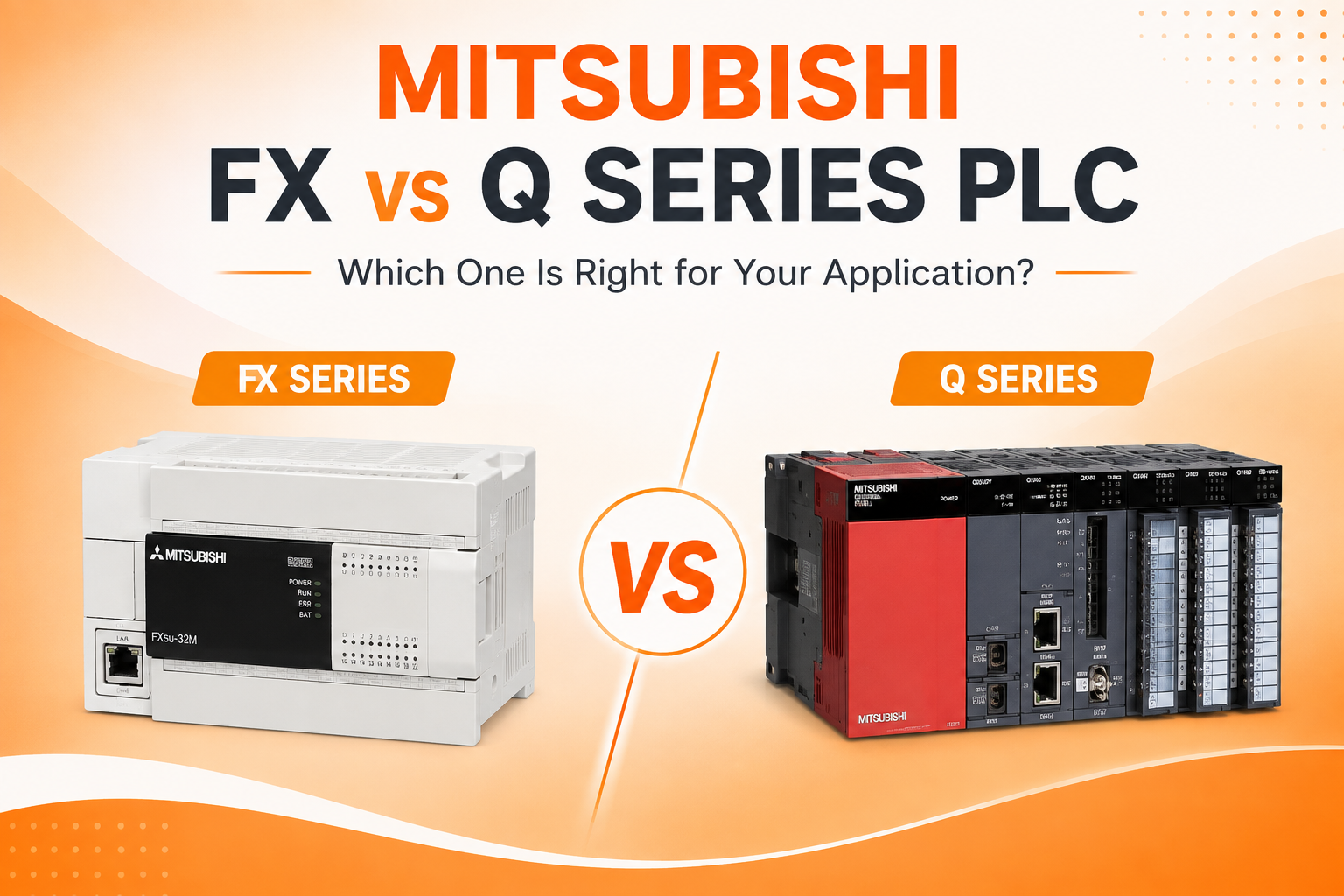
Choosing between a Mitsubishi FX Series PLC and a Mitsubishi Q Series PLC depends on the size, complexity, scalability, communication requirements, and future expansion plans of your automation system.
For smaller standalone machines and cost-sensitive applications, an FX Series PLC can be a practical choice. For larger production systems requiring modular hardware, extensive I/O, advanced communication, and greater scalability, a Q Series architecture may be more suitable.
However, selecting a PLC is not simply about choosing the more powerful platform. The correct choice depends on the specific application, required CPU performance, I/O count, communication network, motion requirements, existing equipment, and hardware lifecycle.
This guide compares Mitsubishi FX and Q Series PLCs to help machine builders, manufacturers, maintenance teams, and industrial automation decision-makers understand which platform may fit their application.
Important: Mitsubishi PLC capabilities vary significantly by CPU model, generation, and installed modules. Always evaluate the exact hardware configuration rather than relying only on the PLC family name.
Mitsubishi FX vs Q Series PLC: Quick Comparison
Mitsubishi FX Series PLCs are generally suited to compact and smaller automation applications, while Mitsubishi Q Series PLC systems are designed around a modular architecture for larger and more complex control requirements.
| Feature | Mitsubishi FX Series | Mitsubishi Q Series |
|---|---|---|
| Typical application size | Small to medium | Medium to large |
| PLC architecture | Compact | Modular |
| System expansion | Limited to moderate | Extensive |
| Processing requirements | Standard machine control | Complex automation systems |
| I/O scalability | Moderate | High |
| Panel space | Compact | Larger modular configuration |
| Communication requirements | Basic to advanced, depending on model | Extensive, depending on configuration |
| System complexity | Low to medium | Medium to high |
| Initial hardware investment | Generally lower | Generally higher |
| Typical applications | Standalone machines | Production lines and integrated systems |
The most important point is that neither PLC family is universally “better.” A Q Series configuration can be unnecessary for a simple machine, while an FX-based architecture may become restrictive if a system grows beyond its original design requirements.
What Is the Mitsubishi FX Series PLC?
The Mitsubishi FX Series is a compact PLC platform commonly used for standalone machines and small to medium industrial automation applications.
FX Series PLCs are widely associated with machine-level automation where control requirements are relatively defined and the system does not require an extensive modular architecture.
Depending on the specific model and configuration, an FX PLC can support a range of industrial control tasks, including digital I/O, analog signals, communication, positioning, and other application-specific functions.
Mitsubishi FX PLC Architecture
A key characteristic of the FX Series is its compact design.
The PLC system can provide an integrated approach where the CPU and a base level of I/O are contained within a compact unit. Expansion hardware can then be added according to the requirements of the particular application.
This approach can offer several advantages:
- Reduced control panel space.
- Simplified hardware architecture.
- Lower installation complexity.
- Faster deployment for standard machines.
- Cost efficiency for appropriately sized systems.
For an OEM building a dedicated machine with predictable requirements, this type of architecture can be highly practical.
Typical Mitsubishi FX Series PLC Applications
Mitsubishi FX PLCs can be suitable for applications such as:
- Packaging machines.
- Filling machines.
- Small conveyor systems.
- Pump control systems.
- Water and wastewater equipment.
- Material handling machines.
- HVAC-related automation.
- Small assembly equipment.
- Food processing machinery.
- Standalone production machines.
For example, a packaging machine with sensors, pneumatic cylinders, motors, a VFD, an HMI, and a defined sequence of operations may not require a large modular PLC architecture.
A correctly sized compact PLC can handle the required control logic without introducing unnecessary hardware complexity.
Advantages of Mitsubishi FX Series PLCs
The main advantages of an FX-based solution can include:
Compact design
FX PLCs can be useful where control cabinet space is limited.
Cost efficiency
For smaller automation projects, using a compact PLC architecture may reduce the overall hardware investment.
Suitable for standard machine automation
Sequential logic, machine interlocks, timers, counters, sensor inputs, actuator outputs, and similar control tasks can often be handled effectively.
Simpler system architecture
A smaller system generally involves fewer hardware components and connections than a large modular control system.
Practical for standalone equipment
Machines that operate independently and have predictable I/O requirements can often benefit from a compact PLC design.
Limitations of FX Series PLCs
An FX Series PLC may become less suitable when application requirements grow significantly.
Potential limitations can arise when a project requires:
- Very large I/O systems.
- Extensive modular expansion.
- Complex multi-machine integration.
- Advanced networking requirements.
- Large distributed automation systems.
- High levels of specialized control.
- Significant future expansion.
The issue is not that a compact PLC cannot perform industrial automation. The issue is whether the system architecture remains practical as the project becomes more complex.
What Is the Mitsubishi Q Series PLC?
The Mitsubishi Q Series is a modular PLC platform designed for larger and more complex industrial automation systems requiring flexible hardware configuration and scalability.
Unlike a compact architecture, a modular PLC system separates major functions into different hardware components.
A typical architecture may include:
- CPU modules.
- Power supply modules.
- Digital input modules.
- Digital output modules.
- Analog modules.
- Communication modules.
- Specialty modules.
- Other application-specific hardware.
This allows the automation system to be configured around the exact requirements of the application.
Modular Architecture of Mitsubishi Q Series PLCs
The modular approach is particularly useful when a system has a large number of devices or different types of control requirements.
Instead of selecting one compact PLC and expanding within its available architecture, engineers can configure a larger system using appropriate modules.
This can be beneficial for applications involving:
- Large I/O counts.
- Multiple production stations.
- Complex communication.
- Specialized signals.
- Large machinery.
- Distributed automation.
- Future system expansion.
The modular design provides greater flexibility, although it also increases engineering and configuration complexity.
Typical Mitsubishi Q Series PLC Applications
A Q Series architecture may be considered for applications such as:
- Large production lines.
- Multi-station assembly systems.
- Automotive manufacturing systems.
- Large material handling systems.
- Complex conveyor networks.
- Process automation.
- Integrated factory automation.
- Multi-machine production environments.
For example, a manufacturing line with multiple stations, hundreds of signals, distributed equipment, multiple operator interfaces, production data collection, and supervisory integration requires a different automation architecture from a standalone packaging machine.
In such cases, modularity can become a major advantage.
Key Advantages of Mitsubishi Q Series PLCs
A modular architecture can offer several important benefits.
Greater scalability
Additional hardware can be configured as system requirements grow.
Flexible system design
Different modules can be selected for different control requirements.
Suitable for large I/O systems
A modular architecture is generally more practical for applications with significant numbers of signals.
Integration flexibility
Complex systems often require communication with multiple devices, machines, and supervisory platforms.
Support for specialized automation functions
Larger industrial systems may require specialized hardware for specific control tasks.
Limitations of Q Series PLC Systems
A larger modular PLC system is not automatically the best solution.
Potential disadvantages include:
- Higher initial hardware costs.
- More control panel space.
- More detailed engineering.
- Greater installation complexity.
- Additional configuration requirements.
For a small standalone machine, a large modular architecture may represent unnecessary engineering and investment.
FX vs Q Series PLC Architecture Comparison
The primary architectural difference is that FX Series PLCs follow a compact approach, while Q Series PLC systems use modular hardware for greater flexibility and expansion.
Understanding this difference is essential before comparing individual specifications.
Compact PLC Architecture
Compact PLC architecture works well when requirements are reasonably predictable.
For example, consider a machine with:
- 24 digital inputs.
- 16 digital outputs.
- A small number of analog signals.
- One HMI.
- One VFD.
- A defined production sequence.
If future expansion is minimal, a compact PLC architecture may provide a practical and efficient solution.
The main benefits include reduced panel requirements and simpler system design.
Modular PLC Architecture
A modular architecture becomes more valuable as the number and variety of control requirements increase.
Consider a production system with:
- Multiple machine stations.
- Hundreds of I/O points.
- Analog instrumentation.
- Multiple communication networks.
- Remote equipment.
- SCADA integration.
- Production monitoring.
- Future expansion plans.
In this situation, modularity can make the system easier to structure and expand.
Which Architecture Is Better for Your Machine?
A compact architecture may be preferable when:
- The machine is standalone.
- I/O requirements are predictable.
- Panel space is limited.
- Future expansion is minimal.
- Cost efficiency is important.
A modular architecture may be preferable when:
- The system is large.
- I/O requirements are extensive.
- Multiple machines are integrated.
- Specialized modules are required.
- Communication architecture is complex.
- Future expansion is expected.
The key principle is architecture-fit: the PLC platform should match the operational footprint of the machine rather than simply maximizing hardware capability.
Mitsubishi FX vs Q Series PLC Performance Comparison
Q Series systems are generally more suitable for larger and more complex control architectures, while FX Series PLCs can provide sufficient performance for many standard machine automation tasks.
PLC performance should not be evaluated using processor capability alone.
The real question is:
Can the selected PLC configuration reliably execute the required control tasks within the application’s performance requirements?
Processing Requirements
Before selecting a PLC, engineers should evaluate:
- Program size.
- Logic complexity.
- Scan-time requirements.
- Number of I/O points.
- Communication load.
- Data handling.
- High-speed operations.
- Motion requirements.
A simple sequence involving sensors and pneumatic cylinders has very different processing requirements from an integrated production system coordinating multiple machines.
Complex Control Logic
Standard PLC logic may include:
- Start and stop control.
- Interlocks.
- Timers.
- Counters.
- Alarms.
- Sequence control.
More complex systems may involve:
- Large state sequences.
- Complex data handling.
- Communication management.
- Multiple process zones.
- Advanced diagnostics.
- Coordinated control.
As complexity increases, system architecture becomes increasingly important.
Multi-System Automation
A standalone machine may operate effectively with a compact control system.
However, when multiple machines need to exchange information and operate as a coordinated production system, requirements can grow rapidly.
This is where a modular architecture may provide greater flexibility.
I/O Capacity and Expansion
FX Series PLCs are generally used for smaller and moderately expandable I/O systems, while Q Series modular architectures are more suitable for large and extensively expandable I/O requirements.
I/O planning should be completed before selecting a PLC.
A common mistake is selecting the PLC first and determining the actual I/O requirements later.
FX Series I/O Expansion
An FX-based system can support expansion depending on the specific PLC model and supported hardware.
This can be practical when the machine has:
- Predictable I/O requirements.
- Limited future changes.
- Moderate expansion needs.
However, engineers should avoid designing a system at the absolute limit of its available capacity.
Leaving reasonable room for future changes can prevent unnecessary redesign.
Q Series I/O Scalability
A modular PLC architecture can provide a more flexible approach to larger systems.
Different modules can be selected for:
- Digital inputs.
- Digital outputs.
- Analog signals.
- Temperature signals.
- Communication.
- Specialized functions.
This can make the architecture more suitable for large automation systems.
How to Calculate PLC I/O Requirements
Before selecting either platform, create a complete I/O list.
Include:
- Digital inputs.
- Digital outputs.
- Analog inputs.
- Analog outputs.
- Temperature signals.
- High-speed counters.
- Pulse outputs.
- Communication devices.
- Safety-related interfaces where applicable.
- Future spare capacity.
A proper I/O list is one of the simplest ways to avoid selecting an incorrectly sized PLC.
Communication and Industrial Networking
Communication requirements can be one of the deciding factors between a compact PLC system and a larger modular architecture.
Modern industrial automation rarely involves a PLC operating completely alone.
A controller may need to communicate with:
- HMIs.
- VFDs.
- Servo systems.
- Remote I/O.
- Barcode readers.
- SCADA systems.
- Other PLCs.
- Production databases.
- MES platforms.
Communication Requirements for Small Machines
A standalone machine may only need communication with:
- One HMI.
- One or more drives.
- Basic external equipment.
- A production monitoring device.
For these applications, a compact PLC architecture may be sufficient when the specific model supports the required communication configuration.
Communication Requirements for Larger Systems
A larger automation system may require:
- PLC-to-PLC communication.
- Multiple communication networks.
- SCADA connectivity.
- Distributed I/O.
- Production data collection.
- Machine integration.
- Higher-level system connectivity.
As communication complexity increases, the flexibility of a modular architecture can become more valuable.
Questions to Ask Before Selecting a PLC
Before choosing FX or Q Series architecture, ask:
- How many external devices must communicate with the PLC?
- Which communication protocols are required?
- Is SCADA integration required?
- Will the machine connect to other machines?
- Is remote monitoring planned?
- Will production data be collected?
- Is future IIoT integration expected?
These questions can prevent a communication bottleneck from becoming a future automation constraint.
Motion Control and Positioning Applications
Motion requirements should be evaluated before PLC selection because basic positioning and complex coordinated motion can require very different automation architectures.
Applications With Basic Positioning Requirements
Examples may include:
- Simple indexing.
- Basic positioning.
- Small conveyor movement.
- Actuator control.
- Simple machine axes.
The exact PLC and hardware configuration should be selected based on the required motion performance.
Applications With Advanced Motion Requirements
More demanding systems may involve:
- Multiple axes.
- Coordinated motion.
- Synchronization.
- High-speed production.
- Complex positioning.
As motion complexity increases, engineers must evaluate the complete automation architecture rather than focusing only on the PLC CPU.
The control platform, network, motion hardware, drives, and engineering environment must work together.
FX vs Q Series PLC Programming and Engineering
FX Series projects can involve a simpler hardware architecture for smaller machines, while Q Series projects may require more detailed configuration because of their modular and larger-scale design.
Programming effort depends on the application, not only on the PLC family.
Programming Complexity
Programming requirements can increase with:
- Number of machine sequences.
- Number of I/O points.
- Communication devices.
- Number of modules.
- Data processing requirements.
- Diagnostic requirements.
A small PLC with complex logic can require significant engineering, while a larger PLC with simple control logic may be easier to program.
Commissioning Requirements
A standalone machine may primarily require:
- I/O testing.
- Sequence testing.
- HMI testing.
- Safety validation.
A larger integrated system may also require:
- Network testing.
- Inter-machine communication.
- Module diagnostics.
- System-wide sequence testing.
- Production validation.
Long-Term Maintenance
Regardless of PLC platform, maintainability should be considered during engineering.
Maintain:
- PLC program backups.
- Electrical drawings.
- I/O lists.
- Communication documentation.
- Software versions.
- Hardware configuration records.
Good documentation can significantly reduce downtime when troubleshooting or modifying an automation system.
Mitsubishi FX vs Q Series PLC Cost Comparison
FX Series systems can have a lower initial cost for appropriately sized applications, while Q Series architectures may provide better long-term scalability for larger and more complex systems.
PLC cost should be evaluated as a total system cost.
Initial Hardware Cost
The total hardware cost can include:
- PLC CPU.
- Power supply.
- I/O modules.
- Communication modules.
- Specialty modules.
- Expansion hardware.
A compact system may require fewer individual components.
Engineering Cost
Engineering costs may include:
- PLC programming.
- Electrical design.
- HMI development.
- Communication configuration.
- Testing.
- Commissioning.
A more complex architecture can require more engineering time.
Long-Term Expansion Cost
This is where short-term decisions can create problems.
A lower-cost PLC solution may reduce the initial budget. However, if the system later requires significant expansion, replacing the control architecture can become more expensive than selecting a scalable platform during the original design phase.
At the same time, purchasing excessive hardware capacity for a machine that will never expand is also inefficient.
The goal is not maximum capacity. The goal is right-sized scalability.
When Should You Choose Mitsubishi FX Series?
Choose a Mitsubishi FX Series PLC when the application is compact, reasonably straightforward, and does not require extensive modular expansion.
An FX-based architecture may be suitable when:
- You are building a standalone machine.
- I/O requirements are moderate.
- Control panel space is limited.
- Budget efficiency is important.
- Control logic is relatively straightforward.
- Communication requirements are defined.
- Future expansion is limited or predictable.
Example FX Series Applications
Examples include:
Small packaging machine
A machine controls sensors, pneumatic actuators, motors, and an HMI.
Pump control system
The PLC manages pumps, level sensors, alarms, and operating sequences.
Standalone conveyor
The system controls conveyor motors, sensors, and material movement.
Small filling machine
The PLC manages filling cycles, sensors, valves, and production sequences.
In each case, the actual PLC selection must still be based on the detailed I/O and functional requirements.
When Should You Choose Mitsubishi Q Series?
A Mitsubishi Q Series architecture may be more suitable when an automation system requires extensive modularity, large I/O capacity, complex integration, or significant scalability.
Consider a Q Series architecture when:
- The automation system is large.
- Multiple machines are integrated.
- Extensive I/O is required.
- Specialized modules are needed.
- Communication architecture is complex.
- Future expansion is expected.
- The control system requires a modular design.
Example Q Series Applications
Examples may include:
Multi-station production line
Multiple stations must operate as a coordinated manufacturing system.
Large material handling system
Numerous conveyors, sensors, drives, and control zones require centralized or coordinated automation.
Complex process system
The application requires extensive instrumentation, control logic, communication, and monitoring.
Integrated manufacturing environment
Multiple machines and supervisory systems exchange operational information.
FX vs Q Series PLC Decision Matrix
Use FX Series for compact and defined machine control requirements, and consider Q Series when application complexity, scalability, or modularity becomes significantly larger.
| Application Requirement | General Direction |
|---|---|
| Small standalone machine | FX Series |
| Compact control panel | FX Series |
| Cost-sensitive project | FX Series |
| Moderate I/O requirements | FX Series |
| Large production system | Q Series |
| Extensive modular expansion | Q Series |
| Complex system integration | Q Series |
| Large I/O architecture | Q Series |
| Multi-machine automation | Q Series |
| Significant future expansion | Q Series |
This matrix is a starting point, not a hardware specification.
The final decision should be based on the exact CPU, I/O modules, communication modules, software requirements, and lifecycle status.
Can You Upgrade From Mitsubishi FX Series to Q Series?
Yes, an FX-based automation system can potentially be migrated to a Q-based architecture, but PLC migration usually involves more than replacing the controller hardware.
A migration project should be treated as an engineering project.
What Changes During PLC Migration?
Depending on the existing system, migration may involve:
- PLC program redevelopment or conversion.
- I/O mapping.
- Electrical design changes.
- Hardware replacement.
- Communication reconfiguration.
- HMI changes.
- SCADA integration changes.
- Testing and commissioning.
Common Challenges During Migration
Common challenges include:
Limited documentation
Older machines may have incomplete electrical drawings or missing PLC backups.
Legacy communication
Older equipment may use communication configurations that require redesign.
Address mapping
I/O and internal addresses may need to be reviewed carefully.
Production downtime
Industrial migration projects often have limited shutdown windows.
Integration risks
The PLC may communicate with drives, HMIs, SCADA systems, or other machines that must continue operating after the migration.
A successful migration plan should include assessment, documentation, testing, backup, validation, and rollback planning where appropriate.
When Migration Makes Business Sense
Migration may be considered when:
- Existing hardware capacity is exhausted.
- The machine requires expansion.
- Hardware support is becoming difficult.
- Spare parts are becoming unreliable.
- System integration requirements have increased.
- The manufacturer needs better long-term maintainability.
Important Lifecycle Considerations for Mitsubishi PLC Selection
PLC selection should consider hardware lifecycle, spare part availability, manufacturer support, and long-term maintenance—not only current technical requirements.
A technically suitable PLC can still create operational risks if lifecycle planning is ignored.
Product Availability
Before finalizing a control architecture, consider:
- Current product availability.
- Manufacturer lifecycle information.
- Availability of replacement hardware.
- Spare part strategy.
Spare Parts Planning
Manufacturers operating critical equipment should understand:
- Which components are essential.
- Which parts are difficult to source.
- Whether spare hardware is required.
- How quickly replacement can be performed.
Why Legacy PLC Status Matters
Older PLC systems can create risks such as:
- Difficult hardware sourcing.
- Longer production downtime.
- Dependence on used components.
- Potential counterfeit components.
- Limited technical support.
For critical production equipment, lifecycle planning should be part of automation strategy rather than an afterthought.
Common Mistakes When Choosing Between FX and Q Series PLCs
The most common mistake is selecting a PLC based only on purchase price instead of evaluating the complete automation requirement.
Choosing Based Only on Price
The cheapest PLC is not always the lowest-cost solution over the life of the machine.
An undersized platform may require costly redesign later.
Ignoring Future Expansion
A machine may initially have fixed requirements but later need:
- Additional sensors.
- New stations.
- Production monitoring.
- Communication integration.
Future requirements should be considered during the initial design.
Underestimating Communication Requirements
Many automation projects initially focus on I/O and control logic.
Later, the system may need:
- SCADA connectivity.
- Data collection.
- Remote monitoring.
- Integration with other machines.
Communication should be part of the original PLC selection process.
Overengineering the System
The opposite problem is also common.
Installing a large and expensive architecture for a simple standalone machine can increase cost without delivering proportional operational value.
Ignoring Maintenance and Spare Parts
PLC selection should consider who will maintain the machine and how quickly failed components can be replaced.
Designing Without a Complete I/O List
Selecting hardware before preparing an I/O list can lead to:
- Insufficient capacity.
- Incorrect module selection.
- Unplanned hardware additions.
Ignoring Lifecycle and Migration Planning
Automation hardware remains in production environments for many years.
A selection decision should consider the expected operational life of the equipment.
How to Select the Right Mitsubishi PLC for Your Application
Start with the automation requirements, then evaluate I/O, processing, communication, motion, scalability, physical installation, and lifecycle factors before selecting the PLC hardware.
Step 1: Define the Automation Process
Document exactly what the machine or system must control.
Step 2: Prepare a Complete I/O List
Identify every required input and output.
Step 3: Identify Communication Requirements
List all devices and systems that must communicate with the PLC.
Step 4: Evaluate Motion Requirements
Determine whether the application requires basic positioning or more complex motion control.
Step 5: Estimate Future Expansion
Consider likely changes over the next several years.
Step 6: Evaluate Control Panel Space
Hardware architecture must physically fit within the electrical design.
Step 7: Review Hardware Lifecycle
Check long-term availability and support before committing to a platform.
Step 8: Compare Total Project Cost
Include:
- Hardware.
- Engineering.
- Installation.
- Commissioning.
- Maintenance.
- Future expansion.
Step 9: Select the Exact CPU and Modules
The final decision should be based on the actual technical specification rather than simply choosing “FX” or “Q.”
Mitsubishi FX vs Q Series PLC: Which One Should You Choose?
Choose Mitsubishi FX Series for compact and defined automation applications, while a Q Series architecture is generally more suitable for larger systems requiring modularity, scalability, extensive I/O, and complex integration.
Choose FX Series If:
- Your application is small to medium.
- The machine is standalone.
- Panel space is limited.
- I/O requirements are moderate.
- Cost efficiency is important.
- Expansion requirements are predictable.
Consider Q Series If:
- The automation system is large.
- Multiple machines are integrated.
- Extensive I/O is required.
- Specialized hardware modules are needed.
- System communication is complex.
- Significant future expansion is planned.
The correct decision is based on application requirements—not on which PLC series appears more advanced.
A properly selected compact PLC can be the best engineering decision for a small machine. A modular architecture can be essential for a large production environment.
Get Help Selecting or Upgrading Your Mitsubishi PLC System
A detailed PLC assessment can help you select the right automation architecture before investing in hardware, programming, electrical panels, and commissioning.
At AutomatexLab, industrial automation projects can be evaluated based on the practical requirements of the machine or production system.
Relevant services may include:
- Mitsubishi PLC programming.
- PLC troubleshooting.
- PLC migration planning.
- Legacy PLC replacement assessment.
- PLC and HMI integration.
- SCADA integration.
- Industrial communication integration.
- Industrial automation consulting.
- Remote automation support where technically feasible.
A proper assessment of the existing system, I/O architecture, communication requirements, and future expansion plans can help reduce unnecessary hardware investment and avoid avoidable redesign later.
Conclusion
The Mitsubishi FX vs Q Series decision should be based on the requirements of your application, not simply on which PLC platform offers more capability.
For compact machines with defined control requirements, an FX Series PLC can provide an efficient and practical solution. For larger automation systems requiring modular hardware, extensive I/O, complex integration, and future scalability, a Q Series architecture may be a better fit.
The most reliable approach is to define the automation process first, create a complete I/O and communication plan, assess future requirements, and then select the exact PLC hardware configuration.
For industrial automation projects, choosing the right architecture at the design stage can reduce engineering rework, simplify maintenance, and create a more scalable foundation for future machine or production system upgrades.
Frequently Asked Questions About Mitsubishi FX and Q Series PLCs
What is the main difference between Mitsubishi FX and Q Series PLCs?
The main difference is architecture and application scale. FX Series PLCs are generally compact and suited to smaller automation systems, while Q Series PLCs use a modular architecture for larger and more scalable automation systems.
Is Mitsubishi FX Series suitable for industrial applications?
Yes. Mitsubishi FX Series PLCs can be used for many industrial automation applications, particularly standalone machines and systems with defined control and I/O requirements.
Which PLC is better for a small machine, FX or Q Series?
For many small standalone machines, an appropriately configured FX Series PLC may be more practical and cost-efficient. However, the exact choice depends on I/O, communication, motion, and expansion requirements.
Is Q Series PLC better for large production lines?
A modular Q Series architecture can be more suitable for large production lines requiring extensive I/O, multiple modules, complex communication, and system scalability.
Can Mitsubishi FX PLC systems be expanded?
Yes, expansion is possible depending on the specific FX PLC model and supported hardware configuration. The actual expansion capability should be verified during system design.
Can an FX Series PLC be replaced with a Q Series PLC?
Yes, migration may be possible, but it usually requires engineering work involving program changes, I/O mapping, hardware design, communication configuration, and system testing.
Which PLC is more cost-effective?
FX Series can be more cost-effective for appropriately sized small and medium applications, while a modular Q Series system may provide better long-term value for larger systems that require expansion and complex integration.
How do I choose the correct Mitsubishi PLC CPU?
Start by defining your I/O requirements, control logic, communication requirements, processing needs, motion requirements, and future expansion plans. Then select the exact CPU and supporting modules that meet those requirements.
Should I consider PLC lifecycle status before purchasing hardware?
Yes. Hardware lifecycle, spare part availability, product support, and future migration requirements should all be considered before selecting an industrial PLC platform.