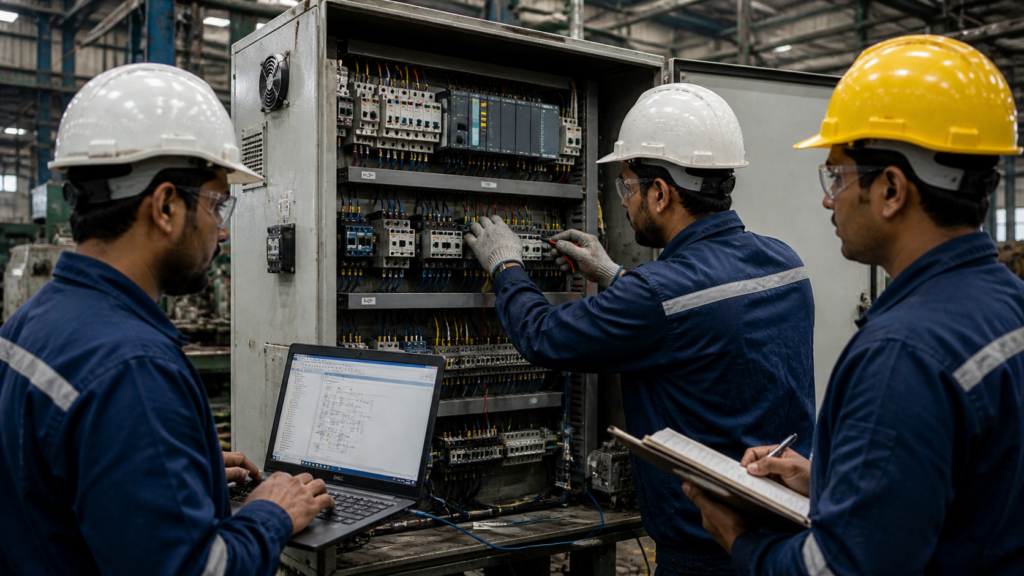
Siemens PLC Programming Services

Engineering-grade control logic for SIMATIC S7-1200, S7-1500, S7-300, and S7-400 platforms from new machine builds to legacy system migration and ongoing production support.
Siemens PLCs control some of the most demanding production environments in the world automotive body shops, pharmaceutical filling lines, water treatment facilities, food packaging systems. When the logic fails or the program cannot be understood by the next engineer who opens it, the cost is measured in downtime, scrap, and delayed projects.

AutomatexLab writes Siemens PLC programs that run reliably, can be read by any competent control engineer, and are documented well enough to hand over to your internal team without a three-day explanation. We work in TIA Portal and STEP 7 Classic, across the full SIMATIC range, for clients in manufacturing, process, and infrastructure sectors.

Siemens PLC Programming Services

Which Siemens PLC Hardware Platforms Do We Support?

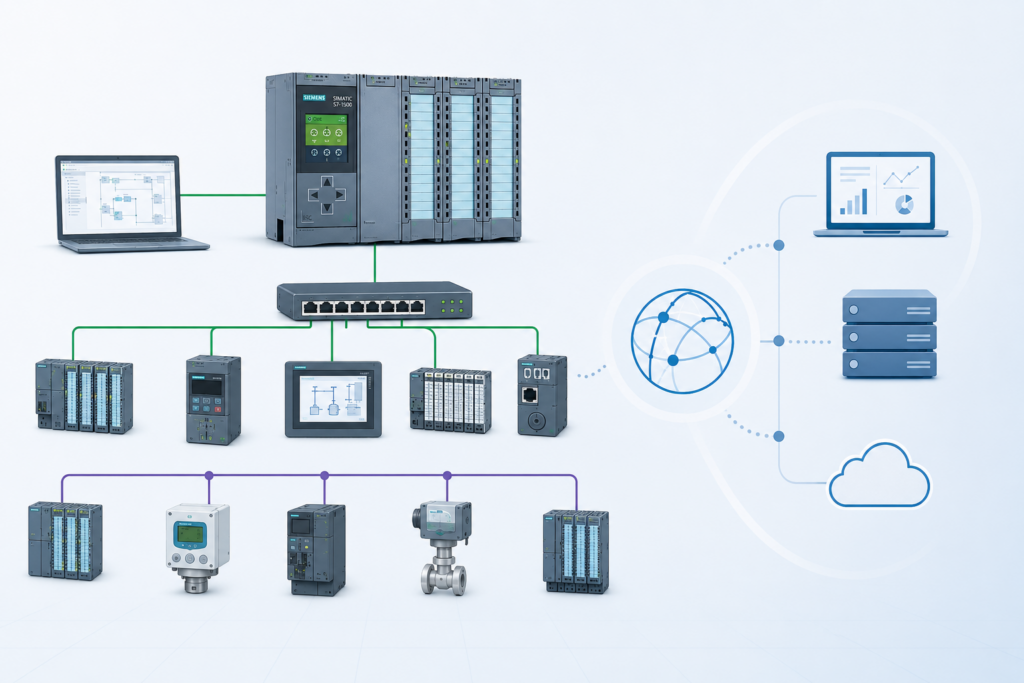
The SIMATIC product range spans several generations of hardware, each with different software environments, communication protocols, and capability ceilings. Our engineers work across all platforms currently in active industrial use.

PlatformProgramming EnvironmentCommunication ProtocolPrimary Use Case
S7-1500 / ET 200SP CPUTIA Portal V15.1 – V18PROFINET, OPC UANew installations, safety applications, IIoT-connected systems
S7-1200TIA Portal V15.1 – V18PROFINET, Modbus TCPCompact machines, standalone equipment, small process control
S7-300STEP 7 V5.7 / TIA PortalPROFIBUS DP, PROFINETExisting systems, partial upgrades, legacy support
S7-400STEP 7 V5.7PROFIBUS DP, Industrial EthernetHigh-availability systems, process industry, large I/O counts
S7-1500F / S7-300FTIA Portal + F-LibrariesPROFINET PROFIsafeFunctional safety applications, SIL 2 / SIL 3, PLd / PLe
ET 200SP / ET 200MTIA PortalPROFINET / PROFIBUSDistributed I/O, remote panel mounting
LOGO!LOGO! Soft ComfortEthernetSmall auxiliary control, simple interlocks

For plants still running S7-200 hardware, we provide migration assessments to S7-1200 that include reusable logic conversion and an I/O-for-I/O mapping document before any physical work begins.
What Programming Languages Are Used in Siemens TIA Portal?

IEC 61131-3 defines five standard programming languages for industrial controllers. TIA Portal supports all five, and S7-Graph adds a sixth for sequential process control. The choice of language for each function block is an engineering decision, not a preference the wrong language for a given task produces code that is harder to test, harder to modify, and harder to hand over.

Ladder Diagram (LAD)

The most widely understood language among maintenance electricians and control technicians. LAD is appropriate for discrete I/O control, relay replacement logic, interlock conditions, and any program section where your maintenance team needs to fault-find without specialist software training. We use LAD for safety interlock structures and equipment enable/disable logic.

Function Block Diagram (FBD)

Best suited for process control applications where signal flow between inputs and outputs carries the primary meaning. PID loop configuration, analog signal conditioning, and drive speed reference calculations are all cleaner in FBD than in LAD. The graphical representation also makes peer review faster.

Structured Text (ST)

A high-level language similar to Pascal. ST is used for complex data handling, recipe management systems, mathematical calculations, string processing, and any logic that becomes unmanageably verbose in LAD. S7-1500 CPUs run ST efficiently. We write ST with consistent indentation, variable naming conventions, and inline comments.

Statement List (STL / IL)

Applied when working with legacy STEP 7 programs that need targeted modifications without a full rewrite. STL is not used for new development on S7-1200 or S7-1500 platforms, as TIA Portal has deprecated it for these CPUs.

Sequential Function Chart (SFC / S7-Graph)

The correct language for multi-step batch processes, machine sequences with defined states, and any application where a state machine maps directly to physical process steps. SFC makes the sequence logic visible at a glance a commissioning engineer can follow the active step without tracing logic through dozens of rungs.

Our Process

What Does Our Siemens PLC Programming Process Look Like?

A PLC project that goes wrong usually fails in one of three places: requirements that were not captured properly at the start, testing that was not thorough enough before commissioning, or documentation that was incomplete at handover. Our process addresses all three explicitly.

01

Requirements and Documentation Review

Every project starts with a review of available documentation: P&ID drawings, machine functional specifications, electrical schematics, and any existing program backups. If documentation is incomplete which is common on legacy upgrade projects we conduct a site survey before writing scope or cost estimates.

The output of this phase is a Functional Design Specification (FDS) that describes what the control system must do, under what conditions, and with what safety and alarm responses. The FDS is agreed with the client before any code is written. Changes to scope after FDS sign-off are managed through a formal change request process.

02

Hardware Configuration

TIA Portal hardware configuration covers CPU selection, module assignment, I/O addressing, PROFINET device naming, drive integration via PROFINET or PROFIBUS, and safety CPU parameterisation for F-CPU projects. This is not a trivial step incorrect hardware configuration is one of the most common causes of subtle timing and communication faults that only appear under specific operating conditions.

For S7-1500 projects, we configure OPC UA server interfaces where the client’s MES or historian system needs direct data access from the CPU. Tag mapping and data type alignment are verified against the historian’s import template before commissioning.

03

Program Development

Control logic is developed in a modular structure. Each machine section has its own function block. Equipment objects motors, valves, drives are instantiated from standard function block templates with consistent interfaces. This means that when your maintenance engineer opens the program and looks at Conveyor 3, it has the same structure, the same alarm outputs, and the same manual override function as Conveyor 1 and Conveyor 2.

Tag naming follows a defined convention: Area_Instrument_Function (for example, FILL_LV101_PV for a level transmitter process value in the filling area). Every tag has a comment. Every function block input and output is described. The program is written assuming the next person to open it has never seen the machine.

Programs are version-controlled. Each revision is archived with a change log describing what was modified, why, and who authorised the change.

04

PLCSIM and Offline Testing

Before the program is loaded onto hardware, it is tested in PLCSIM Advanced (for S7-1500) or PLCSIM (for S7-1200 and S7-300). Offline testing validates sequence logic, interlock conditions, alarm generation, and HMI communication without needing a physical machine.

For projects involving PROFINET drives or remote I/O, hardware-in-the-loop testing uses real I/O cards connected to simulated field signals. This catches timing-dependent faults that simulation alone cannot reproduce.

05

Factory Acceptance Testing (FAT)

FAT is conducted against a written test specification derived from the FDS. Each test case records the input condition, the expected system response, the observed response, and pass/fail status. FAT reports are signed by both AutomatexLab and the client’s representative before the program is released for site installation.

Any test failures identified during FAT are resolved and re-tested before site work begins. Commissioning a program that has not completed a documented FAT is a risk we do not accept on our projects.

06

Site Commissioning

On-site, we perform live I/O verification against the electrical drawings every input forced and confirmed, every output verified at the field device. Sequence testing is conducted under real process conditions in each operating mode: automatic, manual, and maintenance.

Alarm validation confirms that every alarm in the program has a confirmed cause, an appropriate priority, and a clear response instruction. We do not commission systems with undefined alarms or alarms that trip without a documented purpose.

Want to Be a Part of This Automation Process

Your next Siemens PLC project should not start with uncertainty. Whether you are building a new production line, upgrading legacy S7-300 hardware, or troubleshooting a program your team did not write AutomatexLab gives you a clear scope, a fixed timeline, and code you will actually own at the end.

Share your project details and we will send you a written assessment within two business days. No vague quotes. No obligation.

Siemens TIA Portal Safety Programming – S7-1500F and S7-300F

Safety-rated control systems require engineering processes that go beyond standard PLC programming. For projects involving Siemens F-CPUs, we work from the Safety Requirements Specification (SRS) a document that defines each safety function, its required Performance Level or SIL rating, the demanded response time, and the proof test interval.

Safety programs in TIA Portal are written in F-LAD or F-FBD using Siemens-certified F-libraries. Safety function blocks emergency stop, two-hand control, safety door monitoring, light curtain integration are implemented using the appropriate F-library block for each function type. Custom safety logic that bypasses certified blocks is not appropriate for SIL-rated applications.

PROFIsafe communication between the F-CPU and safety I/O modules or safety drives is configured and verified during commissioning. F-signature verification confirms the safety program integrity after any modification.

We do not perform the functional safety assessment or issue the CE Technical File. For projects requiring formal SIL or PL verification, we work alongside the client’s appointed functional safety engineer or TÜV-certified assessor.

Legacy Siemens System Support – STEP 7 and S7-300/400 Migration

A significant portion of industrial plants still run STEP 7 Classic programs on S7-300 or S7-400 hardware. These systems are proven and often have years of accumulated modifications that represent real process knowledge embedded in the code even if that code is poorly documented.

01

Active fault diagnosis and modification

identifying faults in existing STEP 7 programs, making targeted changes, and testing them without disturbing stable sections of the program.

02

Documentation recovery

reconstructing a functional description from an undocumented STEP 7 program. This is done by reading the code, tracing I/O to the electrical drawings, and producing a written description of what the program does. This document alone has significant value for maintenance teams who have been running a machine for years without understanding its control logic.

03

Migration to TIA Portal

converting S7-300/400 programs to S7-1500 hardware and TIA Portal. Siemens provides a migration wizard, but the converted output requires substantial manual review. Data block structures, indirect addressing using accumulators, and network communication configurations do not convert cleanly and require engineering judgment to restructure correctly. We provide a migration assessment report before any physical hardware change, covering conversion complexity, estimated engineering hours, and recommended hardware upgrade path.

siemens plc programming services
PROFINET, PROFIBUS, and Industrial Network Configuration

PROFINET, PROFIBUS, and Industrial Network Configuration

Most Siemens PLC projects involve configuring one or more industrial networks. Network configuration errors duplicate IP addresses, incorrect device names, timing parameter mismatches cause communication faults that can be difficult to diagnose if the network was not set up correctly from the start.

For PROFINET projects, we configure device names, IP address assignments, update rates, and watchdog times for every node on the network. For systems with more than ten PROFINET devices, we produce a network topology document that maps every device to its switch port, IP address, and MAC address.

For legacy PROFIBUS systems, we configure bus addresses, transmission speeds, and GSD file imports for third-party devices. PROFIBUS diagnostics are verified using STEP 7’s hardware diagnostics or TIA Portal’s online view before the system is handed over.

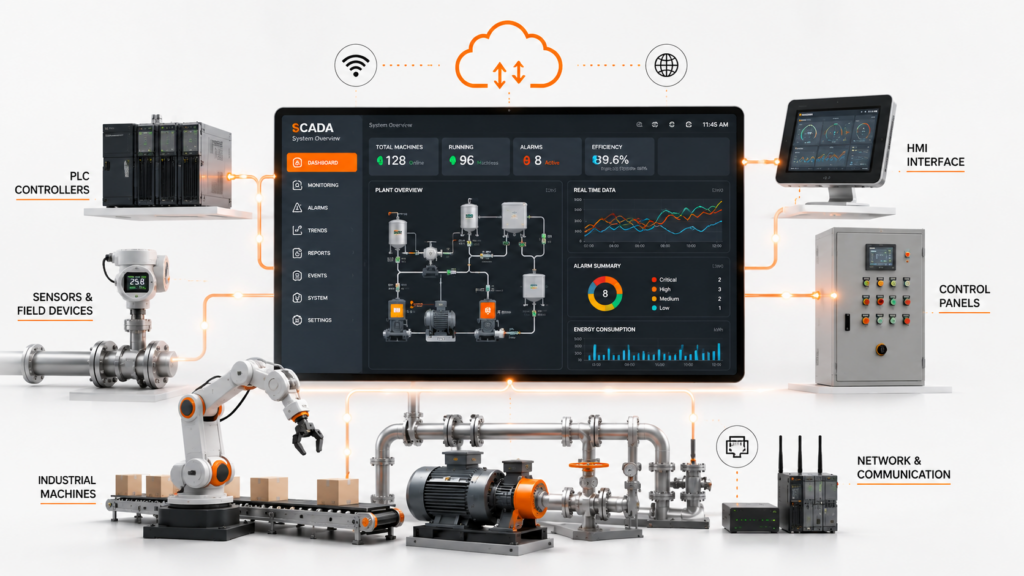
Where clients require data integration with MES, SCADA, or historian systems, we configure OPC UA on S7-1500 CPUs, Modbus TCP on S7-1200 platforms, and S7 communication where the integration partner requires it. Data type mapping, polling rate configuration, and connection monitoring are included in the commissioning scope

Industries We Have Supported

Our Siemens PLC programming experience spans the following sectors. Each sector has specific standards, failure modes, and commissioning requirements that differ from general machine control experience in the sector matters as much as platform knowledge.

Food and beverage

hygienic design requirements, allergen changeover sequences, CIP integration, checkweigher and metal detector interfaces, line tracking, and OEE data collection.

Pharmaceutical and life sciences

GMP environment considerations, audit trail requirements, recipe management with batch records, clean room equipment interlocks, and serialisation line control.

Water and wastewater

remote telemetry, SCADA integration, duty/standby pump sequencing, dosing control with flow-proportional feedback, and alarm management to ISA-18.2 standard.

Automotive and metal fabrication

high-speed discrete control, robotic cell integration via PROFINET or discrete I/O, tooling verification, production count and cycle time data logging.

Chemical and batch processing

S88 batch model implementation, recipe download from MES, multi-product vessels, safety interlock systems for hazardous process conditions.

Conveyor and material handling

distributed I/O across long conveyor runs, barcode scanner integration, sortation logic, accumulation zone control, and variable speed drive configuration.

Featured Industrial Automation Projects

Real-world automation systems involving PLC programming, robotic welding, servo motion control, industrial networking, and smart manufacturing integration.

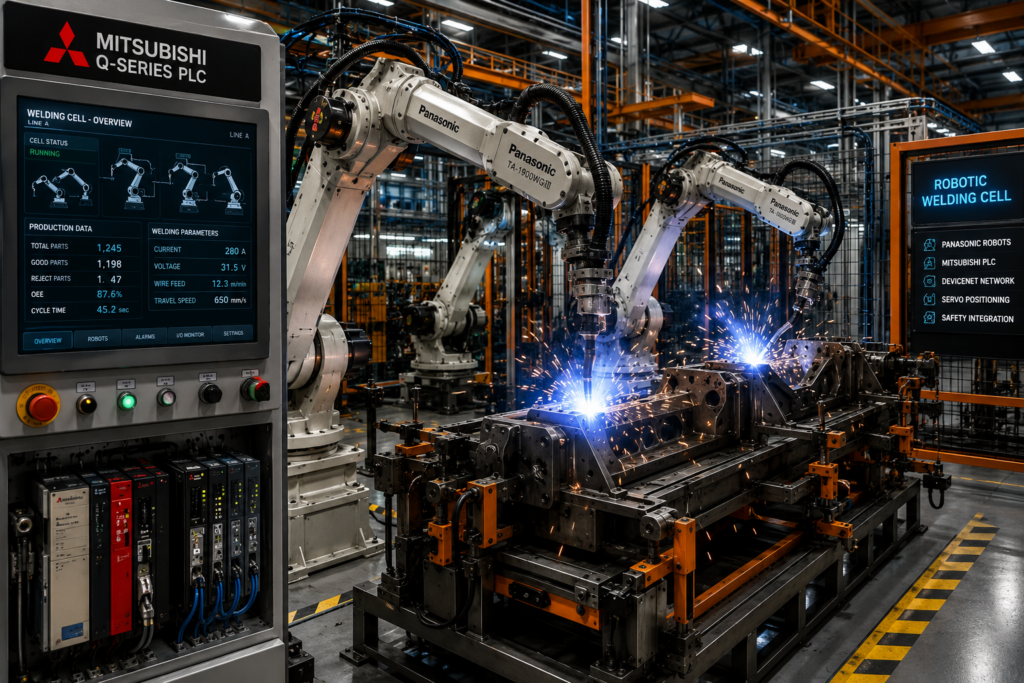
Robotic Welding Automation Cell

Designed and supported a high-performance robotic welding automation cell integrating Panasonic welding robots with Mitsubishi PLC architecture and DeviceNet communication. The system was engineered for synchronized welding operations, stable motion control, and reliable production performance for heavy equipment manufacturing applications. The project contributed to approximately 20% reduction in synchronization-related interruptions, improved welding cycle consistency, and enhanced overall automation reliability during continuous production operations.

Key Outcomes
20% reduction in synchronization-related interruptions
Improved robotic welding cycle consistency
Stable PLC-to-robot communication architecture
Enhanced production reliability during continuous operation
Automatic Bottle Packaging Line Automation
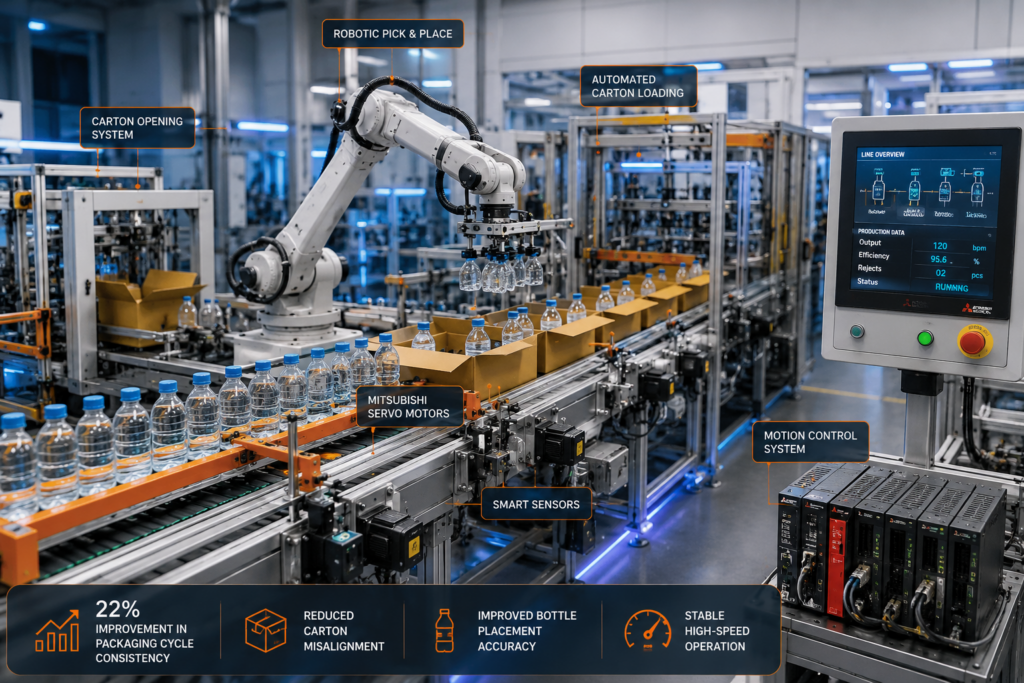
Worked on a fully automated bottle packaging system featuring servo-driven carton handling, robotic bottle pick-and-place operations, and synchronized motion control using Mitsubishi servo technology. The automation system was developed to achieve accurate high-speed packaging, stable cycle timing, and reliable production flow. The project helped improve packaging cycle consistency by approximately 22%, reduced carton alignment issues, and enhanced overall packaging efficiency during continuous operation.

Key Outcomes
22% improvement in packaging cycle consistency
Reduced carton misalignment during production
Improved bottle placement accuracy
Stable high-speed packaging operation

Why Choose AutomatexLab

Choosing the right automation partner directly impacts your production, costs, and downtime. Here’s what makes AutomatexLab a dependable choice

Engineering-first approach

We treat PLC programming as a software engineering discipline with version control, documentation standards, and structured code review. This produces programs that work correctly at startup and are maintainable long-term.

Modular programming practices

We write programs using reusable function blocks and Add-On Instructions rather than duplicated rungs. This makes modifications faster, reduces the risk of introducing errors, and makes your maintenance team’s job easier.

Multi-platform expertise

Most PLC companies specialize in one brand. We work across Allen-Bradley, Siemens, Mitsubishi, Schneider Electric, Omron, and Delta — which matters when you’re running a mixed-platform facility or working with multiple machine suppliers.

Documentation included

Every project includes complete program documentation: I/O lists, network diagrams, program descriptions, and as-built notes. You won’t be left with an undocumented black box.

Scalable solutions

Why Choose AutomatexLab

About AutomatexLab

AutomatexLab is an industrial automation engineering company providing PLC programming, SCADA integration, HMI development, and IIoT system design services. Our engineers have hands-on commissioning experience across Siemens, Allen-Bradley, and Mitsubishi platforms, with a primary focus on Siemens SIMATIC systems.

We do not subcontract programming work. The engineers who assess your project are the engineers who write the code, conduct the testing, and commission the system. Project documentation is produced by the same team not assembled from templates after the fact.

Our work is covered by a undefined warranty period for programming faults. Post-warranty support is available under annual service agreements for clients who require priority response commitments.

What Is SCADA Integration

Ready to Automate Your Operations?

OR

Fill the Form Below

Contact Form Demo

Frequently Asked Questions

Scroll to Top